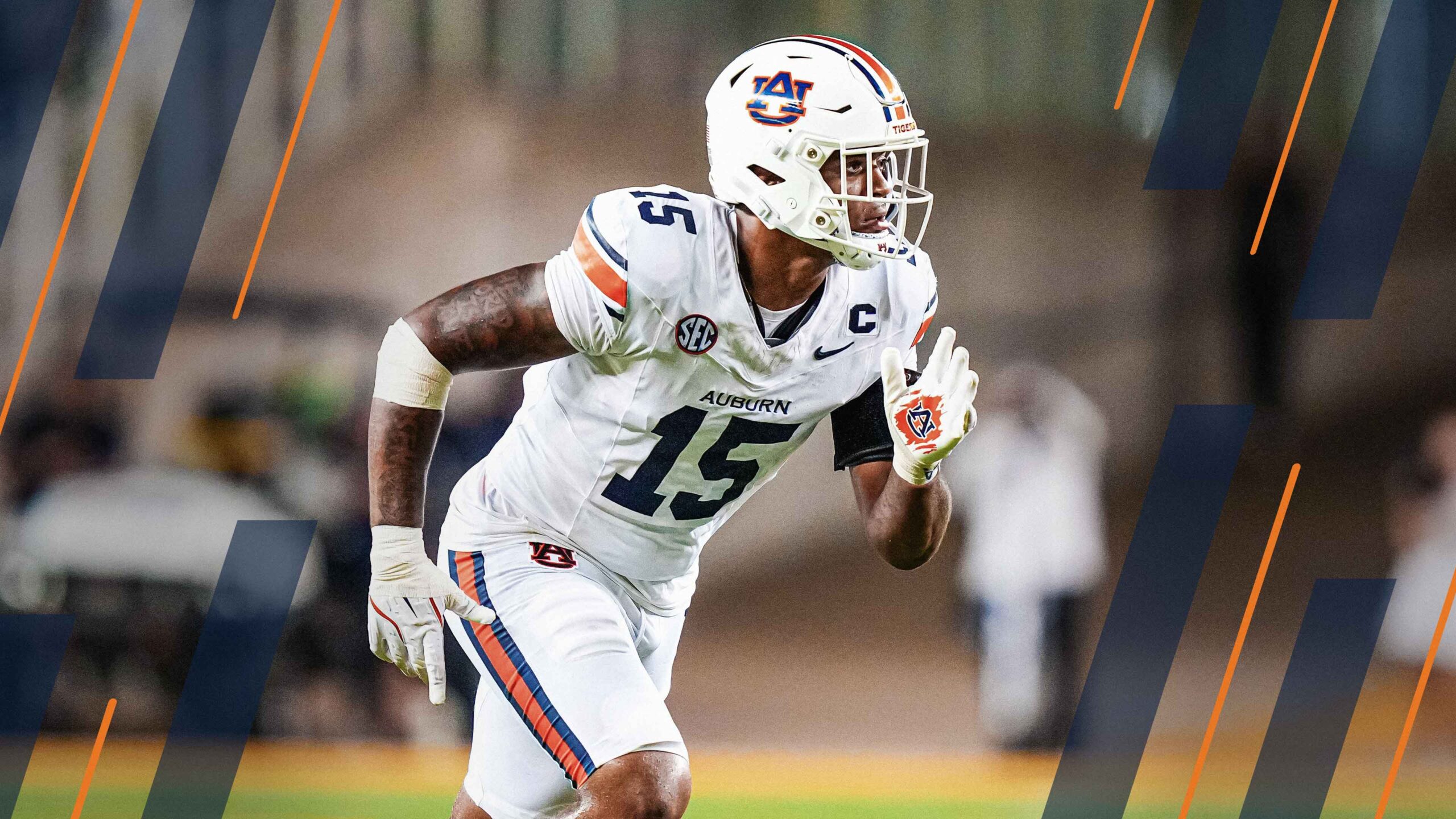
- Keldric Faulk’s pass-rush production isn’t as clean as it seems: Over the past two seasons, Faulk tallied 75 pressures — 37 of which were charted as either unblocked or clean-up pressures. That leaves his 11.5% pass-rush win rate in the range of 2025 first-rounders Mykel Williams and Shemar Stewart, both of whom carried pass-rush concerns heading into last year’s draft.
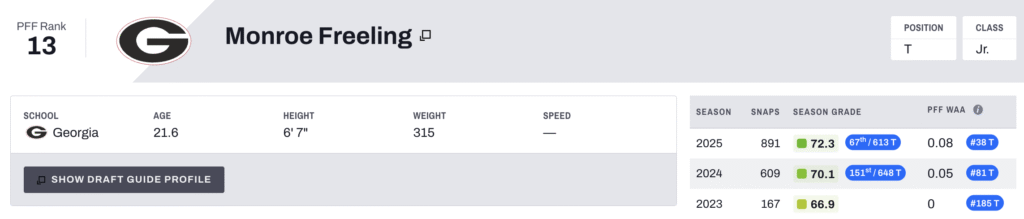
- Monroe Freeling’s lack of true pass sets raises some concerns: While Freeling is undoubtedly one of the hottest names in the pre-draft process, he didn’t play many true pass-blocking reps in 2025 due to Georgia’s play-action-heavy and screen-heavy offense.
We’ve reached the point in the 2026 NFL Draft process where hype and noise can take precedence over objective analysis. Many prospects deserve the recognition they are getting, but some come with profiles that could see them slide further than many of the consensus experts expect. Here is one “buyer-beware” prospect at almost every position in this year’s NFL draft class.
QB Drew Allar, Penn State
Allar boasts one of the strongest arms in the class, attached to a frame that quarterbacks coaches dream of. There are things in Allar’s statistical profile to like, including a 61-to-13 touchdown-to-interception ratio and a career 1.7% turnover-worthy play rate — one of the best marks in the PFF era.
Despite his elite arm strength, Allar posted at least a 3% big-time throw rate in just one of his three seasons as Penn State’s starter. His 56.5% accurate throw rate, per PFF’s quarterback charting, during that time also lags well behind other top prospects, both this year and in years past.
Allar has also struggled throughout his career in big games, earning sub-70.0 PFF passing grades in multiple games against Ohio State and Oregon. He did not complete a pass to a wide receiver in Penn State’s 2024 College Football Playoff loss to Notre Dame.
Allar certainly has stellar tools, but he needs major development in his footwork and ball placement if he is going to carve out a career as an NFL starter.
RB Seth McGowan, Kentucky
McGowan has taken a circuitous route through college football, starting at Oklahoma and featuring stops at Texas College, Butler Community College, New Mexico State and Kentucky. He got a legitimate chance to prove himself at New Mexico State, where he shared a backfield with fellow 2026 classmate Mike Washington Jr., before playing a lead role for Kentucky in 2025.
While he did place fourth in the SEC with 12 rushing touchdowns while earning a solid 77.2 PFF rushing grade in 2025, McGowan has some glaring holes in his game. The most concerning is a lack of explosiveness. McGowan racked up only 13 explosive runs in 2025, 10 of which came in the Wildcats’ first four games. He also did not record a run longer than 20 yards all season. In fact, he was the only Power Four running back in the nation with at least 150 carries and 15 or fewer explosive runs.
McGowan also didn’t bring elite tackle-breaking ability with him to the SEC. Among 165 FBS running backs with at least 100 carries, he ranked just 79th with 0.21 missed tackles forced per attempt in 2025. His 2.72 yards after contact per attempt mark ranked 147th. McGowan’s lack of dynamic traits could see him fall well into Day 3 of the draft.
WR Zachariah Branch, USC
Branch is a dynamic athlete with electric feet who can create explosive plays with the ball in his hands. If used properly, he should be a screen and special teams threat in the NFL who can make tacklers miss in the open field. The issue is that his game appears to be limited, for now, to just those two dimensions.
An increase in volume led to more notoriety for Branch after he transferred from USC to Georgia in 2025. However, his 10.0 yards per reception mark fell right in line with his career average. Branch set career highs with an 82.6 PFF receiving grade and 20 missed tackles forced, but some of that is inflated due to a 3.6-yard average depth of target — the fifth-lowest figure among qualified FBS wide receivers.
In fact, an FBS-leading 49 of Branch’s 81 receptions in 2025 came behind the line of scrimmage. Eighteen more came within the 0-to-9-yard range. Branch’s diminutive frame and lack of downfield production could lead to a gadget role in the NFL that isn’t necessarily worthy of a selection within the draft’s first two rounds.
TE Oscar Delp, Georgia
Delp may be the ultimate test case for whether college production matters for NFL tight ends. He’s an excellent athlete who earned 90-plus marks in PFF’s Game Athleticism Score in each of his four college seasons. His reported 4.49-second 40-yard dash and 38-inch vertical jump suggest that he’s an explosive athlete capable of making an impact.
The question is, why didn’t he make that sort of impact while at Georgia? Delp earned sub-65.0 PFF receiving grades while accruing fewer than 300 yards in each of his four college seasons. His lack of length and strength led to only two contested catches on 12 such targets. While his separation rate ranks in the 99th percentile over the past three years, that may also be buoyed by an average depth of target that sits in just the 23rd percentile.
Georgia’s quarterbacks have drawn the ire of many in the scouting community when watching Delp, but over the past three seasons, they rank seventh in the FBS in PFF passing grade, first in accurate throw rate and second in adjusted completion percentage. Those figures don’t necessarily explain Delp’s lack of targets. However, his projection to the NFL is muddy, considering his relatively small sample size and lack of production.
T Monroe Freeling, Georgia
Freeling is the hottest name in the offensive line class, projected by some to be selected as high as sixth overall by the Cleveland Browns. His athleticism has stood out recently, as he arguably had the best combine of any player at his position. However, some statistics suggest Freeling is still a work-in-progress.
First, we can address Freeling’s seemingly massive improvement in pass protection. He did earn an outstanding 86.1 PFF pass-blocking grade in 2025, which ranked seventh among qualified FBS tackles. That was an improvement over his 65.3 mark in 2024. Georgia’s passing game was heavily built on play action and screens, which allowed Freeling to partake in just 95 true pass sets all season. That ranked just barely among the top 200 tackles in the country.
Freeling earned a solid 75.4 PFF pass-blocking grade on those true pass set reps, but that pales in comparison to top tackles in the class, such as Francis Mauigoa and Spencer Fano. Mauigoa earned his 85.8 true PFF pass-blocking grade, second best in the nation, across 212 such reps, more than twice as many as Freeling.
Freeling’s athletic potential is off the charts, but those concerns coupled with his inconsistency as a run blocker create more risk than many are willing to let on.
DI Caleb Banks, Florida
Banks was one of the biggest risers at the NFL combine after posting historic numbers for his size on what was later found out to be a broken foot. Scouts dreamed about his potential as a pass rusher after he racked up 53 pressures and six sacks across 2023 and 2024.
However, due to injury, Banks suited up for only three games in 2025. When he was healthy, his tape revealed a player whose high-end flashes looked as good as those of any player in this class. But his inconsistencies led to a more mediocre grading profile. In each of the past four seasons, Banks logged PFF overall grades between 68.0 and 73.0.
Injuries and inconsistent production may force scouts to take a cautious approach with Banks. If a coaching staff can get him to play with more consistent effort and technique, he could easily be the best defensive tackle in this class. If that doesn’t happen, though, or if the injury risk is too high, he may be too big a gamble to be selected in the first round.
EDGE Keldric Faulk, Auburn
Faulk is blessed with a freakish build and potentially untapped athleticism. He’s also proven himself to be an excellent run defender, posting a near-elite 89.2 PFF run-defense grade over the past two seasons. That part of his game will never be in question, but there should be concerns about his ability to rush the passer at the next level.
Faulk’s immense size and play style are more suited for a classic 3-4 defensive end who plays directly over offensive tackles. Those fronts are used less often now than they were in prior decades. However, that alignment isn’t ideal for rushing the passer, and Faulk has yet to show he can do so at an elite level. He set a career high with a 72.5 PFF pass-rush grade in 2024 before ranking outside the top 200 qualified edge defenders with his 66.0 pass-rush grade in 2025.
Over the past two seasons, Faulk tallied 75 pressures — 37 of which were charted as either unblocked or clean-up pressures. That leaves his pass-rush win rate, 11.5%, in the range of 2025 first-rounders Mykel Williams and Shemar Stewart, both of whom carried pass-rush concerns heading into last year’s draft. Similar faults in Faulk’s game could see him fall out of the first round.
LB CJ Allen, Georgia
Allen is another Georgia Bulldog who is projected to be selected early in this year’s draft. He’s currently a top-20 prospect on the PFF Predictive Big Board and a consensus first-round pick. Still, there are flaws in his game that are worth addressing.
First and foremost, Allen is so highly thought of because of his instincts and tackling ability in the run game. His 91.6 PFF run-defense grade over the past two seasons ranks fourth among FBS linebackers. He also missed just five tackles in run defense in that span. However, Allen isn’t a splashy playmaker, and his value is much more rooted in his ability to simply not be in the wrong spot and make tackles.
He is also shaky at best in coverage, having earned sub-60.0 PFF coverage grades over the past two seasons while reeling in just one career interception. Allen is undersized and has yet to do any athletic testing, which is a concern, given that his tape shows a player who can make plenty of plays within his range. His range is more limited than that of other players in the class, though, which could create a limited ceiling.
CB Tacario Davis, Washington
Standing at nearly 6-foot-4 with a 4.41-second 40-yard dash, Tacario Davis will be selected in this draft for his freakish physical tools. He spent three seasons as a starter in college, and his potential is off the charts, but he wasn’t able to put together consistent production over the past two years.
Davis’ production peaked in 2023 during Arizona’s resurgent 10-win season. He ranked 20th in the country with an 85.9 PFF receiving grade while breaking up 12 passes. But he earned just a 64.4 PFF coverage grade over the past two seasons, failing to keep up his elite production in man coverage.
Being so heavily reliant on man-coverage ability is a dangerous game. Davis can look at current Philadelphia Eagle Riq Woolen as a similar prospect with a high-end outcome, but he will need to refine his technique to become a consistently reliable starter.