
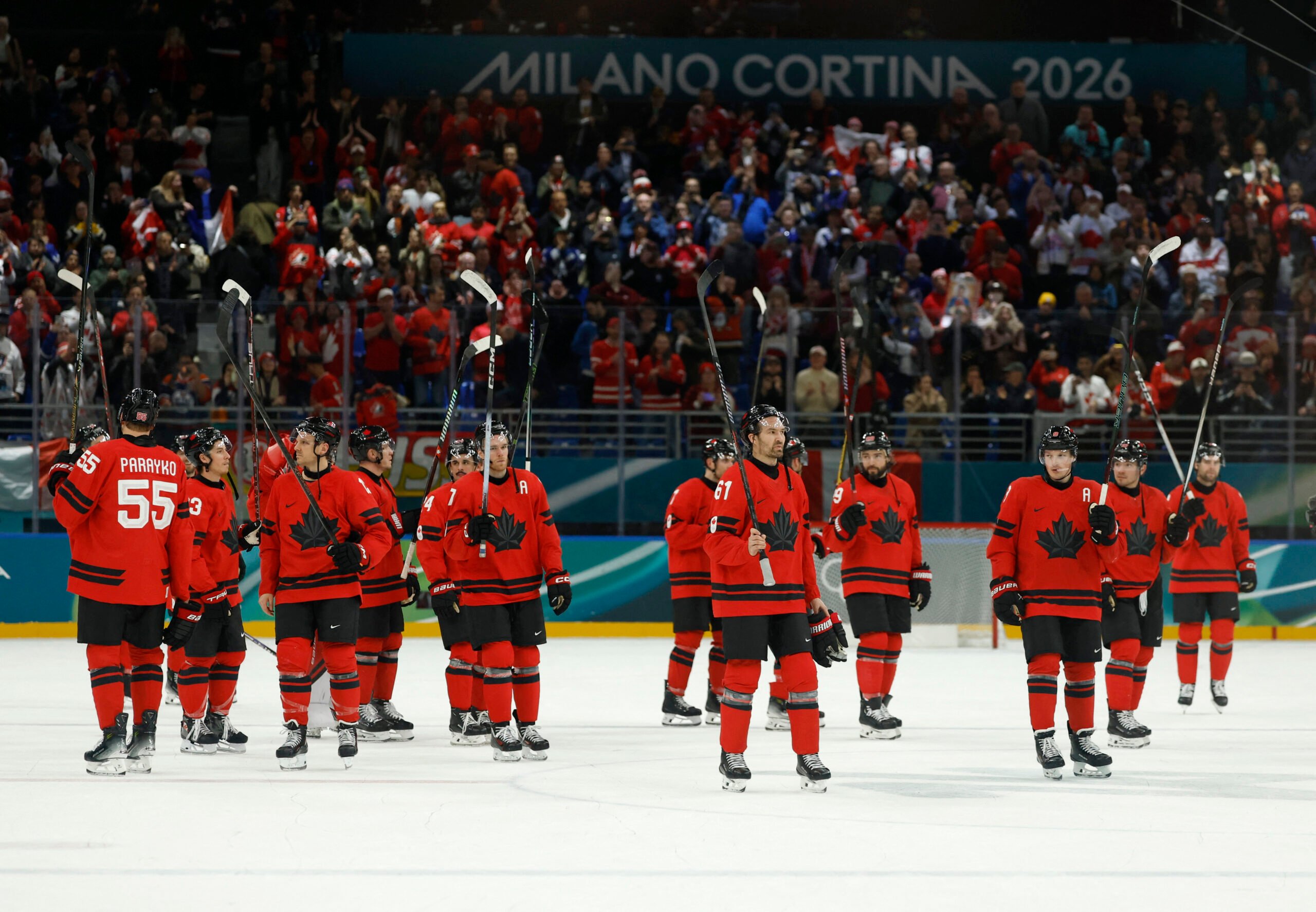
On Sunday, Feb. 15, Canada and France faced off for a preliminary match at the men’s ice hockey Olympic tournament. Both teams were trending in opposite directions, with Canada going 2-0 and France having not won or even tied a game yet. It was a David and Goliath matchup, as one club is an NHL All-Star team, and France has one current NHL player in Alexandre Texier.
Related: Guide to the 2026 Winter Olympics Men’s Hockey Tournament
Earning the first seed overall after the preliminary round was a factor going into today’s matchup. Canada and the USA had one game each remaining today, Canada facing France and the USA facing Germany, with the assumption that both North American hockey nations would earn the win. The final standings will come down to goal differential (GD), determining the final outcome. Canada had a plus-9, and the USA had a plus-6 after two games played. So what’s the reward? Avoiding a very skilled Swedish team in the quarterfinal. Canada took charge and never let go. In the end, Canada defeated France and took a 10-2 win.
France Shooting for Respect
France’s goal in this tournament was to earn the world’s respect, and they put a scare into Czechia on Friday, scoring three goals in 4:53 early in the second period to take a 3-2 lead in what ended as a 6-3 Czechia victory. Louis Boudon was the offensive star, scoring twice and adding an assist, and Martin Neckar was terrific in the French goal, making 20 saves before he was replaced early in the third period. In the game against Canada, they would need to rely on solid goaltending again.
“We know we’re the underdogs of the tournament, of this group, we know a lot of these teams don’t respect us. We don’t really care. We try to show up and do our best, and prove to them that we can play with them.”
With only one current NHL player in Texier, and only three others having NHL experience, Yohann Auvitu, Stéphane Da Costa and Pierre-Édouard Bellemare, France was the undisputed underdog.
France was hoping for a win, but was more than satisfied with a moral victory as all the gaming analytics had them as heavy underdogs. Having no wins in this tournament and facing Canada, the expectation wasn’t to break that streak. However, the goal was to limit the damage and, if possible, hang in the game as long as possible. If that were to happen, and a few bounces go their way, they could pull off an upset, or at least, they could play the spoiler and keep Canada from scoring enough goals to finish in first in the preliminary round.
Defensively, they collapsed down into the slot, hoping to clog the area, making it difficult to get any chances and then relying on the goaltending of Julian Junca, who kept them in the game for long stretches. Their penalty-killing units may have given a roadmap to the other hockey nations on how to defend Canada’s power play. Early in the second period, and down 3-1, they were able to shut down the potent Canadian offence for two full minutes playing a very aggressive puck pursuit style.
Building Good Habits
The outcome of this game was not a question for Canada; they expected a win. What they were trying to build upon during this final preliminary game was the good habits they needed for the quarterfinals. Head coach Jon Cooper continued with his line shuffling at even strength and on special teams, trying to find the right combination, yet his embarrassment of riches makes it so that he has several combinations that can be effective. With the preliminary round complete for Canada now, it means there is no more luxury of time to try new options; he will need to finally settle on his main lineup.
One of those players is Mark Stone, who provided a key shorthanded goal just before the end of the first period. France was hanging in the game and was set to go into the intermission down by only one goal, yet Stone’s goal changed all that and showed why special teams in a short tournament are so important.
The power play has become a cheat code, especially with players like Connor McDavid, Sidney Crosby, Macklin Celebrini and Naathan MacKinnon. Having multiple units that all have elite shooters on the flanks, a cerebral playmaker operating on the half wall, and a mobile, attack-minded defenceman (Cale Makar) quarterbacking from the blue line, Canada can attack any seam.
Their puck movement forces penalty killers to overcommit, opening up cross-ice one-timers and high-slot opportunities that are nearly impossible to defend cleanly. More importantly, Canada’s first and second units both feature legitimate finishing threats, meaning there is no drop-off in danger across the full two minutes, and if they don’t score, they build momentum.
Canadian Goals
Canada’s offence is just steamrolling the tournament teams thus far. It was averaging five goals per game heading into this game, and it increased that average. Unlike other clubs with NHL talent, Canada is not relying solely on one or two superstar scorers; they have constructed a lineup where multiple players can contribute to the scoresheet on any given night. With Team Canada boasting a 57-goal scorer in Sam Reinhart on a fourth line to start the tournament, there is obvious depth across all forward lines.
This multi-threat approach makes it extremely difficult for opponents to shut down Canada with traditional defensive tactics, as neutralizing one line simply opens the ice for another.
Beyond individual skill, Team Canada’s offensive success is anchored in strong chemistry and a proactive system that emphasizes support-by-committee hockey. Players understand their roles and anticipate each other’s movements, allowing for quick transitions and seamless zone entries that often result in controlled offensive possession.
There are still question marks surrounding their goaltending, but the defensive play, thanks in large part to their forwards’ ability to backcheck and provide support for their defencemen, has made a difference in supporting their goaltenders. Also, it allows them to quickly regain puck possession and launch into transitional offence.
This cohesion, combined with an aggressive forecheck and quick puck retrieval on turnovers, ensures a steady stream of quality scoring chances. In a tournament filled with elite competition, Canada’s offensive firepower stands out as the key factor that could propel them toward a gold medal.
Canada will finish as the top seed, since the USA needed to win by 11 goals against Germany and only beat them by four. Canada will now await their next opponent in the quarterfinals on Feb. 18.
