
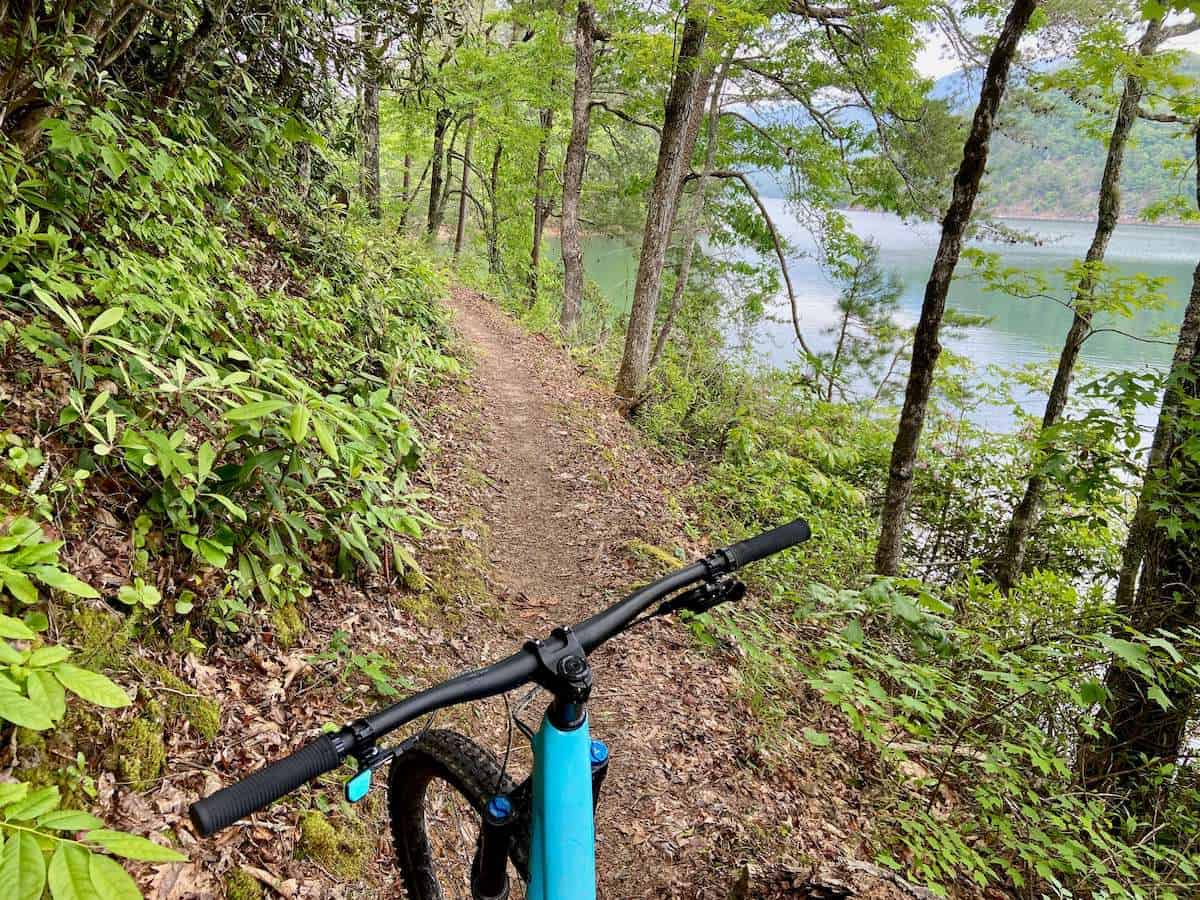
Nowadays, there’s an app for pretty much everything. We rely on our phones more than we probably want to admit (I’m guilty), and that includes apps for outdoor pursuits.
If you mountain bike regularly, you’ve almost definitely used (or at least heard of) apps like Strava and TrailForks. Apps like these have come a long way, and today, mountain bike apps are essential tools for finding trails, planning routes, tracking rides, dialing in fitness, and even building skills.
That said, not all apps are worth the download. Some are incredibly helpful, while others just take up storage and battery life.
So which ones are actually useful? In this post, I round up the best mountain biking apps to help you ride more, get lost less, and stay safe on the trails whether you’re tracking mileage, planning a route, or hunting for new places to ride.
🥇 One Clear Winner: TrailForks
- Best for: All mountain bikers. This is the go-to mountain bike app.
- Price: Free for home region or $54/year (worth it!)
If you download just one mountain bike app, make it TrailForks. It’s hands down the most useful tool for finding the best singletrack. I use it to discover new trail systems, put together routes, and double-check whether I should be climbing or descending (that beta can be questionable..). And honestly, TrailForks is probably the reason I don’t get lost nearly as often as I should.
The TrailForks app is packed with a ton of great features including:
The website version of TrailForks is always free, but the app requires a subscription if you want access outside your designated home region. If you plan on traveling at all to ride, the paid version is worth it—full stop. TrailForks is also what I use for route recommendations in my Mountain Bike Trip Itineraries.

🥈 Runner up: MTB Project
- Best for: Casual mountain bikers who stick closer to home
- Price: Free
I’ll be honest: MTB Project isn’t my favorite. It’s REI’s version (now it looks like they were bought by onX Maps – see below) of TrailForks and offers many of the same core features, but I don’t find it nearly as user-friendly. For one, the app is more focused on showcasing full routes and loops rather than individual trails, which I find frustrating.
MTB Project also has a major limitation — it only lists legal and sanctioned trails. So if a trail isn’t approved by the Forest Service, BLM, or another managing agency, it won’t show up, which, if we’re being realistic, leaves out a lot of mountain bike trails…. I also find that MTB Project leans more toward cross-country riding, whereas TrailForks caters to a much wider range of riders and styles.
That said, MTB Project is completely free. If you’re on a budget or don’t ride often enough to justify paying for TrailForks, it’s a solid alternative as long as you’re aware of its limitations.
🗺️ For Map-Obsessed Tech Nerds: onX Backcountry

- Best for: Backcountry adventure riders, those who love maps and data
- Price: $29.99/year for Premium or $99.99/year for Elite
onX Backcountry is an up-and-coming outdoor adventure app that caters primarily to backcountry skiers and hikers, but can also be used by mountain bikers. If you like detailed maps, layers, and knowing exactly where you are (and what you’re allowed to ride), this app will be right up your alley.
What sets onX Backcountry apart is its depth. You can toggle layers that show land ownership, trail systems, roads, elevation, slope angle, and more. This is especially useful if you’re riding in remote areas, exploring lesser-known zones, or bikepacking through mixed-use terrain where it’s not always obvious what’s legal or publicly accessible.
Some of the features mountain bikers will appreciate include:
It’s not as streamlined or MTB-specific as TrailForks, and I wouldn’t use it as my primary trail-finding app. But for riders who like to geek out on maps (or who regularly venture off the beaten path) it’s a powerful tool to have in your digital toolkit. Think of onX Backcountry as a “big picture” navigation app: less about perfect singletrack beta, more about situational awareness and exploration.
📈 Best for Tracking Stats: Strava
- Best for: Mountain bikers who care about stats
- Price: Free version or $79.99/year
If you like having a detailed record of every ride, Strava is your app. It does a little bit of everything, including:
Most mountain bikers use Strava for the segments (available with the paid version). The app ranks riders by speed over specific stretches of trail, letting you see how your times stack up against friends, locals, and total strangers. Push hard enough and you might land a top-10 or even snag the coveted crown.
If Strava didn’t record it, the ride never happened. Just… don’t turn into a stravasshole.
🥾 Mountain Bikers Who are Also Hikers: AllTrails
- Best for: Mountain bikers who are also avid hikers
- Price: Free or pro version is $29.99/year
I have the free version of AllTrails and I use it when I go for hikes, but it’s also decent for navigating mountain bike trails. It doesn’t come close to what TrailForks or even MTB Project offers, but if you’re a casual mountain biker who is also an avid hiker, this app is a good 2-for-1 option.
AllTrails features include:
AllTrails isn’t a dedicated mountain biking app, and it shows, but if you split your time between riding and hiking and want one simple app for both, it gets the job done.
🥖 For European Adventures: Komoot

- Best for: European mountain bike adventures
- Price: Varies depending on which map bundle you buy
Komoot is a route-planning and navigation app that’s especially popular in Europe for hiking, mountain biking, and cycling. In fact, I wouldn’t recommend using Komoot anywhere else other than Europe (the company is based in Germany).
Komoot shines in the planning phase. You can build routes based on surface type, elevation, and fitness level, then follow them with turn-by-turn (and voice) navigation. It’s great for long days when you don’t want to constantly check your phone.
Komoot is also particularly good for discovering user-created rides like bikepacking routes, gravel adventures, and long point-to-point days that mix singletrack, dirt roads, and pavement. It’s not ideal for navigating dense MTB trail systems, and I wouldn’t use it for local laps. I think of Komoot as a big-ride app (for Europe), not a trail-system app.

Need gear recs?
Head over to my gear closet! I’m always testing out new pieces of bike gear and if I really like them, they earn a place on this page.
What mountain biking apps do you use? What questions do you have? Share in the comments below!