

Having participated in the Atlas Mountain Race and seen Morocco go by in a hazy, exhausted blur, Valerio Stuart returned to the country over the winter to experience it at a gentler pace. Read on to find his story of giving himself permission to slow down, soak in half-seen views, stop for missed conversations, and linger over cups of tea, all while finding plenty of excitement and adventure…
In November, I found myself with a rare chance to squeeze in one last bikepacking trip before the end of the year. The list of routes I wanted to ride in the UK was long, but the idea of freezing rain and endless darkness wasn’t very motivating, especially after getting soaked on every single trip of the year. So, I started looking further south. Somewhere warmer. Somewhere with big mountains and big horizons. Somewhere like Morocco.

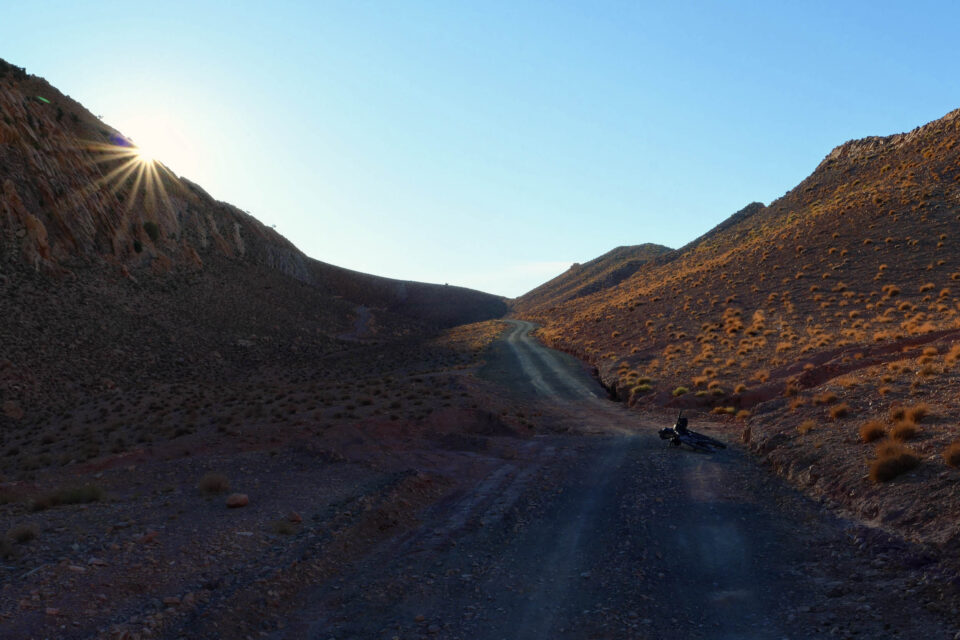
Scrolling through BIKEPACKING.com’s archive, I stumbled upon Kings of the Atlas, a rugged route through the High Atlas Mountains. It looked like exactly what I needed: sun, altitude, remoteness, and the promise of adventure. The description came with plenty of warnings. It was “highly technical,” “not suitable for solo riders,” and recommended “only for experienced mountain bikers” with “unloaded bikes” because of the remote, exposed terrain. Naively, I took that as the usual overly cautious disclaimer. It was rated 7/10 in difficulty; how bad could it really be?
I decided to ride parts of the new 2026 Atlas Mountain Race (AMR) route, then join Kings of the Atlas and finish in Marrakesh via the Agafay Desert. Earlier in the year, I’d raced the AMR and blown past countless moments: conversations, cups of tea, views I only half-saw. This time, I wanted to return without the clock, to ride the same mountains but give myself permission to slow down.
I reassured my wife I wasn’t planning to die out there—at least not intentionally—and that I wouldn’t do anything foolish. In my defence, I meant it. One last look at the forecast had me swapping my light, summer kit for a tent and a pile of warm layers to deal with rain, sub-zero temperatures, and possibly snow. I packed my fears… and the kitchen sink.
First Pedal Strokes
I rolled out of Beni Mellal in the afternoon, starting from the old kasbah above the city. The plan was gentle: 35 kilometres to ease me into the ride. Morocco had other ideas. A 10-kilometre climb at 10 percent in 35-degree heat was my welcome back to the Atlas. My “easy” day quietly turned into 90 kilometres and 2,700 metres of climbing. Apparently, my brain hadn’t received the memo that this wasn’t the AMR.

That first day set the tone for the internal tug-of-war that would follow: part of me craving the simplicity of riding hard and ticking off distance, part of me trying to tap the brakes and look around.
Into the Mountains
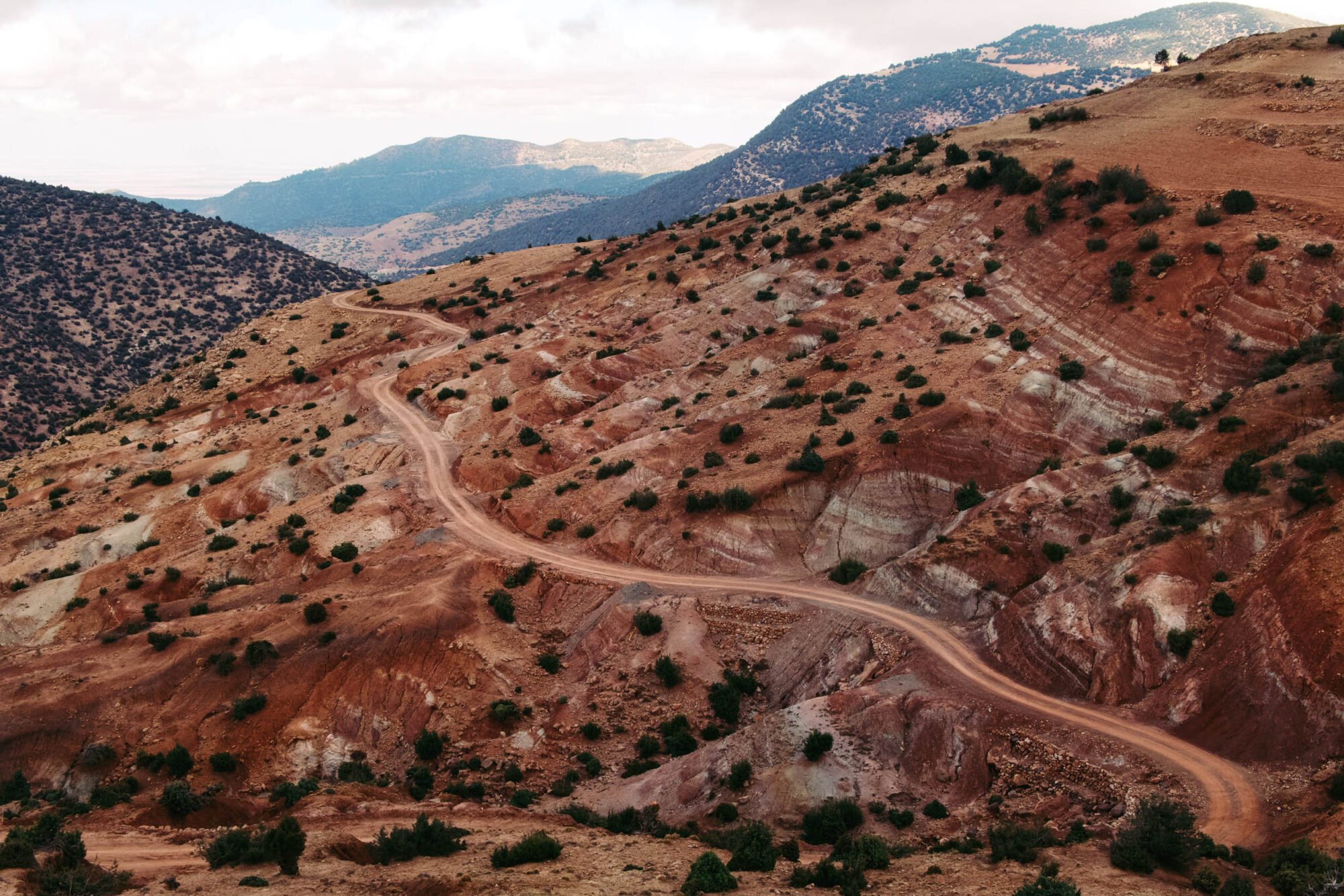
The trail led towards the Cathedral d’Imsfrane, an immense rock formation towering over a green valley. The 10-kilometre climb up to it felt endless, but the views made every slow pedal stroke worth it. The landscape looked at times like Utah—at least how I imagine it—and at times like Spain.
By the time I reached the 2,763-metre Tizi’n’Thirghist pass, one of the highest points on my route, I’d joined Kings of the Atlas and started descending towards Aït Bouguemez. Most of the riding so far had been on good gravel and tarmac. My suspension was barely earning its keep, and my 2.4” tyres felt like overkill.

As dusk fell, the air filled with the sound of evening prayers echoing in the village. I was still riding in just a base layer, but with rain forecast overnight and temperatures dropping, I chose the comfort of a gîte instead of camping. Rain and wind hammered the roof all night, and by morning, the temperature had crashed.
Racing the Storm
The plan for the next day was simple on paper: climb up to Rouguelt (2,000 metres) by midday, then tackle the 3,000-metre Tizi n’Rouguelt pass before dark. The route notes warned of a four-hour hike-a-bike: one so tough that the route creators had hired mules to carry their bikes. It seemed doable, although with little margin for error, and I was both nervous and excited.
By the time I reached Rouguelt, that idea had evaporated. Roughly 80-mile-per-hour wind gusts made walking a challenge, with rain and hail already hitting the village.
I’d scratched from the BearBones 300 earlier in the year because of a huge storm, and that memory came back hard. Part of me was disappointed at once again taking a step back, but another part of me knew that pushing into a huge storm on a remote 3,000-metre pass wasn’t bold. It was stupid.

I found the only gîte in the village, run by a man and his son who spoke only Amazigh and lived next door. “This isn’t a race,” I kept telling myself, trying to accept I’d be spending the rest of the day in the gîte, while the building kept shaking under the wind.
Sleep didn’t come easily. Rain leaked through the roof, dripping onto my bed. I shuffled from one mattress to another as the drips multiplied, eventually pulling my wet bibs and jersey from a hanger after discovering they’d been acting as an impromptu bucket. Wrapped in blankets, I tried to dry them with my own body heat during what was left of the night.
The Gorge
At dawn, I left a few notes for the gîte owner and set off, munching a few biscuits as I crossed a swollen river that split the village in two. On the far side, the track funnelled into a gorge, and the route began to follow the riverbed, or what used to be one. The storm had rearranged everything. Sections of the trail had simply vanished.

I waded through icy water more times than I could count. Progress was painfully slow. Despite the enforced rest day, my body was flat, and my head was worse. Doubts crept in. What was I doing here, pushing a loaded bike up a flooded gorge in November? This wasn’t the kind of holiday I hoped for, or the kind of hardship you can bluff your way through by going faster.
Two shepherds and a young boy appeared, moving in the same direction. The boy watched me curiously as I pushed upstream. When I told them where I was heading, they smiled and gently shook their heads. Later, after I’d lost sight of them, I saw the boy high on the slope, waving and pointing towards a narrow trail above the gorge. The GPX stubbornly stayed in the riverbed, but his gestures were insistent.
The trail steepened into wet, polished rock. As I pulled on the brakes, my feet started to slide, and suddenly the bike was the only thing keeping me from dropping 30 metres into the gorge. Panic flared. Then another kid appeared, this one in thin water shoes. Between them, they grabbed my bike and scrambled up the rock face before I could react. Heart pounding, I followed, speechless and shaky. I handed them a few guava blocks, not knowing how else to express my gratitude.

At some point, stuck in a loop of frustration and self-pity, I stopped. I filtered some water, forced myself to eat, and finally looked up. The sheer walls of the gorge, the roar of the river, the thin strip of sky above: I actually saw where I was. I’d never been anywhere so beautiful, remote, and terrifyingly wild. The mountain didn’t care whether I was racing or touring, how fast I moved, or what I thought this trip “should” look like. It asked the same question again and again: Will you keep going?
I did.
The descent that followed, singletrack clinging to a scree-covered slope, was breathtaking. I walked the most exposed sections, hugging the hillside where the trail was too narrow for both tyres and shoes. When the trail finally widened and smoothed into something playful, with natural berms and rollers, I didn’t exactly “shred” it, but for a while, I remembered what riding a bike actually felt like.
Frost and Flow
Just past Amezri, I stopped for a late lunch at a roadside café. By chance, a Moroccan expat visiting from the U.S. helped translate between me and the locals, who thought it hilarious that someone had carried a fully loaded bike over the mountains. They urged me to stay the night, warning that the road ahead was flooded. In race mode, I would have thanked them and pushed on. Instead, I happily decided to stay.


I shared a simple tajine with the café owner—literally the same dish, torn bread in our hands—and talked about his allotment as he taught me a few Arabic words. Neither of us really understood the other, but we laughed anyway. It was messy, unexpected, and exactly the kind of moment I’d come back for.
The next morning, my bike was frosted white. Over bread and amlou—a sweet, nutty mix of almonds, honey, and argan oil—I watched the mountains turn pink.

The broken tarmac dropped into the Tessaout Valley, the road merging with the river in places, and water crossings quickly became routine. As the day warmed up, so did my mood. Riding in vast, dry landscapes over wide and smooth doubletracks, I was finally making some progress.
I’d just reached the plateau above Anmiter when darkness finally fell. A shooting star arced across the sky, leaving the longest, brightest streak I’ve ever seen, like a firework in slow motion. I stopped and decided that was reason enough to camp, right there and then.

Somewhere nearby, dogs began barking. Then closer. Then right outside the tent. I froze, heart racing, listening to low growls circling the thin nylon wall. Eventually, silence returned, but it didn’t last long. Barking and growling continued all night, and I barely slept a minute.
Telouet and Familiar Ground
The sunrise set the desert glowing gold, and a fast descent dropped me into Anmiter. Soon, I was at Auberge Restaurant Telouet, a former AMR checkpoint. “Atlas Mountain Race!” the owner shouted when he saw the bikepacking setup. Breakfast was a feast: msemen, amlou, honey, cheese, eggs, and mint tea. It was the best meal of the trip, and it powered me towards Telouet Pass.

Despite another short night, I approached this hike-a-bike with a different mindset. There were no flooded gorges or crumbling drops. This was just a short, steep two-hour hike. On some pitches, it was easier to hoist the bike onto my shoulders and climb than to fight the angle.
At the top, faint cheering drifted across the wind. Two men were sitting by the trail, simply enjoying the views. My sweaty arrival clearly made their afternoon. They fist-bumped and took photos with me before they rode away on a scooter.

The trail down threaded through tiny villages, herds of goats, and stretches of open gravel. I pushed on, aiming for Azgour at the base of a 1,000-metre climb to the Yagour Plateau. The plateau itself, I decided to save for the next day. As daylight faded, thick clouds rolled in, and I decided to drop into the valley to avoid camping high.
What followed was a sketchy descent in the dark: tight, steep switchbacks and exposed singletrack that might be fun for a skilled rider on an unloaded bike, but for me, with a full kit and tired legs, it was firmly in the “nope” category. After a bit of bushwhacking, a lot of muttering, and accidentally crashing a wedding procession, I finally reached Azgour and pitched my tent just outside the village, falling asleep to the sound of rain.
The Plateau and Beyond
Rain continued through the night but eased by morning. The local shop was permanently closed. “Thirty-two kilometres on little water and a couple of snacks,” I told myself. “How long can it take?” Those 32 kilometres took me most of the day.
The climb averaged eight percent and felt endless. Mist soaked my jersey, and for a moment, I could have sworn I’d been transported back to Wales. Then, suddenly, the fog lifted. Ahead, Mount Meltsene rose, dusted white with snow.

When I finally crested the plateau, colour returned: red rock, green terraces, and blue sky. Shepherds moved their herds between stone buildings, and fossils sat etched into the rocks beside the trail. It felt like riding across someone else’s past and present at the same time.
The descent was both glorious and gruelling. Tight switchbacks, steep drops, and loose rock. Somewhere along the way, I met another tourist, the only one I’d see the whole trip, hiking towards the plateau. We burst out laughing at the absurdity of meeting there, hugged like old friends, and had a rushed conversation in our not-quite-native English before heading in opposite directions.

Eventually, the singletrack spat me onto a wide gravel road where I could finally let the bike go, at least until I reached a fallen bridge. Crossing a makeshift bridge of planks and cables marked the end of Kings of the Atlas and the return to civilisation. I celebrated the only way I knew how: with two enormous tagines at the nearest restaurant.
Ourika, Agafay, and Marrakesh
With time to spare, I resisted the temptation to beeline straight to Marrakesh. Instead of racing towards the finish, I let the route meander, leaving the beautiful Ourika Valley and detouring towards Lalla Takerkouste through forestry roads, olive groves, and ochre valleys.
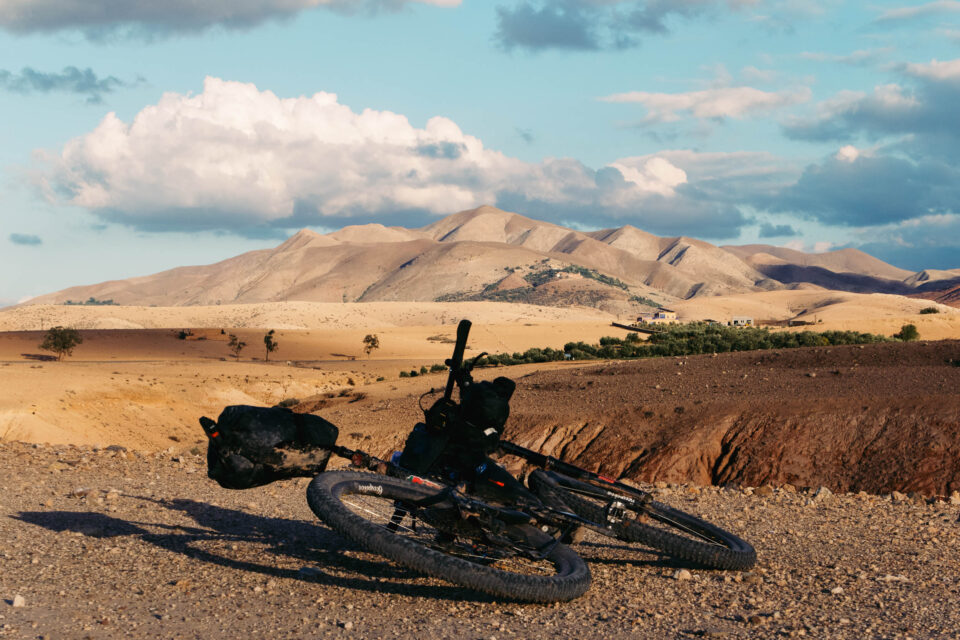
On the final morning, after a classic Moroccan breakfast, I rode across the Agafay Desert: dunes, dust, and silence. Another face of Morocco entirely. I stopped at a tourist café for an espresso that cost as much as one in Manchester but came with panoramic views and a tray of dates and cake. With the place to myself, it felt like a bargain.

The last stretch into Marrakesh followed wide gravel roads and, finally, a surprisingly calm highway with a generous cycle lane. Rolling back into the Medina, dusty and content, I felt that familiar mixture of relief and melancholy that marks the end of a true adventure.
Final Reflections
Stressing about this trip while planning it, a friend told me, “It’s better to regret something you’ve done than something you didn’t do.” I don’t regret this. Not a single part of it.
Morocco was as wild and beautiful as I’d remembered from the race. I’m still not sure whether I managed to fully unplug from “race mode.” I could have gone slower. I could have stopped more, drunk more tea. As other memories blur, the human moments are the ones that remain sharp: the boy pointing me to safety above the gorge, the café owner sharing his tajine, the men cheering at the top of the pass, the generosity of people who have so little yet are always ready with a smile, a bed or a meal.
The High Atlas reminded me how small we are in landscapes like these, and how small our daily worries can be compared to other people’s realities. It pushed me mentally, tested my limits, and rewarded me with some of the most memorable riding I’ve ever done.
It also taught me something honest: after just a couple of months on a mountain bike, I’m not quite ready to ride a singletrack-heavy epic like Kings of the Atlas the way it’s meant to be ridden. Not yet. But I’m keen to get there.
The Route
Further Reading
Make sure to dig into these related articles for more info…
Please keep the conversation civil, constructive, and inclusive, or your comment will be removed.