
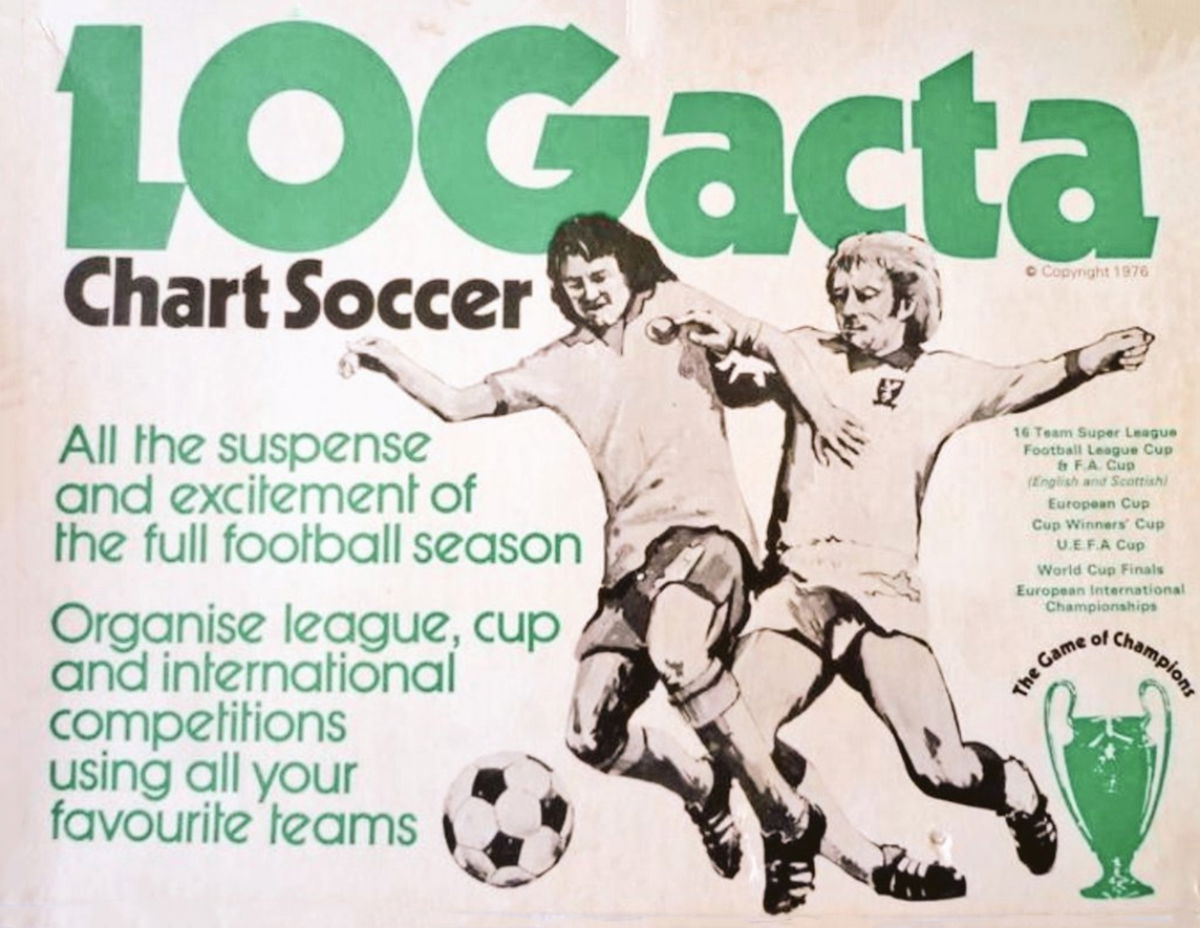
Anyone remember the last time Newcastle United won the league?
Well, from memory, it was sometime in the early part of 1980, during season three of the quite excellent LOGacta game that I played endlessly during that era.
Bear with me here, because there’ll be folk just not getting it.
However, for those who were fortunate enough to discover this wonderful game that was advertised in Shoot magazine and could be obtained by sending a Postal Order to a residential address in Leeds, it was a godsend, particularly on those dank weekends when the real Newcastle United were in dire straits back in the day.
LOGacta was a gift from my parents for my eleventh birthday, in January 1980.
LOGacta was advertised in Shoot magazine as ‘Chart Soccer, the new football game you can play by yourself’ and its headline descriptor mentioned a system of charts, dice and cards used to organise true to life league and cup competitions for British clubs at home and in Europe, plus the European Championships and the World Cup Finals.
At its heart was the sixteen team Super League, together with a full schedule of fixtures and a points recorder that ensured teams could be ranked in a league table of sorts, the points recorder also reliably informing whoever was playing LOGacta to attend to the various Cup competitions, both domestic and abroad, at certain junctures.
There was the League Cup, played out in the early part of the season and of course, the FA Cup which ramped up from around the season’s halfway point. In between, the schedule was punctuated by the three European competitions, the European Cup, the UEFA Cup and the Cup Winners Cup.
Teams were selected to participate in the Super League and the various Cup competitions, the instruction booklet identifying who was who across the continent as this ten year old was introduced to exotic sounding teams like Grasshoppers Zurich, Viking Stavanger and Lokomotiv Leipzig.
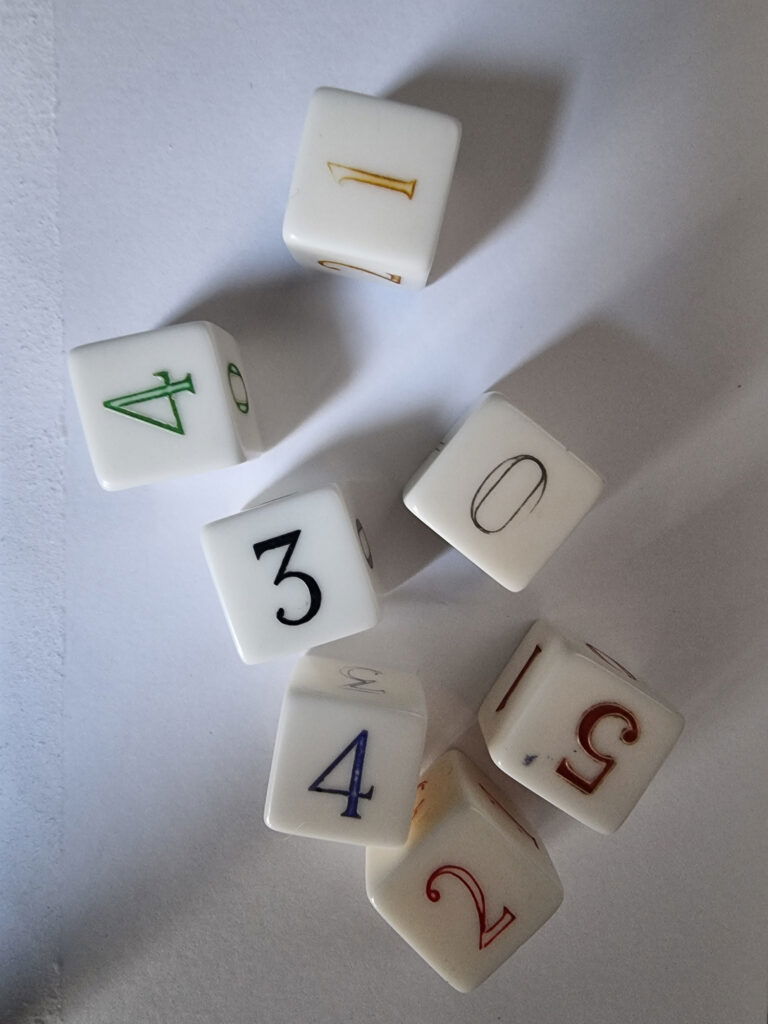
Matches had a degree of realism thanks to the seven coloured dice which managed to simulate home advantage as well as reinforcing the superiority that sides tend to have when facing clubs from lower divisions.
In the Super League, the points differential between the two competing sides established which dice were thrown and whilst the accompanying guide seemed hellish complicated to begin with, familiarity made it easy to navigate in time.
The green dice was the best, five goals were possible using this one and it would only ever be paired with the yellow dice (which could only register a maximum of two goals).This combination was thrown if a team was at home and more than ten points clear of its opponent in the Super League, or if a Super League side was playing home (or away) against a non-league club.
The Chartbook where all results were recorded provided for eight Super League seasons, so having an auntie with access to a photocopier was extremely helpful, an endless supply of the various charts made possible thanks to Rank Xerox.
In real life, the 1979/80 campaign saw Newcastle United once again in the Second Division, having adjusted to life in the second tier the previous season after relegation in 1978.
An impressive run early doors saw Bill McGarry’s side sitting in pole position on Christmas Day 1979, but a spectacular collapse saw United register only two more league wins after defeating the Mackems on New Year’s Day, a disastrous run that led to a disappointing ninth placed finish.
The Cups had also brought their usual distress; Sunderland knocking us out of the League Cup on penalties, whilst there was an embarrassing home defeat by Third Division Chester in the FA Cup.
Meanwhile, in LOGacta land, after losing their penultimate game of the season, a first home defeat no less, Newcastle United ‘travelled’ to Kenilworth Road knowing that a win would still clinch the title, but anything less and it would likely be going to Portman Road, Ipswich Town only a point behind and with a superior goal difference, playing their final match of the 30 game season at home to struggling Queens Park Rangers.
Talk about nerves! In the end, Ipswich walloped QPR, but United still won the league, twice coming from behind to edge past the Hatters by three goals to two.
Believe me, there was absolute bedlam in the big open terrace behind the goal that housed the away fans, the 5,000 official allocation bolstered by thousands of other Newcastle United supporters dotted around the tiny stadium.
This was in the days before the ZX Spectrum, which introduced us to a rather primitive version of Football Manager, a game that has developed beyond recognition over the years thanks to huge advances in technology.
Coming back to today, a cursory online search tells me that it’s still possible to purchase LOGacta, but I suspect with the popularity of Xbox and PlayStation, it’ll only be of interest to old timers like me.
I don’t think I’m looking back on that era and the game of LOGacta through rose coloured spectacles; I remember it being truly magical.
If anybody visiting The Mag has fond recollections of also playing LOGacta, it would be great to hear about it.