
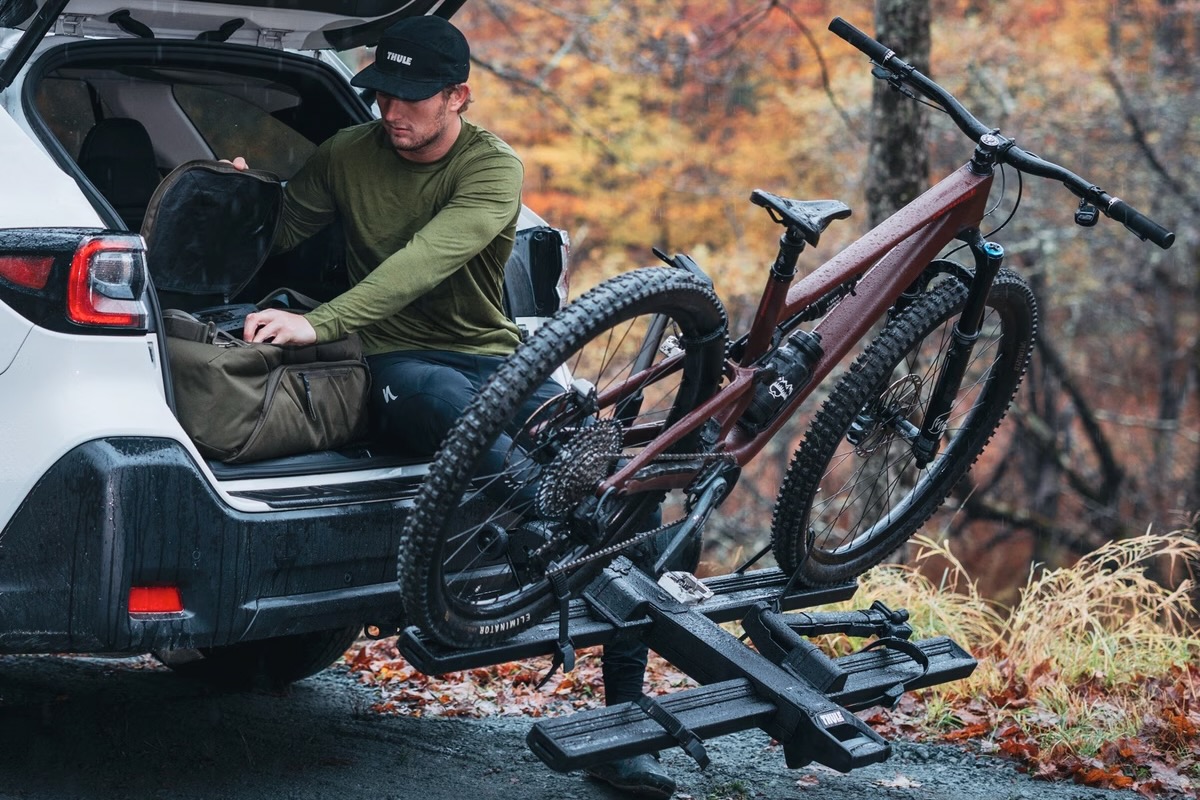
Thule hasn’t exactly been keeping its latest hitch bike rack, known as the Vero, a secret, but today, it is officially launching and available for purchase. I got my first glimpse at this new rack a couple of months ago at the Thule Experience in Sweden, and we spotted it in the Thule booth at the SEMA show as well. This new rack was designed to bridge the gap between the performance-oriented Verse and the convenience-oriented Epos by combining elements of both models.
The Vero borrows the sturdy tray-style design of the Verse with the super versatile and secure 3-point attachment system of the Epos. The result is a rack that can carry bikes weighing up to 80 pounds per tray and can literally haul any bike you own. I got my hands on the Vero a few weeks ago and have been using it for trips to the trailhead and around town to see if it lives up to its lofty bike compatibility claims.
-
High weight limit -
Very versatile bike fit – including bikes with fenders -
Tilt function is easy to operate – folds flat against the vehicle -
Comes with transport wheels to roll it -
Sturdy and secure bike hold – 3 points of contact -
Works with loading ramp for heavy bikes
-
More involved loading/bike attachment process -
No add-ons to increase capacity -
Expensive
Thule Vero Details

As mentioned above, the Vero is a cross between the brand’s Verse and Epos models. It uses the same sturdy pivot, support arm, and trays as the former, and the versatile 3-point bike attachment system of the latter. While it shares the same general design as the Verse, the per-bike weight limit goes up from 60 pounds on that model to 80 pounds on the Vero, thanks to the different bike attachment system. That 3-point attachment system includes front and rear wheel straps, as well as telescoping arms to support and secure the bike by the frame or rear wheel. When combined with the high weight limit, this bike attachment system makes the Vero compatible with virtually any bike, including those with fenders, fat tires, and heavy electric bikes.
The versatile bike fit includes wheel sizes from 20″ to 29″ and tires up to 5″ wide. Thule claims it will work for wheelbases up to 53″ (1,350mm) or 55″ (1,400mm) with Thule’s extra-long wheel straps ($35). Thule states the distance between loaded bikes is 11.4″, and the rack itself weighs a claimed 56 pounds. Given the rack’s total weight capacity of 160 pounds, it comes in the more robust 2″ receiver size only. The Vero comes with removable transport wheels, making it easier to move when it is off the vehicle and helping it stand up more easily on its own.

The Vero has an anti-wobble mechanism with a keyed lock built into the handle/crank that secures the rack to the vehicle. Additionally, the ratcheting attachment straps atop the telescoping bike arms have flexible metal cores and include keyed locks to secure the bikes to the rack. The main support arm has a convenient tilt-release handle on its end to fold the rack against the vehicle, flat for use, or tilted down for easier access to the trunk. The Vero’s trays have slots to accommodate an optional loading ramp ($120), sold separately, which is a very helpful addition for transporting heavier bikes. Thule also sells a handful of other accessories, such as the light-and-license-plate kit ($300) or an integrated cable lock kit ($70), should you want them.
The Vero has a two-bike capacity, and as of now, Thule doesn’t offer any add-ons to expand its capacity. Thule states that it is off-road capable and rated for use on “gravel roads, forest service roads, and access roads.” Additionally, it is approved for motorized RV travel with a 40% load reduction, equal to a per-bike weight limit of 48 pounds.
Assembly

The Vero arrived at my house in a characteristically large box. Opening the box revealed the rack, packaged very securely to prevent damage during shipping. It comes in five main pieces, plus a few smaller parts. Like most bike racks and other Thule racks that I’ve assembled, it’s fairly straightforward to put together, assuming you follow the printed instructions. Thule’s printed instruction manuals are somewhat interesting: they have no words and only graphical representations of the assembly steps, but I’ve always found them easy enough to follow along.
Like other hitch racks, the Vero is easiest to assemble on the vehicle. The five larger pieces of the rack include the receiver arm/pivot/main support assembly and the trays, which are each in two pieces and need to be bolted together. Lining up and holding the tray pieces against the support arm is made easier with the clever clips that Thule includes. This frees up your hands so you can insert and tighten the thru-bolts securing the trays to the main support arm. You repeat this process for each tray, then snap on the cosmetic side panels. Thule includes three lock cores with the Vero, which also need to be installed in the anti-wobble cam knob and both of the telescoping strap heads.


The Vero’s included transport wheels slide into a quick-release attachment underneath the rack’s pivot. These wheels are quite helpful and can be positioned under the rack so it’s easy to roll the 56-pound rack across firm surfaces like a garage floor or driveway. When the rack is installed on the vehicle, the wheels can be removed entirely or flipped up and out of harm’s way above the receiver arm.
Installation and Removal


Installing and removing the Vero is quick and easy thanks to its tool-free system. Simply insert the receiver arm into the hitch receiver and slide it in far enough that the folding “stinger” hitch pin lines up and hooks through the holes on the rack and the receiver. Tighten the anti-wobble cam with the folding knob at the end of the receiver arm until there is no play in the system. It can be slightly fiddly to crank it down super tight with this folding knob system, but it’s always worth doing to get the rack secure and wobble-free in the receiver. Once tightened adequately, the folding handle locks in place on the rack and secures it to the vehicle. Reverse the steps to remove it from the vehicle.
Using the Thule Vero

Like most Thule hitch racks that I’ve used over the years, the Vero is pretty easy to get along with. The convenient, well-designed tilt-release handle lets you fold the rack up and down with one hand, so you can easily balance a bike with the other. The tilt function is super smooth, and it clicks securely into place in the up and flat positions, plus the whole rack can be tilted down, even with bikes loaded, for easier access to the trunk, or in my case, the tailgate.

The 3-point attachment system is incredibly versatile, but loading bikes is a bit more involved than with some simpler systems, like that on the Verse, for example. The trade-off is that it works with pretty much any bike weighing 80 pounds or less. My Rad Power RadRunner Max is a great demonstration of this rack’s versatility. That bike weighs over ~75 pounds (with the battery removed), it has fenders, 20-inch wheels, and plump 3.5″ wide tires. With all those factors combined, it’s nearly impossible to fit on any hitch bike rack. The Vero, however, handles it with relative ease. Heck, it can handle two of them, or any combination of the bikes in my garage.


The most unique element of the 3-point attachment system is the telescoping, articulating arm topped with a long, ratcheting strap. This strap can be attached the any part of the bike frame or to the rear wheel to hold the bike in its upright position. Of course, securing the bike by the frame means the rack must make frame contact, but it may be the only option if you have an e-bike with fenders, let’s say. Those with high-end carbon frames or paint jobs still have the option of attaching the telecoping arm to the rear wheel, which I have been doing with my fancy mountain bikes. In addition to the telescoping arm, long ratcheting straps on the trays secure the front and rear wheels, using opposing force pulling toward the middle. All of the attachment points have rubber covers to minimize the potential for abrasion in transport.

In my experience, loading bikes on this rack takes a few minutes longer than something like the Thule Verse or the Kuat Piston Pro X, but it gets much quicker once you get your system down, especially if you’re loading the same bikes frequently. Lifting heavyweight e-bikes on this rack is no simple task, however, and given that e-bikers are the target market for the Vero, I think it would make a lot of sense for the rack to automatically come with the loading ramp accessory. Even without the ramp, I was able to muscle all my bikes into place; it would just be way easier with it.

On the road, I’ve occasionally noticed the front wheels/handlebars of my bikes wobbling just a tiny bit, but nothing that gives me pause in the slightest. Otherwise, the three-point attachment system holds the bikes impressively securely. I’ve carted around my heavy electric compact cargo bike, 50+ pound eMTBs, and 30-pound non-electric mountain bikes. I’ve had no issues attaching any bike to the rack, and it seems to carry them all with the same level of stability and security, regardless of weight.

As with most tray-style hitch bike racks, bike-on-bike conflict is a possibility and will depend on the bikes in question. For example, my RadRunner has a large metal basket on the cargo rack that makes contact with the suspension forks on mountain bikes if paired together. But all of the other bike combinations I’ve tried have been contact-free. The included locks are convenient and easy to use, but like any integrated lock system, I’d call it low-security. For peace of mind, I’d add a beefy aftermarket lock, but that’s the case with most racks.
What’s Not to Like?
The Vero was made to be compatible with virtually all bikes, and I think that Thule accomplished that goal. That said, it feels a bit clumsier to attach bikes to this rack with more steps and a bit of fiddling around required. Given its unique attachment system, I’d argue that there are better options for transporting precious high-end road, gravel, and mountain bikes, like the Thule Verse, which secures bikes differently. In terms of bike attachment, many other racks are a bit more user-friendly, quicker, and easier to use. But for heavier e-bikes, bikes with fenders, or other bikes that are otherwise hard to carry on other racks, the Vero has you covered with its supremely versatile attachment system and high weight limit.
At $1,300, it’s certainly not cheap. That price puts it well into premium territory at the high end of the hitch rack market. It’ll set you back another $120 for the loading ramp, too. That said, if you’ve been struggling to find a good solution for transporting your e-bikes, then it may well be worth the asking price.

Thule Vero: My Takeaway
Despite the proliferation of heavier electric bikes of all kinds, the ability to safely and easily transport them has been lagging a bit behind. Bike racks are undoubtedly catching up, and the Thule Vero is an interesting new option that has both a high weight limit and a unique attachment system that works with virtually every bike. You really can carry almost any bike that weighs 80 pounds or less on this rack. Beyond a slightly more involved 3-point attachment system, this rack is otherwise very user-friendly, with helpful features like integrated locks and convenient transport wheels. Pick up the optional loading ramp accessory, and loading e-bikes will be a breeze.
While I would steer most high-performance cyclists, particularly if you aren’t hauling e-bikes, toward other racks, the Vero is a sensible option for many riders. If you’ve got e-bikes, bikes that are difficult or impossible to attach to other racks, or maybe even the full spectrum of bike types and weights in your garage, the Vero is a rack that can haul them all.