
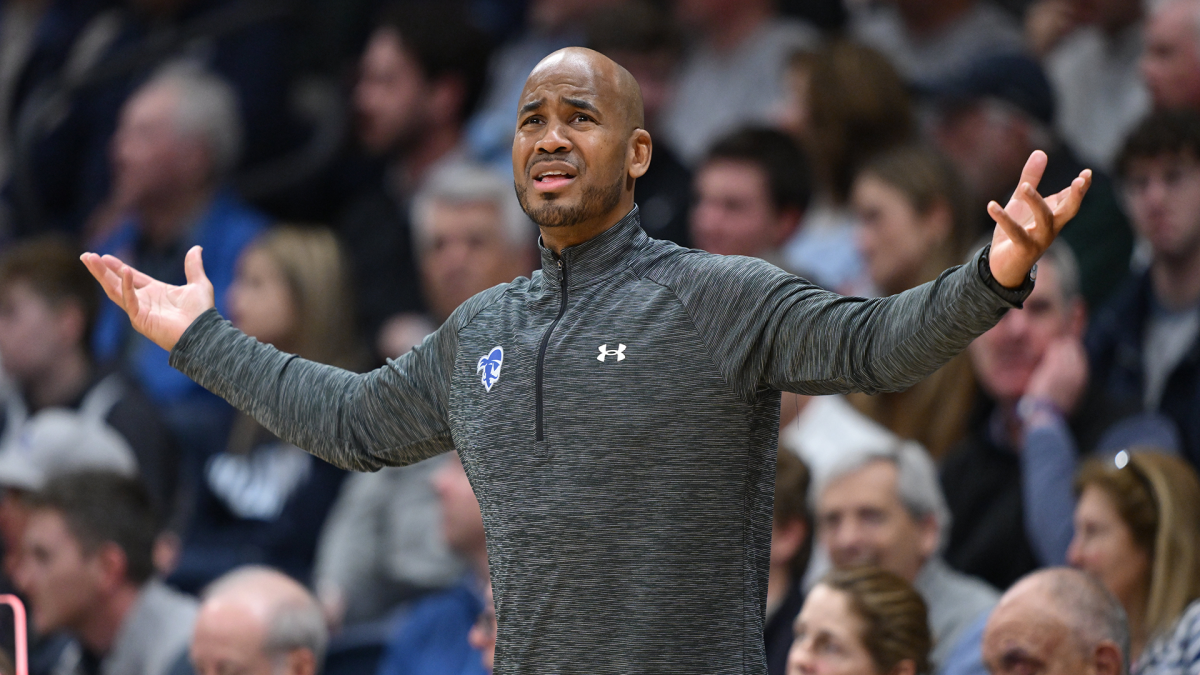
Seton Hall’s 72-60 loss at Villanova on Wednesday night shifted it back to the wrong side of the NCAA Tournament bubble and underscored an increasingly bleak reality facing the Big East. If the Pirates don’t right their ship over the next five weeks, the league will likely send just three teams to the NCAA Tournament for the second time in the past three seasons.
The loss dropped Seton Hall to 16-7 (6-6 Big East) from “Last Four In” status in CBS Sports Bracketology to the First Four Out. It marked the Pirates’ fifth loss in their past seven games since a 14-2 start. The stretch features three Quad 1 losses — including the Villanova defeat — but also includes lower-tier Quad 2 defeats vs. Butler and at DePaul.
Even at its peak following a 4-1 start to league play, Seton Hall never rose above No. 43 in KenPom’s ratings, which suggested a regression on its win-loss ledger was likely. It has come with a vengeance over the last three weeks and contributed to the Big East’s floundering overall profile.
All is not lost for the Pirates, who get second cracks at No. 3 UConn (Feb. 28) and No. 22 St. John’s (March 6) before the Big East Tournament. But as we take a look at the CBS Sports Bracketology model’s latest field, you won’t find the Pirates included and you won’t find much Big East representation.
Bracketology top seeds
Check out the full field of 68 at the CBS Sports Bracketology hub.
Notable Bracketology movement
At first glance, Wednesday night’s slate appeared relatively light. It ended up packing a punch. With Seton Hall sliding out of the projected field, Oklahoma State rose up from the “First Four Out” to become a projected No. 11 seed following its 99-92 upset win over No. 16 BYU. It was the first Quad 1 win of the season for the Cowboys (16-6, 4-5 Big 12), who also have high-end Quad 2 wins against projected NCAA Tournament teams Texas A&M and UCF.
The night’s most shocking result concluded after midnight ET, when No. 6 Gonzaga fell 87-80 at Portland for a Quad 3 loss. The Bulldogs narrowly retained their spot as a No. 3 seed, although they are now the final No. 3 seed. Part of the explanation for why the Zags didn’t drop to a No. 4 seed can be found in Minneapolis, where Michigan State fell 76-73 at Minnesota. The Spartans might have been equipped to rise and take Gonzaga’s place until suffering a Quad 2 defeat.
Oddly enough, Gonzaga actually gained a Quad 1 victory when Thursday’s metrics updated to reflect Wednesday’s results. That’s because Arizona State rose from 80th in the NET to 73rd following its 71-63 win at Utah. As a result, Gonzaga’s Nov. 14 road win over the Sun Devils changed from a Quad 2 victory to a Quad 1 victory to give the Zags a 5-1 mark in Quad 1 instead of a 4-1 mark. In total, Gonzaga fell just one spot (from 13th to 12th) in wins above bubble (WAB).
Revolving door for final No. 1 seed
Our model’s revolving door at the final No. 1 seed took another twist, as UConn replaced Iowa State on the No. 1 seed line. Though the Huskies rate behind teams like Iowa State and Illinois in performance-based metrics — UConn is No. 8 at KenPom — they are squarely ahead of both in resume-based metrics. At No. 3 in WAB and No. 2 in strength of record, the Huskies are a deserving No. 1 seed. Whether they can retain the spot will depend largely on Friday night’s showdown with No. 22 St. John’s inside Madison Square Garden.
Big East blues
UConn, St. John’s and Villanova are each in great shape heading into the final month of the regular season. But outside of a Seton Hall revival, the Big East’s chances of finding another at-large candidate are getting slimmer by the day. Butler’s 97-87 double-overtime loss at Providence on Wednesday marked the Bulldogs’ third straight loss and pushed them further to the wrong side of the bubble.
Creighton is also on a three-game slide after a 6-3 start to league play briefly resurrected the Bluejays’ bleak at-large hopes. No one else from the Big East ranks inside the top 80 of the NET. A year ago, the conference sent five of its 11 teams to the Big Dance. Two years ago, it produced just three tournament teams but had three more in the top 60 of the NET that were excluded.
This year, it rates as the worst high-major conference at KenPom. It’s the first time since 2021 the Big East has held that distinction.
Rematch rules
Amid conference consolidation and the proliferation of nonconference matchups between high-major schools, the NCAA Tournament Selection Committee faces challenges when it comes to avoiding regular-season rematches. The 2025 NCAA Tournament bracket featured three potential second-round games between conference teams, although none of them came to fruition.
The committee will still seek to minimize conference meetings and nonconference rematches, and our model is coded to do the same. However, NCAA bracketing principles permit games between conference teams in the second round, so long as the teams in question played each other just once before the NCAA Tournament. For conference teams that met twice prior to the NCAA Tournament, principles state they should not meet prior to the Sweet 16. If the teams played three times, NCAA bracketing principles state they should not play before the Elite Eight.
With regard to rematches of nonconference games, NCAA bracketing principles state that they should be avoided “in the First Four and first round.” The committee will also “attempt to avoid” nonconference rematches in the second round. But the committee has historically prioritized keeping teams on their natural seed line over changing their seed line for the sake of avoiding a rematch.