
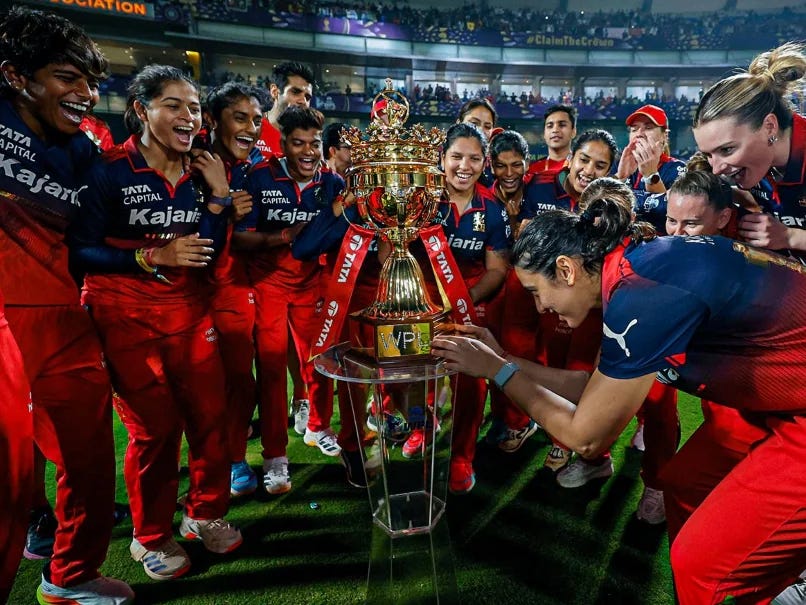
RCB chased down 203 runs to win their second WPL!
But good god, that was some heart attack-inducing nonsense. Shafali Verma & Jemi Rodrigues put away some truly poor RCB bowling, before Smriti Mandhana & Georgia Voll put away some fairly decent (if outmatched) bowling.
But, what happened beyond the headlines?
-
🍃 RCB’s wayward PP bowling opened the door for DC…
-
🎯 …DC came ready with a plan for RCB’s MO bowling…
-
🏏 …and Jemi + Wolvaardt were ready to capitalise.
-
🏆 And yet, the Mandhana-Voll partnership made chasing 203 look easy!
If you’re reading this online, remember: you can get it via WhatsApp or direct to your email👇!
✍️ Written by Tarun Pratap, who runs The Rank Turner. Follow him on X.
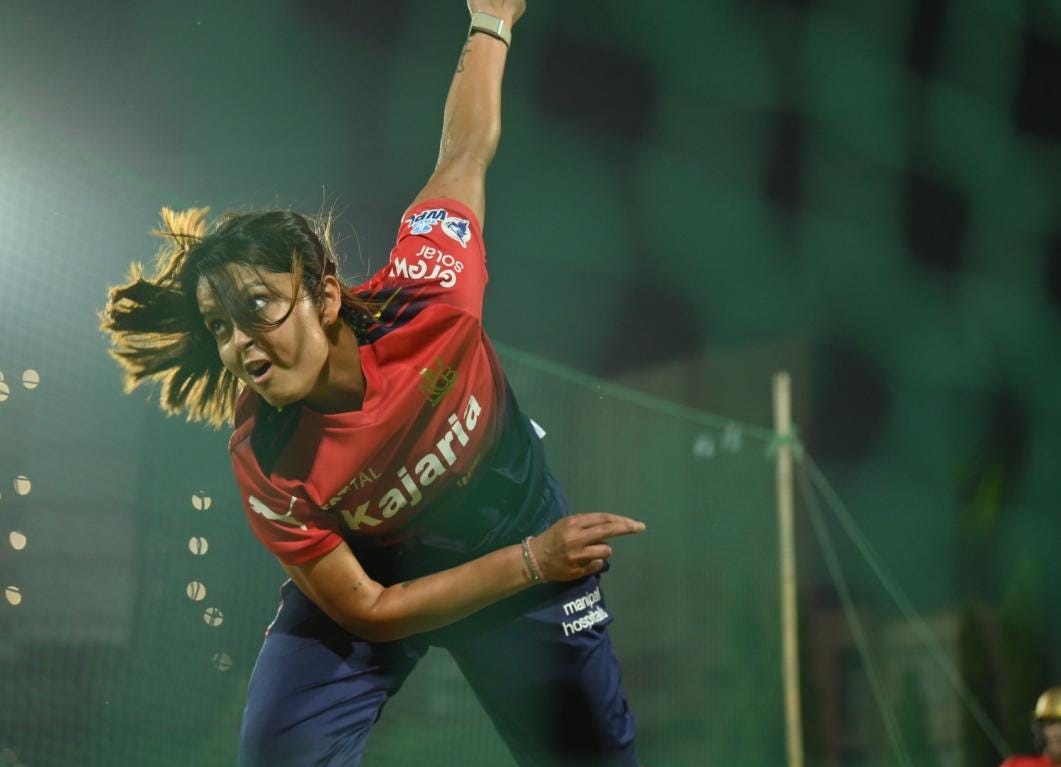
RCB’s bowlers entered the final with clarity about what they had to break. DC built their season on a simple template: 5 wins, all while chasing, and 3 opening stands of 50+ between Lizelle Lee and Shafali Verma in those wins. The constant was momentum up front. If RCB were to disrupt DC’s rhythm, the opening 6 overs had to belong to the ball.
In Lauren Bell, they have a bowler perfectly suited to the task. In 9 innings and 26 powerplay overs, she’s taken 6 wickets at an economy of 5.35 and a dot-ball percentage near 68%. Bell has made scoring a batter’s exception rather than her right.
From the other end, Sayali Satghare’s season has been far noisier. She has 6 wickets in 14 overs, but at an economy of 8.14 and a dot-ball percentage just over 51%. She has taken wickets but gone for runs too.
On this occasion, though, she initially held her nerve early: probing length, minimal width, only three runs conceded. Bell and Satghare, different profiles entirely, had DC inching at 9/0 after 3 overs. DC opener Lee was marooned on 4 (14).
However, tonight, Satghare’s second over undid the choke in 6 chaotic deliveries. The first ball was a half-volley, too full, too straight, and Lee, searching for oxygen, cleared the ropes. Anticipating the correction on the next ball, Lee shuffled across her stumps. Satghare dragged the next ball shorter, and Lee was ready again, another six, this time over midwicket.
The over spiralled from there: a full inswinger down leg for five wides, a slower ball sprayed wide outside off. In just 2 legal deliveries, DC had taken 18 runs.
It was eerily reminiscent of Satghare’s powerplay over against UPW earlier this season. Her first over was economical – going for just 7 – and she came back in the 5th with UPW at 36/0. What followed was near-identical.
A half-volley to Meg Lanning was lifted for six. The immediate correction went shorter and sat up to be pulled for four. Then came the wide. 11 runs off 2 balls, and control lost in the space of seconds before returning to the back-of-the-length ball and beating Lanning and having an LBW appeal, and conceding only three in the last four balls.
Here too, only when Satghare returned to her natural back-of-a-length inswinger did she trap Lee on the pad, prompting a strong LBW appeal that was turned down. The pressure had produced the right ball, but only after the release had already come.
Similarly, Arundathi Reddy’s over in the 6th – after Bell had applied more pressure with a 7-run 5th over – released this pressure. She picked up the important wicket of Shafali Verma via the batter’s traditional weakness to bouncers, but she also conceded 17 runs.
DC’s opening partnership had gotten them to 53/1 in the powerplay; 10 runs higher than their average score of 42.5 this season.
Which meant that DC’s formidable middle order, featuring multiple international stars, didn’t have to salvage a broken start as per usual. Tonight, due to RCB’s sloppy bowling outside the Bell overs, DC could head into the middle overs ahead of par.
Data from ESPNcricinfo & Cricmetric.
If you’re reading this online, remember: you can get it via WhatsApp or direct to your email👇!
✍️ Written by Raunak Thakur, who runs Dead Pitch’s Society. Follow him on X.

DC’s plan against Shreyanka Patil was formed before she released a ball. They identified the method she trusts: fuller lengths, modest pace variation, and sequencing built on batters misjudging flight or mistiming aggression.
DC made an early decision not to let Patil settle into her groove.
Patil began as she usually does in the 7th over, leaning into her stock areas. Full to good length, moderate pace, control-first intent. Against Lizelle Lee, that plan immediately ran into resistance. Lee set herself up leg-side from the outset. Anything full was swept with commitment, fetched from outside off and dragged into the midwicket arc.
When Patil shortened marginally, Lee dropped to one knee and slog-swept flat. The leg-side access was clear and deliberate. The blueprint was laid bare. Patil’s lengths barely drifted from full and good, the areas she usually trusts to draw miscues. Lee met them with early commitment.
The over’s closing blow, however, came from Laura Wolvaardt. A tossed-up, full delivery outside off was leaned into and driven cleanly through extra cover for four, pushing the over to nineteen. The delivery’s shape was used against itself, reinforcing the sense that Patil’s stock ball was no longer applying control.
The distinction mattered. Two batters, same over, and the same result despite different expressions of the same plan.
What mattered more was that Patil did not miss her length. She bowled into the zones she prefers to operate in. DC had already decided those zones would not be treated as defensive areas. The scoring shots were repeatable and low-risk because they were designed to play with the spin, not react to it late. Once that exchange was established, Patil was left persisting in lengths that were already being accessed cleanly.
Her response was subtle rather than structural. She stayed fuller, trusted her line, and searched for timing errors. 19 came off the over because Patil never managed to pull Lee off that leg-side access point.
As a result, she had to be taken off for multiple overs, and could only be reintroduced in the 12th over when Laura Wolvaardt and Jemimah Rodrigues were ticking along comfortably. The DC plan had not changed.
Rodrigues played the lengths rather than the bowler. A fractionally full ball disappeared through cover. Another, fuller on the pads, was swept hard between long-on and deep midwicket. When Patil went shorter and wider, Rodrigues rocked back and cut behind point.
3 boundaries were played, and 13 runs came off the over. Even the defensive moments were intentional. Balls on the stumps were blocked and reset. Rodrigues trusted that scoring opportunities would continue to arrive.
Patil’s adjustments never moved beyond the incremental. Small changes in length, no meaningful shift in pace, no attempt to alter angles or deny access. The pitch map reflected that continuity. She continued to live in the fuller zones, hoping for mistimed shots that never came. Without drift in plan or pace, she became predictable, and predictability is fatal for an off-spinner in the middle overs.
By attacking Patil inside her designated middle-overs role, DC fractured RCB’s middle order bowling sequence at its core. Once that happened, RCB’s array of bowling options began to blur into one another. The lack of variety offered no release point, no alternate line of defence or attack to pivot towards.
The contrast with their earlier win against DC this season is difficult to ignore. In that game, Prema Rawat quietly shaped the middle overs, returning 2 wickets at an economy of 5.3 and compressing scoring to keep DC down to 166. The chase that followed was uncomplicated.
Tonight, Rawat was missing, while Pooja Vastrakar featured in the XI without being meaningfully utilised across the game. With no alternate way to distribute middle overs pressure, RCB’s bowlers spiralled. The template to pressure DC’s right-hand heavy batting order existed, but it was not used.
Data from ESPNcricinfo & Cricmetric.
✍️ Written by Tanish Taneja. Follow him on X.
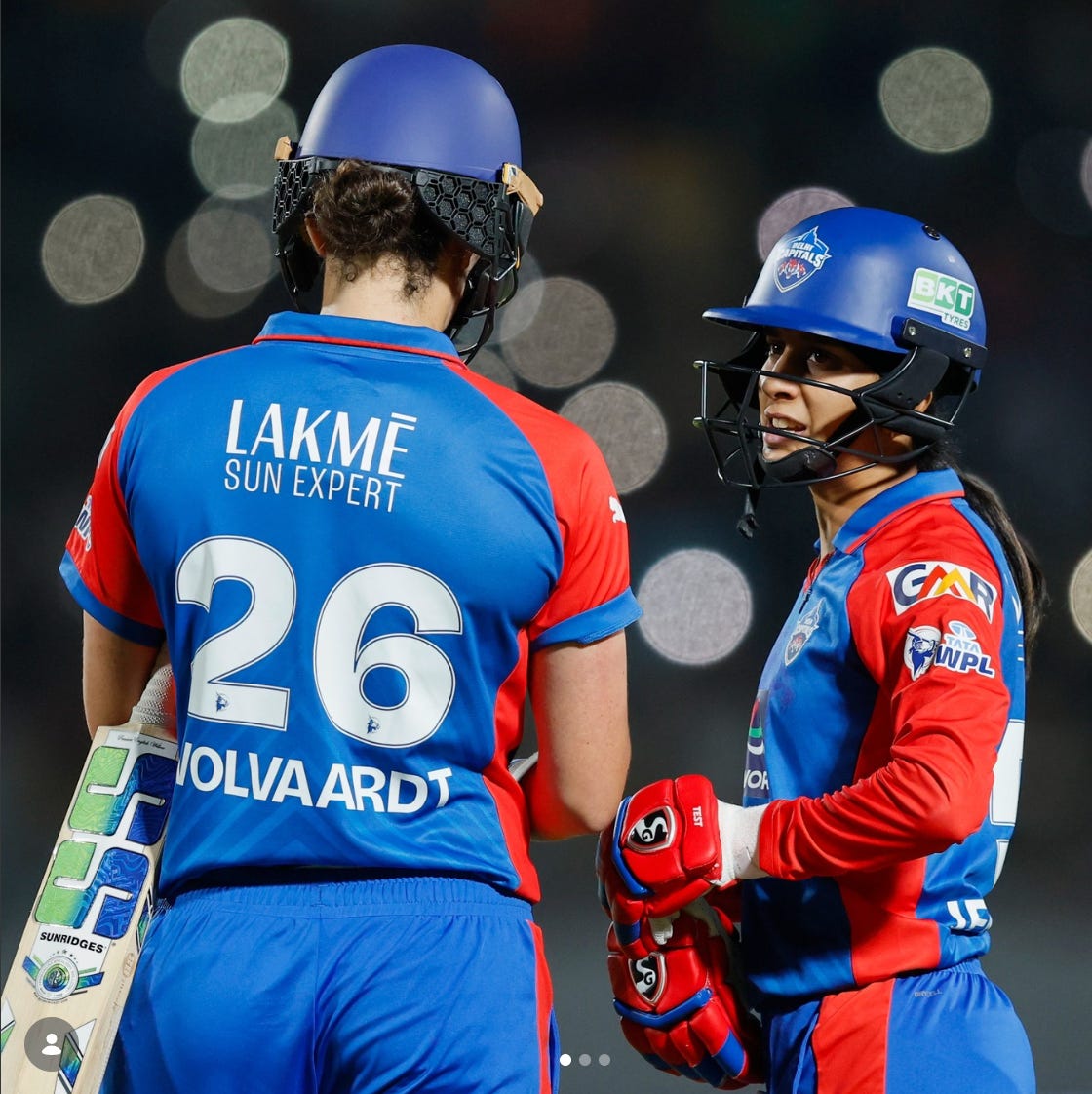
From the moment she walked out to bat, Jemimah Rodrigues brought a sense of urgency with her. Partnered by Laura Wolvaardt, the diminutive DC batter didn’t just want to consolidate the 72/2 start that DC openers had established; she wanted to accelerate.
The two players are famed for their fitness, and today’s partnership was no different. They focussed on rotating strike, scoring 41 runs in their 49 non-boundary balls cumulatively. Wolvaardt in particular was the perfect second fiddle; she was happy to constantly give Jemi the strike (the DC captain played 70% of the balls and scored 75% of the runs in their partnership), while scoring 0 dots in 25 balls tonight.
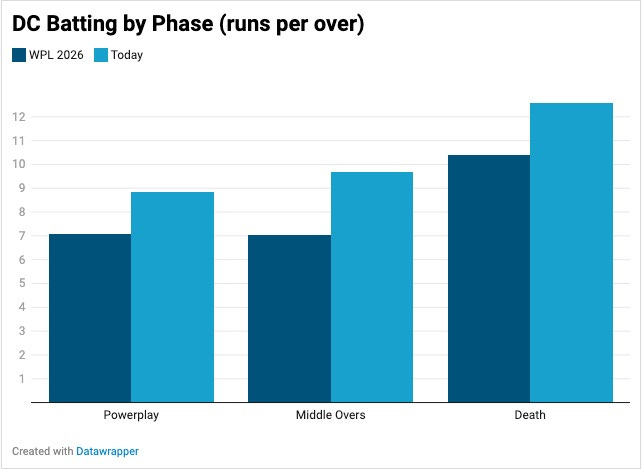
In the 51 balls the duo batted together in the middle overs, they scored 76 runs and ensured that the run rate never dipped below nine an over.
This is particularly impressive considering RCB’s bowling record and DC’s batting record in the middle overs. RCB are the second best bowling unit in the league by economy, conceding just 7.68 RPO. Meanwhile, DC have the worst batting record in the phase, scoring at just 7 RPO.
Rodrigues in particular stepped up today. She’s been a good middle overs bat during her WPL career – scoring 360 runs at a SR of 120 – but not a great accelerator.
Today, she scored at 154.05 while taking down every RCB bowler she faced. In particular, she targetted the spinners to make sure RCB couldn’t effect their traditional middle overs squeeze, taking 29 off 21 against Radha Yadav & Shreyanka Patil.
She did this despite the seemingly smart bowling plan that RCB’s bowlers had for her. They stuck to full-ish balls on a stumps line to the DC captain, with 86% of the balls faced by Jemi landing in that tight cluster.
Rodrigues’ wide range of shots seemed to have an answer for everything they threw at her. Her ability to find gaps all over the field was a treat to watch, and she was (quite literally) equally strong on both sides, accumulating 29 runs through the off side and 28 on the leg side.
She showed a special liking for the cover region, blasting 5 boundaries through there and pouncing on any width. Perhaps the most telling stat of this dominance was her control – even in this extremely busy innings of 57 (37) striking at 154, she finished with an unbelievable control percentage of 89.2%.
At the other end, Laura Wolvaardt hit 5 boundaries and 20 singles in her innings, striking at 176. Even after Rodrigues’ wicket, the South African committed to rotating strike. This yielded immediate fruit as she put together a quick 55 (24) with Chinelle Henry while facing just 9 balls. Despite this fractured innings, she still finished with 96% control rate.
The result of this chemistry between Wolvaardt’s rotation and Jemimah’s precision was a DC middle-overs phase that refused to dip. They never scored fewer than 8 runs – and maintained an RPO of 9.25 – despite using strike rotation as their main scoring weapon.
When Henry walked in, she didn’t have to fear losing her wicket cheaply – and it led to an onslaught that set up the biggest WPL final total of all time.
Data from ESPNcricinfo & Cricmetric.
If you’re reading this online, remember: you can get it via WhatsApp or direct to your email👇!
✍️ Written by Tarutr Malhotra.
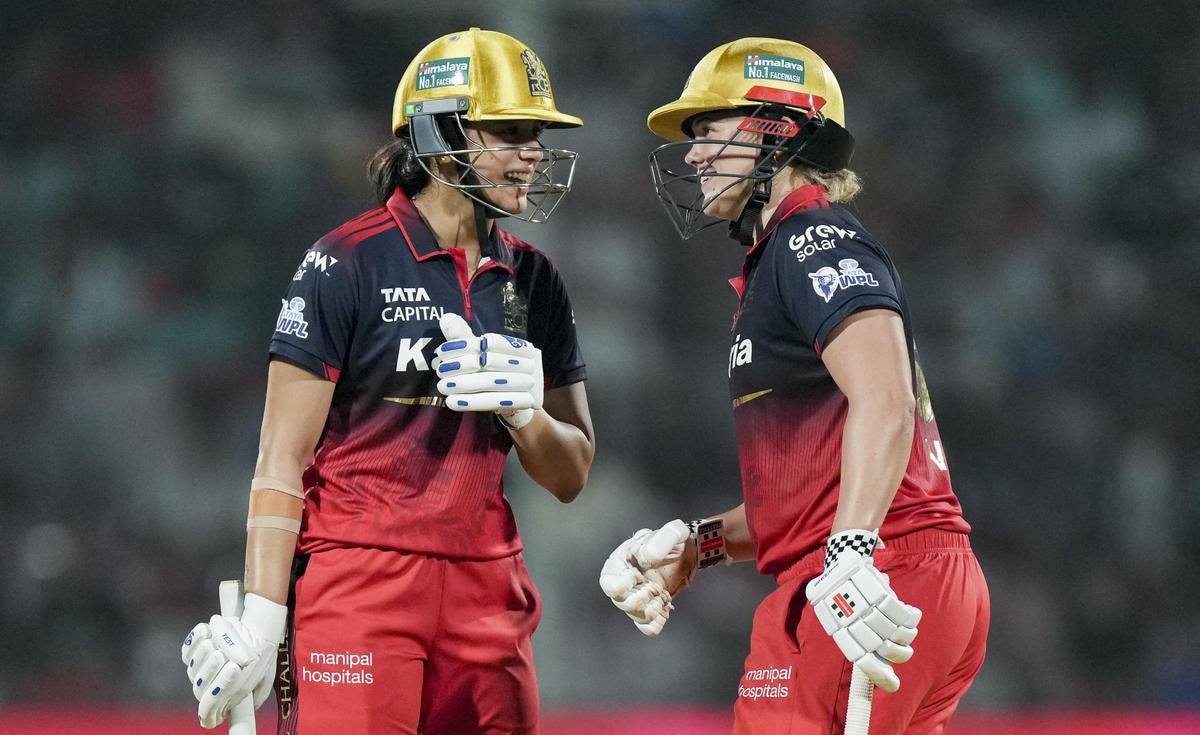
This DC bowling unit is well-rounded; they have an aggressive and economical frontline bowler in Marizanne Kapp, a consistent and probing first change in Nandani Sharma, a stump-to-stump menace in Chinelle Henry, and a world class SLA in Shree Charani. And, for fun, they have a couple of above-average off-spinners in Sneh Rana & Minnu Mani.
It doesn’t matter what you’re weak against, DC have a bad match up for you – as RCB found out when they posted a wretched innings total of 109 against them last week. And, unfortunately for RCB, they’re barely a rock solid batting order. They are prone to middle order collapses, and played with just 4 specialist batters today.
However, despite the early loss of Grace Harris and the late loss of Richa Ghosh (for a combined 15 runs in 13 balls), RCB felt in full control of this innings from early on. Georgia Voll and Smriti Mandhana put together the perfect partnership that bent and broke the DC bowing unit within the first 8 overs of the 203-run chase.
Voll played the role of master field manipulator, forcing the DC field to keep switching around, while Mandhana picked out empty boundaries to clear at every possible opportunity. The Aussie faced the bulk of the deliveries in their partnership (54 of 92), and set the tone early on.
Against Marizanne Kapp in the 3rd over, Voll played an early scoop (aping a similar boundary Harris had scored in the 1st over) forcing DC to send the two boundary fielders to protect the ground behind the wicket. That opened the entire arc of the field in front of Voll’s vision, and the Aussie took advantage. She aimed to drive through different cover regions depending on the line of the ball, and picked up a second boundary off the Protea pacer that over.
The strategy was relentlessly repeated against Chinelle Henry (4th over), Kapp (5th) and Nandini Sharma (6th). Find the gaps, and play low-risk shots to find the boundary.
You’ve brought in an offside boundary fielder? I’m going to scoop you again. You’ve moved the fielders back? I’m going to drive you through the covers. You’re bowling a slower ball? I’m going to loft you to the empty deep midwicket region.
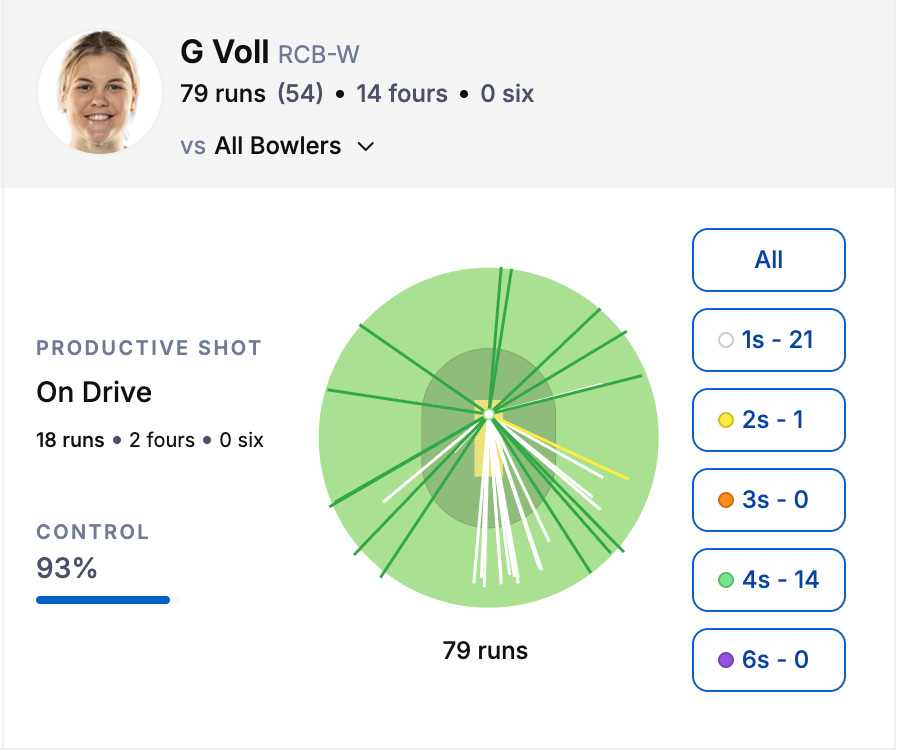
In all, she scored 5 fours in 19 balls across 4 powerplay overs, and dismantled DC’s three-headed pace monster. But, the most in-form of those three picked up on her tactics. After the aforementioned lofted boundary, Sharma placed a fielder at deep midwicket and cramped Voll by bowling a leg stump line at her.
So, the Aussie took a single to mid-on, and brought Mandhana on strike.
It’s a tactic Voll would use repeatedly against the bowlers who squeezed her – particularly Sharma & Charani. The captain faced just 28 balls in their partnership, and 17 were against those two. As they strangled Voll, her skipper came to the rescue.
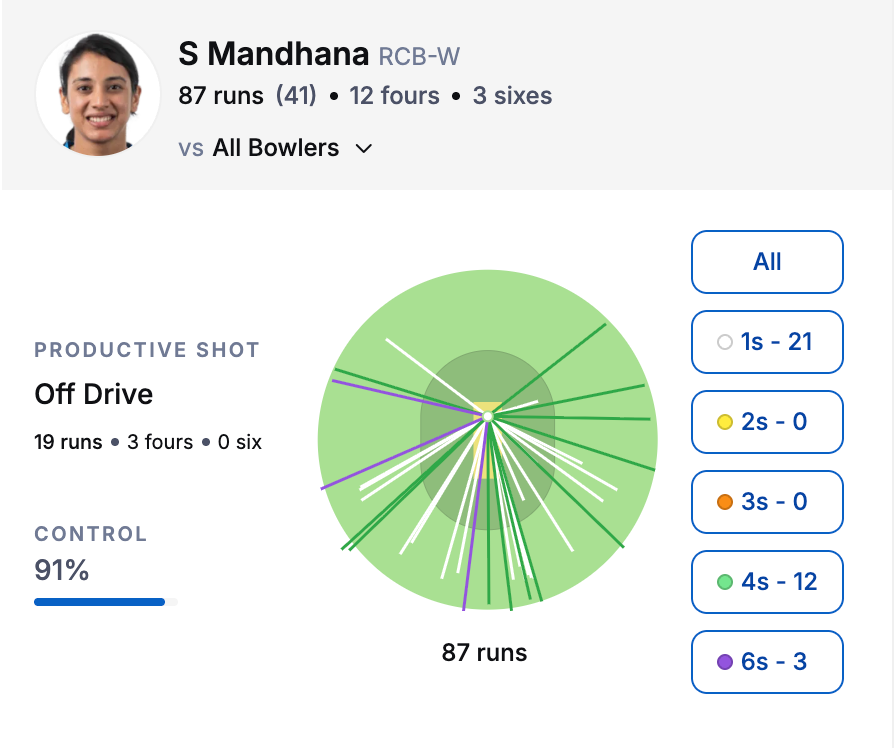
In the WPL, Mandhana scores at 131.6 SR v/s pace & 178.4 SR v/s SLAs. Tonight, she scored 20 in 8 (250 SR) v/s Sharma, and 22 in 9 v/s Charani (244.44) during the partnership. She required no set up time against either; she often scored these boundaries immediately after coming on strike.
In the 6 overs Sharma & Charani bowled during the Mandhana-Voll partnership, the RCB skipper picked up four 4s and two 6s – but never more than two boundaries in a single over.
That distribution is important. In the 15.5 overs they batted together, the duo never scored fewer than 7 – or more than 16 – runs in an over. Unlike the DC batters, Mandhana and Voll didn’t run a lot; they scored 71.5% of their runs in boundaries. They scored steadily, and they scored by finding the ropes.
Georgia Voll preferred to target the boundaries as she scored fourteen 4s, while recording a 33.35% dot ball percentage. Mandhana scored twelve 4s and three 6s, but conceded just 4 dots in her 41-ball innings (9.3%). For those of you counting at home, that’s nearly 4x as many boundaries as dots for the RCB captain!
The most impressive part of this partnership was how they both brought the best out in each other. Mandhana’s power game allowed Voll the freedom to pick and choose the bad balls to hit – she only hit 5 lofted shots anywhere near a fielder today, and all from the 12th over onwards when the pair decided to accelerate.
Meanwhile, Voll’s insistence on playing the gaps and manipulating the field had an interesting effect on Mandhana too. Across formats, Mandhana has a well-known weakness to off-spin. Against elite off-spinners, even standard deliveries can become tough, but even an above average off-spinner – like DC’s options – have one ball they can always count on.
A flighted, slower delivery on an off-stump line is almost always smacked to the deep midwicket boundary by Mandhana. She just can’t resist the allure. She may score a boundary or three, but eventually she will spoon a catch to your boundary fielder. It’s how Minnu Mani got Mandhana out last week in RCB’s 109-run collapse.
Today, she resisted.
When Mani bowled an enticing full toss in the 9th over, she just nudged it for a single. Sharma and Charani tried the tactic too – one ball got hit for a 6 squarer than the bowler intended, while three others were dispatched with technically beautiful inside-out cover drives to the empty long-off boundary. In all, she scored 24 runs in that quadrant and scored just 10 in her historically favoured – but riskier – deep midwicket region.
You read that right; this was a disciplined Mandhana performance!
After 7 overs, DC had gone through all four front-line bowlers without success. For the 8th, they turned to a desperation ploy; their World Cup-winning wildcard, Shafali Verma. She conceded 9 runs with no dots. DC wouldn’t concede fewer runs in an over until the 16th.
When Harris was dismissed on the 7th ball of the innings, ESPN’s win predictor gave DC an 82% chance of victory. By the start of the 16th over, that number had flipped to a 91% likelihood that RCB would take home their second title.
The Aussie No.3 bent DC’s bowlers with her field manipulation, and the RCB skipper broke them with her power hitting. But, don’t mistake their easy demeanour between the wickets as a sign that this chase was easy.
We witnessed a miracle tonight. Mandhana and Voll just happen to be the two most nonchalant messiahs around.
Data from ESPNcricinfo & Cricmetric.