
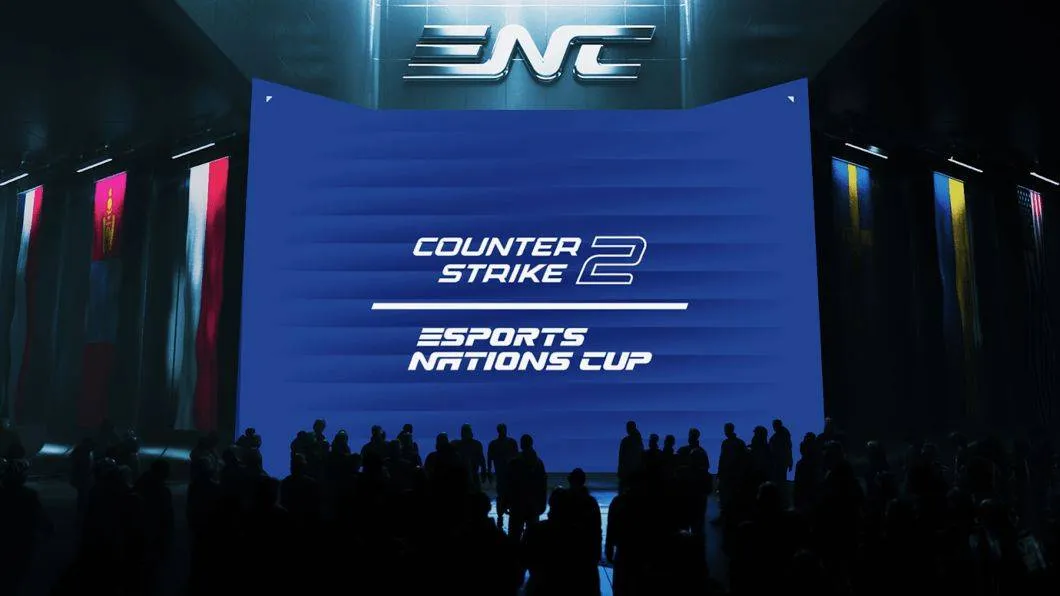
The Esports World Cup Foundation (EWCF) announced Sunday that it has added Counter-Strike 2 as an official title of the inaugural nations vs. nation competition, the Esports Nations Cup (ENC), set to take place in November in Riyadh, Saudi Arabia.
Counter-Strike 2 joins other previously announced titles including Dota 2, Chess, Mobile Legends: Bang Bang, FATAL FURY: City of the Wolves, and Trackmania. Also announced on Sunday as an official competitive title is Tencent’s popular mobile MOBA, Honor of Kings (see more on that in this story).
The CS2 tournament at ENC will begin on Nov. 10, and conclude on Nov. 15, with the playoff final.
The first stage of the competition will feature 24 national teams competing in a round-robin group stage, featuring four groups of six teams (best-of-one). The top four teams from each group advance to the next stage.
The second stage will feature 16 teams competing in a single-elimination playoff bracket(best-of-one).
Playoff matches will be best-of-three while the Grand Final will be a best-of-five series.
For national teams to get there in the first place
The 24 teams competing at ENC will be selected via a two-stage qualifier that will take place July 6-19, that utilizes a newly created CS2 National Team Ranking system to identify eligible nations.
This new ranking system will be used to determine which countries and territories will feature a national qualifier, and to seed teams in the qualifiers (EWCF claims it is based on the Valve Regional Standings, or VRS. The national ranking will then accumulate the points of the top five players on the national roster. The cut-off date for the CS2 National Team Ranking is June 1. For all nations and rosters not covered through the VRS Ranking, FACEIT Elo points will be used as a secondary mechanism to identify nations with qualifiers and to seed teams in those.
The first stage of this qualification process is National Qualifiers, with competitions being hosted in 96 countries and territories to determine each nation’s top CS2 team. The winner of each National Qualifier will then advance to the Regional Qualifier, for a chance to secure a spot at the ENC in Riyadh. National Qualifiers will feature a single elimination bracket, and will run in the following regions:
- North America (8 National Qualifiers)
- South America (8 National Qualifiers)
- Western Europe (16 National Qualifiers)
- Eastern Europe (16 National Qualifiers)
- Middle East + Central Asia (16 National Qualifiers)
- North Africa (4 National Qualifiers)
- South + Central Africa (8 National Qualifiers)
- South + East Asia (8 National Qualifiers)
- Southeast Asia (8 National Qualifiers)
- Oceania (4 National Qualifiers)
The second qualifier stage (Regional Qualifiers) will determine which national teams qualify for the ENC. Regional Qualifiers feature a double-elimination bracket and will take place in the following regions:
- North America (3 slots)
- South America (3)
- Western Europe (4)
- Eastern Europe (4)
- Middle East + Central Asia (3)
- North Africa (1)
- South + Central Africa (1)
- South + East Asia (2)
- Southeast Asia (2)
- Oceania (1)
Finally, it should be noted that for the sake of ranking within the VRS, CS2 at the ENC 2026 is designated as a VRS Tier 2 event and event eligibility rules require national rosters to only feature players with the same citizenship. More fine print from EWCF:
“For teams appearing in the VRS rankings as of the cut-off date of June 1, no more than three players from the same VRS-ranked team may be registered on a single national team. Clubs that release three of their core line-up into the national team will be able to earn VRS Ranking points for their Club through ENC.“
The Esports Nations Cup is set to take place Nov. 2 -29, in Riyadh Saudi Arabia. The competition is being produced by the EWCF, which is funded through a so-called “sports grant” by the Saudi Arabian government’s sovereign wealth fund, the Public Investment Fund (PIF).
Projects backed by the Saudi government are often accused of being used for “sports washing,” or as a cover for the government to gloss over its record on human rights, women’s rights, LGBTQ+ rights, its mistreatment (and executions of) journalists, military actions in Yemen, and more. These and other criticisms have been highlighted by international watchdog groups such as Amnesty International and Human Rights Watch.