
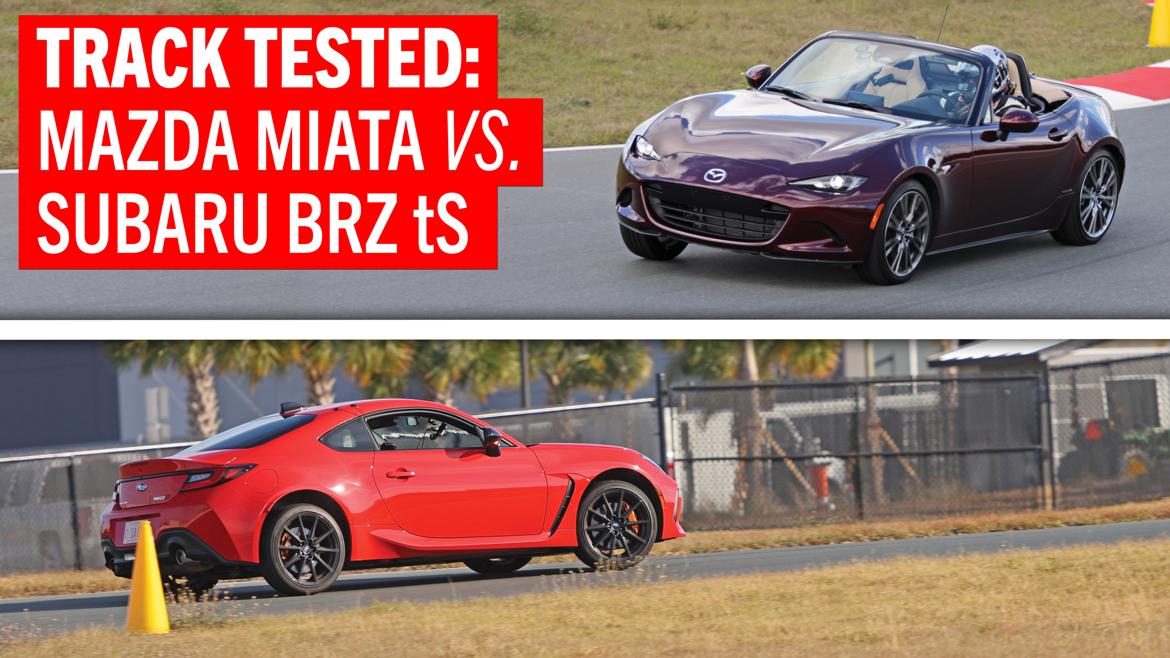
Small, rear-drive cars that don’t cost a mint are becoming a dead language. No more Nissan 240SX, no more rear-drive Corolla, no more Pontiac Solstice. Camaro? Dead as well. And have you priced a BMW lately?
We’re kind of left with a two-car battle in the space: Mazda with the now decade-old ND-chassis MX-5 and Toyota and …
Not Much Introduction Needed
Photograph by Chris Tropea
At a little over 2300 pounds, our test MX-5 is what it’s always been: an homage to the basic sports cars of yore, one that leverages modern technology without breaking its tight link to the past.
Even though it has only 181 horsepower on tap, the MX-5 punches above its weight class. Credit the six-speed manual transmission, limited-slip diff, well-balanced chassis and light fighting weight. It’s nimble.
Our test car is something a bit more special than the usual: a Miata 35th Anniversary Edition, meaning it wears the Bilstein dampers from the Club Package, today’s top-performing Miata, but not the larger Brembo brakes often paired with them.
Photograph by Tom Suddard
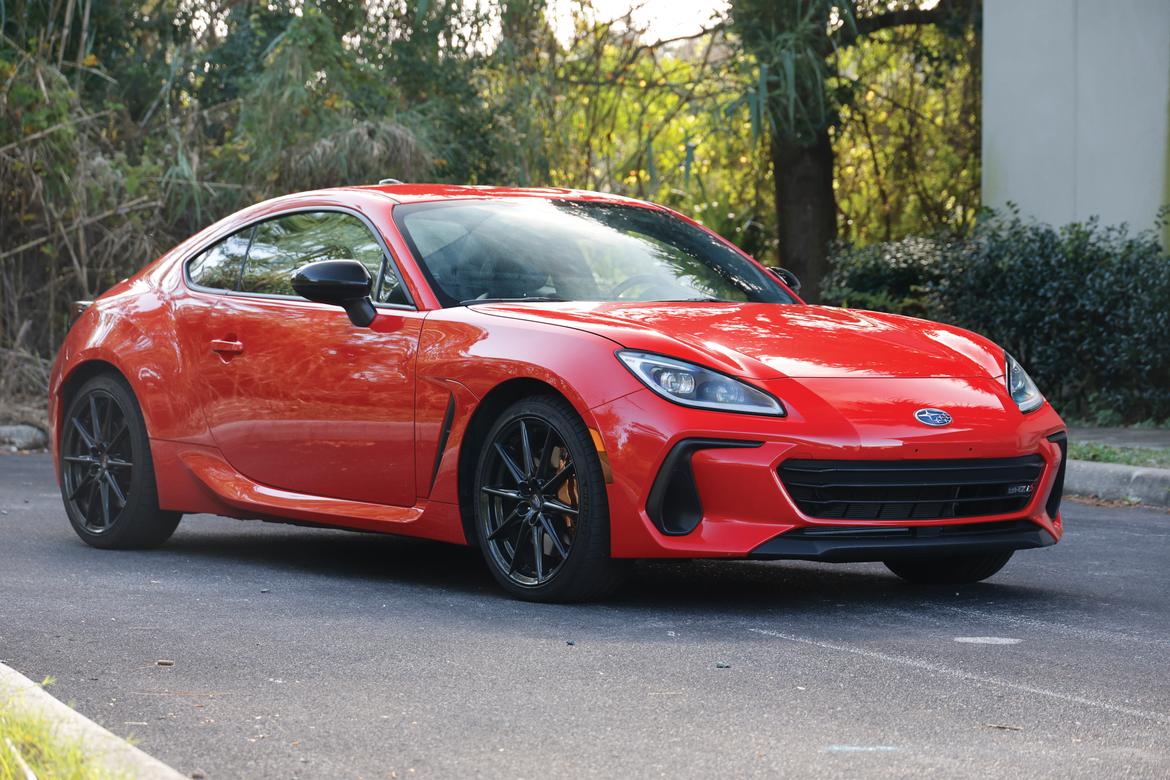
The Subaru BRZ recalls 2+2 coupes of the ’80s and ’90s–like the Nissan 240SX, Hachi-Roku Corolla and Mitsubishi Starion variants. The BRZ carries 500+ additional pounds over the Miata, but it also makes 45 more horsepower.
We sampled Subaru’s sportiest BRZ variant, the tS. The big upgrades include a substantial set of Brembos–the Subaru’s 12.83-inch-diameter front rotors tower over the Miata’s by more than 2 inches–plus Sachs dampers. The Torsen diff comes standard on the two different BRZ trims. The BRZ tS represents more car on paper than the Miata, but the whole point of the Miata’s existence has long been to do more with less.
Price for these two? Pretty close. As delivered, figure $36,250 for the special Miata and $38,360 for the BRZ tS. Looking to spend less? You can get into a base Miata for $30,430, while the Subaru starts at $35,860.
Time to Hit the Track
Let’s not get too wrapped up in lap times here. While that sounds like something someone with bad lap times would say, there are some real reasons behind this asterisk.
While we tested both cars on the fresh, smooth asphalt of Circuit Florida–a new, challenging track found just west of Orlando–that excellent surface and the predictability that comes with it does nothing to make up for the Miata’s power deficit. The Mazda also gives up some grip: It wears a set of 215mm Bridgestone Potenza S001 tires, while the Subaru wears grippier 225mm Michelin Pilot Sport 4 rubber.
This might sound like a bit of an apples-and-oranges comparo, but the VBox data should provide some insight into the driving experience.
Was it close? The BRZ outran the MX-5 by nearly 3 seconds around Circuit Florida. It’s a significant difference, and as expected, blame the differences in power and grip.
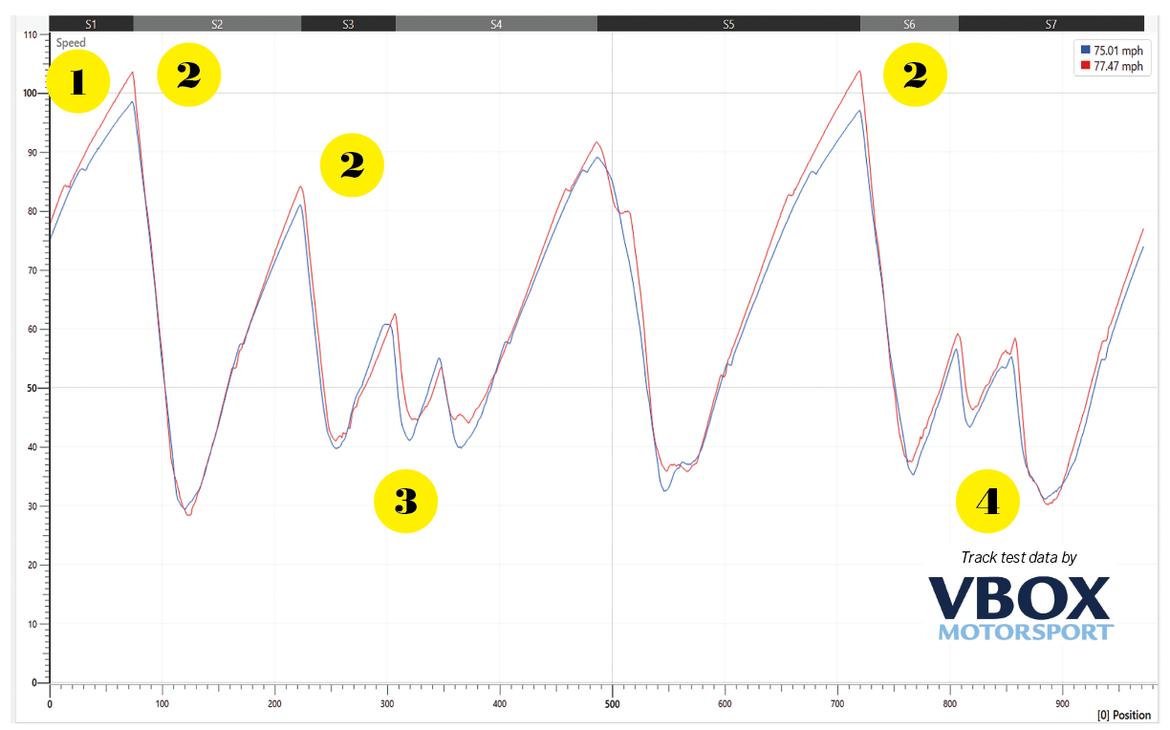
1. As early as the end of the long first straight, you can see how it’s going to be an uphill battle for the lower-powered MX-5, particularly after both cars make the 3-4 shift. The MX-5 (blue trace) drops off in acceleration rate while the BRZ’s red trace is still pulling strong. 2. Despite having the base brakes, the Mazda does produce some nice, sharp brake initiations along with a good deceleration rate. By the final hard stop, though, you can see the braking trace shallowing out compared to the BRZ’s red trace–a sign that those small brakes could be fading a bit due to thermal load. 3. Through the middle section of Circuit Florida, the BRZ bolsters its lead thanks to its superior grip in the corners and quicker reactions. 4. The MX-5 does excel in the tight stuff, though, like the final hairpin before the start/finish line. As soon as it’s time to hit the gas, though, bye-bye, BRZ.
The biggest surprise revealed by the VBox Circuit Tools: The BRZ constantly–and we mean constantly–pulls away from the MX-5. We usually see a stairstep graph where one car uses its power advantage to outrun the other down the straights but allowing the gap to close in the corners. This time, though, the BRZ also does a nice job through the twisties.
The combined g graph–which basically shows both the lateral and longitudinal g-forces–simply shows a couple of steeper gains for the Subaru as it uses its superior grip and power to do multiple things at once.
In Circuit Florida’s center twisties, for example, the BRZ simply shines through the multiple fast transitions and elevation changes. This also kind of points out the Miata’s glaring weaknesses in stock form: its chassis softness and body roll. And this was with the upgraded dampers.
The Mazda produces some good cornering numbers despite its narrower and less grippy tires, but it does take longer to get into the corner and take a set due to that softness. The MX-5 communicates clearly, though, and has excellent steering feedback and load, but it feels like the chassis is reacting in slow motion compared to the sharper, more immediate response of the BRZ.
Circuit Florida’s downhill, left-hand Turn 8 dramatically captures this difference. The lateral g graph shows both cars exceeding 1g through the corner, but the BRZ quickly gets up to the limit; the Miata has to creep up on the side load so as not to overwhelm the tires too quickly.
The kink into Turn 10 shows another great example of the BRZ’s ability to multitask, while the MX-5 needs some time to settle. The BRZ is able to negotiate the kink before the braking zone at a steady speed, while the MX-5 needs to start bleeding speed earlier, even using the kink as part of the braking zone so it doesn’t overload the tires before the hard braking and turn-in for the right-hand entry into Turn 10.
Under braking, both cars produce some excellent numbers, which is particularly impressive for the MX-5 considering it’s equipped with the fairly small base brake package. While this package doesn’t have the thermal reserve found in the optional Brembos–it was showing serious signs of fade after just a lap and a half–the feedback, feel and bite are exceptional.
Until those brakes overheat, which is quickly, they work like a charm for both deceleration and corner entry, allowing you to set the front and rear axles with exactly the slip angle you’re looking for. The MX-5 can still dance, it just dances slowly with that soft stock suspension.
Not-So-Hard Facts
By the numbers, it’s clear the Subaru has made strides in closing the gap toward affordable sports car dominance. Ergonomically, the BRZ easily outclasses the MX-5 thanks to more elbow room, a better seating position–the Mazda’s seat sits far too high off the deck and puts the wheel in your lap–and excellent sight lines.
The Subaru’s wheel/seat/pedal/shifter relationship is every bit as good as anything else out there today, and even taller drivers can comfortably wear a helmet and maintain a reasonable seating position without having to recline more than necessary.
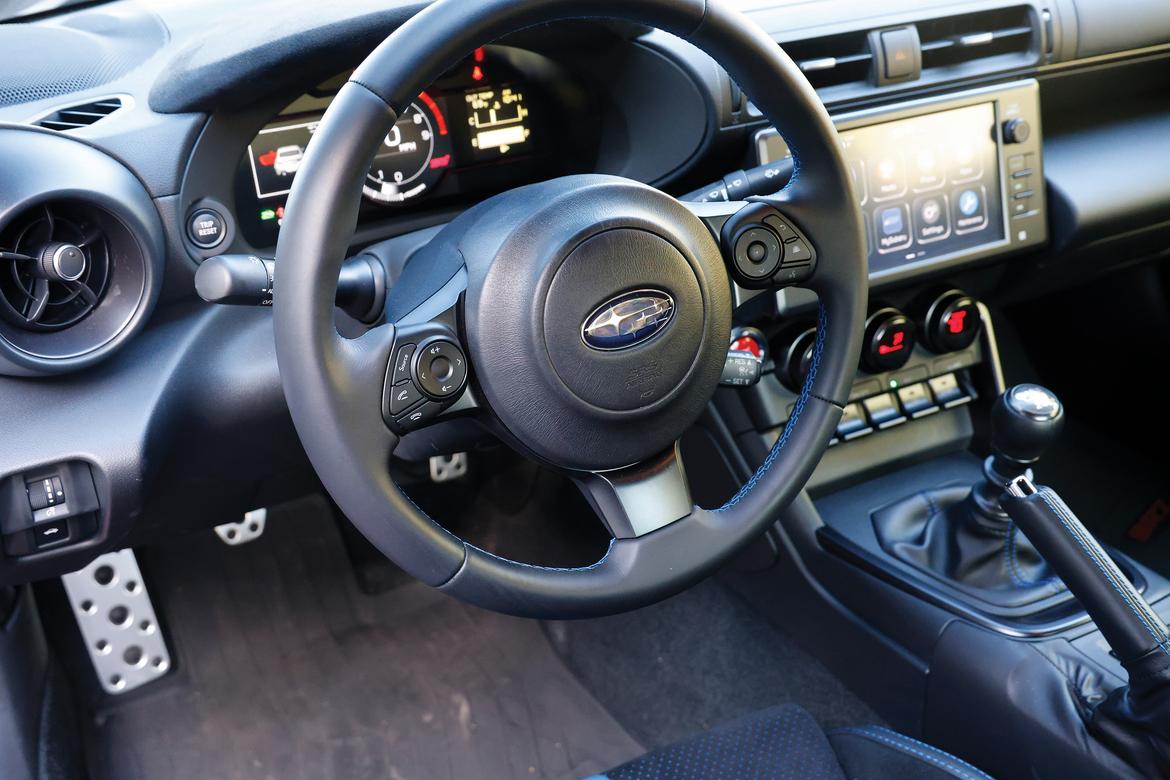
How do two longtime rear-drive favorites compare? We found the Subaru’s cockpit more comfortable and appreciated its lower seating position. Photograph by Chris Tropea.
Of course, the Miata has never had helmet room issues, given that you have the entire sky to swallow your head, no matter how small or large it may be. The top-down aspect is still the MX-5’s killer app, and dropping or raising the top is easily accomplished with one hand and no need to ever leave the driver’s seat.
The Subaru also gets rear seats–tiny and cramped as they may be–and trunk space that can open into the cabin once those rear seats are folded down. It’s a real car that can be used for real things 365 days a year.

Photograph by Chris Tropea.
And look, plenty of you reading this right now use Miatas as your sole means of transport, and we get that that’s a thing. It can be done. We’ve done it, too. But if practicality is involved at all in your decision between these two cars, there’s a clear winner in that category, and it rhymes with “Blubaru.”
But the “winner” of this comparison is less clear. Yes, the BRZ–particular in tS trim–is an exceptionally track-capable car right off the showroom floor. Those 12.8-inch front rotors plus Brembo calipers and Sachs dampers see to that nicely.
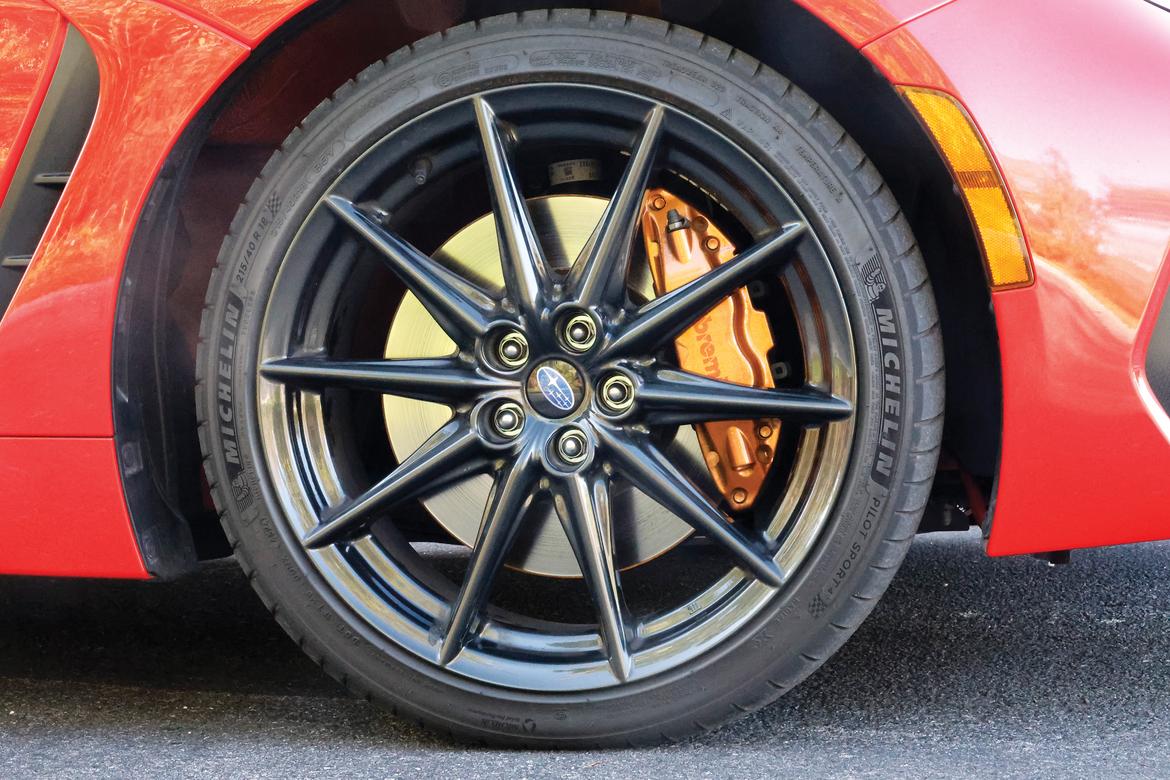
Photograph by Chris Tropea.
But beyond the specs, the BRZ just presents well. Its limits are exploitable, the driving position is world class, and it has enough power to make the throttle a serious option when balancing the chassis in corners–or even just honing it a bit.
The Miata is … the Miata. There’s a reason it’s been The Answer® for years, if not decades, and the fact that our test car carries a 35th Anniversary badge means that Mazda captured some magic when it unleashed this formula on the masses–and the masses were quick to embrace it.
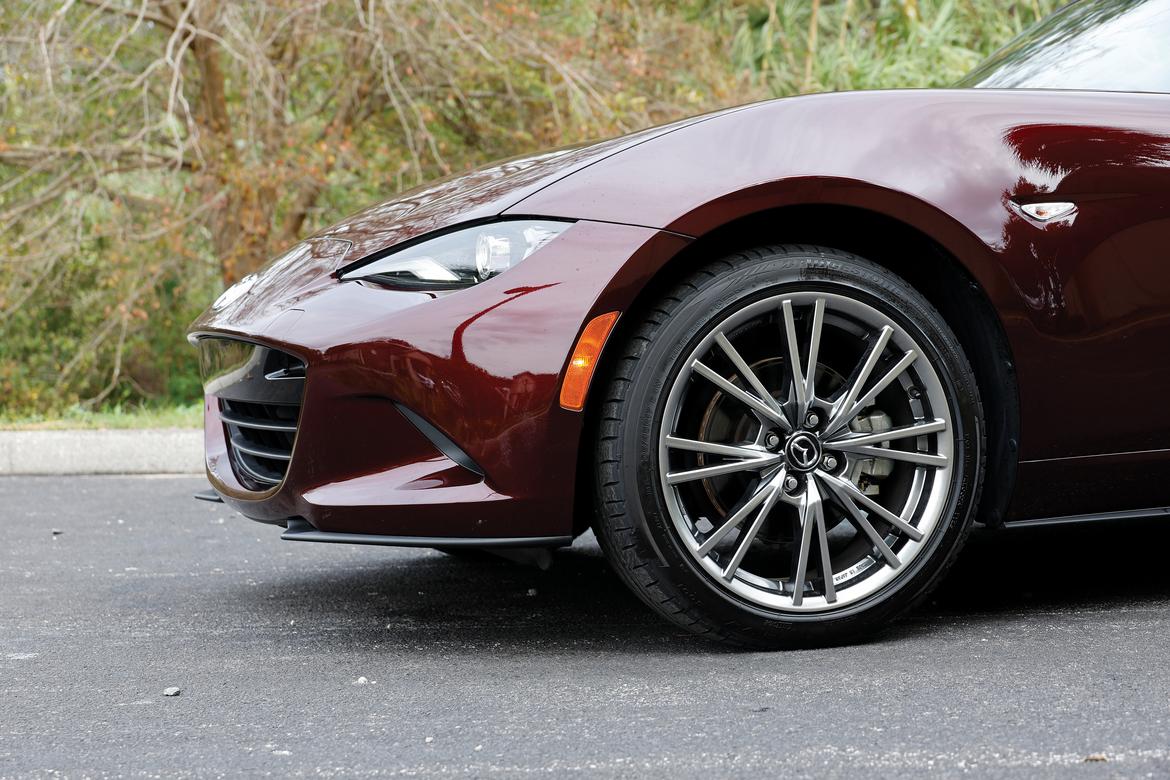
What lets the MX-5 down? Three things that could be improved in the shop: the less grippy tires, the power deficit and the soft, soft suspension. Photograph by Chris Tropea.
Still, these are both niche cars. Mazda sold fewer than 9000 Miatas in 2025, and Toyota and Subaru combined sold nearly 13,000 coupes during that same period. Those are not exactly Camry numbers, so if you’re wondering why we’ve transitioned from a crowded market full of accessible sports cars and sports coupes to full niche appeal in just a couple decades, there’s your answer.
So the real winner here is us. We get to celebrate that the last remaining examples of this format just happen to be excellent and not carryovers running out the clock. Wow, that’s a super huge cop-out, isn’t it?
Okay, look, we love Miatas. We own Miatas. Our entire world is based on the fact that the Miata is awesome.
But golly, this BRZ/GR86, particularly in its factory-upgraded form, is just an exceptional car really pushes the envelope of what a mass-market car company can deliver for around $40,000.
It’s an exceptional package that really challenges the king of the small-sports-car hill to be an answer of its own–an answer that provides real utility and practicality along with no-compromise sportiness.
Mazda is due to freshen the MX-5 any day now. We’re expecting a serious look at the next generation by summer of ’26. With as good as its competition is, it’s time for Mazda to reassert itself as the answer if it wants to keep up.