
This short article is derived from Strength Training For Golf – The Fit For Golf Guide. That article goes into detail on everything you need to know about strength training for golf. In this shorter piece, I am providing theoretical knowledge about exactly what happens as a result of strength training.
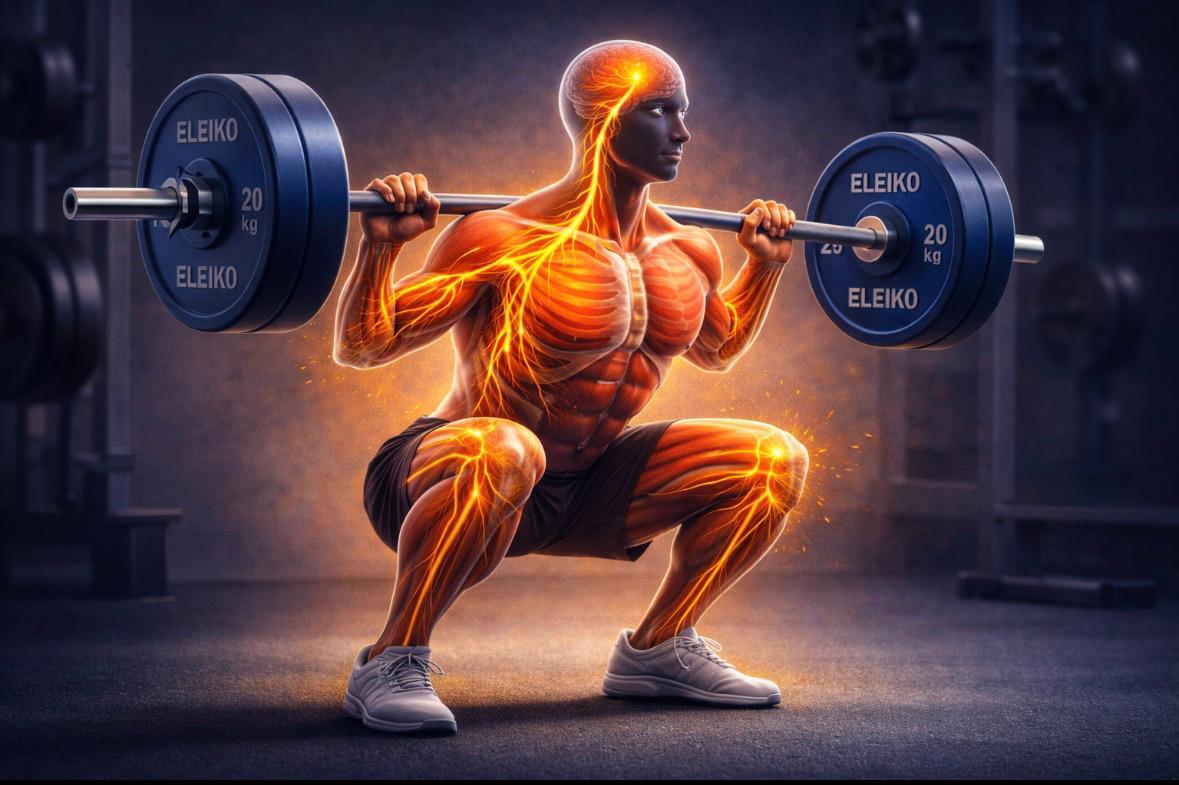
Strength training works by stimulating adaptations in the neuromuscular system. The neuromuscular system is made up of the nervous system and the muscular system.
Neural and Structural Adaptations
Neural and Structural Adaptations
These neuromuscular adaptations can be grouped into two main types:
Neural adaptations – how the nervous system sends signals to the muscles.
Structural adaptations – physical changes in the muscles and connective tissues.
← Swipe to view the whole table →
| Adaptation Type | Specific Adaptation | Explanation | Transfer to Club Head Speed |
| Neural | Increased Fast Twitch Motor Unit Recruitment | Learning to activate a higher percentage of fast twitch muscle fibers. | High – recruiting more fast twitch fibers means more potential for speed. |
| Neural | Rate coding (firing frequency) | The nervous system increases the speed and coordination of signals sent to muscle fibers. Needs explosive intent in reps for maximum benefit. | High – faster firing improves how quickly force can be produced. |
| Neural | Intermuscular coordination | Different muscles involved in a movement work together more efficiently and in the correct sequence. | Low – largely limited to the trained movement pattern and velocity. |
| Structural | Type IIa (fast twitch) fiber hypertrophy | Increases in the size of the fast twitch fibers responsible for high force and velocity. | High – bigger fast twitch fibers produce more force and power. |
| Structural | Tendon stiffness | Stronger tendons can store and release elastic energy more effectively. | Low – the golf swing is more muscle-driven than tendon-driven. |
| Structural | Fiber type shift (IIx ↔ IIa) | Strength training tends to convert our fastest twitch fibers IIx to slightly slower IIa fibers. | Moderate – training style matters; larger IIa size may offset IIx loss. |
Neural adaptations from strength training improve the signals we send from the brain to our muscles. This is an untapped source of strength potential that can be improved rapidly, and can lead to improvements in strength, power, and speed, without any changes in the actual muscle tissue.
Structural adaptations from strength training lead to changes in muscle and connective tissue that allow us to increase force production. A classic and relevant example is an increase in the size, our cross sectional area of the fast twitch (type IIa), muscle fibers.
While this article focuses on strength training, I must mention that higher speed training, both in terms of workouts, including, sprints jumps, medicine-ball throws, slams, other explosive lifts and most importantly specific swing speed training, play an enormous role in stimulating these neural and structural adaptations for increasing club head speed.
In the Science of Speed Series I wrote about adaptations that occur as a result of high-speed training.
In my understanding and opinion, there are two key adaptations golfers benefit from most as a result of strength training: Increased Motor Unit Recruitment and increased size of the fast twitch muscle fibers. Improvements in each of these make perfect sense for increasing our ability to generate club head speed.
All progress follows the same process:
Stimulation → Adaptation → Enhanced Capabilities.
The reason I laid out the various adaptations is that I want you to take an “adaptation focused” approach to strength training, rather than an “exercise focused” approach.
Once you understand that it is these adaptations that improve our ability to generate club head speed, the question is no longer “What exercises are best?”, but instead, “What adaptations am I trying to stimulate?” The exercises we choose are important, but completely irrelevant if they do not stimulate adaptation.
As long as the stimulus keeps progressing, the body keeps adapting. When it stops, progress stops too. Unfortunately, many people strength train in a way that leads to little or no adaptation.
If you want to see how these concepts are applied to designing training programs, and learn more about strength training for golf, check out my most comprehensive article on the subject, Strength Training For Golf – The Fit For Golf Guide.