
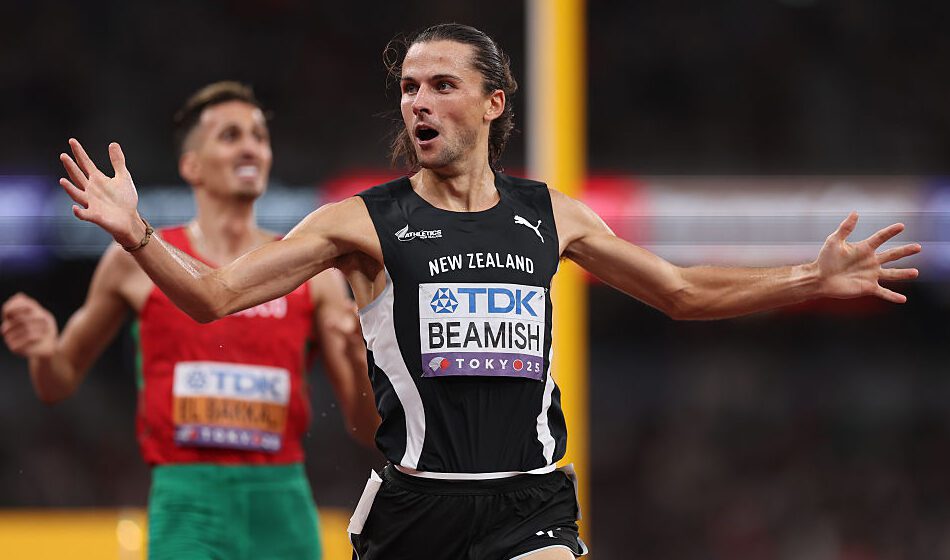
The 3000m steeplechaser on about striking gold, getting his timing right and why he finds it helpful to take a bird’s eye view of athletics.
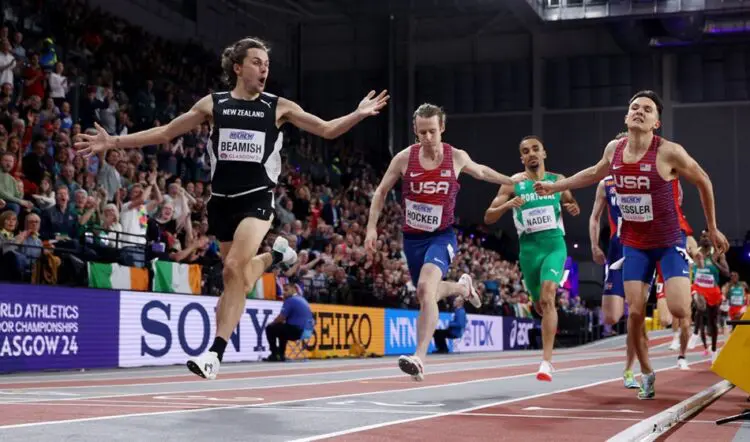
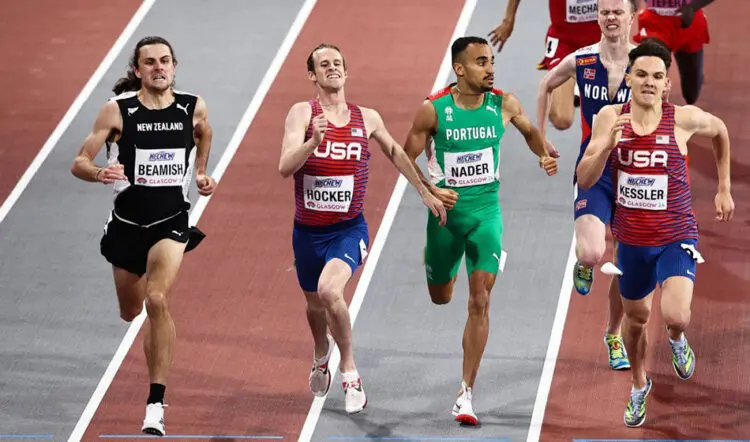
When Geordie Beamish is involved, more often than not the race is worth watching. Take the men’s 1500m final at the 2024 World Indoor Championships in Glasgow as our first example. Coming off the final bend, he sat fifth as Hobbs Kessler, Isaac Nader and Cole Hocker looked set to fight it out for the medals. Yet the New Zealander engaged what has become a trademark kick (it has its own name), flying down the outside to seize a dramatic victory.
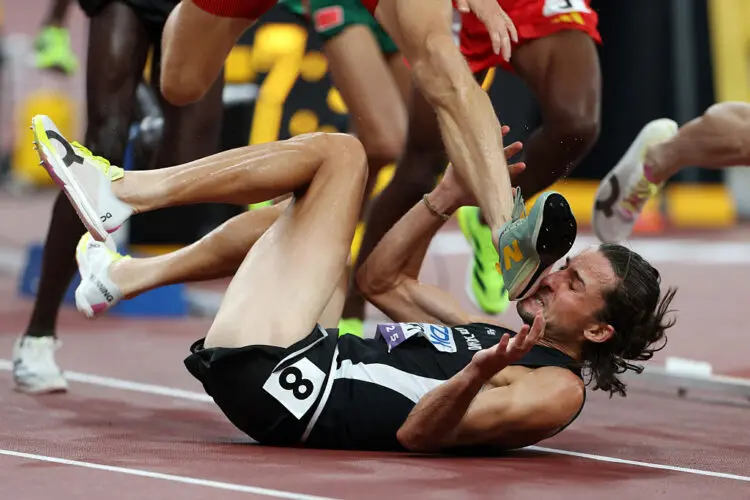
Fast forward to last year’s outdoor world championships in Tokyo and he was in the thick of the action again. This time, it was the qualifying heats of the 3000m steeplechase where he came to the crowd’s attention and became the subject of an extraordinary photograph after falling in the closing stages of the race. Having cleared a hurdle, Beamish hit the deck, the spike of Canada’s Jean-Simon Desgagnes grazing his face mid-tumble. There was no hint of panic, however, as he got to his feet, closed the gap and secured his “safe” passage with a wide grin on his face.
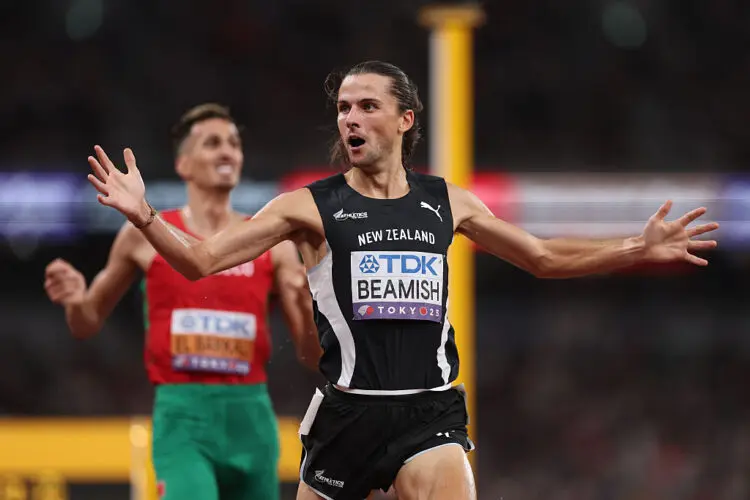
The final itself was even more eventful. In his report for athleticsweekly.com from the evening of September 15, my colleague Jason Henderson described the 29-year-old’s performance: “Approaching the bell, he was in 11th place and seemingly out of contention. Yet he moved into eighth down the back straight, then fourth at the final water jump and, into the home straight, he still had to get past Soufiane El Bakkali, the two-time Olympic and two-time world champion from Morocco.
“Beamish didn’t take the final hurdle perfectly but once he gets into sprint finish mode he is unstoppable. Surging past El Bakkali, he stormed to a brilliantly unexpected gold. It was, as keen track fans might say, a genuine ‘from the depths of hell’ moment.”
In a championships crammed with unforgettable finishes, here was a final flourish that truly stood out.
“I seem to have found a bit of a knack for timing it right, at least sometimes,” smiles Beamish in rather understated fashion, as he reflects on it all with AW from his training camp in Phoenix, Arizona. “It’s not going to work every time but hopefully that’s also what people will want to watch me race for – just to see if it might work this time. I’d love to leave a bit of a legacy for being someone that people look forward to seeing out on the track, just knowing that something might happen.”
If he has his way, there will be plenty of chances to see him in action in 2026. At the time of writing, Beamish was due to open his year over two miles alongside Jake Wightman and Josh Kerr at the Millrose Games in New York, while a crack at 3000m gold at next month’s world indoors is his “Plan A”.
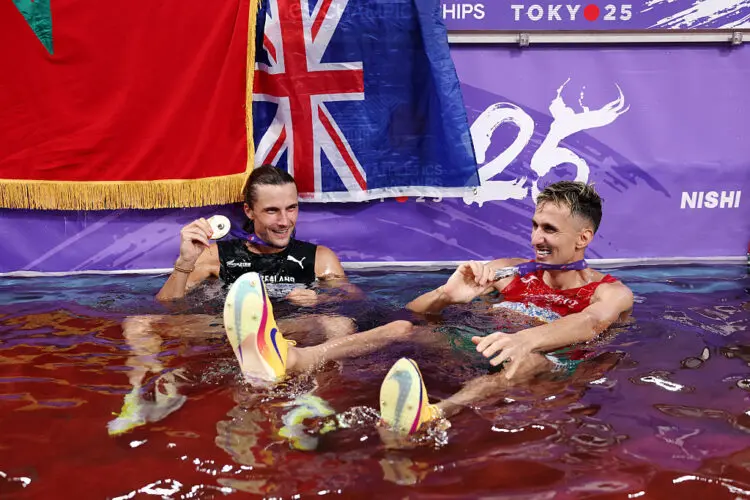
“I’ll just see how many different events I can win a world title in,” he laughs. But there’s more.
“The mile at the Commonwealth Games is not out of the picture. I’ve got some good memories from Glasgow so I’d love to go back. The schedule looks like it would be conducive to a steeplechase/mile double, so that’s in the back of my mind. I could have a crack at something like that.
“Copenhagen [the world road racing championships] at the end of the year also seems like a fun thing to close out the season, and it’s probably a good year to have a crack at a properly fast steeple. It’s a fun year for some different stuff.”
That feeling of being able to experiment even more freely is further accentuated by the fact that the 3000m steeplechase is not one of the events included for World Athletics’ Ultimate Championships, the new three-day extravaganza that will bring the season to a close in Budapest.
“I’m not taking it personally,” says the Oceania record-holder, whose best is 8:09.64 from 2024. “Too many people have told me that the steeple was one of their favourite races from Tokyo. Too many people have said it was good enough and entertaining enough that there’s definitely a place for it [in the Ultimate Champs]. But obviously this is a new event and it sounds like the host country has quite a say in what they put on. I hope the event is a success and maybe we’ll see [the steeplechase included] down the line.”
More performances like the one Beamish produced in Japan certainly wouldn’t harm the cause. To dethrone an athlete like El Bakkali is no mean feat in the first place, but it becomes all the more remarkable when you consider it was done by an athlete who only really began learning the event in the spring of 2023. Struggling to get what he wanted out of either the 1500m or 5000m, he was nudged in a different direction by his coach at On Athletics Club (OAC), Dathan Ritzenhein.
“Watching my skill set and the way I run, he said: ‘I think you could steeple’,” says Beamish. “That wasn’t the first time I’d been told that I looked like I could jump over things. I bounce a lot when I run. It’s probably pretty inefficient, but it’s good for jumping over things, but I hadn’t been able to stay healthy long enough to consider it, to add that extra risk or the extra bit of training that it required to become a steeplechaser.
“It just hadn’t really been realistic until a couple of years working with Dathan and finding a bit more consistency. [I was also] finding some frustration and trying to run the 5000m in the middle of summer was just something I was not enjoying. It was similar with the 1500m and I was kind of stuck between the two events. Neither were going as well as I thought they could and so we thought 2023 was the year to try it.”
There was, Beamish discovered, a lot to learn.
“I think the biggest adjustment is the mental part of running up to a barrier and jumping it smoothly,” he says. “I honestly think that the steeplechase is way more about rhythm than it is about hurdle technique. If you can’t sight the barrier and run at it without stuttering, it doesn’t matter how good your hurdle form is.
“Learning how to run smoothly into a barrier and clear it, no matter what leg comes up, then run out of it is, I think, the biggest challenge to being good at the steeple. That didn’t click immediately.”
He adds: “I’ve always been someone that thrived on learning something new and challenging myself like that. It was frustrating for a while just being bad at something. Honestly, after a long time in the sport, I was suddenly just really bad at a new skill, which was a frustrating experience. There were moments where I was like: ‘Am I cut out for this or not?’, but I stuck with it and I just had to get through a couple of months of that before it started to click.”
Beamish made a more than encouraging start, placing fifth in the 2023 world championships final in Budapest, and was supported through the process by Ritzenhein, not to mention his OAC team-mates. Having first moved to the US to take up a college scholarship in Arizona, in 2021 the New Zealander was one of the first intake in the then brand new group based in Colorado.
“We’ve had some really great results and had some really tough ones as well together,” says Beamish, who hosts the Coffee Club podcast with fellow OAC athletes Ollie Hoare and Morgan McDonald. “Dathan is a coach that feels all of that.”
The path to a second global gold certainly wasn’t a straight line. After that indoor success in 2024, Beamish struggled with various injuries in the lead-up to the Paris Olympics, where he failed to make it beyond the heats. His build-up to Tokyo was hampered, too, this time by an ankle issue and a stress reaction in his femur that put him in a race against time to be ready.
“We’ve created a relationship where we can have harder conversations and bring stuff up that either of us feels needs to be raised,” he says of working with Ritzenhein. “I think that’s been an important part of learning from the setbacks, and I think that was a really important piece of the two to three months leading up to Tokyo – having a real sit down after that injury and taking a look at some things that we felt we needed to do better. I feel like I can bring stuff to him that I want out of training and he can do the same for me.
“And to have the rest of the team on board, such a solid group of guys to train with, as well as the support of On for the last five years, has been instrumental in my success. Of the original team, I was the last to join and probably the lowest profile signing at the time. To be On’s first indoor world champion and On’s first world outdoor champ as well has been pretty surreal.”
Not that Beamish is showing any signs of being overwhelmed by what has unfolded. He is the most laidback of characters who gives the impression of being able to take everything in his bouncy stride. Ahead of our interview, I watched performance in Tokyo again. Even with the distance of a few months, it still brought goosebumps, so goodness knows what it was like to be the man in the middle, making it all happen. So I ask him. Doing so takes us back to the slow early laps of a race that allowed him to unleash that ferocious kick known as “textbook George”.
“I find myself doing a lot of reacting to what’s going on around me, just because I prefer to leave things late, so that lends itself more to doing as little as possible, at least in the first half the race,” he says. “I’m not going to do something that’s going to shock anyone in the first few laps – that’s just not conducive to how I want to win races.
“But I have this technique, in some of those races where it is slower, of mentally trying to take a bird’s eye view of the race while you’re in it. I find that, if you visualise everything close to you, the hurdles feel close and it feels stressful when people are right around you. But if I can just visualise the whole pack of 10 or 15 people and try to picture the race as a whole, it’s more relaxing in my mind.
“If I’m able to step away from my immediate surroundings, especially in the first two thirds of a race where we’re running that slow, I find I’m able to really relax and not get caught up in what’s happening so close to me. That’s something I’ve used a bit in that kind of race and I find it helpful when you’re on a big stage like that, to make it relaxing and you’re able to enjoy those few laps of the race.”
And what of that closing 400m?
“It’s hard to put myself back in that last lap,” he says. “But I remember the crowd being right on top of us. [Japanese athlete Ryuji] Miura was making moves towards the front and the crowd was loving that. You can feel that on the track and you know what the crowd’s thinking, which is a cool experience.
“I felt surprisingly in control in that last lap, apart from a really bad water jump. And you only get so many shots at a last lap like that. Those opportunities don’t come around very often. It’s not a feeling you can recreate in training or on a day-to-day basis. You just have to remember: ‘This is what we’re doing it for and this is why we’ve been training for this many years’, so [you have to remember] just to enjoy that last bit. That’s part of the race I look for.
“[Championships racing] is like no other part of running and I think it’s why people love watching it. It’s just such a pure expression of racing and something that I think makes athletics pretty special. It’s just instinct at that point.”
There are elements of his time in Japan that Beamish is trying to hold on to.
“I love the culture of respect,” he says. “We have a new OAC gym on the way, so we’ve been saying we’re going to have Japanese rules on indoor shoes in the gym and stuff like that. It was an incredible place to kind of have that kind of experience in.”
His is now a well-known face in the land of the rising sun, while his name is also very much in the conversation when it comes to New Zealand’s distance running greats. There is plenty of time to raise that profile even higher, too.
“I have learned a lot – over the last few years, especially – and I’m enjoying it more than I ever have,” says Beamish. “Part of that might be due to finding a bit of success near the top of the sport but I honestly don’t think that’s all of it. I’ve been able to have a view of training where I can go out and enjoy it without feeling like any one day is going to make or break a year or a week or a month.
“I know what it now takes to be good, and that you don’t have to crush everything all the time. I just have a bit more gratitude towards the sport and I think the skill of running is more important than I ever did. I think it’s an underrated part of running. A huge aerobic system can get you a long way, but I think the skill of running is something that separates the really good people at the top of the sport.”
Beamish, it seems, is planning to stay there.