
It’s official: Oregon lawmakers are pondering the sacrifice of program that makes streets safer for kids to walk and bike to school in order to keep our transportation system above water. A program that builds bike paths with revenue from the $15 tax on new bikes is also on the chopping block, as is the payroll tax that funds public transit statewide. It’s all part of a desperate scramble to fill a $242 million budget hole at the Oregon Department of Transportation that remains unfilled due to legislators’ inability to pass a robust transportation funding package last session and the uncertainty created by a referendum that — if approved by voters — would kill the band-aid measure that did pass.
ODOT has spent years warning these same lawmakers about the fiscal cliff caused by dwindling gas tax revenues and political choices that have tied Oregon to expensive highway projects without a sustainable way to pay for them. And with public opposition to new taxes at an all-time high, lawmakers have put themselves into a very bad position. The talk in the halls of Salem has shifted from which projects to fund to which programs to cut and which positions to keep.
Lawmakers hosted an informational session about the ODOT “budget rebalance” Tuesday at the Joint Committee On Ways and Means Subcommittee On Transportation and Economic Development. At that meeting, they heard a presentation from Interim ODOT Director Lisa Sumption (who’s been on the job just four weeks) and Finance and Budget Division Administrator Daniel Porter about the dreadful choices the agency faces in light of this crisis.
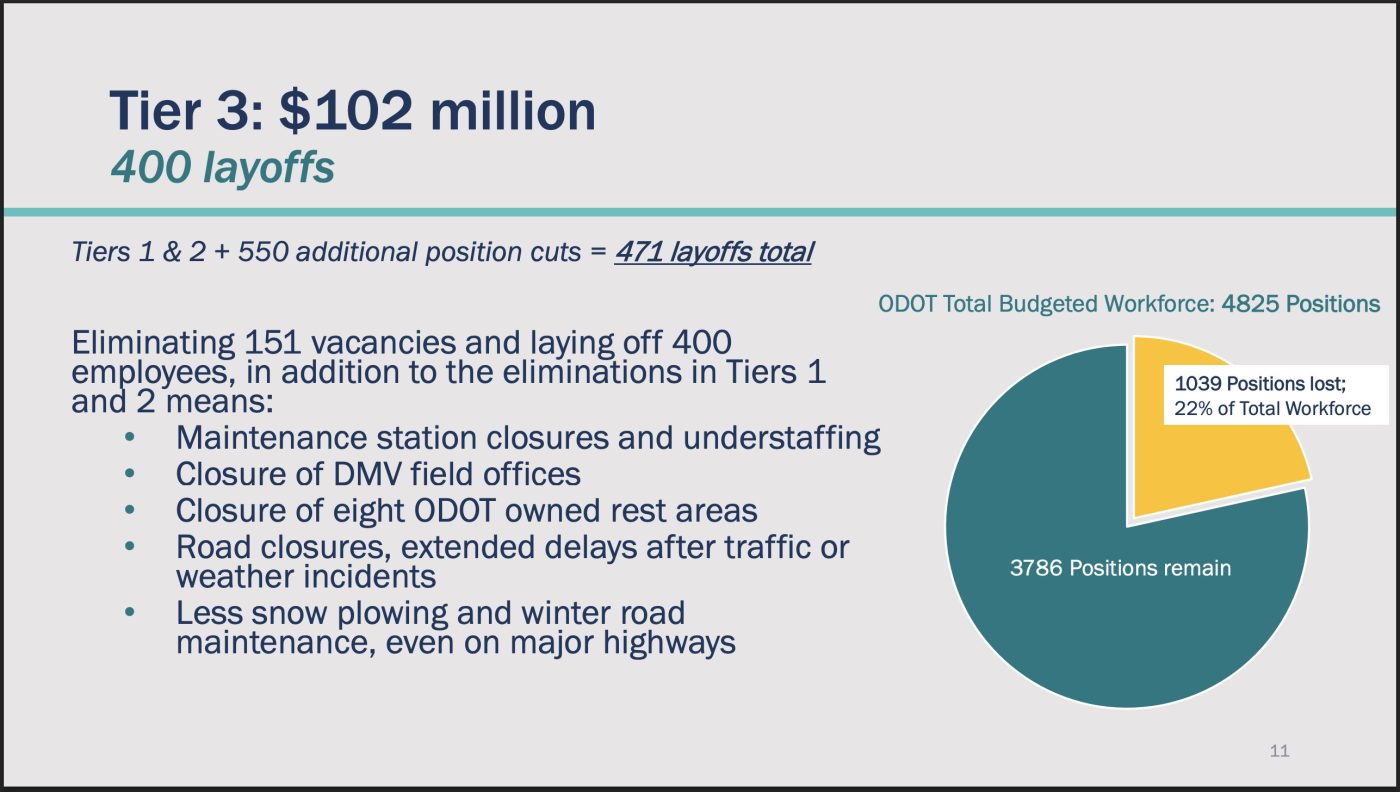
To keep DMVs and maintenance shops open and avoid the ODOT doomsday scenario of bare bones operations that would put road workers and road users at imminent risk, the legislature can either identify new revenue and/or slash funding already dedicated to existing programs. Sumption and Porter shared three tiers of cuts (below) and laid out programs where funds could be redirected to operations and maintenance as a short-term solution.
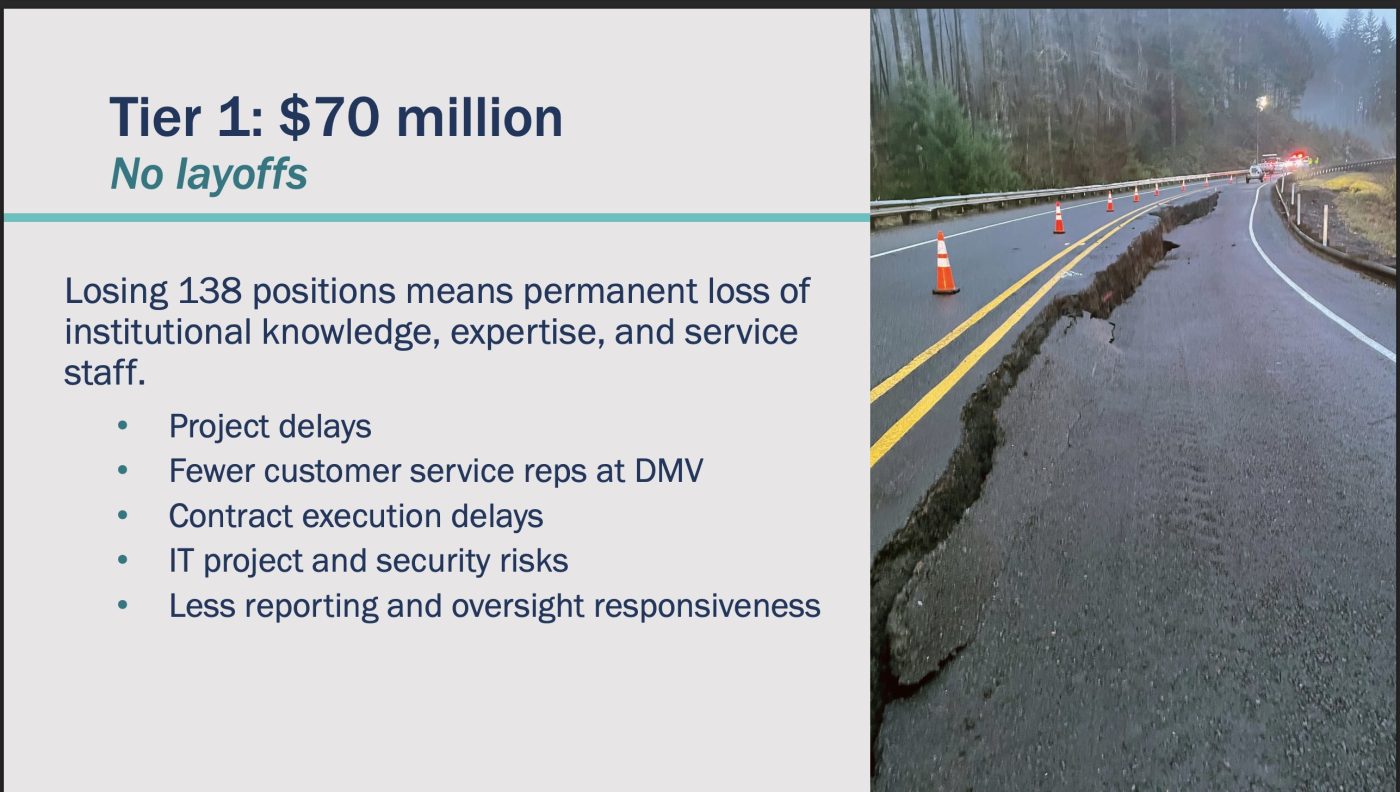
The first tier would avoid the worst case scenario. It counts on the legislature to identify some new revenue and it would allow ODOT to avoid layoffs while still requiring them to cut $70 million and maintain 138 vacant positions.
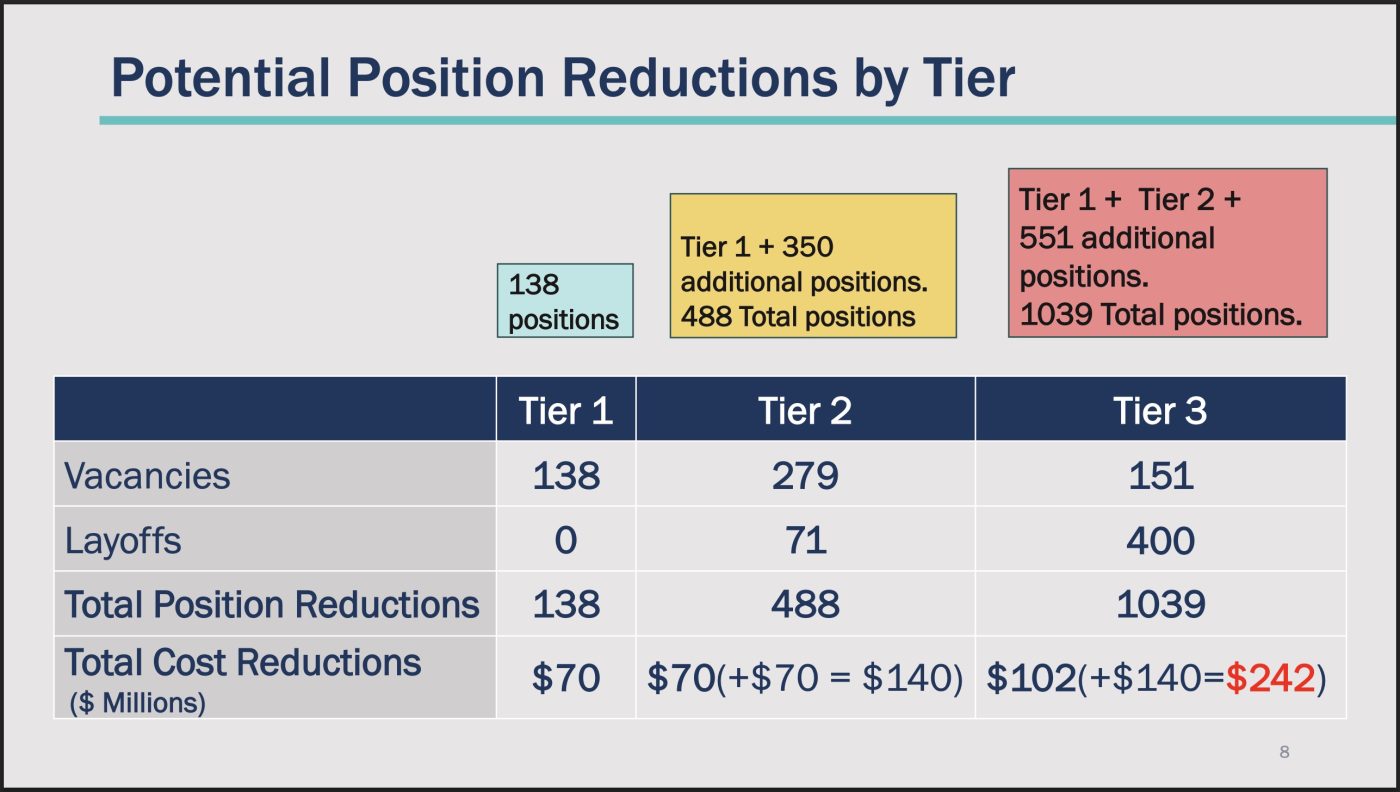
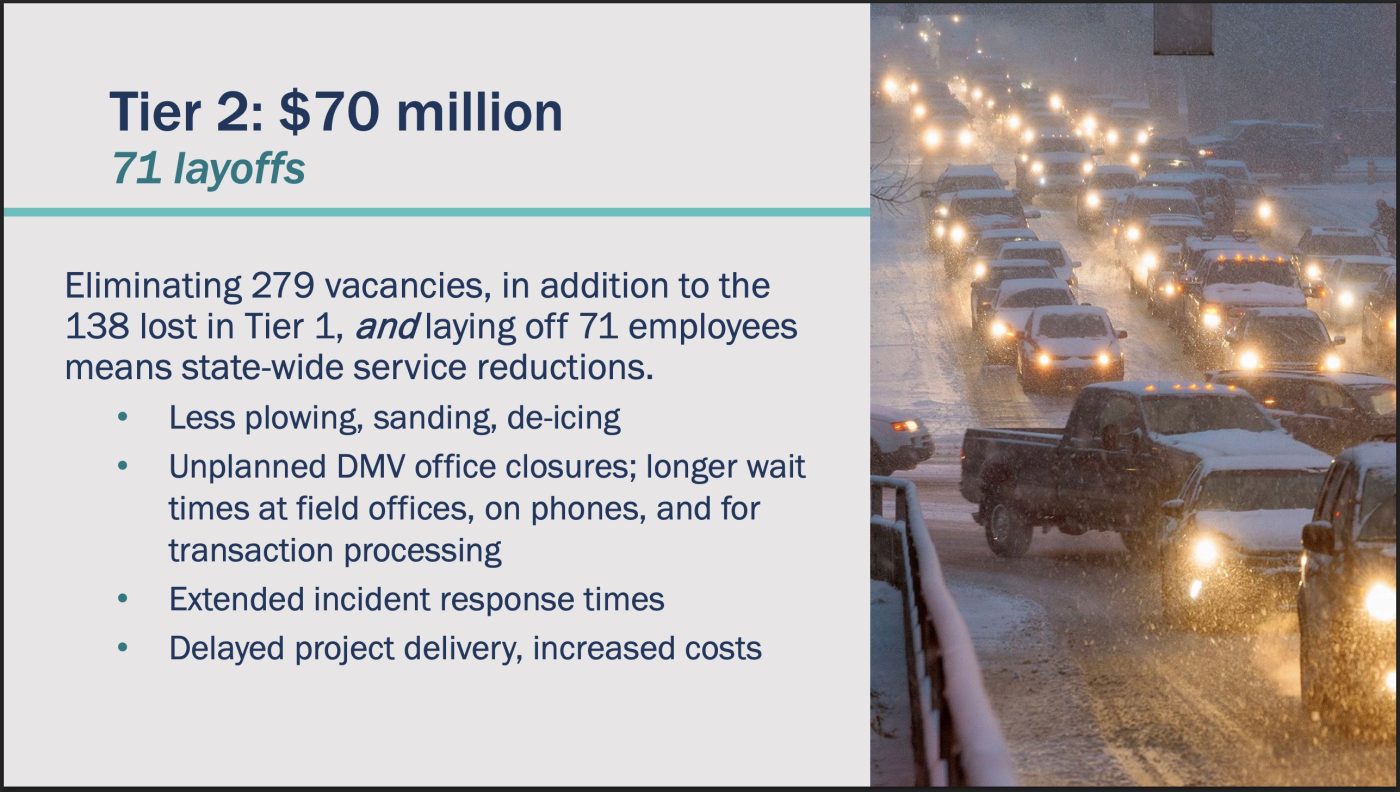
The second tier would add another $70 million in cuts for a total of $140 million. It would require 279 vacant positions and 71 layoffs. (Vacancies are positions that are held just not filled, while layoffs remove the position from the agency completely.)
If no additional revenue is identified, ODOT would move to tier three and layoff 400 people. This option would reduce the total number of staff positions by 1,039 (about 20% of the total workforce) to save $242 million. This level of cuts would, “Have serious impacts to Oregonians as we move throughout the state,” Sumption warned.
The redirection of funds from throughout the bureau is another avenue lawmakers are considering. As I reported last month, Governor Tina Kotek has said everything is on the table, except transit. In documents shared with this committee, ODOT has shared which programs would provide the biggest budget impact. Keep in mind that only unobligated funds are being considered. If a project is already funded or a contract has already been signed, it would still move forward.
Lawmakers could choose to redirect $84 million currently programmed for bridge seismic repairs and/or $85 million major highway projects named in House Bill 2017. The statewide payroll tax that pays for transit is also up for consideration, as is a pot of funding created by the “vehicle privilege tax” created in 2017 that’s paid by car dealerships. Other sources that could be redirected include programs funded through a gas tax on non-highway equipment and vehicles (like lawnmowers). This program funds bike paths and other bike-related projects across the state.
Another possible source of funds that will likely get a lot of attention is the Safe Routes to School program. ODOT currently puts $15 million per year into that fund to make streets around schools safer for walking and biking. Its inclusion in a presentation slide at Tuesday’s meeting makes it a very real possibility that lawmakers will opt to pause all Safe Routes to Schools grants for the coming two years in order to plug this hole in the budget. ODOT says the Safe Routes account currently has $27 million of unobligated funds that could be redirected.
Both redirection of funding and staffing reductions will be difficult choices for legislators. Is it more difficult than passing new taxes and fees? That’s the big question. The disconnect on funding from so many of our legislators (almost all of them Republican) that we can operate a transportation system without charging people a fair price to use it is really coming into focus during this short session.
At one point during Tuesday’s meeting, committee chair and House Rep. David Gomberg asked a DMV employee who came to testify what her experiences have been with customers. “There’s a lot of confusion,” the eight year DMV veteran shared. The rest of her response really stuck with me and helps illustrate why we are at this precipice:
“I understand Oregonians don’t want to increase taxes. At the same time, they’ll tell us that we’re doing an amazing job and that they can’t believe that they were able to be helped with such friendly faces. So it’s a tale of two different things from the same person. I literally had a person both ask me if they could work for us because we’re so amazing, while also saying that they love that they don’t have to pay any higher registration fees and that they were signing the [no gas tax] referendum.”
The short session is in full swing. I’m tracking several bills with major implications for ODOT’s future. See them here and stay tuned for more coverage.