
Updated in January 2026 to cover the new Cobalt Q6 M and provide updated market comparisons.
There have been so many new rangefinders coming out these days, it’s hard to keep up with them all.
And with Bushnell being a little bit slow to come out with any new devices, much of the hype has come from some of the eager upstarts in the budget to mid-tier price range like Precision Pro and Voice Caddie.
But there are a handful of companies on the higher end of the market that have been making rangefinders for years, that you probably aren’t hearing as much about in your Instagram feed.
Cobalt Golf is a great example of this.
They’ve been making rangefinders for 25 years, and considering they’re at a higher price point, with a lower marketing budget, you just don’t hear about them as much.
But I’ve had the opportunity to use both the original Cobalt Q6 Slope and now the updated Q6 M extensively over the past few years.
And you know what? I remain impressed.
Very, very impressed.
What makes it so good? Let’s take a look and find out.
First Impressions of the Cobalt Q6 M Slope
One of the hallmarks of my golf rangefinder reviews lately has been to talk about presentation and packaging – because I really do think it can make a difference in the experience and perception of a product.
Some of the newer brands have really upped their presentation game for devices costing well under $300.
Well the Cobalt Q6 M Slope plays in a different market with a price of $450.
So I was a bit surprised when I opened up the shipping box to find packaging that was pretty unimpressive compared to many of the competitors in the market.
A basic sleeve slipped over some cardboard packaging, that doesn’t necessarily scream high-end product.
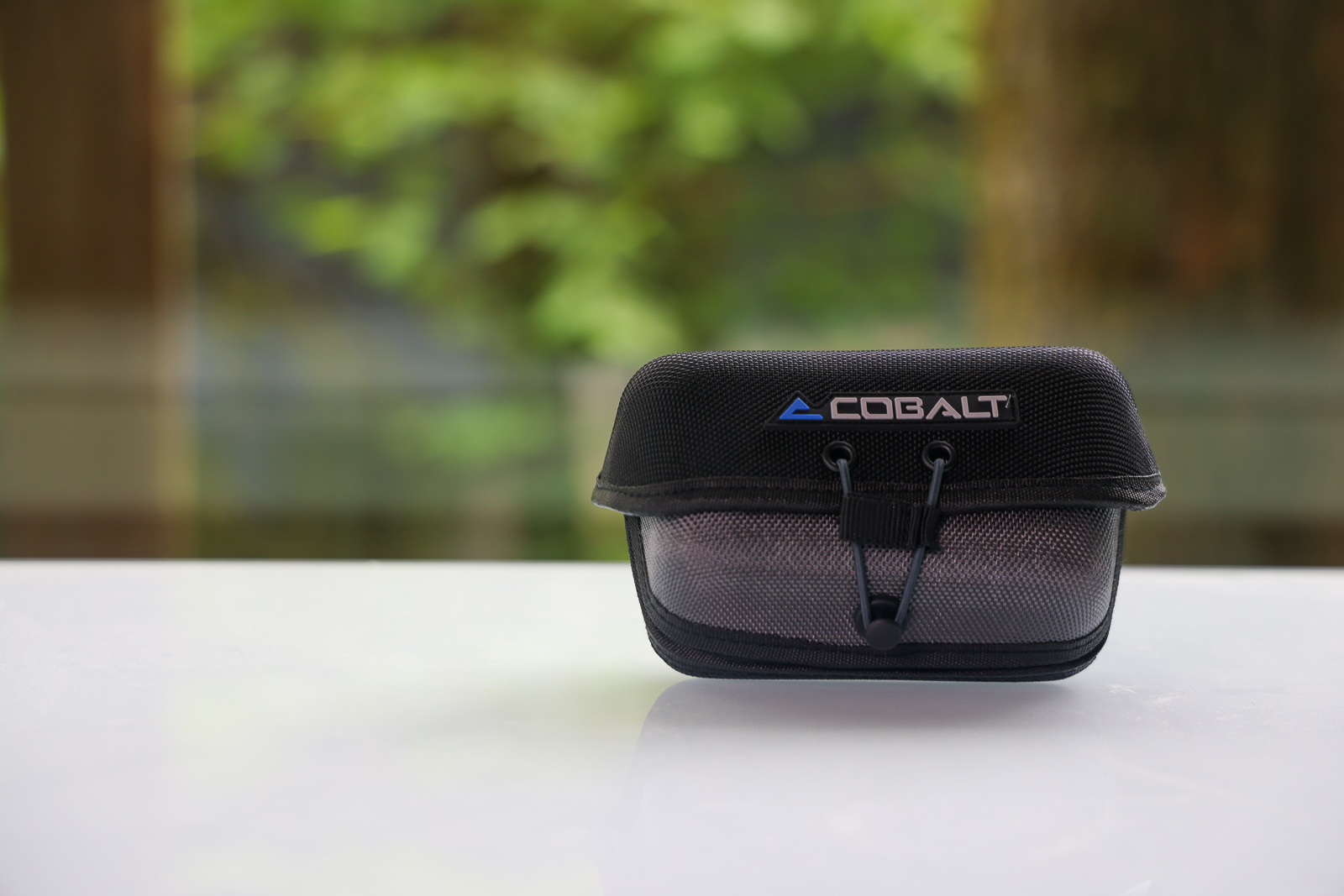
Inside is the Q6 M device, a case, some instructions, and a microfiber towel.
Nothing out of the ordinary, and while the case is well done and a nice upgrade from a standard rangefinder case – you won’t be overly wowed by the presentation of it all.

But you know what is special?
The device itself.
From the second you pick it up, you can tell this thing is a step up from most rangefinders on the market.
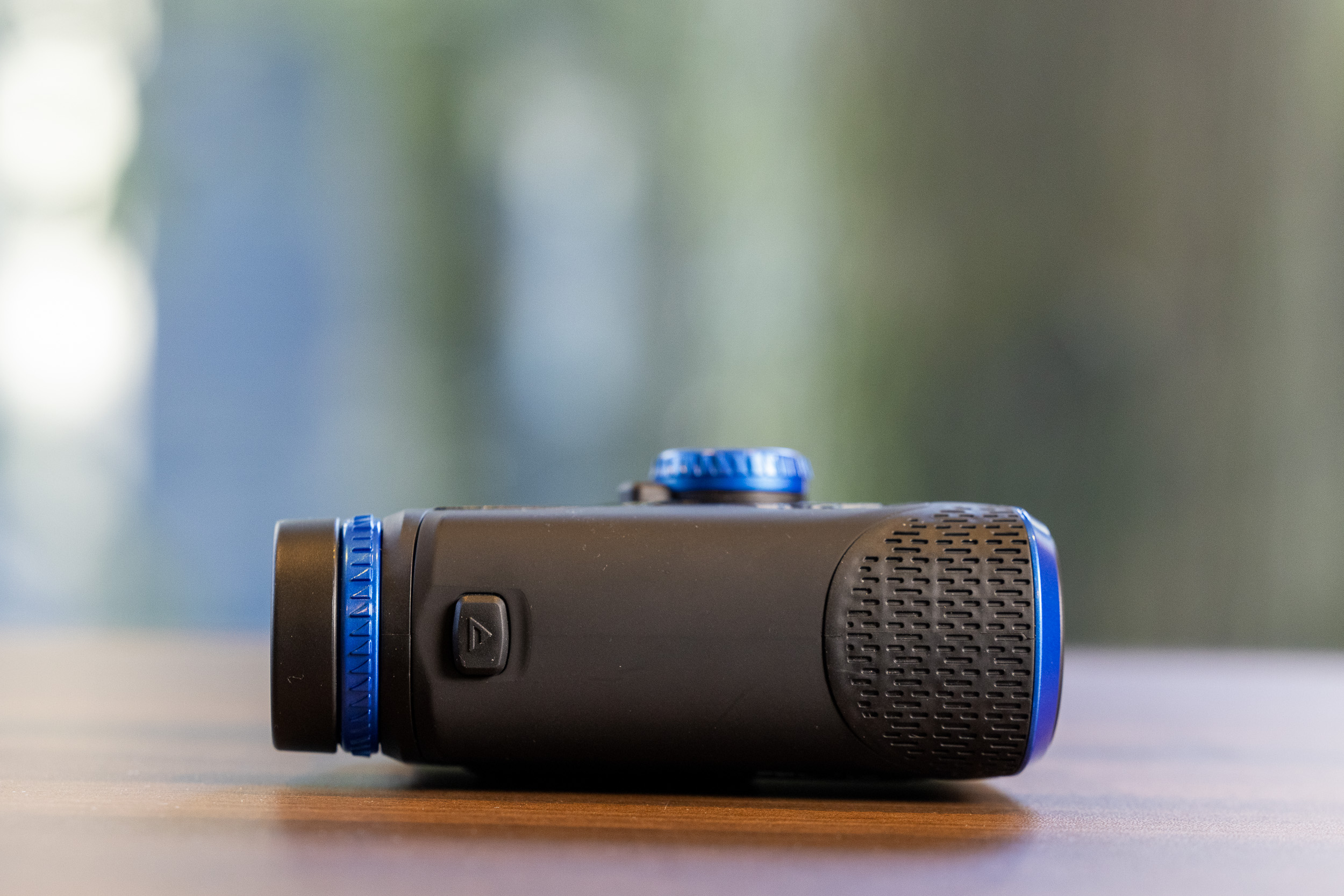
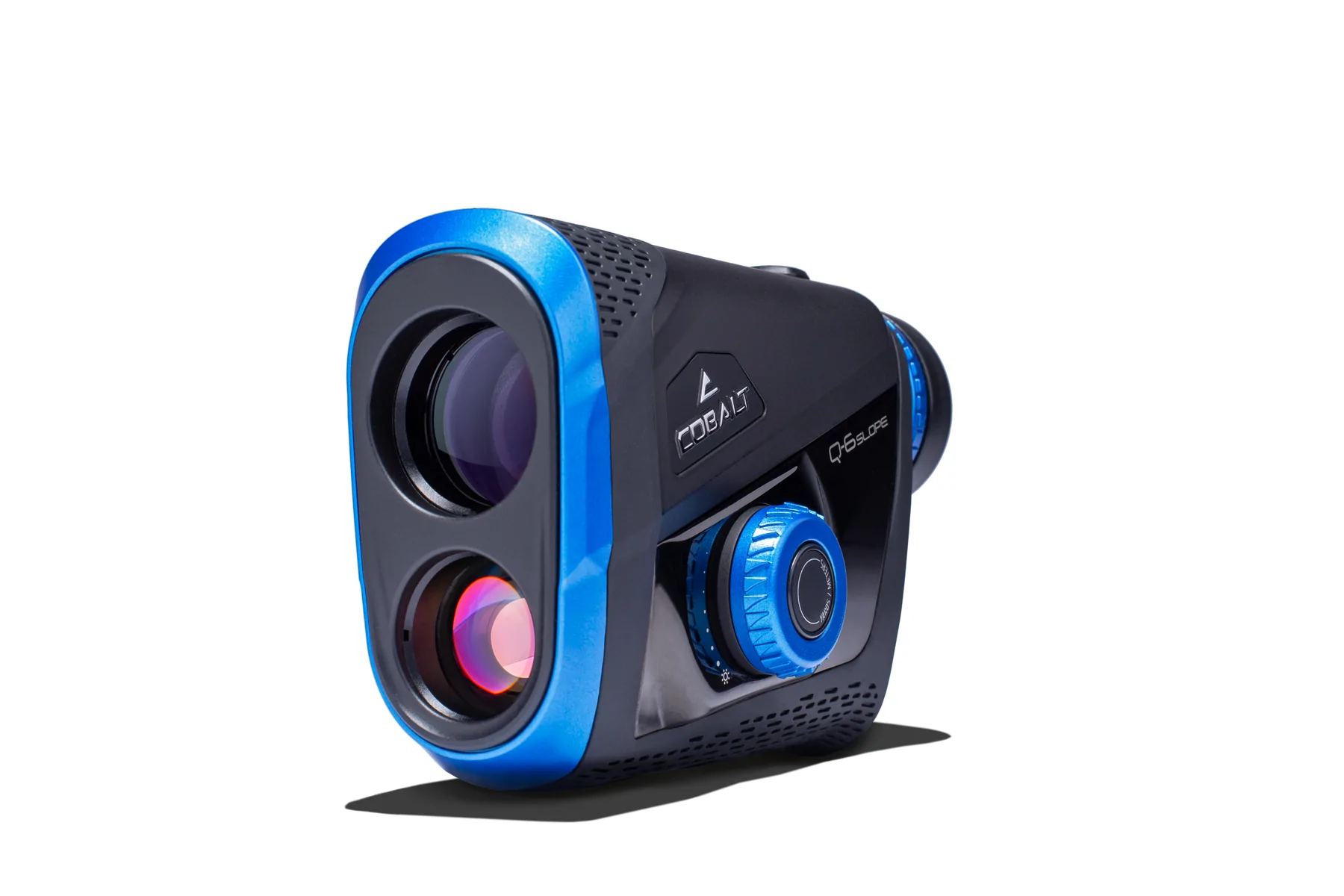
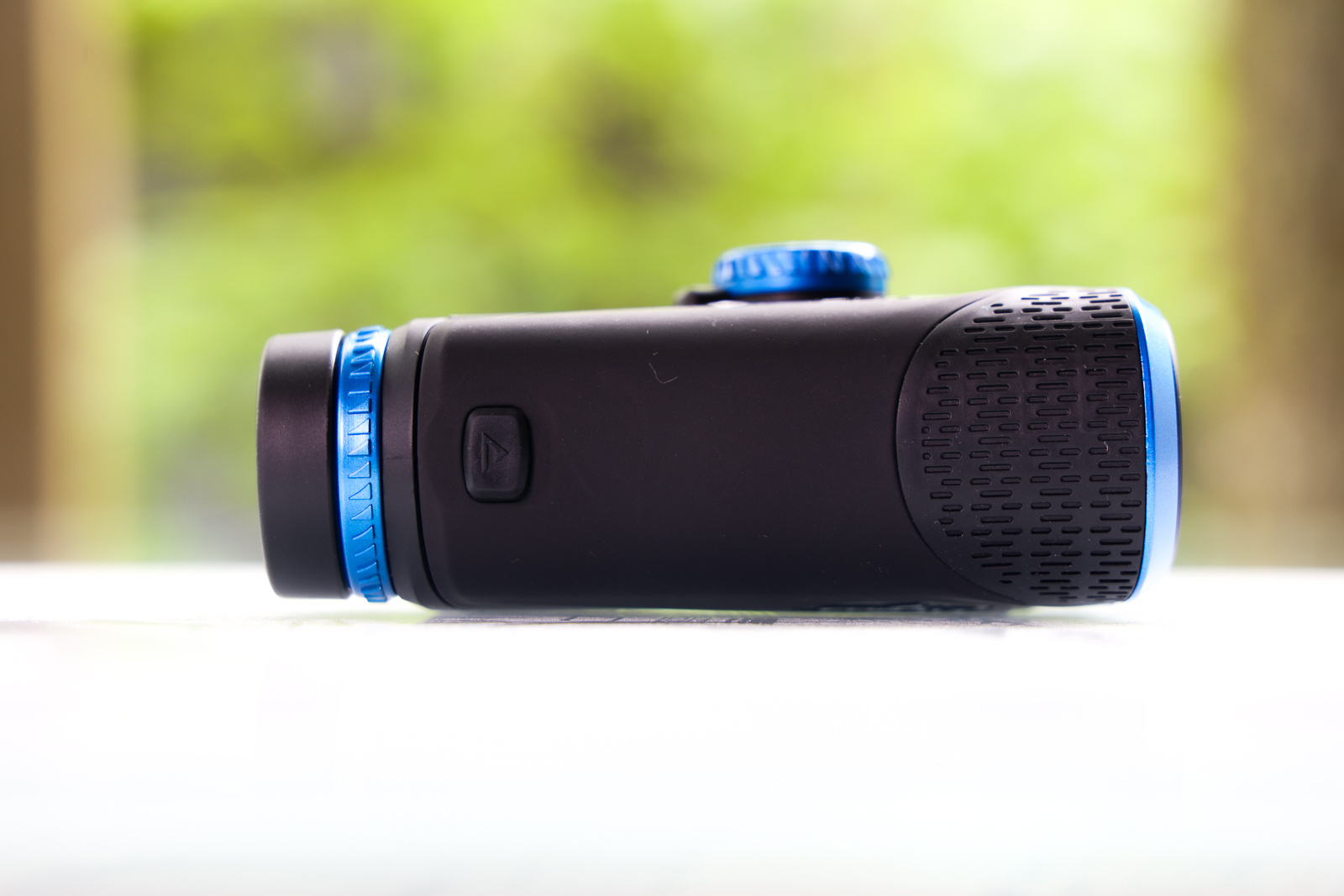
The Cobalt Q6 M feels like a high-end product. The magnesium body means there’s a nice weight to it, and this thing just feels expensive.
It’s rated at IPX7, so it’s completely waterproof, and the metal touches throughout its design add to the sturdy feel of the device.
I personally love the black and blue motif the device has, and I think it makes the Q6 M one of the best-looking rangefinders on the market.
I will note that the device is on the larger side compared to some competitors, and if you prefer a more compact rangefinder, this might not be your first choice. But for me, the size contributes to that premium, substantial feel.
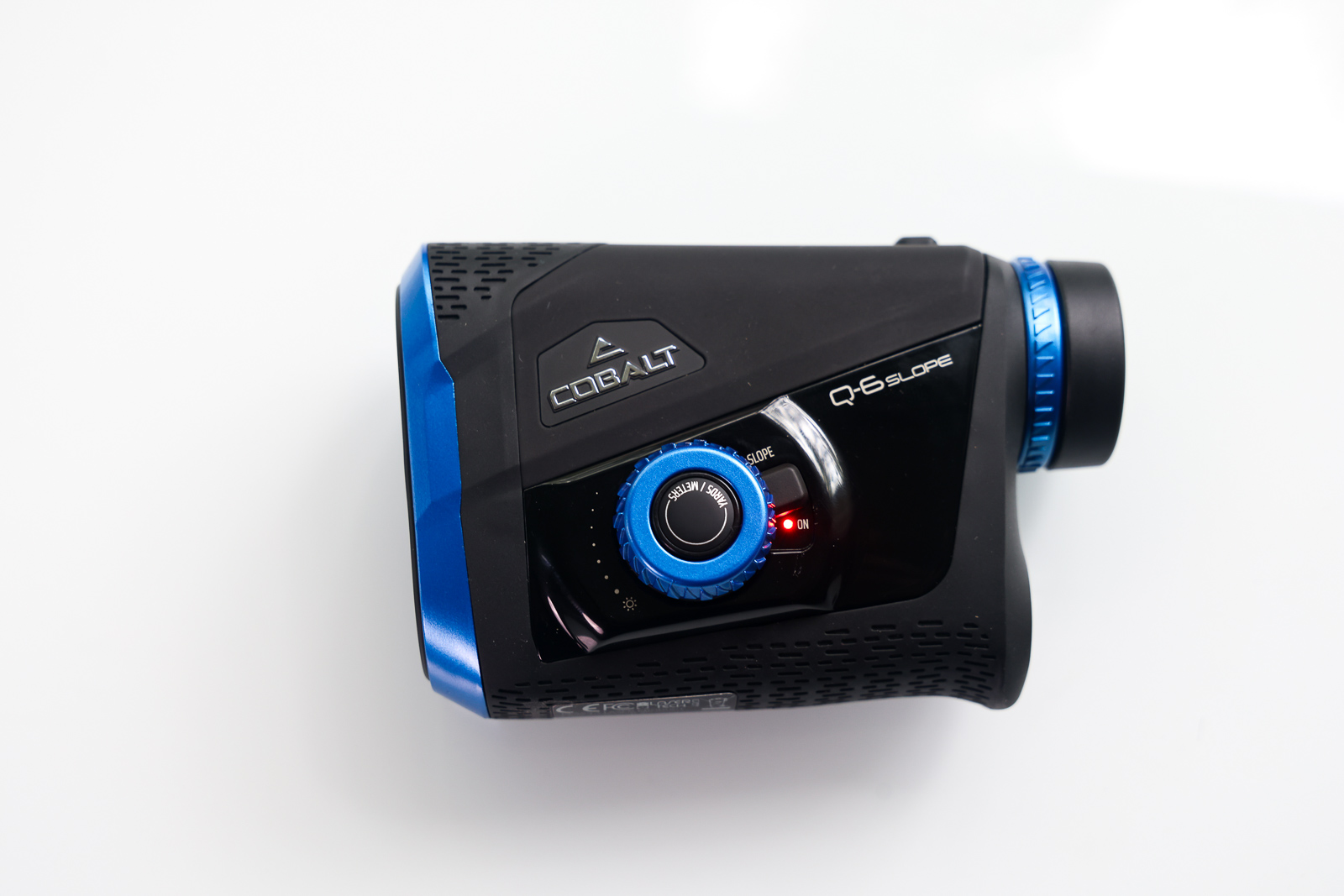
When first looking at it, there’s also one other prominent feature that’s impossible to ignore: the dial on the side of the device.
Cobalt calls this the “SmartSwitch” and it’s used to change the illumination in the display and to turn slope mode on and off.
This begs the question, does the switch actually work well? Or is it another gimmick meant to separate itself from the increasingly strong rangefinder competition? We’ll get to that in a second.
Editor’s Choice: Most Accurate
Cobalt Q6 M Slope Features
The Cobalt Q6 M is a pretty feature-heavy rangefinder, which you’d expect from a device costing $450.
Cobalt Q6 M Build Quality and Waterproof Rating
As I mentioned above it has a waterproof rating of IPX7, which means it can withstand water immersion of up to 3 feet for 30 minutes.
This is the highest rating I’ve ever seen on a rangefinder before. I don’t usually put too much stock in this, because how often are you immersing your rangefinder in water?
But what it does do is give you some insight into just how well built this thing is.
In fact, I might even go as far to say as it’s the most well-built device I’ve used to date.
It’s certainly on par with the Bushnell Pro X3+.
What’s New: The Magnet
The biggest change from the original Q6 to the Q6 M is right there in the name – the “M” stands for magnet.
This was the most glaring omission from the original model, and Cobalt has finally addressed it.
The magnet is plenty strong and works well for attaching the device to your cart. It’s a nice addition that brings the Q6 M in line with what you’d expect from a premium rangefinder in 2026.
That said, I was hoping for a bit more from this update. The addition of a magnet is great, but it feels like the bare minimum evolution for a product that’s been on the market for a few years now.
Cobalt Q6 M Optics and Display
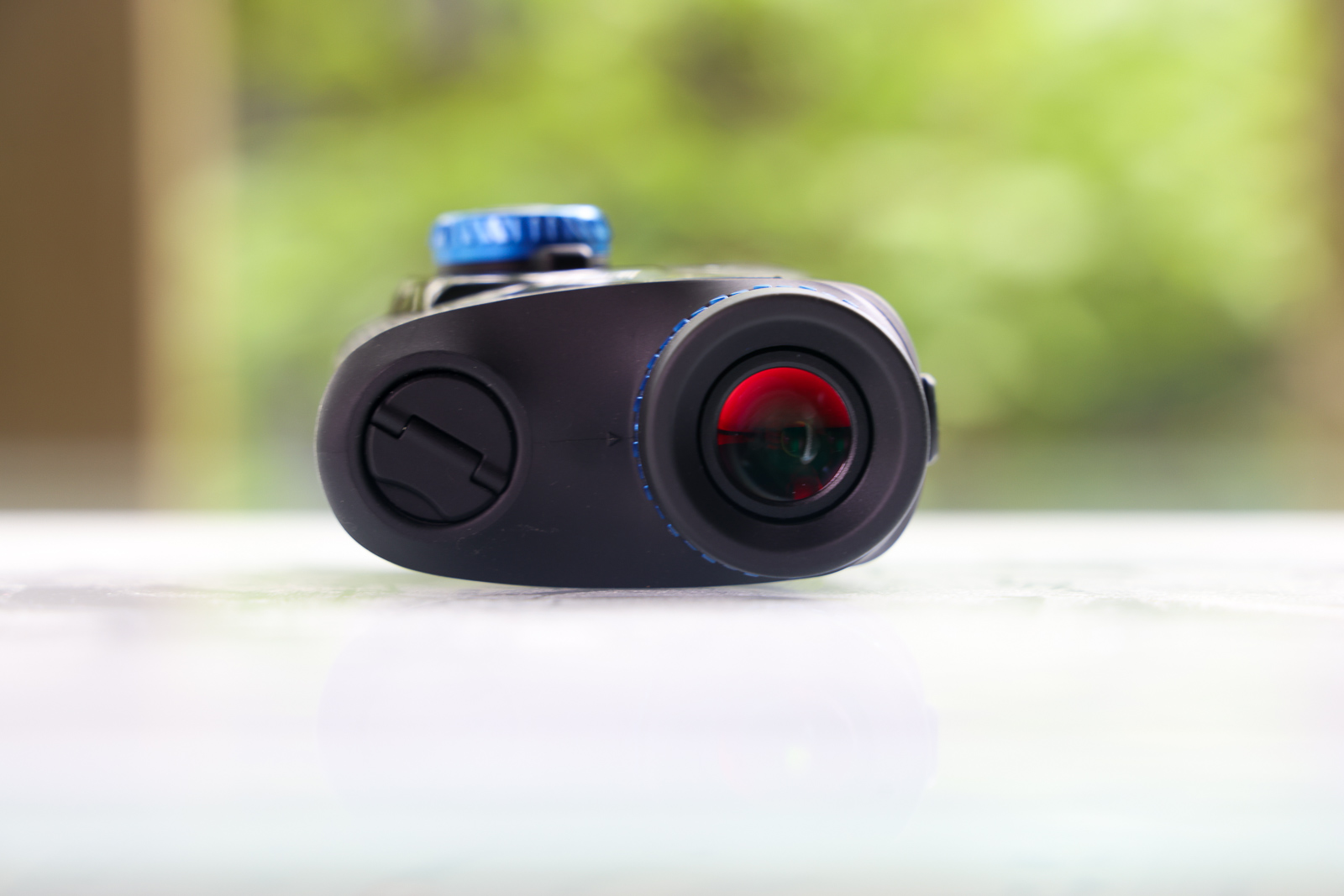
One look in the Cobalt Q6 M viewfinder, and it’s hard not to be impressed.
The 7x magnification is big and beautiful, and among the finest displays I’ve seen.
It’s right up there with the gold standard Nikon Pro II Stabilized, which has been my primary reference device for display and optics.
The Q6 M has a full-time illuminated display, which is excellent.
I’ve commented in the past about how less expensive devices that include an ambient display often sacrifice quality in order to add to the bullet point list of features.
Unfortunately, with these, the outside edge of the viewfinder can often get distorted or blurry when using the red display.
Not in the Cobalt Q6 M.
The clear red numbers are extremely crisp, sharp, and don’t degrade the optical image at all.
Remember the “SmartSwitch” we mentioned before? Well, this controls how bright your display is in the viewfinder, and it works beautifully.
A turn of the dial can turn up or down the brightness immediately, and I actually found it to be more useful than I expected. When there was cloud cover or a darker situation you could easily ratchet up the brightness a little bit, or go the opposite direction when needed as well.
Ultimately, I found this to be a personal preference situation, but one that I have adjusted multiple times throughout my rounds to help my readings perfectly fit the surrounding environment.
The switch is definitely the most differentiating design element from its competitors, and I honestly have found myself really enjoying it.
Slope Functions on the Cobalt Q6 M Slope
Integrated into the SmartSwitch of the Cobalt Q6 M Slope is a simple on/off switch for turning slope mode on and off.
One cool feature is when it’s on, there is a little light that is revealed beneath the switch that illuminates to let you (or any of your tournament playing partners) know that it’s in slope mode.
Slope on/off is one of those things different manufacturers have implemented in different ways, and this little light is one more way of doing something unique from their competition.
When looking through the viewfinder, the display is very minimal which I love.
I talked about this at length in my NX10 review, and I was pleased to see Cobalt follow a similar suit with the Q6 M.
You’ve got a box for ranging the flag, and then the yardage down to 1/10th of a yard.
That’s it. And that’s all I need or want.
In slope mode, they also did something I hadn’t seen before, which is only show the slope number.
When slope mode is on, it shows you the slope-adjusted distance in the same spot where it previously gave you the actual yardage. Then right below it tells you what degree of adjustment was necessary.
Some people will love this, and some will hate it.
It can be useful to know both slope and non-slope distances, and to get that, you’ll have to flip slope mode on and off.
Fortunately, the design makes this very fast and easy, but it is an extra step.
But honestly, after using this device for years now, this remains my biggest frustration with the Q6 M.
It’s still extremely annoying that you can’t see slope-adjusted and actual distances at the same time. In 2026, with so many competitors offering dual display options, this feels like an oversight that should have been addressed in the M update.
Others only care about the slope-adjusted number, and will have zero issues with this.
One other minor quibble: there’s a button on the side for switching between yards and meters. Most golfers will set this once and never touch it again, and it feels like this button could have been put to better use for another function.
But overall, the display and optics are among the best of any rangefinder I’ve used.
Cobalt Q6 M Accuracy and Performance
Ok, I’m gonna be real honest here. Even after years of testing rangefinders and with all the new products that have come to market, the Cobalt Q6 M is still the most accurate rangefinder I’ve ever used.
That feels like a bold statement to make, since these days most of the rangefinders I review on this site are very accurate.
But something about the Cobalt Q6 M inspires more confidence than anything I’ve used.
There are two reasons for this.
The first is the fact it provides a distance down to a 1/10th of a yard.
Does anybody need this? No, of course they don’t. If the flag is 100.4 or 100.8 yards away, this will have no bearing on your shot no matter how good you are.
But it’s the consistency of the laser distances that inspires so much confidence. I’ll shoot the same thing multiple times, and I’ll get the exact same yardage over and over.
Whereas many less expensive rangefinders might bounce around a yard or two.
This is very consistent and very fast with its numbers.
The second reason is due to the “Surge” feature.
Surge, Jolt, vibration – it’s all the same, depending on the brand.
When a device locks onto the flag, it vibrates to let you know it has indeed targeted the flag, and not a tree or something else in the background.
The NX10 basically vibrates every single time you get a distance.
The Bushnell Pro X3+ has improved significantly in this area compared to earlier models.
The Cobalt “Surge” feature is the best implementation of this vibration technology I’ve ever used.
Why?
Because it only does it when it truly knows I’m locked onto the flag.
Shooting it on my deck at the trees out in my backyard? Never get a vibration.
But take it out on the course, and on the first hole I get the vibration as well as a visual signal that it has the flag.
It does it frequently, but not all the time. So when I get it? I know with 100% confidence the distance is correct.
You combine these two things with wonderful build quality, and a history of high-quality products?
And my gut is to say this is the most accurate rangefinder I’ve ever used.
Or if not the most accurate, we’ll at least say it’s among the most confidence-inspiring devices I’ve used.
Final Thoughts on the Cobalt Q6 M Slope
The Cobalt Q6 M Slope is a wonderful product in an increasingly competitive market.
Here’s what I mean by that.
When I first reviewed the original Q6, there were clear tiers in the rangefinder market. Budget options around $200, mid-range devices around $300, and premium products like the Cobalt and Bushnell at $450+.
But the market has changed significantly since then.
These days, you have excellent options like the Voice Caddie TL1 and the Precision Pro Titan Slope that perform incredibly well for under $300. The Mileseey GenePro G1, especially after discounts, can be had for around the same price as the Q6 M but comes loaded with extra features.
Both Precision Pro and Voice Caddie have very good products in the $200-$260 range. They’re accurate, feature-heavy, and affordable.
Cobalt even has its own less expensive model in the Q-4 Slope – which is fantastic and often my pick for the best rangefinder under $300.
At the high end of the market is Bushnell – the market leader. These days you can likely find a last-gen Pro X3+ in the same price range as a Cobalt Q6 M.
98% of tour players use Bushnell, and that’s the brand most golfers are familiar with and constantly seeing ads for.
So where does that leave the Q6 M?
It’s still one of my favorite rangefinders. I still love to use it. The superior optics and wonderful display make it a joy to use. The build quality inspires confidence in the brand. And the 1/10th calculations and incredible implementation of target lock vibration inspire a confidence in the device that remains a step up from other devices I’ve used.
The addition of the magnet brings it in line with modern expectations, even if I was hoping for more innovation in this update.
But here’s the reality: at $450 retail, the value proposition has become more challenging. There are now many products that perform similarly for significantly less money. The inability to see both slope-adjusted and actual distances simultaneously is more frustrating now than it was a few years ago, especially when competitors have solved this problem.
The Q6 M is lacking a bit in the value department compared to what else is available in 2026.
If you’re able to move beyond the very good budget products and look past brand recognition, you’ll find the Cobalt Q6 M Slope to be one of the very best rangefinders on the market from a pure performance and build quality standpoint.
Throw in the fact they’re a small company dedicated to customer support with a lifetime warranty – and you’ve not only got a fantastic product, you’ve got peace of mind as well.
This is a product that lives up to its premium price point in terms of quality and performance. But whether that premium is worth it for you will depend on how much you value best-in-class optics, build quality, and that intangible confidence factor versus the increasingly strong competition at lower price points.
If you want the absolute best and are willing to pay for it, the Q6 M won’t disappoint. But if you’re looking for great performance at a better value, there are now several excellent alternatives worth considering.
Editor’s Choice: Most Accurate
Recent Updates:
January 20th, 2026: Full update to the review to account for the new Q6 M, with added magnet. Also added a video review. Adjusted review score. Lowered one point for price, and another for personal affinity to reflect the current position in the market.
June 29th, 2023 – Updated to add references to the Cobalt Q-4 and give a one year in review update.
This page contains affiliate links. This means that if you click a link and buy one of the products on this page, I may receive a commission (at no extra cost to you!) This doesn’t affect our opinions or our reviews. Everything we do is to benefit you as the reader, so all of our reviews are as honest and unbiased as possible.
One of the best golf rangefinders at any price point
Buy It
Over the last 2 years, I’ve used the Cobalt Q-6 more than any other rangefinder. That should be all you need to know considering I own 30+. It’s fantastic across the board. The downsides? No built in magnet, and you can’t get both slope and non-slope distances simultaneously. Outside of that? It’s as good as it gets.
The Good
-
Fantastic Build Quality -
Top of the class in terms of accuracy and pin seeking -
Smart dial suprisingly useful
The Bad
-
No built in magnet -
Can’t see slope and non-slope distances simultaneously
-
Presentation
-
Performance
-
Price
-
Personal Affinity