
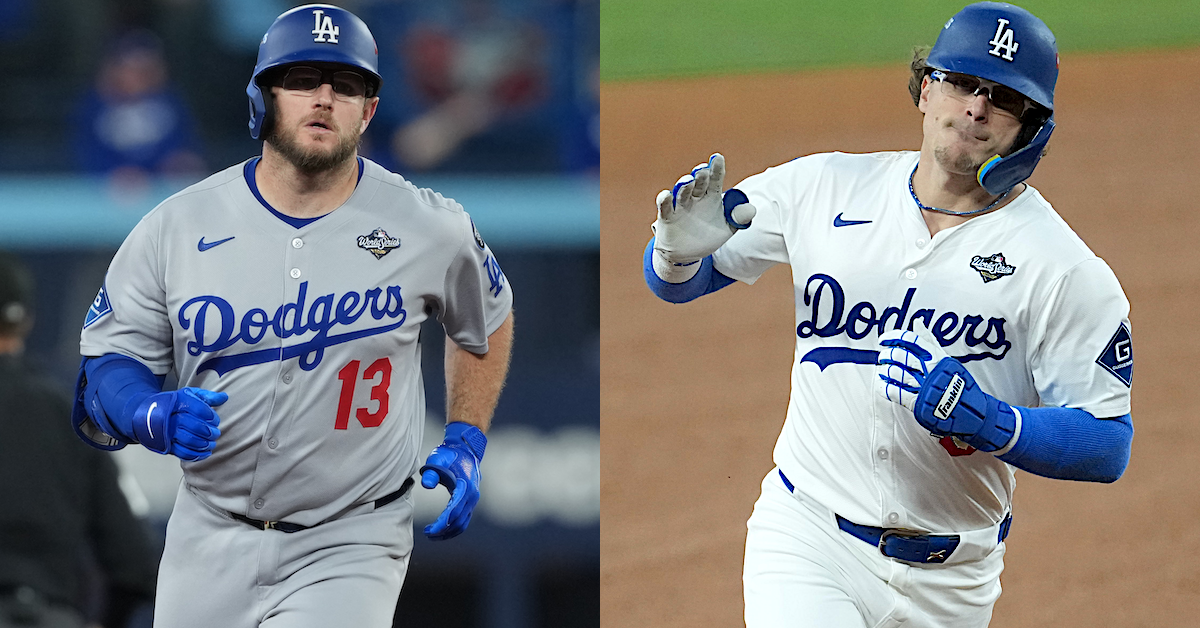
While winning three World Series with the Dodgers, Max Muncy and Enrique Hernández have both made their marks in October, with the former setting the franchise record for postseason home runs (16) and the latter doing so for games played (92). Both will remain in Dodger Blue for awhile longer, with a chance to increase those totals — and chase a third consecutive championship. On Thursday, a day ahead of their pitchers and catchers reporting to Camelback Ranch, the Dodgers announced that Muncy has agreed to an extension for 2027, and that Hernández, a free agent, will again return to the fold. A day earlier, Los Angeles announced that it had re-signed righty Evan Phillips, who missed last year’s postseason run due to Tommy John surgery and was non-tendered in November. Amid the ensuing roster crunch, the Dodgers designated catcher Ben Rortvedt for assignment for the second time this winter, and traded previously DFA’d lefty Anthony Banda to the Twins for international bonus money.
That’s a lot to pick through, creating ripples up and down the roster. We’ll start with Muncy, who with the retirement of Clayton Kershaw is now the longest-tenured Dodger, having joined the team in 2018. The 35-year-old slugger was already signed for 2026, because in November the Dodgers picked up the $10 million option on his previous two-year, $24 million extension. His new contract — his fourth extension in the past six years, all of them so team-friendly that he’s never had a base salary above $13.5 million — guarantees him another $10 million, with $7 million for his 2027 salary and another $3 million as a buyout for a $10 million club option for ’28.
Those are bargain prices given the production and track record of Muncy, who has evolved from a cast-off by the A’s into a two-time All-Star and a pillar of the Dodgers lineup. While he was limited to 100 games in 2025 due to a bone bruise in his left knee — suffered on July 2, moments before Kershaw notched his 3,000th career strikeout — and then an oblique strain in mid-August, he hit .243/.376/.470 with 19 home runs in 388 plate appearances. Both his 137 wRC+ and 2.9 WAR were his highest since his All-Star 2021 campaign, but hardly out of character. Limited to 73 games in 2024 due to an oblique strain and a displaced rib, he hit .232/.358/.494 (133 wRC+) with 15 homers and 2.3 WAR in just 293 plate appearances.
Muncy ran hot and cold during the 2025 postseason, hitting .214/.353/.411 overall with some big home runs. His solo shots off the Brewers’ Freddy Peralta in the sixth inning of NLCS Game 2 and the Blue Jays’ Kevin Gausman in the seventh inning of World Series Game 2 chased those starters and extended 2-1 leads, while his eighth-inning solo blast off Trey Yesavage in Game 7 of the World Series pulled the Dodgers back to within one run. Home runs by Miguel Rojas in the ninth inning and Will Smith in the 11th carried the Dodgers to their second straight championship and third under manager Dave Roberts.
A few things stand out when poring over Muncy’s 2025 numbers. For one, his 16.5% walk rate was the highest of his career, while his 21.4% strikeout rate was his lowest since 2021 — and he did it while swinging more frequently than ever, both overall (42.4%, compared to a 38.9% career rate) and at pitches in the zone (64.3%, compared to a 59.3% career rate). Not only did he swing and miss less often (9.4%) than in any season since 2021, he set career highs in both average exit velocity (91.2 mph) and hard-hit rate (51.5%), the former by an eyelash, the latter by nearly five full percentage points. When he made contact, he pulled the ball in the air more often than ever before (31.5%, the majors’ fourth-highest rate). Long story short, he remains a legitimate thumper.
You Aren’t a FanGraphs Member
It looks like you aren’t yet a FanGraphs Member (or aren’t logged in). We aren’t mad, just disappointed.
We get it. You want to read this article. But before we let you get back to it, we’d like to point out a few of the good reasons why you should become a Member.
1. Ad Free viewing! We won’t bug you with this ad, or any other.
2. Unlimited articles! Non-Members only get to read 10 free articles a month. Members never get cut off.
3. Dark mode and Classic mode!
4. Custom player page dashboards! Choose the player cards you want, in the order you want them.
5. One-click data exports! Export our projections and leaderboards for your personal projects.
6. Remove the photos on the home page! (Honestly, this doesn’t sound so great to us, but some people wanted it, and we like to give our Members what they want.)
7. Even more Steamer projections! We have handedness, percentile, and context neutral projections available for Members only.
8. Get FanGraphs Walk-Off, a customized year end review! Find out exactly how you used FanGraphs this year, and how that compares to other Members. Don’t be a victim of FOMO.
9. A weekly mailbag column, exclusively for Members.
10. Help support FanGraphs and our entire staff! Our Members provide us with critical resources to improve the site and deliver new features!
We hope you’ll consider a Membership today, for yourself or as a gift! And we realize this has been an awfully long sales pitch, so we’ve also removed all the other ads in this article. We didn’t want to overdo it.
Muncy’s defense was a bit of a mixed bag according to the metrics; his -4 FRV at third base matched a career low, set in 251 more innings in 2023, though his 3 DRS was his third year out of four in the black. As we saw time after time during the postseason, he’s able to make the big plays when needed.
Speaking of making big plays, they don’t come much bigger than the double play that Hernández pulled off to seal the Dodgers’ 3-1 win in Game 6 of the World Series. With runners on second and third after Addison Barger’s ground-rule double on a ball that got stuck in the bottom of the outfield fence, Hernández — playing a shallower left field than Dodgers coaches wanted — speared a potential game-tying bloop off the bat of Andrés Giménez, then threw back to second to double off Barger and send the series to Game 7.
The 34-year-old Hernández, whose versatility and knack for coming up big in the postseason have made him a vital part of five pennant winners dating back to 2017, started all 17 games of the Dodgers’ championship run, two at third base against tough lefties while Muncy sat, two in center field, and the rest in left. Through the first three rounds of the postseason, he hit 306/.375/.417 as the Dodgers steamrolled Cincinnati, Philadelphia, and Milwaukee, and had enough big hits to add to the lore of “Señor Octubre.” He hit a game-tying double off the Reds’ Zack Littell in the fourth inning of Game 2 of the Wild Card Series. His two-run double off the Phillies’ Cristopher Sánchez in the sixth inning of Game 1 of the NLDS helped the Dodgers dig their way out of a 3-0 hole, and his walk against Orion Kerkering in the 11th inning of Game 4 set up the walk-off error that ended the series. He collected a pair of hits that helped stoke rallies in Game 2 of the NLCS against the Brewers, and his single off Max Scherzer in the fifth inning of Game 3 of the World Series keyed a two-run, game-tying rally.
Hernández is a career .272/.339/.486 (122 wRC+) hitter in the postseason, though he’s hit just .236/.305/.403 (91 wRC+) during the regular season in his 12-year career — a contrast he has attributed to his his attention-deficit/hyperactivity disorder. “I think my superpower is also my kryptonite — that’s called ADHD,” he told teammate Mookie Betts for a podcast after the Dodgers’ 2024 championship. “During the season, my brain is just everywhere and the postseason, it just brings out hyperfocus. I just go into compete mode.”
The 2025 regular season was another subpar one for Hernández, who hit .203/.255/.366 with 10 homers and a 70 wRC+, his lowest mark since 2016. He missed seven weeks in July and August due to inflammation in his left elbow, and said that he’d been playing hurt for about a month before that, traceable to a headfirst slide into home plate in late May. That helps to explain the .109/.169/.200 he hit in 59 plate appearances from June 1 through July 5 before going on the IL. In mid-November, he underwent surgery to repair a torn extensor tendon in the elbow.
“I played till, basically, I felt like I couldn’t even hold the bat anymore,” he said upon returning to the roster in August. “And I mean, it was kind of dumb on my end. But I’ve always felt that if I feel like I could play, I’m not going to go on the IL. By the time we went in for the MRI, it was a little too late.”
Hernández’s 31.2% chase rate, 13.2% swinging strike rate, and 26.6% strikeout rate all set career highs, with the last of those a seven-point jump from last season, the majors’ seventh-largest increase. Once again, he was better against lefties (.202/.269/.415, 85 wRC+) than righties (.203/.245/.333, 59 wRC+), and was very solid on the defensive side while filling in at five positions (first, second, third, left, and center), though the less said about his mopup relief performance (a 15.19 ERA in 5 1/3 innings), the better.
Hernández will make $4.5 million on a one-year deal, a substantial cut from last year’s $6.5 million. It’s not clear yet whether he’ll be ready in time for Opening Day, but once active, he figures to contribute at second base, third base, left field, and center field, serving as a platoon partner and/or late-inning defensive replacement.
The 31-year-old Phillips is just one of several pitchers whom the Andrew Friedman-era Dodgers have coaxed more out of than their previous teams. When the Dodgers plucked him off waivers from the Rays in August 2021, he owned a 7.26 ERA in 57 major league innings. After they helped him to turn his slider into a devastating sweeper, and to add a sinker and cutter to combat lefties, he emerged as one of the best relievers in baseball, posting a 2.21 ERA and 2.76 FIP with 44 saves and a 29.6% strikeout rate in 179 innings from 2022–24. He added 15 1/3 scoreless postseason innings (including 2021), though he was left off the 2024 World Series roster due to what was eventually diagnosed as a partial tear of his right rotator cuff, suffered during Game 6 of the NLCS against the Mets. While he managed to avoid surgery for that injury, a bout of elbow inflammation last spring led to a PRP injection, then he made just seven appearances totaling 5 2/3 innings in late April and early May before needing Tommy John surgery, which he underwent on June 4.
The Dodgers non-tendered Phillips in November but maintained interest in bringing him back, even after landing free agent closer Edwin Díaz. Phillips will make $6.5 million for what’s likely to be about half a season of work; that the team placed him on the 60-day IL in order to open up a spot on the 40-man roster for Hernández fits that timeline, as he’ll be roughly a year removed from surgery once eligible for activation.
With Phillips out, Roberts will likely rely upon lefties Tanner Scott and Alex Vesia and righties Blake Treinen and Brusdar Graterol for the higher-leverage work in front of Díaz, though that group offers considerable uncertainty. Scott led the Dodgers with 23 saves but posted a 4.74 ERA and missed the postseason due to “a lower-body abscess,” which doesn’t sound like something anyone wants to know more about. Graterol underwent surgery to repair a torn labrum in November 2024 after making just seven appearances that year, and didn’t pitch at all last season. Treinen missed 99 days in midseason due to forearm tightness; he posted a 3.12 ERA through August before an ineffective September ballooned that mark to 5.40 with a 4.75 FIP. His every postseason appearance became a white-knuckle affair, as he yielded a 6.75 ERA in 5 1/3 innings. Lefties Jack Dreyer and Justin Wrobleski and righties Will Klein and Ben Casparius could work their way up the leverage ladder if there’s an opening, but one look at all those question marks helps to explain why Los Angeles feels it needs Phillips.
While the Dodgers are running it back with those guys, Rortvedt and Banda have been squeezed off the roster. Back in November, they re-signed Rortvedt — who is out of options and would have to consent to a minor league assignment — to a one-year, $1.25 million deal, hoping that his salary would prevent him from being picked up off waivers. The Reds selected him, but after signing free agent Eugenio Suárez earlier this month, they DFA’d Rortvedt, and the Dodgers reclaimed him. The addition of Phillips to the 40-man roster has led to yet another trip through the DFA wringer, which has to be frustrating.
The 28-year-old Rortvedt — “Benny Biceps” for his weightlifter physique — split his season between the Rays and Dodgers, filling in for Smith in September and early October as the starter recovered from a hairline fracture in his right hand. Rortvedt hit just .152/.240/.205 (31 wRC+) overall but a more respectable .224/.309/.327 (83 wRC+) in 58 plate appearances for the Dodgers, then went 3-for-7 while starting the team’s first four games of the postseason. Still, he only figured to be third on the depth chart behind Smith and Dalton Rushing, so his hold on a roster spot was always tenuous.
As for Banda, he’s another success story like Phillips. Prior to being traded from the Guardians to the Dodgers in May 2024 for cash considerations, he spent time in 11 different organizations after being drafted by the Brewers in the 10th round in 2012, never making more than 32 appearances or throwing more than 33 2/3 innings in a major league season. Within a day of his acquisition, Dodgers assistant pitching coach Connor McGuiness helped Banda adjust his grip on his slider. From The Athletic’s Fabian Ardaya:
He instructed Banda to try to grip the baseball with a “spike,” digging the nail of his index finger into the seam to impact movement and spin. The instruction was simple: Aim down the middle, throw it like a fastball and let it rip.
“It hooked right away,” Banda said. Rather than loop, the slider moved sharply. Instead of feeling like he was guiding the pitch, he threw it emphatically without sacrificing command.
“It was like a ‘thank you’ moment. I went through, what, 11 organizations? And no one could find that for me. He did it within 24 hours.”
That slider turned into a go-to, with Banda throwing it 28.2% of the time in 2024 and 49.2% in ’25. Batters hit just .147 and slugged .263 against the offering while whiffing on 42.2% of their swings in that span. After making 48 appearances totaling 49 2/3 innings in 2024, he set career highs with 71 appearances and 65 innings in ’25, putting up a 3.18 ERA and 4.52 FIP; he struck out 22.8% of hitters while walking 12.7%, though six of his 34 walks were intentional. Lefties hit a meager .153/.241/.255 (.226 wOBA) in 112 plate appearances against him, though righties hit .229/.346/.427 (.326 wOBA) in 156 plate appearances. In a bullpen full of southpaws — Scott, Vesia, Dreyer, and perhaps Wrobleski — Banda became expendable, and the Dodgers dealt him to the Twins for $500,000 worth of international bonus money.
The Friedman-era Dodgers have spent massive amounts of money on stars and superstars while making 11 straight postseason appearances; their payroll for Competitive Balance Tax purposes currently sits at a staggering $405.2 million. Even so, the team’s ability to turn the likes of Muncy, Hernández, Phillips, and Banda — and Justin Turner, and Chris Taylor, and so on — from fringy journeymen into reliable contributors has defined this era as much as the marquee free agents. No wonder these guys keep coming back for more.