
Three days of testing in Bahrain meant spending hours trackside studying the class of Formula 1 2026.
Here is an early assessment of every car from what Edd Straw and Scott Mitchell-Malm observed across multiple stints to various corners across the stint.
FERRARI
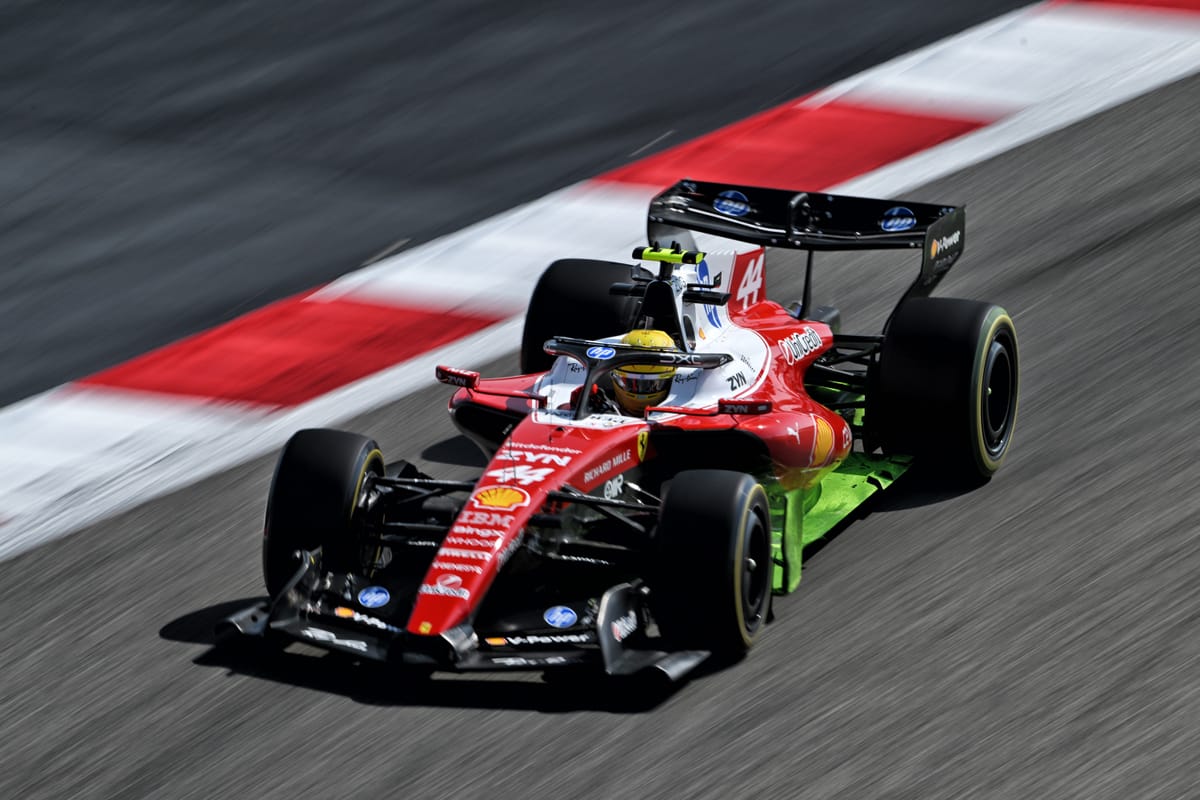
The Ferrari never looked like the most planted car, particularly when Lewis Hamilton was at the wheel. During Friday morning’s running, there was a clear example of that in the comparison of his fastest lap of the morning compared to George Russell, which were set minutes apart but night and day in terms of how stable the car appeared through the Turn 6 right-hander in the middle of the sweepers and into Turn 8.
Hamilton described these cars as like “rallying” sometimes and that comes across more in his hands than Charles Leclerc’s from trackside. Hamilton had the rear sliding a lot more, which sometimes seemed a consequence of him trying to work the front harder on entry – but other times just seemed to be a hint of lingering rear instability.
It is also noticeable that the Ferrari-engined cars have to stay in second gear when others are dropping to first to keep the turbo speed up. That partly reflects what’s reckoned to be the smaller turbo in the Ferrari, but also the extra downshift just seems to unsettle them too much: Leclerc tried it once but the instability seemed to put him off experimenting further.
AUDI
The Audi misbehaved monstrously under braking early in the test, with both drivers visibly struggling with the impact of trying to downshift to ultra-low gears in the slow stuff to keep the turbo working hard, then struggling with getting the power down on exit anyway.
Whether that was the sole cause of the turn-in instability that was evident at times, or just compounding it, remains to be seen. While it improved as the test went on, the car only ever got to a level where it looked to be towards the rear of the midfield pack.
There were also hints it was one of the softer cars in terms of mechanical platform, which wasn’t a problem but just an emerging characteristic in these cars that run less low and stiff than last year.
RED BULL
The Red Bull was visually and audibly impressive from the very first day, as its capacity to smash down through the gearbox all the way to first gear so smoothly highlighted just how well-prepared and sorted this new package seems to be.
It was not all smooth sailing. Verstappen caught a big slide at Turn 10 on day one, and on day three he went in so hot he was never going to make the corner – so just booted the throttle when deep into the run-off, and carried on pushing! There were also times when rear instability in the entry phase led to a couple of bites being required for the corner.
Another encouraging thing is that Isack Hadjar seemed to cope well and beyond seeming to struggle just a tiny bit more with the rear instability that came with the car demands, he was adjusting his driving well through stints and so it tended to get neater rather than more lairy.
ALPINE
The Alpine was generally just that bit behind the leading group of four cars when it came to grip. Often, you could see both Pierre Gasly and Franco Colapinto having to be that little bit tentative on corner exit to keep the rear end in place.
Sometimes it looked really well-sorted, other times, like when Colapinto had to bail out of a way-too-hot entry into Turn 11, it just didn’t seem to have the grip required to handle what the drivers wanted the car to do.
The overall impression was that this was the most ‘midfield’ of the midfield cars, which is not a criticism, and in terms of consistency it had the edge over the Williams.
MERCEDES
A standout feature of watching the Mercedes trackside is that, as the test progressed, there was nothing particularly standout about it. That’s a big positive because even when the laptimes were fast, it rarely looked as difficult as most of the other cars.
At Turn 10 it didn’t catch the eye or the ear in the way the Red Bull does by going down through the gears quite so aggressively, or having the same rotation. But it looked and sounded neat and tidy, moving on well from a sometimes trickier opening day when its drivers had the occasional moment, as most did at some point.
For regular trackside insight throughout F1 testing, join The Race Members’ Club – claim a free 7-day trial here
The end of the test is when it stood out most. Watching at Turn 11 during a late Kimi Antonelli long run, it was striking just how confident and aggressive he seemed to be.
Antonelli was comfortable opening up the corner wider than anyone else over the outside kerb, and turned in sharply and committed every time. The car complied well and looked good all the way to the exit, which definitely couldn’t be said for some others.
CADILLAC
It visibly struggled for grip compared to most other cars, and looked perhaps a little less compliant than it ideally would be, but the impression was that this was a solid enough car in terms of behaviour that simply lacked overall grip.
There were occasions in the Turn 4 right-hander where the drivers would find themselves with some correction to do as one axle or the other gave up. And it was perhaps the most prone of any car, except the Aston Martin, to some front-locking into the tricky Turn 10.
First and foremost, it just needs more aerodynamic load – and adding that might expose some of its underlying balance limitations, but it looks like a car that’s destined for backmarker respectability that would count as a huge success for this new team.
McLAREN
There was not much consistency to the McLaren trackside. It could look very good – some push laps from Lando Norris on day two, hammering down to first gear at Turn 10, were particularly impressive – but it also seemed unruly as well.
Coincidence or not, as fuel loads could have a huge impact on this kind of behaviour, the unruliness seemed to happen more with Oscar Piastri behind the wheel. He seemed to have a tougher time with the car moving around under braking and locking up the fronts, and also the rear stepping out at higher speed.
Even on the final afternoon, Piastri was inconsistent in Turn 10, with the car variable in how it reacted on turn-in – and therefore sometimes wider than anticipated and other times seeming to respond more then he would have wanted.
Where there was a clear trend across both drivers was a tendency for the engine to rev aggressively on traction and have wheelspin up to third and fourth gear, which is consistent with a team still not quite as refined on battery charging and deployment as the works team.
HAAS
We’re used to the Haas keeping a low profile during testing to focus on heavy fuel work and it was probably the car that grabbed the least attention during the Bahrain test. That’s meant in a good way, for it seemed to be the car that, if not had fewer moments than others, was likely having more minor and contained ones.
As it’s not a car that is blessed with class-leading downforce, things inevitably looked harder on longer stints. Ollie Bearman could be seen starting to grapple with some understeer on a longer Thursday evening run, which turned to rear instability as he presumably tried to compensate with some brake-setting changes.
But overall it’s a solid car that looks unremarkably decent, runs well and for which, as Bearman says, “driveability has been good from the beginning”.
ASTON MARTIN
So many of my (Scott’s) trackside notes regarding Fernando Alonso and Lance Stroll reference a lock-up, or a slide. Three in four laps for Stroll on day one, four in a row for Alonso on day two, which included the biggest I think I’ve ever seen at Turn 10 – which, when I told him that on Friday, caused a real ‘yeah, that’s what I’m dealing with’ kind of grin.
This is a car that usually looks difficult to drive and when it doesn’t, it looks slow – maybe because the drivers just have to be so restrained, maybe because the energy recovery capacity of the Honda engine means there’s more saving to do.
It could also be the engine and the new gearbox are just not comfortable with the aggressive downshift demands of this energy formula, and that the package is not that well-refined – hence front-locking turning to rear-locking very quickly, either as the drivers try to manage the car behaviour with brake balance or engine braking changes, or as the energy recovery demands change lap to lap.
Ultimately, it just reflects a package that is a lot less well-understood than all its rivals’.
RACING BULLS
The Racing Bulls appeared to be grappling with the effects on car dynamics of the power unit behaviour more than most. In both slow and fast corners, there were moments where the expected grip simply was not there, including on Friday morning when Liam Lawson found the rear end not sticking as expected in the fast sweepers and took to the run-off after collecting the resulting moment.
The car could be erratic on turn-in and was also often a handful when it came to putting down the power in traction zones out of slower corners. But those problems likely started before the corner given the inconsistency on corner approach and the tendency to be variously under- or over-rotated.
WILLIAMS
The number of times the Wiliams went past was probably more impressive than the manner in which it did so, topping the mileage charts for this test.
Williams didn’t leave a midfield-leading impression by any means. Sometimes its car looked pretty tidy but others it was hard to slow down and there was one stint where Carlos Sainz didn’t look like he was having a good time at all.
Perhaps the high rake means it’s having to run a little stiffer, which is creating its own problems, but that might be eased as it catches up on set-up work following its delayed start.
It’s decent for a car that started the week well behind the others but there is quite a bit of room to improve.