

Over the past decade, cities around the world have radically reshaped how people move. Once car-dominated streets now support everyday cycling at a scale that would have seemed unimaginable a generation ago—families riding to school, cargo bikes replacing delivery vans, and bicycles functioning as true urban infrastructure rather than recreational afterthoughts.
The Copenhagenize Index, widely regarded as the most comprehensive global ranking of bicycle-friendly cities, evaluates 100 cities on how effectively they’ve made cycling safe, convenient, and appealing. The criteria go far beyond bike lanes alone, measuring safe and connected infrastructure, cycling usage and reach, and long-term policy support—a combination that rewards consistency, political commitment, and real-world outcomes.
At the very top of the Index, European cities remain far out in front, and the gap is not closing. Places such as Utrecht, Copenhagen, Amsterdam, and Paris have achieved cycling mode shares between 11% and nearly 40%, backed by serious and sustained investment, incredible networks of protected bike lanes, and, overall, taking street space away from private cars and giving it to people.
Against that backdrop, North America still has catching up to do, especially that reallocation where governments across Canada are actually initiating court cases to stop bike lane networks from being expanded. This is the opposite of what should be done.
In the 2025 Copenhagenize Index, only three North American cities cracked the global Top 30—all in Canada. Montréal ranked highest at 15th overall, followed by Québec City at 29th and Vancouver at 30th. No U.S. cities made the Top 30, highlighting the structural gap between North American cycling cities and their European counterparts.
While North America’s top cities trail true bicycle-friendly leaders in cycling mode share and networks, they are increasingly distinguished by momentum—rapid infrastructure buildout, improving policy frameworks, and growing everyday ridership. Montréal, Québec City, Vancouver, Portland, and Minneapolis now form a clear top tier within the continent, each demonstrating different pathways toward bike-friendly urban mobility.
What separates these cities from the rest of North America is not climate, geography, or culture—it’s political commitment and follow-through. These cities are investing consistently, prioritizing protected infrastructure, maintaining routes year-round, and moving cycling out of pilot-project territory and into the core of transportation planning. They may not yet rival Utrecht or Copenhagen in scale, but they are well ahead of most North American cities—and, crucially, they are building the foundations required to close that gap.
Here’s a closer look at the five cities currently leading the way for cycling in North America, according to the Copenhagenize Index—and why they matter.
1. Montréal, Québec
Copenhagenize Index score: 58.3
Montréal continues to set the benchmark for bicycle-friendly cities in North America. With decades of sustained investment and a long-term vision, the city has built a cycling network that feels intentional, continuous, and genuinely useful for daily travel.
The backbone of Montréal’s success is its impressive infrastructure, anchored by the Réseau Express Vélo (REV)—a system of wide, protected bike corridors designed for both speed and comfort. The network links downtown, residential neighborhoods, transit hubs, and commercial streets, ensuring cyclists can move efficiently across the city without relying on busy car streets. Alongside these major corridors, neighbourhood greenways and local bike routes expand accessibility and connect to schools, parks, and community centers, making cycling a realistic option for riders of all ages and abilities.
Montréal has also pioneered innovative street designs, including North America’s first bicycle streets and protected intersections, where cyclists have priority and safety is engineered into every movement. These features, combined with traffic-calmed streets and generous bike parking infrastructure—including Bixi bike-share stations that have set usage records—demonstrate that cycling is embedded into daily life, not just an occasional activity.
“We are extremely proud to see Montreal and Quebec City take the top two spots in North America,” said Jean-François Rheault, CEO, Vélo Québec. “This international recognition confirms what we have observed for years: when cities invest with vision, coherence, and ambition, cycling becomes a powerful tool to transform the city. We applaud the leadership of both administrations and encourage them to continue their work. Quebec is now demonstrating it can be a global model in active mobility.”
Strong political leadership has been critical. Successive city administrations have treated cycling as a core part of urban mobility, maintaining investment through years of challenging winters. In fact, winter cycling is a point of pride, with routes cleared of snow and ice and public campaigns encouraging riders to brave the cold. Montréal’s efforts prove that climate is no barrier when infrastructure and culture align.
Copenhagenize notes that Montréal’s general score of 58.3 reflects not just the quantity of bike lanes, but their quality, connectivity, and integration into city life. For anyone studying North American urban cycling, Montréal provides a blueprint for scaling infrastructure while normalizing cycling as a mainstream mode of transit.
BIXI Trailer (CNW Group/BIXI Montréal)
2. Québec City, Québec
Copenhagenize Index score: 51.1
Québec City’s rise in the Copenhagenize Index demonstrates how rapid progress is possible with political will, strategic planning, and focused investment. While the city may be smaller than Montréal, it is making strategically targeted interventions that enhance safety, comfort, and reach for cyclists.
A standout feature of Québec City’s approach is the creation of a dedicated, multidisciplinary cycling team, tasked with coordinating planning, project delivery, and community engagement. This internal structure has allowed the city to implement projects efficiently, delivering tangible improvements across neighborhoods without long delays.
Policy support is one of Québec City’s strengths, reflected in its high Policy and Support score of 68.1. This includes funding for new protected lanes, investment in public bike-share systems, and citywide programs that encourage cycling adoption. Safety is also a priority: traffic-calmed streets, dedicated bike signals, and better crossings are making previously intimidating roads accessible to everyday riders.
Infrastructure is steadily expanding, with new lanes linking suburban neighborhoods to the city center, and pilot projects being scaled into permanent routes. The city’s growing ridership reflects both smart design and promotional efforts, and the electric Bixi fleet expansion is enabling longer and more practical trips.
Québec City’s Copenhagenize ranking shows that momentum matters as much as scale. Its score of 51.1 places it ahead of most North American peers, proving that a small city with the right focus can punch well above its weight in cycling friendliness.
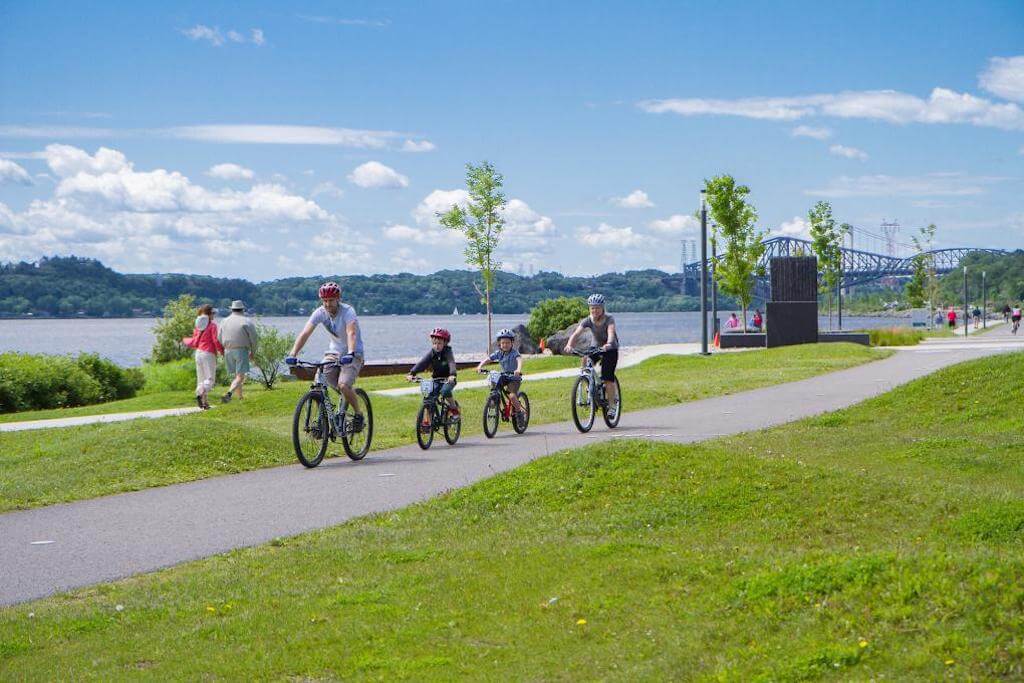
Quebec City cycling (photo: Stephane Audet, Destination Quebec)
3. Vancouver, British Columbia
Copenhagenize Index score: 50.3
Vancouver remains one of North America’s most recognizable cycling cities, though its latest ranking reflects a slight dip in momentum. Despite a well-established network, the city has faced challenges in extending comfort and connectivity beyond its downtown core.
The city benefits from a strong foundational network, including high-profile routes such as the Seawall, Stanley Park loop, and the Granville Connector, which combine off-street paths with physically protected lanes. These corridors attract both commuters and recreational riders and are widely recognized for their safety and scenic appeal. Vancouver’s network also incorporates low-stress neighborhood streets and greenways, supporting riders of varying confidence levels.
However, Copenhagenize notes that the city has experienced slower follow-through in rolling out protected infrastructure to outer neighborhoods, contributing to a modest decline in overall cycling modal share. There is also a persistent gender gap, indicating that infrastructure comfort has yet to reach “All Ages & Abilities” standards in many areas.
Policy support remains a strong point, with a Policy and Support score of 68.7, showing that the city’s institutions continue to prioritize cycling. Programs include traffic-calmed residential streets, integration with transit, and engagement with advocacy groups to plan for future expansion.
Vancouver demonstrates the challenges of maintaining leadership. Its legacy network and political support give it a strong base, but continued progress will require accelerating network expansion, improving connectivity, and extending high-quality infrastructure beyond the city center.
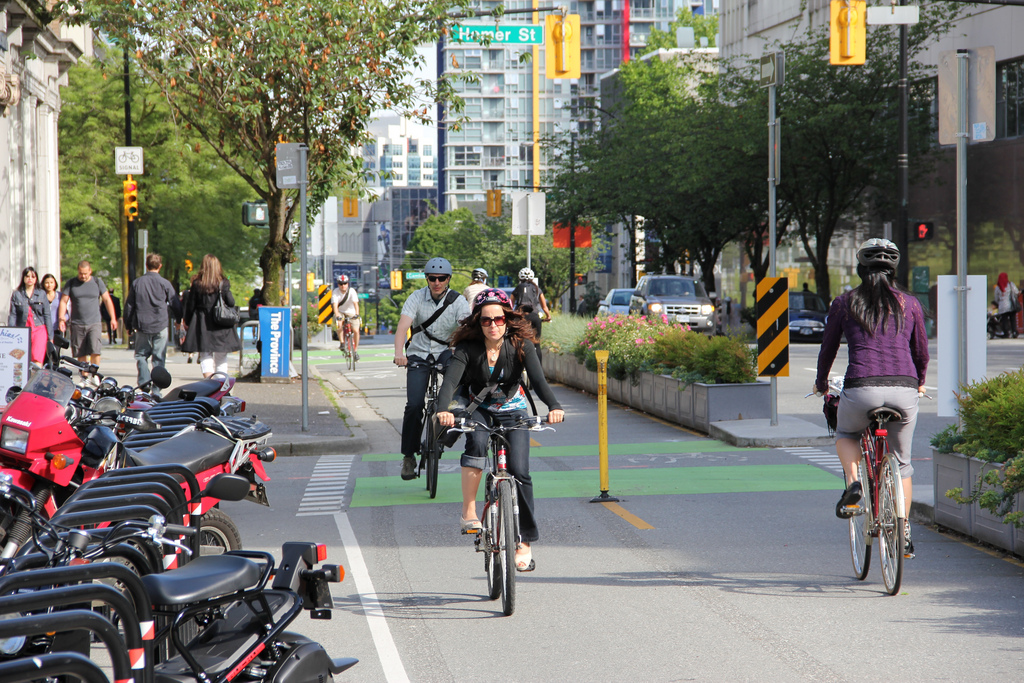
Dunsmuir Street, Vancouver, BC. Photo by Paul Krueger.
4. Portland, Oregon
Copenhagenize Index score: 49.1
Portland has long been one of the United States’ most influential cycling cities, and its recognition by cycling observers reflects decades of policy-driven investment in bike infrastructure.
The city is known for its dense network of neighbourhood greenways, physically protected bike lanes, and traffic-calmed streets that prioritize cycling and walking. These low-stress routes have helped normalize everyday cycling and integrate bikes into Portland’s broader transportation system.
Portland’s strength lies in its institutional memory—cycling has been a part of city planning for years, supported by clear design standards and consistent public engagement. It needs to push forward while it can. While growth has slowed in recent years compared to its early leadership phase, the city remains a reference point for North American bike planning, particularly in how residential streets can function as safe cycling corridors.
It has a bicycle culture that is a true asset, and has the potential to move up the rankings faster than any other American city.
5. Minneapolis, Minnesota
Copenhagenize Index score: 45.2
Minneapolis rounds out the top five as one of the most resilient cold-climate cycling cities in North America. Frequently cited for its high winter cycling rates, the city has demonstrated that year-round bike transportation is achievable with the right infrastructure and maintenance practices.
The city’s network includes protected bike lanes, off-street trails, and strong connections to transit, supported by consistent snow clearance on key routes. Projects like the Midtown Greenway have become national case studies in how separated cycling infrastructure can reshape urban mobility.
Minneapolis has also prioritized data-driven planning and equity-focused expansion, extending cycling comfort beyond the city’s core. Its presence on the Copenhagenize Index reflects a balance of usage, infrastructure quality, and long-term policy commitment—particularly impressive given its climate.