
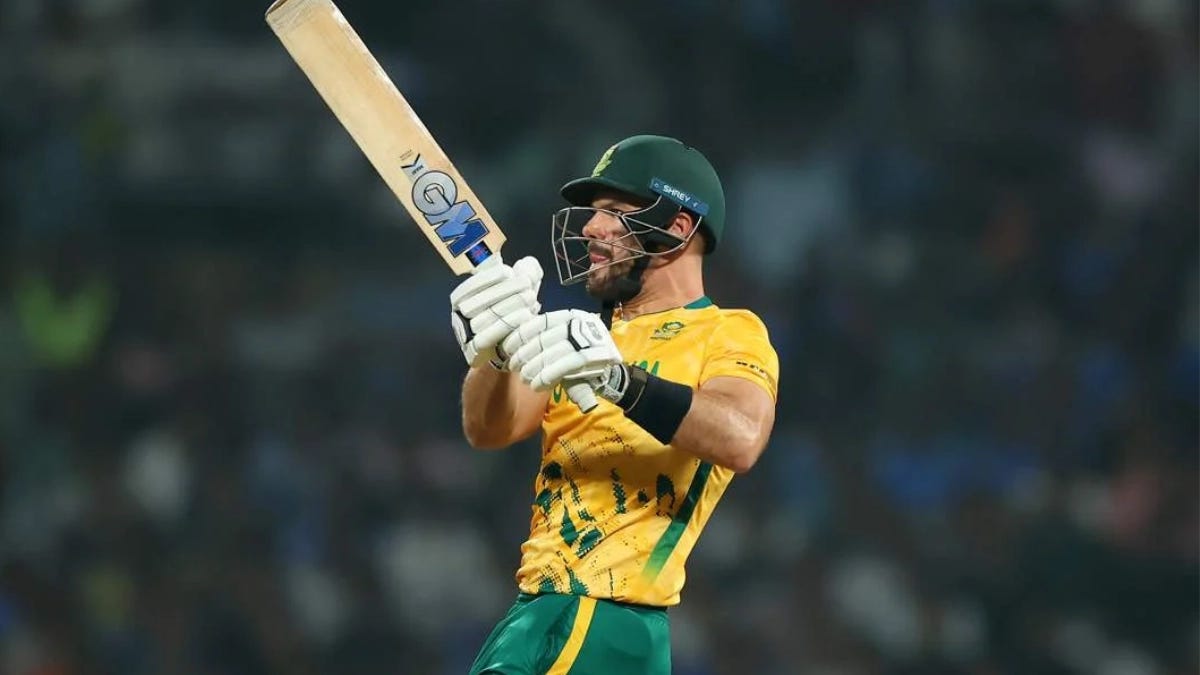
SA beat NZ by 7 wickets, but it was far more comfortable than that suggests. The game was over early, as NZ collapsed to 58/3 in the powerplay and never really recovered. Markram led from the front to seal the victory in style for South Africa.
But, what happened beyond the headlines?
If you’re reading this online, remember: you can get it via WhatsApp or direct to your email👇!
✍️ Written by Raunak Thakur, who runs Dead Pitch’s Society. Follow him on X.
On paper, there is no reason why NZ and SA should’ve started their innings so differently. Both sides’ bowling units operate in and around that conventional new-ball length, hovering at the top of off, occasionally fractionally fuller, rarely truly short, all while generating ample bounce on this Ahmedabad surface. And yet, NZ finished at 58/3, while SA got out at 83/1.
NZ’s first 6 overs carried a nervous rhythm. Despite the opening pair putting together 33 off 20, their scoring arrived in bursts rather than with any regularity. Tim Seifert’s first three balls faced set the tone: a lucky edge for boundary, another thick outside edge for a single, and a genuine play-and-miss in the channel. His control percentage tonight was a measly 44.4% while Finn Allen’s wasn’t much better at 64.7%.
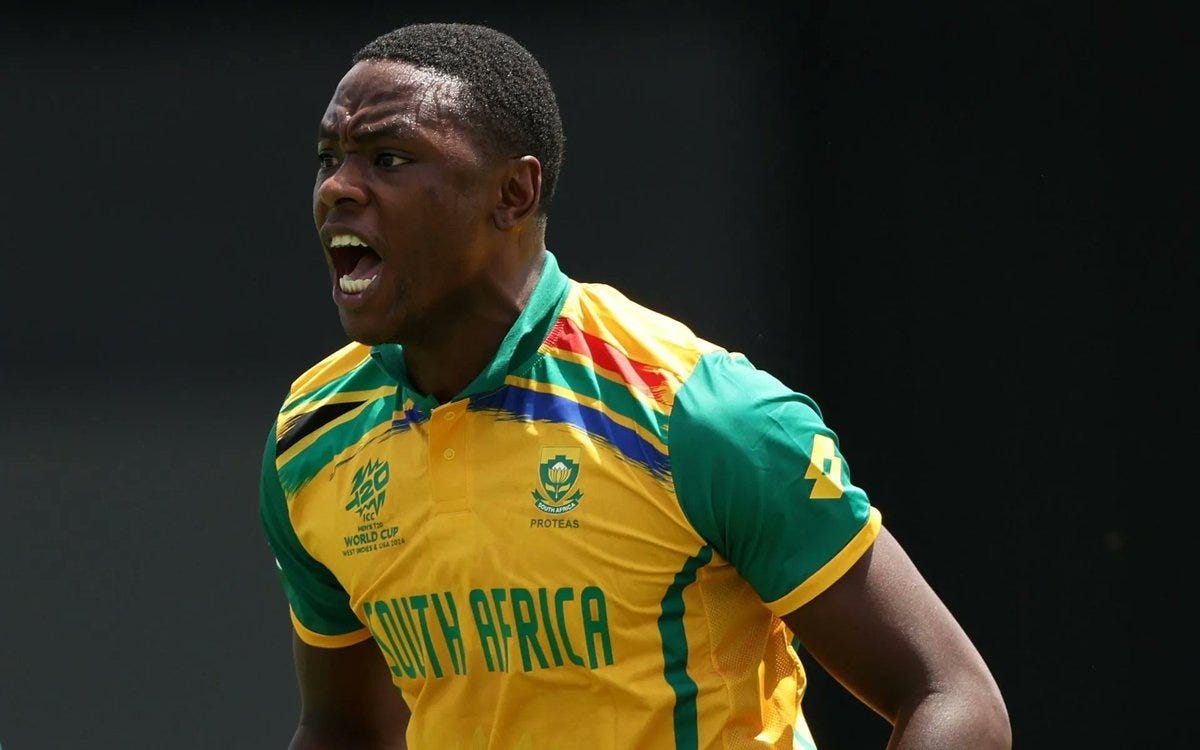
For SA, Lungi Ngidi conceded 25/0 in two, while Jansen went for 23/3 in his two. Both operated in the same short of good length bands, and both had overs where the ball was lofted for boundaries over the infield. The duo conceded a boundary every 2.67 balls, while Rabada conceded just one in his 12 powerplay balls. His 2-over spell went for just 9 runs, an economy of 4.50 in a phase where every other frontline seamer across both teams operated above 11 RPO.
He achieved this economic success via repeatability, rarely straying from the top-of-off corridor. Against right-handers, he angled the seam across and forced square contact rather than dishing out deliveries that could be driven through cover. Against left-handers, he adjusted the angle without gifting any width whatsoever.
The threat of the yorker prevented the batters from planting their front foot early. Shorter balls were aimed into the body instead of an easy off line that could be cut. There were little to no slot balls, minimal width, and few balls that could be met with the full face of the bat.
Rabada’s powerplay overs went at just 4.5 RPO, compared to Ngidi & Jansen’s 12 RPO. His spell slowed down the heartbeat of NZ’s heavy metal opening duo. The air thickened at one end, and the urge to break free drifted elsewhere, where it grew louder and looser, and hands started to reach a little more than they needed to.
Rabada’s run pressure compounded NZ’s uncontrolled shot selection, and gave Jansen the platform to pick up his wickets despite his own leaky bowling.
However, when SA walked out to bat, NZ had no such counterweight. Matt Henry conceded 24/0 in his two overs, Lockie Ferguson 23/1 in his two, and Duffy was taken for 36/0 in his two.
The trio also worked in the familiar powerplay length band, similar to Jansen and Ngidi. Henry was heavy on good length. Duffy attempted changes of pace and hard lengths. Ferguson mixed full and back-of-a-length deliveries, and used a slower leg-cutter for the sole wicket of the phase. NZ’s bowling was not particularly reckless, especially in comparison to the work of Ngidi & Jansen.
However, it didn’t account for the opponent at the other end of the pitch.
Aiden Markram is a top tier player of right-arm pace, and the numbers are unambiguous. Across his T20I career he strikes at 152 against right-arm seam. In 2025 that has risen to 164 with an average of 51. This year the strike rate stands at 193 and an average of 172. Right-arm pace at good length outside off is not a neutral match-up for him by any means, it’s his sweet spot.
NZ’s quicks repeatedly fed that zone.
By the end of the phase SA had struck eleven 4s and five 6s. In comparison, NZ scored six 4s and four 6s during their powerplay. That detail matters. An overabundance of 6s can distort the look of a powerplay total without signalling control, while 4s signal repeatable access to gaps. SA’s scoring was built on a strong foundation, rather than erupting from a base of chaos.
The pitch did not meaningfully change across the two innings and the good-length band did not transfigure itself either. The difference lay in who owned these phases with their tactics and execution.
By the end of NZ’s powerplay, they had lost three wickets and had consumed their margin for error. By the end of SA’s powerplay, they were in the driver’s seat and never gave up control.
Data from Cricmetric.
If you’re reading this online, remember: you can get it via WhatsApp or direct to your email👇!
✍️ Written by Tarutr Malhotra, who runs Best of Cricket.
South Africa were very good with the ball, limiting an explosive New Zealand batting order to just 175/7. They were exceptional with their strategy in the powerplay (conceding 58/3, including multiple lucky uncontrolled shots that beat the ropes), and their execution during the death overs (32/1).
However, they conceded 85/3 during the usually lean middle period of T20s, and conceded 52 runs from the 11th to 15th overs. It didn’t cost them today because NZ’s batting order collapsed with surprising ease – but SA’s bowling order confusion could cost them against better sides.
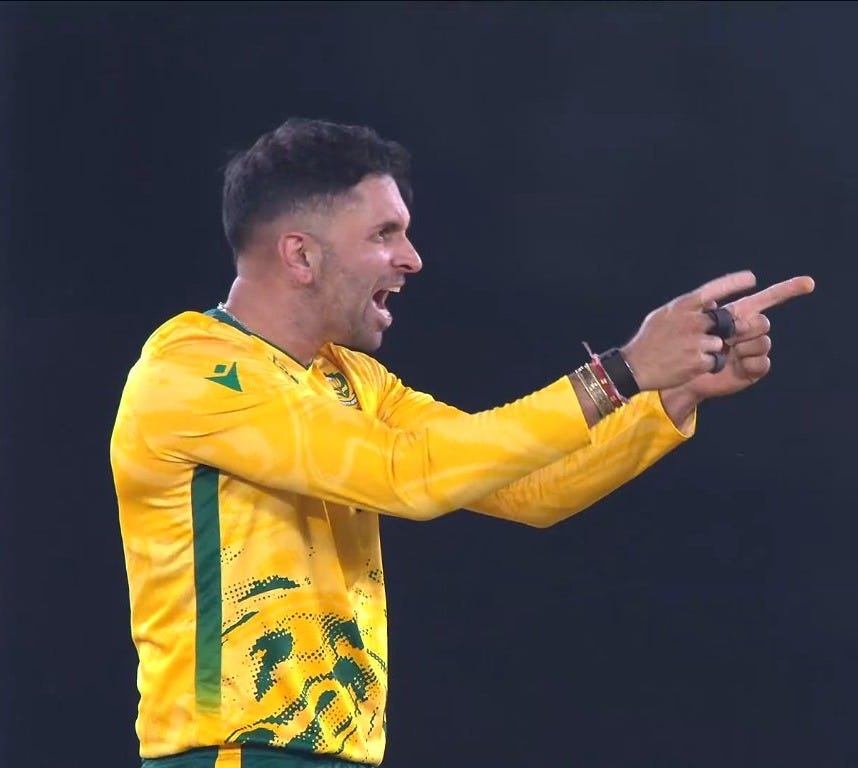
In the 10th over, Keshav Maharaj went for 9 runs and just a single boundary – which popped out of the diving fielder’s hands near the ropes – and then didn’t bowl again until the 15th over. The 5-over gap between his two spells was ridiculously expensive. In a game where NZ scored at just 8.75 RPO, SA conceded 10.4 RPO between the 11th and 15th overs – and part of the problem was the Proteas’ overanalysed fear of the wrong matchup.
Mark Chapman is a left-handed bat who feasts on SLAs like Maharaj. He strikes at 137.4 and has lost just 15 wickets to them in his entire T20I career. Today, he scored 19 off 8 v the Protea SLA in 2 overs. However, that overall stat is misleading.
In the first over (SA’s 8th over), Maharaj bowled a couple of wrong lines and lengths and was hit for 11 off 3 by Chapman (though he did pick up Glenn Phillips’ wicket between boundaries). In the second over (SA’s 10th), Maharaj went at 8 off 5 v the left-hander, and the only boundary of the over was nearly a catch near the ropes.
This is the first time this match-up has ever occurred in any T20, and the experienced bowler was getting a sense of how to handle the Kiwi middle-order bat. You could see it in the stats, and you could see it with your eyes. However, the looming fear of a “bad matchup” saw Maharaj pulled from the rotation.
Instead, we saw 4 different pacers take the ball – a bowling type that Chapman scores at 154.3 against in T20Is – and a single over of off-spin by skipper Aiden Markram. Chapman’s partner in the middle, Daryl Mitchell, has scored at 210.7 against off-spinners since the start of 2025. The Protea captain’s single over tonight read 15 runs conceded with two 6s.
But, maybe it’s a coincidence. Maybe Maharaj just wasn’t considered the best choice for SA’s middle overs. There are two reasons why that is unlikely. The first is that Maharaj was brought back immediately after Chapman holed out. The second is because Maharaj has been SA’s premier middle overs bowler at the World Cup.
He bowled 4 overs in a row v AFG taking 27/1 at 6.75 in the period, while the other 5 overs went for 56 runs at 9.33 RPO. Similarly, he went for 24 runs at 8 RPO v Canada in the middle overs, when everyone else went at 8.33. In both games, he bowled the most middle overs of any SA bowler. In both games, his overs slowed the batters down, created run pressure, and helped the rest of the bowling unit catch a breath.
So, why am I going on and on about a hunch about a bad matchup in a game that SA ultimately won with great ease? Because, it messed up their entire bowling order, and had knock on effects that would have had major consequences on another day.
Lungi Ngidi and Kagiso Rabada had wasted overs in the middle, and didn’t have enough left to cover the death between them. Marco Jansen – the in-form strike bowler tonight – was held off for almost the entire middle phase when SA desperately needed a wicket because the use of the other frontline pacers meant Markram needed to save someone for the death.
SA’s 4th choice pacer, Corbin Bosch, is not even a regular in the XI, but was asked to handle two death overs tonight (including the 20th). Maharaj was so underutilised, he finished the game with just 3 overs completed because SA don’t often bowl spin at the end.
Against NZ’s tailenders, this didn’t matter. Not having the economy of Rabada or the striking potential of Ngidi to create pressure in the death didn’t matter. Bosch’s relatively tame deliveries looked elite because he was facing bowlers asked to do a job with the bat. The unnecessarily expensive middle overs – and the underutilisation of SA’s most economical bowler – didn’t matter because SA’s batters finished the job off in style.
But against a team like India – who they will inevitably have to go through for the title – those small differences matter. And, at some point, you have to trust that your best players are the elite outliers who can find a way to overcome matchup weaknesses. After all, if you’re not good enough to defy the odds, you’re not good enough to win the World Cup anyway.
Data from Cricmetric.
If you’re reading this online, remember: you can get it via WhatsApp or direct to your email👇!