
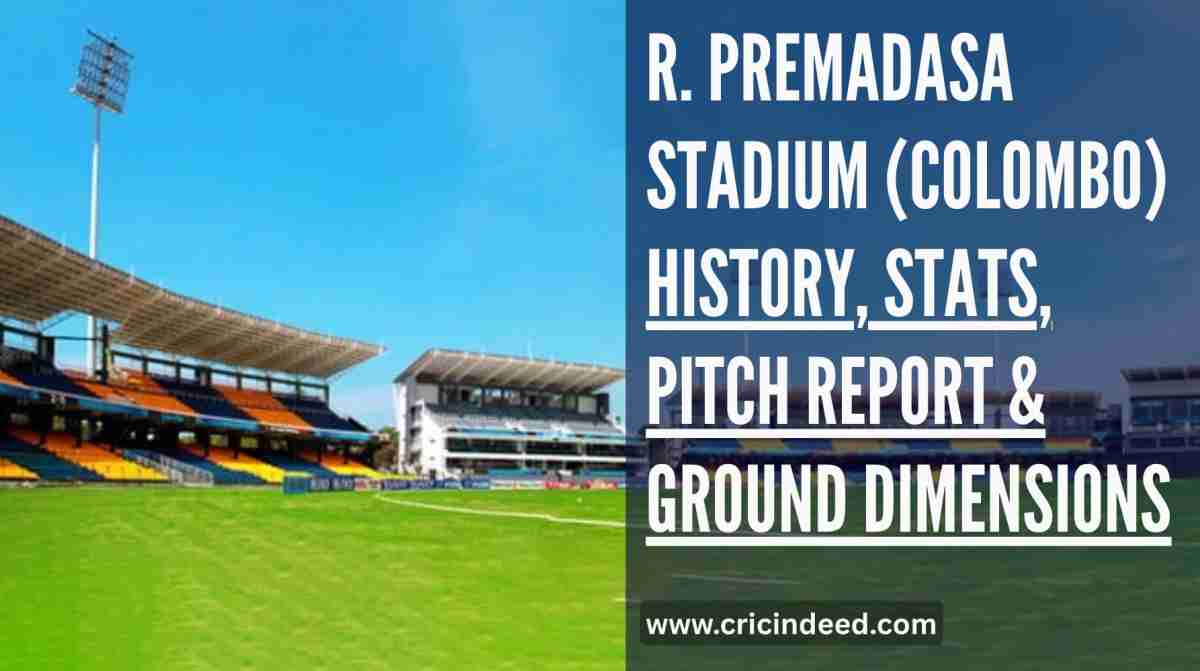
R. Premadasa Stadium in Colombo is Sri Lanka’s largest cricket venue and one of Asia’s most tactically complex white-ball arenas. Known for spin-assisting surfaces, heavy evening dew, and chase-friendly T20 patterns, it has hosted World Cups, Asia Cups, and some of the sport’s highest ODI totals.
It looks calm. It rarely is.
What Is the History of Colombo’s Premadasa Stadium?
R. Premadasa Stadium, formerly known as Khettarama Stadium, was established in 1986 and renamed after Sri Lankan President Ranasinghe Premadasa. With a seating capacity of approximately 35,000, it is Sri Lanka’s largest cricket ground and a regular host of ICC tournaments, Asia Cups, and bilateral series.
Built in Colombo’s Maligawatte district, the venue quickly became Sri Lanka’s white-ball headquarters.
It has witnessed:
- ICC Cricket World Cup fixtures (1996, 2011)
- ICC T20 World Cup matches
- Asia Cup tournaments
- Countless India–Sri Lanka and Pakistan–Sri Lanka contests
The ground matured alongside Sri Lanka’s golden generation. Think Sanath Jayasuriya launching inside-out lofted drives. Think Muttiah Muralitharan bending matches with relentless off-spin.
Premadasa became less a stadium and more a laboratory for subcontinental cricket.
What to expect at RPS Colombo in White Ball Contests?
Let’s separate formats.
ODI Snapshot
- Average first innings: 260–280
- Highest totals: 350+ recorded multiple times
- Successful chases above 300: Achieved on several occasions
- Spin accounts for a significant share of middle-overs wickets
T20 Snapshot
- Average first innings: 150–160
- Winning trend: Teams batting second win roughly 65–70% of night games
- Powerplay scoring: Crucial for momentum (40–50 par start)
Numbers tell a story. Dew tilts it.
What Makes the Premadasa Pitch Unique?
The Premadasa surface is traditionally black-soil based, offering early seam movement and bounce before slowing considerably as the match progresses. Middle overs favor spinners as the ball grips and turns, but heavy evening dew often flattens the pitch during second innings, aiding chases.
First ten overs? Assistance for seamers. Overs 7–15? Spin territory. After sunset? Skid.
The surface evolves in three acts:
1. Powerplay Phase
- Light seam movement
- Carry through to wicketkeeper
- New-ball swing under humidity
2. Middle Overs
- Reduced pace off the surface
- Increased grip for finger spinners
- Batsmen forced into strike rotation
3. Night Dew Phase
- Ball becomes slippery
- Spin loses bite
- Stroke-making becomes easier
This is why captains overwhelmingly choose to field first in T20 cricket here.
Control first. Chase later.
How Significant Is the Dew Factor?
Evening dew at Premadasa materially changes match dynamics. The wet ball skids onto the bat, neutralizes spin grip, and makes bowling difficult in the second innings. This creates a statistical edge for teams chasing under lights.
Floodlights intensify condensation. Outfield moisture quickens boundaries.
Spinners struggle to:
- Maintain revolutions
- Control length
- Grip the seam cleanly
Batsmen, meanwhile, trust the bounce.
This environmental variable makes Premadasa a venue where toss decisions carry strategic weight.
What Are the Ground Dimensions?
Premadasa Stadium features relatively short square boundaries and moderate straight boundaries, encouraging calculated aggression once batsmen settle. The playing area typically ranges between 65–70 meters square and 70–75 meters straight, though rope placement varies by tournament.
Short square boundaries reward:
- Sweeps
- Cuts
- Pick-up pulls
Straight hits demand timing rather than brute force.
The compact dimensions amplify:
- Powerplay intent
- Death-overs finishing
- Left-right batting combinations
Small margins. Large consequences.
Which Iconic Performances Define the Venue?
Premadasa has hosted landmark innings and bowling spells that reflect its tactical diversity—high-scoring ODI epics and spin-dominated chokeholds alike.
Sri Lanka’s aggressive era flourished here. Jayasuriya’s early overs demolition reshaped ODI batting philosophy. Muralitharan turned matches inside out during middle overs.
Visiting teams learned quickly: survive spin, manage dew, finish clinically.
Chasing Advantage: Historically, teams chasing have had a slight edge, winning 28 out of 51 matches at this venue.
Spin vs. Pace: The pitch is known for assisting spinners, who have taken 282 wickets at the ground compared to 323 by pacers. Recently, in the T20 World Cup 2026, spinners have maintained a tight economy rate of roughly 6.25.
India’s Dominance: India has a stellar record at RPS, winning 11 out of 15 T20Is played here.
Average Score: The average first-innings score at the stadium is approximately 152, though it has climbed to 158 in recent tournaments.
What Are the Key International Stats at Premadasa?
Premadasa Stadium is historically high-scoring in ODIs but tactically nuanced in T20s. First-innings ODI totals frequently exceed 270, while T20 scores typically range between 150–165 depending on dew and surface wear. Chasing sides enjoy a measurable advantage in night matches.
Key ODI & Test Stats at R. Premadasa Stadium (Data as of February 15, 2026)
| Record Category | Statistic | Player/Team |
|---|---|---|
| Highest Test Score | 952/6 dec | Sri Lanka vs. India (1997) |
| Highest Individual Test Score | 340 | Sanath Jayasuriya |
| Highest Individual ODI Score | 169 | Kumar Sangakkara |
| Best ODI Bowling Figures | 7/19 | Wanindu Hasaranga |
| Most ODI Wickets at Venue | 75 | Muttiah Muralitharan |
Key T20I Statistics at R. Premadasa Stadium (Data as of February 15, 2026)
| Category | Record | Player/Team |
|---|---|---|
| Highest Team Total | 215/5 | Bangladesh vs. Sri Lanka (2018) |
| Lowest Team Total | 80 | Afghanistan vs. England (2012) |
| Highest Individual Score | 99* | Luke Wright (England) vs. Afghanistan (2012) |
| Best Bowling Figures | 4/9 | Wanindu Hasaranga (Sri Lanka) vs. India (2021) |
| Most Career Runs | 442 | Kusal Perera (Sri Lanka) |
| Most Career Wickets | 24 | Wanindu Hasaranga (Sri Lanka) |
| Highest Run Chase | 215/5 | Bangladesh vs. Sri Lanka (2018) |
5 Iconic Matches at R. Premadasa Stadium
Sri Lanka vs. India (Test, 1997): The World Record Total
In a match that rewrote the record books, Sri Lanka posted 952/6 declared, the highest team total in Test history. Sanath Jayasuriya scored a monumental 340, and he shared a then-world-record partnership of 576 runs with Roshan Mahanama (225).
Sri Lanka vs. West Indies (T20I, 2012): World T20 Final
This stadium hosted the final of the 2012 ICC World Twenty20, where the West Indies defeated the hosts to claim the title. It remains one of the most significant T20 matches played at the venue, which has hosted 15 matches from that tournament.
Sri Lanka vs. New Zealand (ODI, 2011): World Cup Semi-Final
A high-stakes encounter where Sri Lanka defeated New Zealand by 5 wickets to reach the 2011 Cricket World Cup final. The stadium was extensively renovated for this tournament, increasing its capacity to approximately 35,000.
Sri Lanka vs. India (ODI, 2002): ICC Champions Trophy Final
The final of the 2002 ICC Champions Trophy was held here, famously resulting in the title being shared between Sri Lanka and India after rain washed out the match on two consecutive days.
Sri Lanka vs. England (ODI, 2011): World Cup Quarter-Final
In another dominant World Cup performance, Sri Lanka thrashed England by 10 wickets, chasing down 230 without losing a single wicket—the first time England had ever lost a World Cup match by such a margin.
Is Premadasa Batter-Friendly or Bowler-Friendly?
Premadasa is condition-dependent rather than format-biased. ODIs trend batter-friendly, particularly in daylight. T20 matches begin balanced but frequently tilt toward chasing sides due to dew and smaller boundaries.
It is neither flat paradise nor spin minefield by default.
It is situational.
Captains must read:
- Humidity levels
- Cloud cover
- Surface dryness
- Match timing (day vs night)
The venue punishes static strategy.
What Should Viewers Watch For During a Match?
To understand a game at Premadasa, monitor the toss decision, early seam movement, and dew intensity after sunset. These three variables largely determine scoring patterns and momentum swings.
Observe:
- New-ball behavior in first 3 overs
- How sharply the ball grips by over 10
- Outfield sheen under lights
If dew sets early? Chasing team smiles.
If surface stays dry? Spin dictates.
Why Does Premadasa Matter in Global Cricket?
As Sri Lanka’s premier cricket ground and a frequent ICC tournament host, Premadasa symbolizes subcontinental white-ball cricket—where spin, climate, and tactical depth outweigh brute pace.
It reflects the region’s cricketing DNA:
- Skill over speed
- Calculation over chaos
- Patience over panic
A venue that evolves each innings. A surface that demands intelligence.
Premadasa is not just a stadium in Colombo.
It is a chessboard under floodlights.
Next: Mumbai Wankhede Stadium – In Focus