
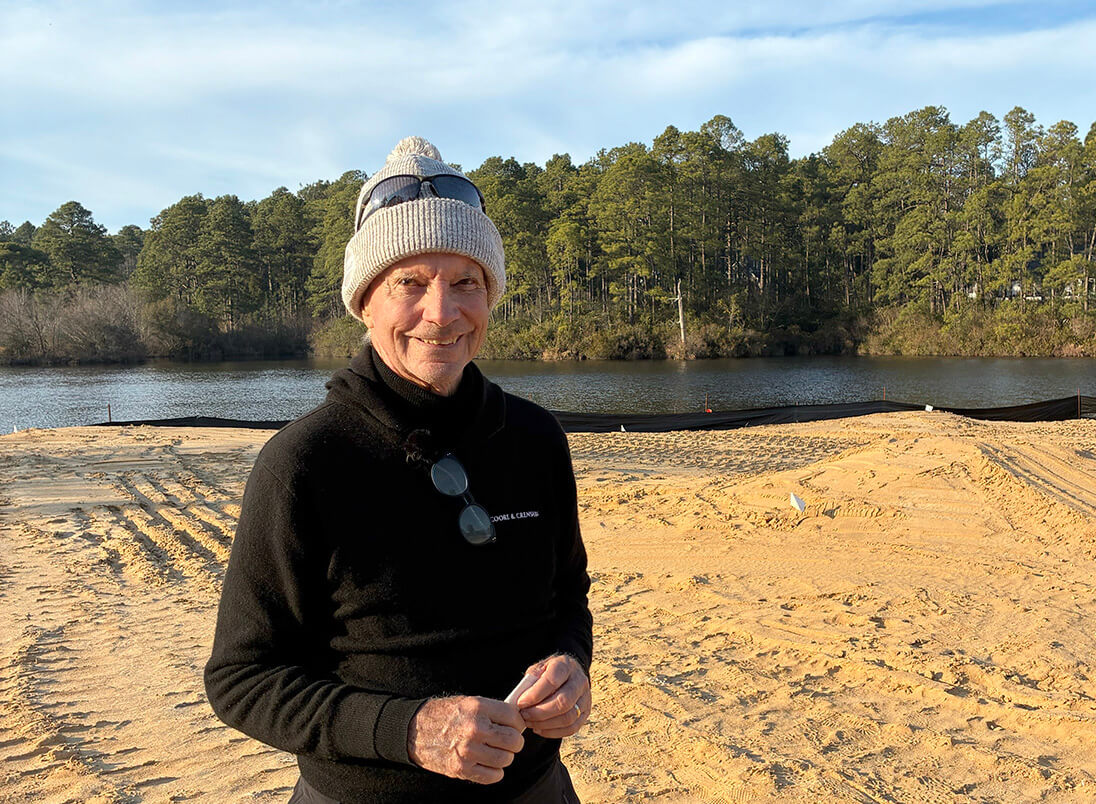
Standing in what will be the first fairway at No. 11, Coore looks up toward the green site in the distance where a slightly leaning flagstick is dug into the ground. There is a substantial rise in front of the green that includes a pair of dug-out holes that will become ragged-edged bunkers to stop shots that come up short from rolling back down into the fairway.
Coore remembers wondering if some – owner Dedman included – might think the hill on the first hole was too much. He got his answer when Dedman looked up from the fairway and told him, “I love the second hole at Pine Valley and this is nowhere near that severe.”
It is like a house in the framing stage, a skeleton of lumber waiting for walls and all of the finishing touches. The roughed-out fairway was the driving range for The Pit years ago and the bulldozers have unearthed a few old practice balls, whitish gray with red stripes around them. When a shaper took down a nearby cedar tree, he found approximately 40 old range balls in the debris.
The ground is imprinted with tracks left by the heavy equipment and, in places, the sand crunches like stepping on dry cookies as Coore walks. He marvels at what the crew and their machines can do, deflecting much of the creation credit to them, saying he and Crenshaw feel more like editors than authors at times.
Except for a handful of corridors where golf holes were years ago, this golf course is being carved out of an overgrown sand mine, property freckled with humps and bumps where trees have grown up from waste piles and, in other spots, where there was little more than unspoiled pine forest.
“He is constantly looking for a site that is different. That’s why he is so excited about No. 11. It has all these random mounds. I don’t know if there’s ever been a course built like that,” says Ryan Farrow, a design associate who has been with Coore & Crenshaw for nearly a decade.
“Whenever we are out here, he is so whimsical in a way. He doesn’t want to repeat himself so he’s pretty slick.”
This is where Coore summons an organic artistry, seeing through the trees and beyond the ridges, creating more than computers and maps can.
“It’s a little like trout fishing,” Dedman says. “You can be out there for hours and see the beauty of it.”
Coore pauses and looks around, offering a quick aside about why the layout follows the path it does, explaining there is a patch of “uninteresting” land near the fifth and sixth holes he wanted to avoid.
“We have [topographical] maps but we’re still pretty much dinosaurs in that regard,” he says. “You can read the topo maps and you can get some conceptual ideas from those but, more than anything, it’s just coming out and walking through the woods, particularly during the winter when there are no leaves on the trees.
“There’s an app with GPS that tracks where you go and you can drop little pins if you find interesting spots and if you don’t know where you are. For us, it’s still pretty much the old-fashioned way. You walk through there and say this feels like a golf hole.”
No. 11 begins to show its character on the second tee.
“Right here, it’s like ‘hello,’” Coore says with a small smile. “This is where you see the randomness of nature.”
The second hole will be a gentle dogleg right playing around a ridge line that intrudes at the corner of the dogleg. Not far away, there will be small mounds that will ask players to go right, left or over them before approaching a green tucked in among more mounds and ridges that will retain their scruffy, natural look when the course eventually opens.

Coore calls it engaging with the more interesting land.
“Out here walking, you get a sense,” he says. “You start to connect the dots with no preconceived notions, oh it’s got to be a par-4 or a par-5, it has to be a par-72. You go find what you think, and it’s a judgment call, [what] are the most interesting holes and let the golf course play out, par-70, par-73, whatever.
“A lot of people do it on computers and you can visualize with 3D. For me, I’m just old-fashioned. I like to see what’s behind it, not just what’s right here. What’s in the distance? What do you see?
“The idea is here, nestled down in these piles. It’s what people look at.”
As Coore walks on through the front nine, he points out low sandy spots that, once a couple of trees are removed, will become bunkers. He points to sharp ridges, some that remained there when the sand around them was dug out and others that were the result of debris that was left in a stack, only to regenerate with trees and ground cover through the years.
“We didn’t create the landforms. We found the landforms and tried to make the golf course fit within it.” — Bill Coore
“Bill reminded me of the French sculptor Maillol who, between the world wars, was able to capture classic beauty in design with female nudes,” Dedman said. “Bill harkens back to classic design features, back to Old Tom [Morris] and [Donald] Ross. I love that we are moving back to the classic style.”
It’s those random features that will ultimately separate No. 11, quirky landforms that were never intended for a golf course but will now define one like birthmarks. Coore stands and wonders aloud about one day finding a piece of land and turning a group of guys loose on bulldozers, telling them to make a mess of the place and then letting the property sit untouched for 25 years before coming back to build a golf course.
“In some ways, this is a little like that,” Coore says. “We didn’t create the landforms. We found the landforms and tried to make the golf course fit within it.
“Through the decades these trees have grown out of the piles. That’s what makes it amazing. If it weren’t for the trees and the vegetation, you could look at some of these landforms and go, oh they made that … they wanted to go make something super dramatic and they wanted to make it look like it was Ireland. We didn’t make that.”
Coore will sketch out the idea for each hole but “once we get out here we don’t use it,” Farrow says. “So much of it is a reaction to what he sees.”
Subtraction becomes addition in places.
“Really the worst thing you can do is to try and force the golf course into some preconceived notion,” Coore says.
Because Crenshaw is less inclined to travel these days, Coore does much of the on-site work. They share the same design sensibilities and rarely have strong disagreements. When they do, one will always give in to the one with the strongest conviction.
Coore recalls, early in their work together, getting a call from Crenshaw, who had toured the site of what became Kapalua’s famous Plantation Course on Maui. It’s one of the most spectacular sites anywhere with 460 feet of elevation change as the course plays up and down a mountain and along gorges.
“I remember Ben calling saying he’d been there with Mark Rolfing and they had a couple of Coronas sitting where the clubhouse now sits. I asked him what the property was like and he said, ‘It rises gently from the sea,’” Coore says.
“When I finally went out there and actually saw the (famously hilly) property, I said to Ben, ‘How many Coronas did you guys have?’”
Together, they found a way to turn a pineapple farm into one of the most dramatic layouts in the world.
During one of Crenshaw’s visits to their new course in Pinehurst, they arrived at what will be the 17th hole. When Crenshaw asked where the hole would be, Coore admitted he wasn’t sure.
“Somewhere through these thousand piles of stuff,” Coore said.
That’s how it happens. Walking the property then walking it again and again and again until it reveals itself.
“He has an art, a trait that not many people have,” Crenshaw says. “He can assess a piece of property pretty quickly and he arrives at a conclusion that this is the way we should go. He has an unbelievable capacity to route natural golf holes across a property.”
As the sunlight begins to slant across this elaborate work site, Coore has returned to the ninth green where he spent most of his morning. He studies the edges of what will be a green, considering where to pull the edges out and pull them in. He decides to soften a portion near the middle of the putting surface but that can wait until tomorrow.
Standing near the old clubhouse, Coore can see down the hill into the first fairway where a big truck loaded with debris is making its final trip of the day in the dying light.
As the truck drives away, it leaves behind a cloud of dust in the wind.
And Bill Coore, his black outfit dusted from the day, watches it go.