

Cyclists Hub is supported by its readers. We may receive a commission if you buy products using our links.
All content on Cyclists Hub is written by humans, not robots. Learn More
If you are buying a new wheelset, you might encounter two hub flange designs: closed and open. There are horror stories surrounding the open hub flange design, as it can lead to complete loss of spoke retention, potentially causing a sudden, catastrophic wheel collapse in a crash or hard impact.
In this article, I’ll walk you through how both systems work, where open flanges make sense (especially with carbon spokes), and when you’re better off choosing a safer, closed or “captured” design.
KEY TAKEAWAY
Open hub flanges are common on wheels with carbon spokes and can offer weight and manufacturing advantages. However, they rely heavily on spoke tension and, without a proper capture system, may not retain spokes well in extreme situations.
Closed flanges (or open designs with an effective spoke-capture solution) add a bit of weight but provide better structural integrity and keep spokes in place even after damage. For most riders, they are the safer and more robust choice. That’s one reason why many manufacturers, especially Chinese brands, are moving away from fully open flanges toward closed or semi-captured designs.
What Hub Flanges Do
Hub flanges are the parts of the hub where the spokes attach. They transfer load between the hub and the rim and significantly affect wheel strength and stability.
Closed or enclosed flanges, without large cutouts, are usually heavier. In return, they offer better structural integrity and reduce stress concentrations around the spoke interface.
Because the flange supports the spoke head or threaded end, its design also affects long-term durability and the wheel’s behavior after spoke damage or failure.
Open (Cutout) Flange Hubs
Open, or cutout, flanges have windows or slots that expose the spoke heads or ends instead of fully enclosing them.


On some designs, especially older steel-spoke systems, an open flange combined with simple J-bend or large-head spokes can allow a spoke to be ejected if tension is suddenly lost, such as after a crash.
In open flange hubs, if several spokes fail and opposing tension disappears, the remaining spokes can rotate or “spin out” of the hub shell. There is no mechanical stop to keep them in place. This can lead to complete loss of spoke retention and rapid wheel collapse.
Wheels with open or cutout flanges that lack any capture system rely mostly on spoke tension and flange geometry to keep spokes seated. In rare but severe events, hard pothole impacts, bike-to-bike contact, or crashes, multiple spokes can detach at once.
This failure mode is uncommon in everyday riding, but it is real. It has led to recalls and design changes in the past, particularly on high-end aero wheels.
Open Flanges and Carbon Spokes
Modern carbon road wheels are where open flange issues are most relevant. Carbon spokes are usually wide, making them impossible to insert through small, fully closed holes.


The downside is that, in many of these designs, there is no true mechanical capture if tension is lost. This problem mostly affects carbon-spoke wheels. Steel-spoke hub manufacturers learned long ago that fully open flanges without retention can be problematic and largely abandoned them.


On open-flange carbon hubs, losing a few spokes in a crash can allow the remaining spokes to sequentially eject from the hub as the wheel deforms and rotates.
Open Flange Solutions that Might Work
Nepest uses a patented open-hub flange design on its NOVA wheels that aims to address some of the traditional weaknesses of open flanges. Instead of relying purely on spoke tension, Nepest’s system shapes the flange windows and spoke interfaces so the spoke heads are partially captured within the hub shell. Even though the flange is visually open, the spokes sit deeper and are guided by the flange geometry, helping prevent them from freely ejecting when tension drops.


This approach keeps the weight and assembly advantages of an open flange, while improving spoke retention compared to fully open, window-only designs.
That said, it is still fundamentally an open flange system. In extreme crash scenarios, it cannot offer the same level of mechanical security as a fully closed or threaded capture design. It’s best viewed as a safer evolution of the open-flange concept rather than a full replacement for closed flanges.
TIP: Based on my discussion with Patrick Clark, co-founder of the wheel brand Particle, who has deep insider knowledge of Chinese wheel factories, it is wise to stay somewhat skeptical of patent and aerodynamic claims or impact test results, especially when they come from Chinese brands.
Closed (Enclosed) Flange Designs
Closed-flange designs keep the spoke head or threaded end fully enclosed by material. Even if spoke tension drops, the spoke cannot simply fall out. In some modern systems, spokes even screws into the hub flange using a threaded insert. The threads act as a positive capture mechanism, keeping the spoke seated even when it is cut or loses tension.
However, this system can be prone to spoke twisting, loss of tension, and getting out of the most aerodynamic orientation.
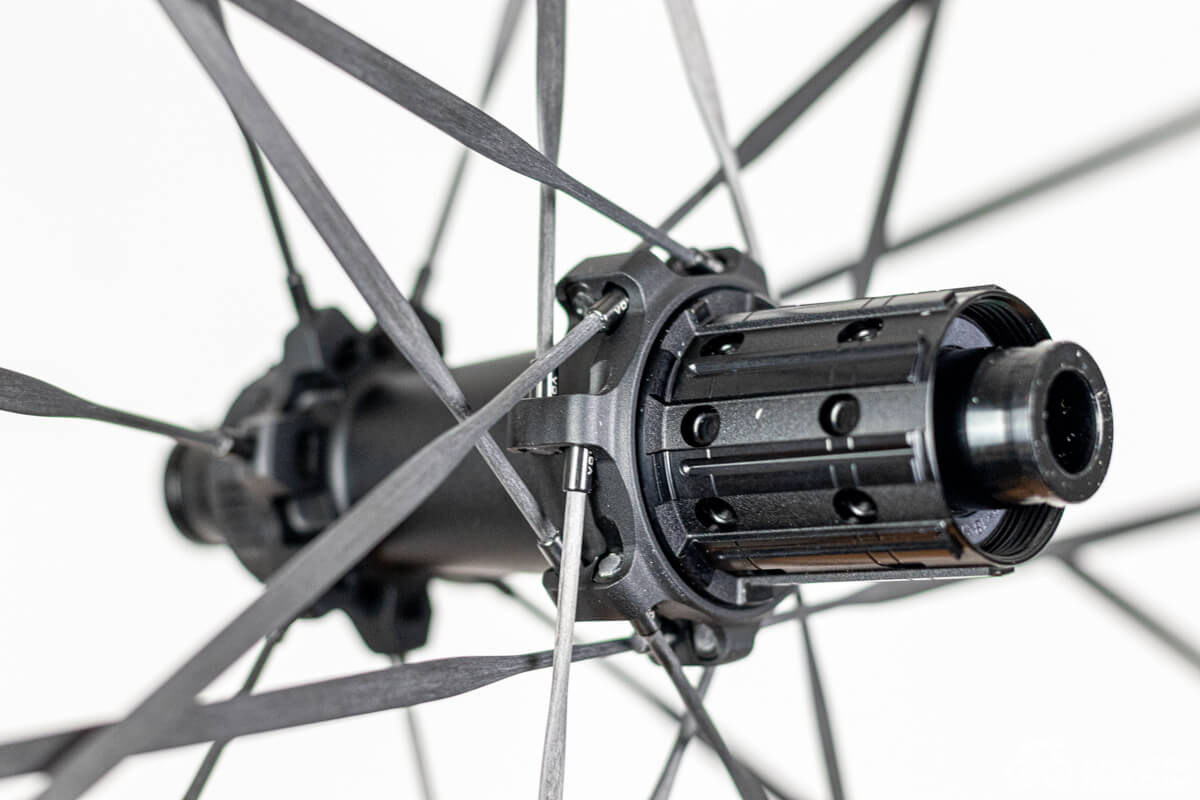

Closed flanges are usually heavier because they use more material. However, they distribute the load more evenly and avoid sharp stress points that are common in open-flange designs (see the image below).

In the following demonstration, wheel builder and Caden Wheels founder Ben Cawood cuts two carbon spokes on a front wheel and then rides uphill out of the saddle at around 95 kg body weight. Despite the missing spokes, the remaining spokes stay in the hub, and the wheel remains rideable.
This shows the key safety advantage of closed or captured flange systems: the wheel can deform and lose local tension without immediately ejecting spokes from the hub.

Conclusion
Open flanges with carbon spokes were originally popular because they made lacing and spoke replacement easier. They were also lighter and looked better on a spec sheet.
However, several well-known Chinese brands, including Winspace (Lún) and Elitewheels, have moved away from open-flange designs used in their early generations. Complete wheel failures are rare, but I think this shift is a good thing.
When it comes to wheels, I’ll happily accept a few extra grams in exchange for better spoke retention and a lower risk of catastrophic failure. I’m also glad that the manufacturers listened to feedback from reviewers like Peak Torque and adjusted their designs accordingly.
I also updated my past wheel reviews to include this information. I clearly point out which flanges each wheelset uses so you can make a more informed decision.
If you are in the market for a new wheelset, I recommend checking out my in-depth guide on how to choose road bike wheels.