
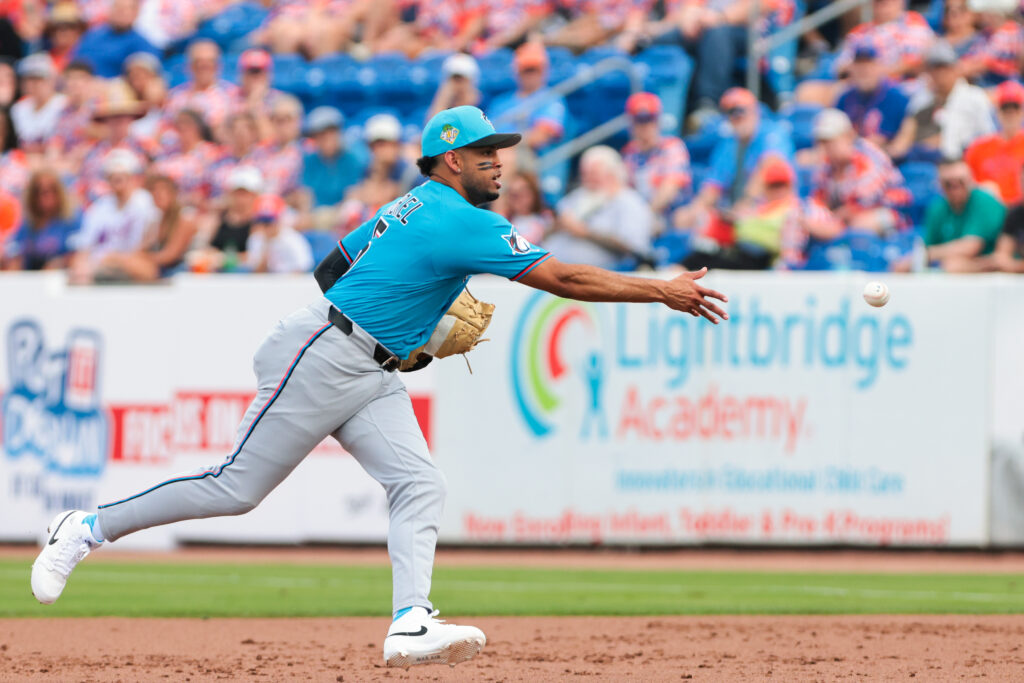
Stop me if you’ve heard this one before: the Marlins dipped a toe into free agency but didn’t commit to anything substantial. Their larger moves were trades of established pitchers for controllable young talent, as the team continues to chase the ever-elusive idea of a “sustainable,” cost-controlled core.
Major League Free Agent Signings
Trades and Waiver Claims
Minor League Signings
Extensions
Notable Losses
The Marlins closed out the 2025 season with a 56-50 record over the final four months of the year. That wasn’t enough to erase a poor start to the season, but Miami’s 79-83 record overall was good for a third-place finish in the National League East — a surprisingly strong result for a club whose biggest moves of the preceding offseason were trading away Jesus Luzardo and Jake Burger. Right-hander Cal Quantrill, who didn’t even finish the season on the roster due to his significant struggles, was the only veteran free agent addition for Miami last winter.
That strong four-month stretch ensured at least something of a different tone this winter, though the Marlins didn’t fully commit to pushing into a win-now mentality. The third offseason for president of baseball operations Peter Bendix and second for manager Clayton McCullough was punctuated by a handful of free agent pickups but also saw the Fish continue trading from their perennially strong collection of starting pitching depth.
Miami entered the offseason with needs at first base, in the bullpen and in the outfield. They were each addressed to varying extents, but in typical Marlins fashion, those solutions generally came in the form of low-budget transactions. Miami jumped early to bring slugger Christopher Morel into the fold after he was non-tendered by Bendix’s former Rays club. Bendix was the general manager in Tampa Bay, but he was out the door by the time the Cubs traded Morel to the Rays as part of the Isaac Paredes return in 2024. It stands to reason that the Rays’ interest in Morel dated back several years to when Bendix was their GM, and he’ll now get his hands on a player with big power but also alarming strikeout concerns and no true defensive home.
The Marlins are rolling the dice on Morel as their primary first baseman — a position he’s never played before. (Insert your “Tell ’em, Wash” jokes here.) Morel has huge pull-side power and comes to Miami on just a $2MM salary with three seasons of club control remaining. If they can coax a breakout, he’ll be a bargain for them, though it’s also fair to wonder whether he’d play out all three seasons with the perennially frugal Fish in that scenario. Tapping into that raw power and unlocking a full-fledged breakout would likely lead to substantial arbitration raises, so even if Morel can finally put it all together, his price tag down the road in 2028 might prove steep enough that Miami deals him before his final arbitration season.
While Morel was the first to sign, the Bendix-led Marlins made it clear early on that former Rays closer Pete Fairbanks was a target. Fairbanks’ $11MM club option being declined by Tampa Bay rated as at least a mild surprise, and he was met with robust interest early on. In the end, it was the Marlins who bid $13MM to install Fairbanks at the back of their ‘pen, giving McCullough the sort of established closer he lacked in 2025, when six Marlins players logged between three and 15 saves. It’s the largest one-year salary the Marlins have ever given to a reliever. Fairbanks will be able to remain in Florida and continue piling up saves in a pitcher-friendly setting, making it a sensible move for all parties.
Also joining the Miami pitching staff are right-hander Chris Paddack — a former Marlins prospect — and lefty John King. Paddack will step into the rotation on the heels of a career-high 158 innings pitched but also the second-worst ERA (5.35) of his seven-year run in the big leagues. The former top prospect’s brilliant 2019 debut with the Padres is a distant memory, but he’ll pitch all of 2026 at 30 years old and brings some of the best command in baseball (career 5.2% walk rate) to South Florida.
The 31-year-old King was a quality middle reliever for the Rangers and Cardinals from 2021-24 before a tough season in 2025. He has one of the game’s lowest strikeout rates among relievers but also boasts plus command and one of the top ground-ball rates in the sport: 61.8% over the past half decade. Southpaw Cade Gibson gave Miami a strong rookie showing out of the bullpen in 2025, but the only other left-handed relievers to make an appearance were Josh Simpson (7.34 ERA, 30 2/3 innings), Anthony Veneziano (4.71 ERA, 21 innings) and Patrick Monteverde (four runs in 3 2/3 innings). Veneziano is no longer with the organization. Simpson was designated for assignment and traded to the Mariners (for cash) after Miami signed King.
All of Miami’s free-agent additions were, in some way or another, buy-low acquisitions. Morel and King were non-tendered despite affordable arbitration projections. Fairbanks’ club option, which looked fairly reasonable, was declined (partly due to budget constraints for the Rays). Paddack was traded from Minnesota to Detroit at the deadline and quickly lost his rotation spot. He has a 5.23 ERA over the past three seasons. All four have traits on which Miami can dream — Morel’s power, Fairbanks’ velocity/strikeouts, King’s grounders, Paddack’s plus command/formerly plus changeup — but they’re all projects.
Beyond the level of aggression the Marlins would or wouldn’t show with respect to their veteran additions, the biggest question surrounding the club was whether they’d once again deal from their stock of talented young starters. As we’ve seen so often in the past, even under prior front office regimes, Miami isn’t afraid to deal away young arms, trusting in the development staff’s ability to continue to turn more out.
If you’d told most fans, pundits and even other teams at the end of the 2025 season that Miami would trade two starters, most would have assumed longtime ace Sandy Alcantara would be one of them. He had a rough year overall in his return from Tommy John surgery, but the former NL Cy Young winner finished strong and is heading into the final guaranteed season of a contract that guarantees him at least $19MM more ($17MM salary, $2MM buyout on a $21MM club option for 2027). That’s a reasonable price for most clubs but a steep one for the ever-cost-conscious Marlins.
Instead, it was 27-year-old righty Edward Cabrera — long rumored as a trade candidate in his own right — and 26-year-old southpaw Ryan Weathers. While many expected Cabrera to be a popular trade target this winter, the Weathers trade came somewhat out of the blue, given that he only made eight starts last year due to injury and had three years of club control remaining.
Weathers’ trade to the Yankees netted the Marlins a quartet of prospects, none of whom are expected to be immediate contributors. Outfielder Dillon Lewis was the most highly touted prospect in the swap but hasn’t even played in Double-A yet — nor has young infielder Juan Matheus. Outfielder Brendan Jones and infielder Dylan Jasso reached Double-A in 2025, but both will presumably require further development time in Triple-A.
Weathers originally came to the Fish in what’s now a clearly lopsided trade sending Garrett Cooper to the Padres — a swap put together by former general manager Kim Ng. That acquisition gave way to a 2024 breakout and enough promise in 2025’s limited sample for Bendix to cash in on a four-prospect package that deepens the Marlins’ position player pool.
The trade of Cabrera was both more expected and more consequential in terms of 2026 impact. While he was far from a lock to change hands, Cabrera has been discussed frequently in recent years. Interest in the former top prospect’s electric arsenal has been widespread, and his 2025 breakout was enough to push it over the top. There are big durability concerns with the 6’5″ flamethrower, but Cabrera’s 3.53 ERA, 25.8% strikeout rate, career-best 8.3% walk rate, 97 mph average heater, 12.6% swinging-strike rate and three remaining years of club control pushed the Cubs to part with a three-prospect package headlined by Owen Caissie, who’s now the favorite to break camp as Miami’s right fielder.
Caissie, 23, is a 2020 second-rounder who has spent several seasons ranked among baseball’s top-100 prospects but had no clear path to regular at-bats at Wrigley Field (at least not this year). He’s a three-true-outcomes lefty slugger with a big arm — a prototypical right field mold whom the Marlins hope can pair with 2025 breakout bopper Kyle Stowers to give the Fish some genuine middle-of-the-order thunder for the foreseeable future.
Caissie mashed at a .286/.386/.551 rate and popped 22 homers in only 99 Triple-A games, but he also fanned in 28% of his Triple-A plate appearances (against a 13.2% walk rate). The Marlins also added minor league infielders Cristian Hernández and Edgardo De Leon in that swap, but they’re both down-the-road considerations; Hernández hasn’t played above A-ball, and De Leon is only 19. Caissie is the headliner, and he gives the Fish a potential lineup cornerstone with six full seasons of club control and two minor league option years remaining. In Caissie, Stowers and center fielder Jakob Marsee (.292/.363/.478 in 55 games as a rookie), Miami has the makings of an excellent young outfield — no small feat considering the years of turnover they underwent on the grass prior to the arrival of this trio.
Most of Miami’s other dealings centered around role players. Dane Myers is a solid fourth outfielder who runs well, but he’s entering his final minor league option year and was shipped to the Reds for minor league outfielder Ethan O’Donnell, who’s not yet on the 40-man roster. Another fourth outfield option, Victor Mesa Jr., went to the Rays for lottery ticket teenage infielder Angel Brachi. Utilityman Eric Wagaman was traded to the Twins for minor league reliever Kade Bragg, who could make his debut at some point in 2026 — a nice bit of business considering Wagaman was a minor league free agent who signed a big league deal with Miami last winter.
In addition to selling off that trio of role players, the Marlins brought in some depth pieces by acquiring righty Bradley Blalock from the Rockies and speedster Esteury Ruiz from the Dodgers. Blalock replenishes a bit of rotation depth. He’s coming off a brutal year in the Rockies organization but had some decent results in the minors with the Brewers before that. Ruiz is in his final minor league option year and offers more speed than Myers. He could fill a similar fourth outfield role.
Setting aside the trades of Cabrera and Weathers as well as the signing of Fairbanks, most of Miami’s moves amount to tinkering around the margins. The 2026 season will be pivotal to determining their identity. They’ll see if a combination of Morel, Graham Pauley and Connor Norby can handle the infield corners. The middle infield is set for now with defensive standout Otto Lopez at shortstop and exciting leadoff man Xavier Edwards at second base. Stowers, Marsee and Caissie are the outfield hopefuls. Former top prospect Agustin Ramirez will try to improve behind the plate, but top-100 prospect Joe Mack is nipping at his heels in Triple-A, so Ramirez could eventually move to more of a first base/designated hitter/third catcher role.
On the pitching side, it’ll be Alcantara, Eury Pérez and the veteran Paddack, with former top prospects Max Meyer and Braxton Garrett returning from injury-lost seasons. Miami has two of the game’s top-ranked pitching prospects in Thomas White and Robby Snelling. Both could debut in 2026. Former prospects Dax Fulton and Adam Mazur are both still on the 40-man roster and have minor league options remaining, which gives the Fish some more depth. The bullpen already lost Ronny Henriquez to Tommy John surgery in December, but Fairbanks and King join holdovers like Gibson, Calvin Faucher and Anthony Bender to form a decent nucleus. If any of Meyer, Garrett, Fulton or Mazur don’t pan out as starters, they could shift there.
The Marlins thinned out their rotation but did so by shipping out a pair of starters who had durability issues — an all-too-common problem that seems to regularly plague their always impressive groups of young arms. Alcantara’s name could come up as a summer trade candidate, but if Miami is contending he’s not likely to go anywhere. The thought of a rotation including Alcantara, Pérez, White and Snelling is tantalizing regardless of who the fifth option would be.
Miami has the feel of an up-and-coming team, but it’s hard not to wonder what they’d look like with even a shred of payroll support from ownership. They’re currently projected to spend about $73MM on the 2026 payroll — a basement-level mark even by their standards and one of the lowest figures in the league. A bit more money on the bullpen or the infield could’ve made this club all the more compelling, and with only $83MM of luxury-tax obligations on the books, they’re running the risk of a grievance regarding the allocation of the reported $70MM or so of revenue-sharing funds they receive. Extensions for Marsee and/or Stowers — they’ve broached the subject with both young outfielders — could mitigate some of those concerns, but as MLBTR’s Contract Tracker shows, Alcantara’s five-year, $56MM deal is the only extension of five or more years the Fish have given out in the past decade. It’s hard to imagine them going to the lengths necessary to sign one of their young outfielders for the long haul.
How would MLBTR readers grade the Marlins’ offseason? Have your say in the poll below: