
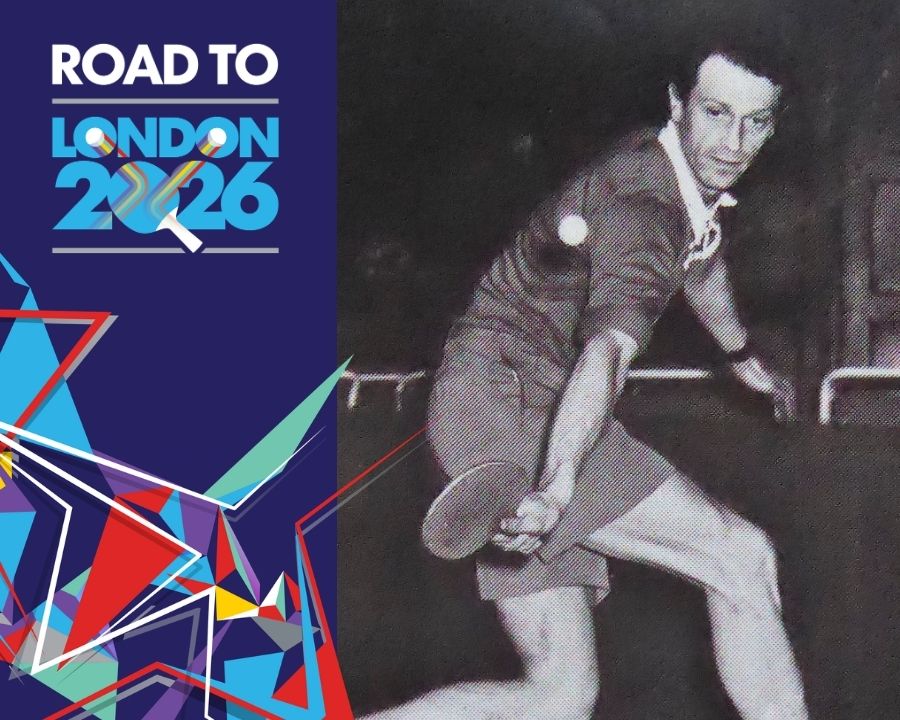
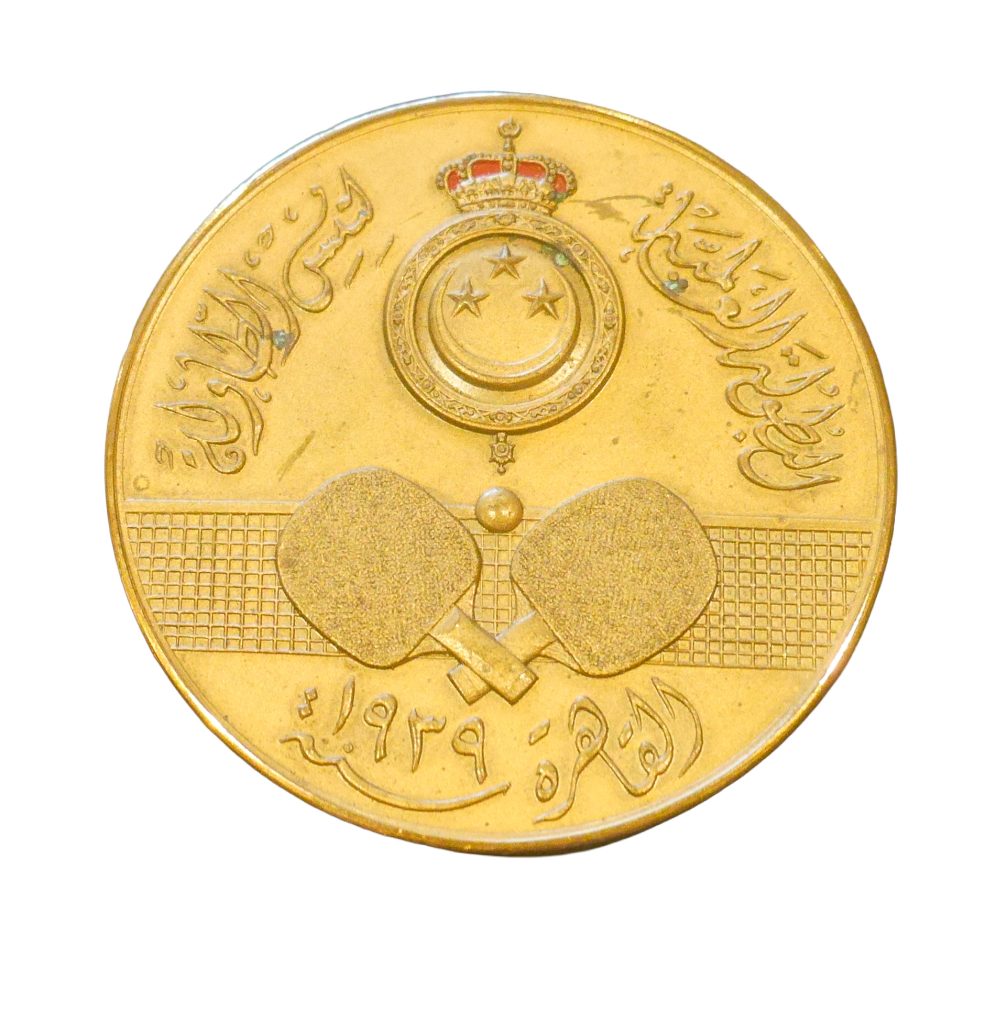
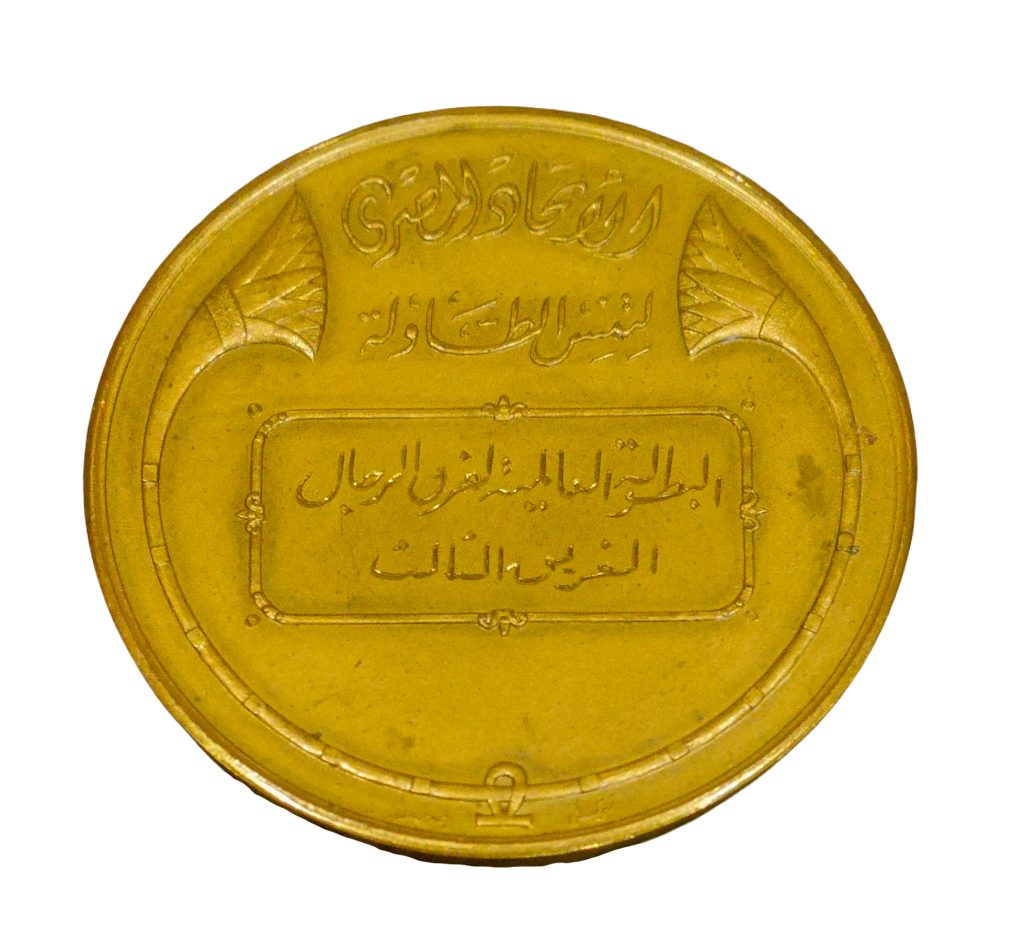
In the latest instalment of our series on England’s World Championships performances over the years, Diane Webb (Chair of Archives, Museum and Records Committee) turns to Cairo 1939 – the first Championships held outside Europe.
England sent only a men’s squad, but there were two gold medals in the final Championships before the Second World War.
With thanks to Gunther Angenendt for photos. Keep an eye on our website and social media platforms for a host of features in our Road to London 2026 series – and click below to secure your tickets for London 2026.
Ultimately, it was only a men’s team who travelled to Cairo, the first time the World Championships had been played outside Europe.
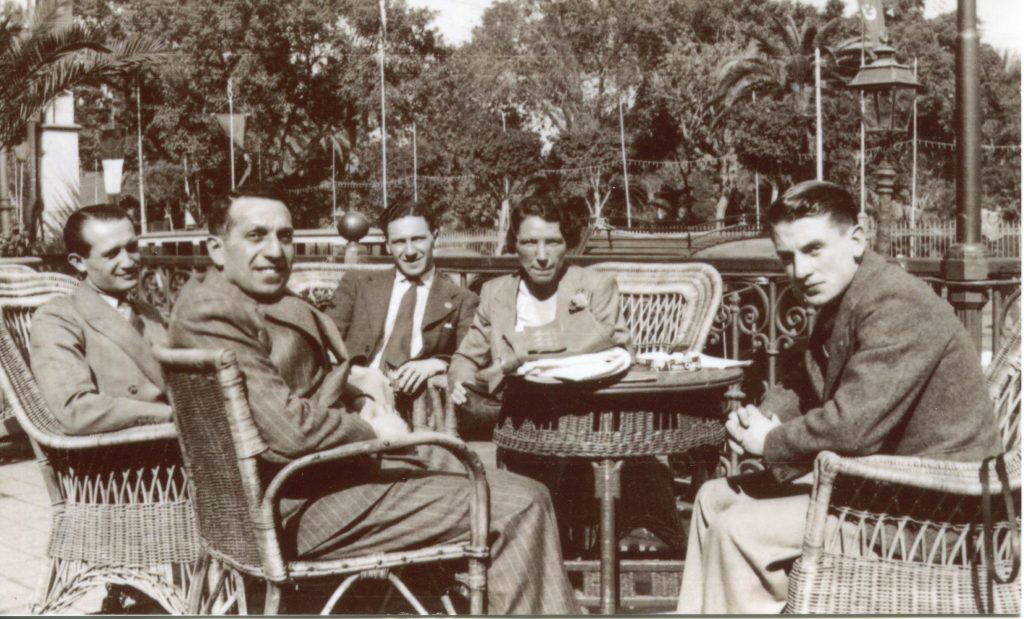
It was a five-day journey for the players – starting with a train to Newhaven and a rather rough trip across the Channel to Dieppe where “the brave ones sat on deck, the not-so-brave went to sleep in their bunks. Later on, the formerly brave tottered below, and the others, much refreshed, emerged happily on deck.”
Their onward journey took them to Paris where they were welcomed by the French Association and joined up with the French players for the next leg by train to Marseilles, third class which took 10 hours. Followed by a three-day sea voyage to Alexandria and then on to Cairo. It was 16 days away from home and no out-of-pocket expenses for the team.
The trip across the Mediterranean was described: “On board ship, physical jerks were ordered for the team, but after Lurie and Hyde had retired to their cabins (whether with the effect of the exercise or of the motion of the boat we know not) these had to be abandoned.
“We were fortunate to pass the volcano Stromboli at a time when it was in eruption, but otherwise the voyage was uneventful, although we played tournaments in chess (won by Barna), shuffleboard (won by Wilmott) and deck tennis (which resolved itself into a struggle between Wilmott and Barna which was never really decided).”
Bubley, a virtuoso violinist, had his instrument with him and was the life and soul of the party whilst onboard, even joining the ship’s orchestra. Amongst other renditions he amused the audience with his version of the Lambeth Walk. Bubley always wore a white glove when he was playing table tennis to protect his hand for his violin playing. A born entertainer, Bubley in later years appeared on the Michael Barrymore prime-time television show which at its peak was watched by 12 million viewers.
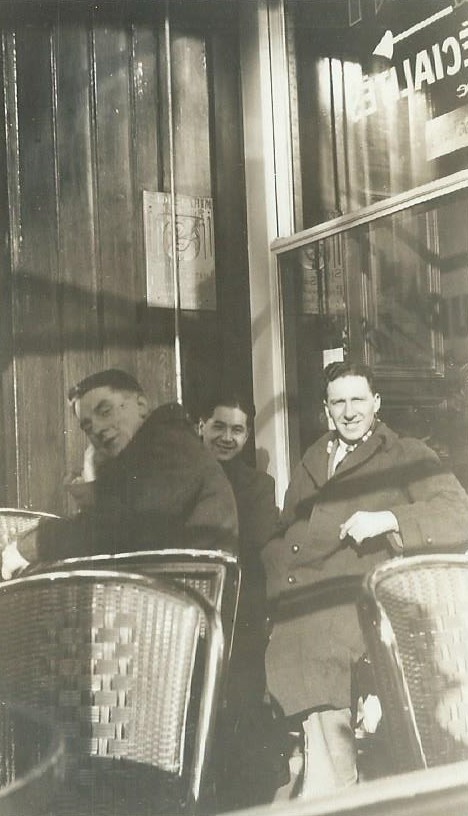
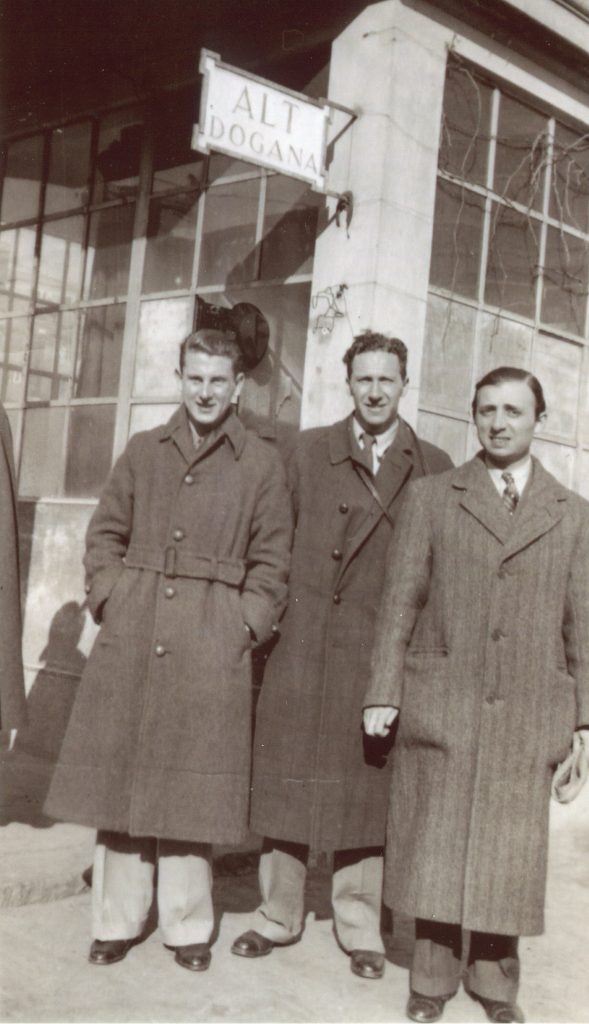
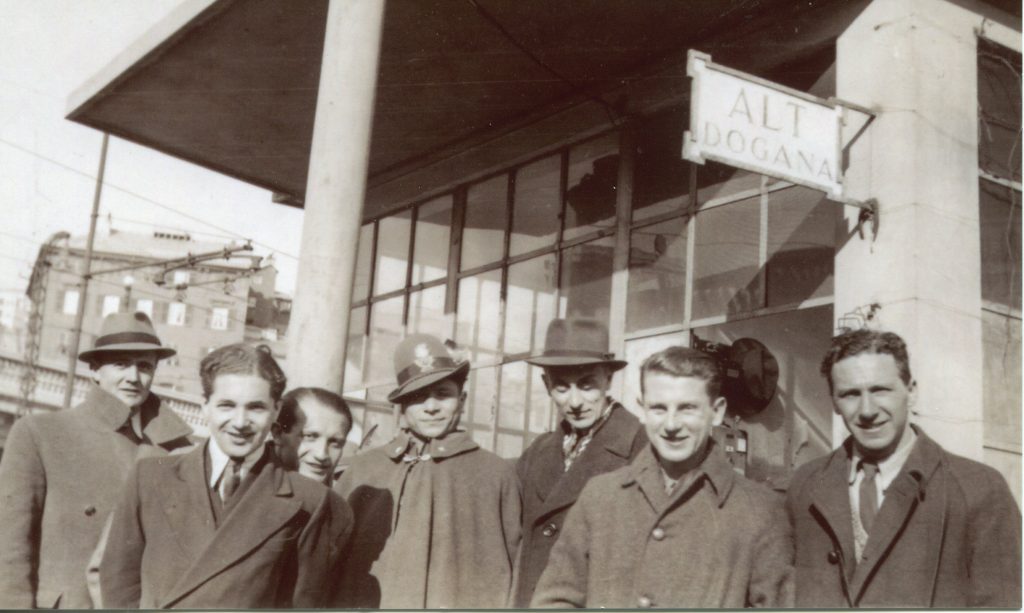
Arriving in Cairo, the teams were given a warm welcome by the Egyptian Federation and presented with bouquets of flowers. Some players went to find a table to practise whilst others went to the venue where “We were amazed at the perfect conditions provided. Special wooden flooring had been built for each court, whilst the centre court had banked seating for 2,000, with beautiful carpeting between the court and the seats. The lighting provided – a replica of that used in this country (England) – was all that could be desired, and as readers probably know, the tables had been specially brought from England. We must express our gratitude to the Egyptian people for their unsparing efforts to provide the best in everything, and for their unfailing hospitality to all our party.”
All the players stayed in the same hotel with the majority of the matches played at the Royal Palace of Agriculture. Coaches transported the players between hotel and venue and Bubley, with his violin, was so popular the players waited to see which coach he got on before they boarded. The result was an overloaded coach, so Bubley transferred to another coach and only enough players moved with him to ensure the first coach wasn’t over the limit.
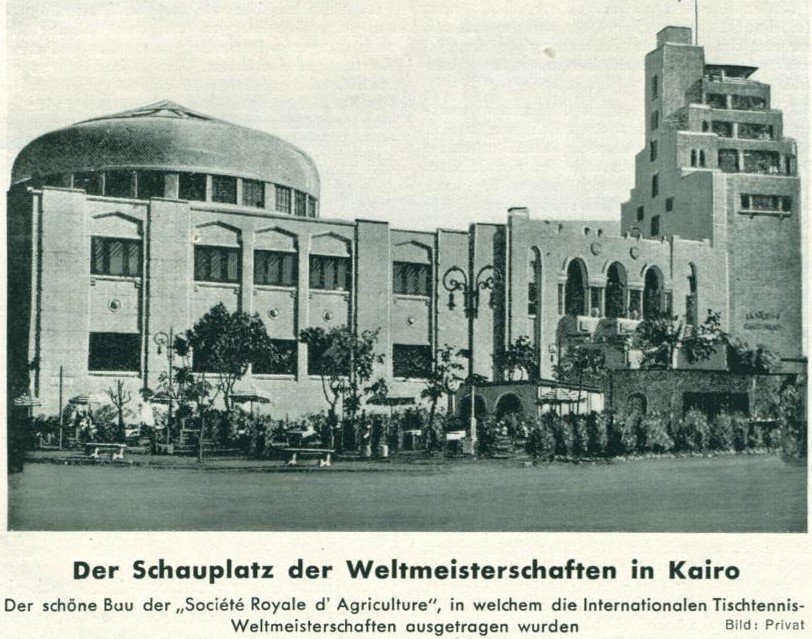
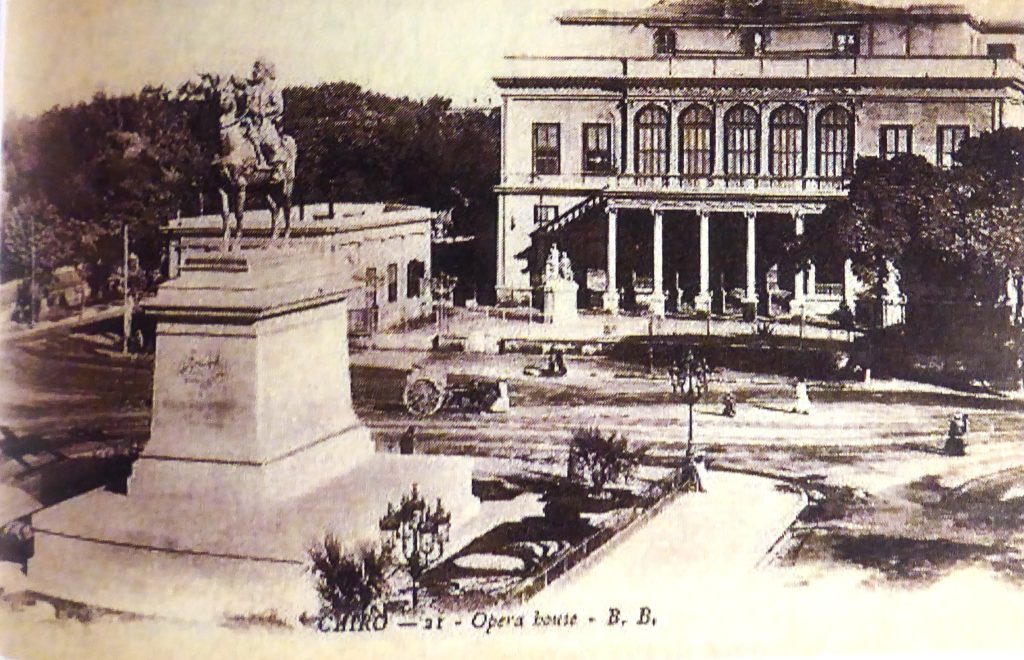
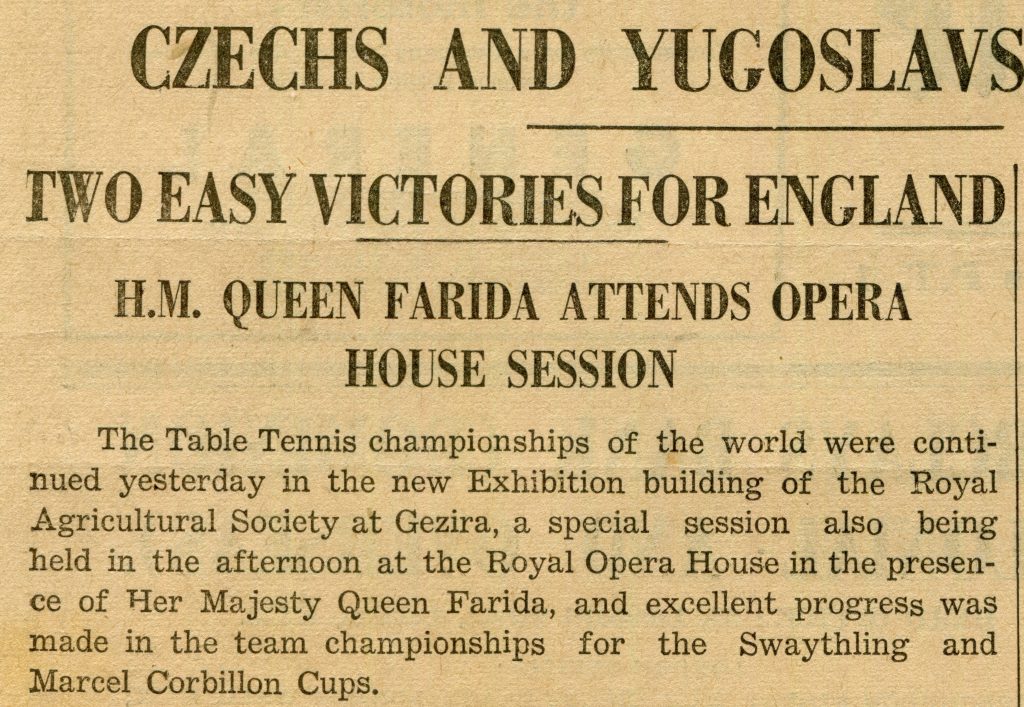
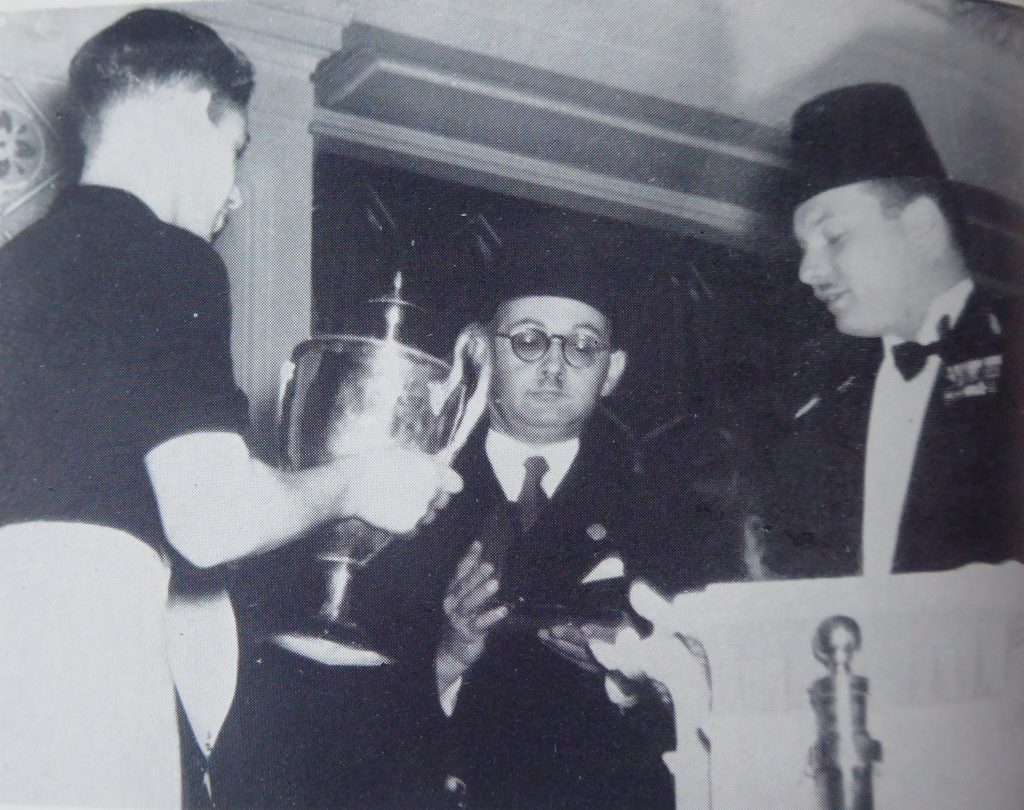
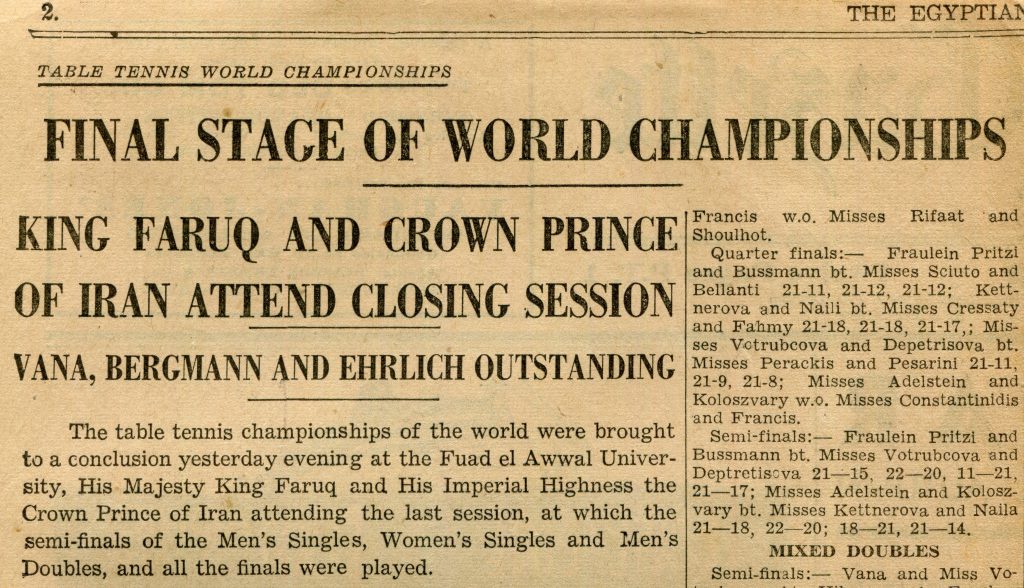
Later matches were played at the Exhibition Hall of Foudavag University, Heliopolis on the outskirts of Cairo, later still matches were played at the Royal Opera House in Cairo and at one session all the female players were presented to the Queen. Both the King and Queen of Egypt watched the play, the first time a reigning monarch had done so. King Farouk donated the Egypt Cup which was presented to the country who were to host the next World Championships.
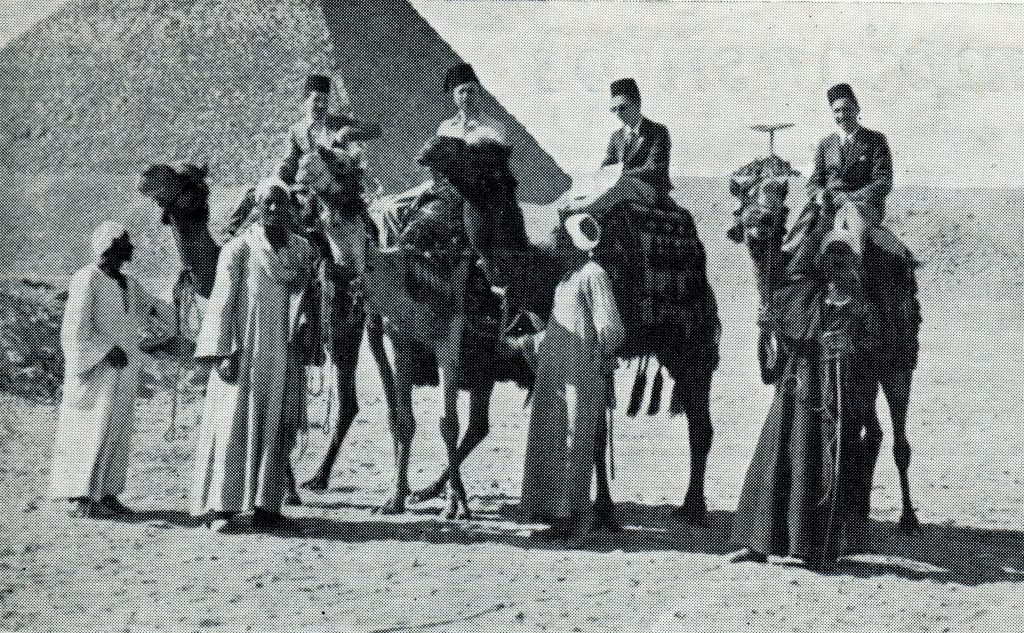
A trip up the Nile one afternoon provided a welcome break for the players and officials, the King and Queen of Egypt also attended, as did the Prince of Iran.
Arthur J Wilmott was Deputy Keeper, Department of Botany at the Natural History Museum and was the first Head of the European Herbarium. He found time for some exploration and greatly assisted the curator of the Cairo Museum who had for years been trying to find a particular kind of small sand bug, only one specimen had ever been preserved. They drove out to the desert and stopped before a steep slope. Wilmott pointed to a cave and said the bug would be found there, and so it was. He had worked out the location from the report of a previous expedition. Two delighted men returned, sharing their spoils.
Swaythling Cup
Matches were played over three days. Eleven teams had entered, 10 matches for each team.
The Palestinians were held up owing to passport difficulties and arrived late on Tuesday, thereby missing several matches. The French too, didn’t field a full team. Michel Haguenauer was taken to hospital on arriving at Alexandria where he had to undergo an operation. Added to which Raoul Bedoc and Le Josne became ill, which reflected in their low finish.
England had four 5-0 results which were against India, Luxembourg, Palestine and Romania. It was 5-1 against France, Greece and Lithuania and 5-2 against host nation, Egypt. England’s two losses were to Yugoslavia 5-3 and Czechoslovakia 5-1.
The match against Yugoslavia was closer than the result indicates. Hyde went on first and lost 19, 15 to Max Marinko, next Bubley was on the table and it couldn’t have been closer but the win went to Ladislav Heksner -19, 19, 20. Lurie brought some hope to the team with a fine win against Tibor Harangozo 15, -19, 11. Hyde was back for his second match but that too went Yugoslavia’s way 19, 11 against Heksner.
Lurie, playing brilliantly, brought the score to 3-2 as he dispatched Marinko 16, -22, 15. This was followed by another close loss for Bubley -13, 17, 19 against Marinko. With the score 4-2 to Yugoslavia there was still hope for England as Lurie got a hat trick of wins with a comfortable 7, 16 win against Heksner. Hyde was on to save the match for England but another deuce result in the decider against Harangozo -15, 17, 19 meant victory went to Yugoslavia. England were so close, three matches lost in deuce, what might have been.
England’s match against Czechoslovakia was also closer than the 5-1 defeat implies. Bubley faced Vana in the first match and again, it was close with Bohumil Vana winning 18, -16, 14. Hyde then lost to Vaclav Tereba 14, 13 and at number three, Lurie had another close match against Miloslav Hamr -21, 18, 17. Then came a wonderful win for Hyde beating world champion, Vana, 12, -19, 17. The fifth match went to Hamr who beat Bubley 15, 15 and in the final match Lurie lost to Tereba 13, -16, 17.
Bubley played 20 matches and won 16 of them, Lurie played 17 and won 13, Hyde played 15 and won 11 and Stanley played six and won five and was awarded a walkover in one other.
Czechoslovakia won all their ten matches, eight of them 5-0. Their only losses were Vana to Hyde of England and Hamr to Marinko of Yugoslavia 17, -10, 19. Czechoslovakia’s defeat of Yugoslavia meant they finished first, the new world champions. Yugoslavia was in silver medal place and England in bronze medal position. Lithuania was fourth, Romania fifth, Egypt sixth, France seventh, Greece eighth, India ninth and Palestine and Luxembourg joint 10th. The Egyptian team had been coached by multiple World Championship medallist Aloizy Ehrlich for the last four months, which helped them towards their sixth place with some creditable wins.
Corbillon Cup
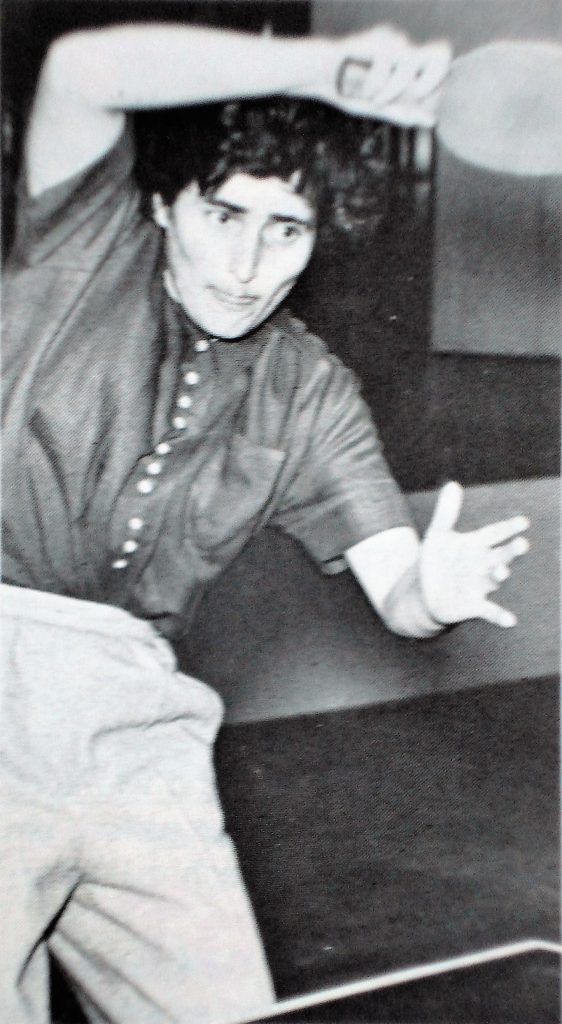
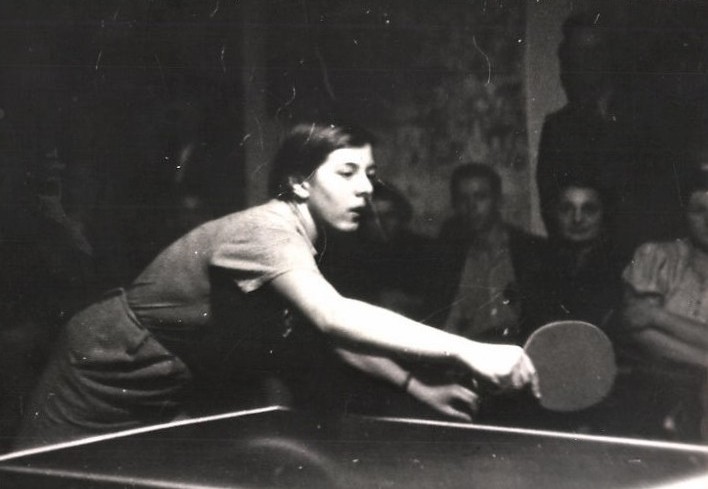
Gertrude Pritzi had previously played for Austria but with Germany annexing her country she was now playing under the flag of Nazi Germany. Hilde Bussmann was the second player in the German team and the pair were undefeated in their three Corbillon Cup matches. They beat Czechoslovakia and Egypt 3-0 and Romania 3-1. It was a walkover against Palestine due to their team being held up en route at passport control.
Czechoslovakia’s team of Vlasta Depetrisova, Marie Kettnerova and Vera Votrubcova were second with their one loss to Germany. Romania also had two players, Angelica Adelstein and Sari Kolosvary, and finished third, leaving home nation Egypt fourth and Palestine fifth.
Men’s Singles
Bubley, Stanley and Wilmott all went out in the second round. Bubley met Michel Haguenauer who had now recovered and it was an excellent match which the Frenchman won -11, 17, 10, -18, 21. Stanley lost to the Lithuanian Vladas Dzindizliauskas 22, 16, -15, 11 and Wilmott to Romanian G Eroes 10, 17, 14. Barna, Bergmann, Hyde and Lurie all had comfortable wins in this round.
The round of 32 saw Hyde beat Abou Heif, Egypt, 14, 10, 17; Bergmann beat Hamr (Czechoslovakia) 18, 19, 18; Barna beat M Hilmy (Egypt) 14, 9, -17, 15; and Lurie beat Abou Heif 10, 6, 6.
Moving on to the round of 16, all except Lurie won their matches. Hyde beat Finkelstein (Palestine) 12, 17, 19; Bergmann beat Eroes (15, 11, 17) and Barna had a -19, 19, 20, -17, 20 win over Tereba. Lurie lost to the on-form Ehrlich 17, 15, 21 who, after being in Egypt for four months, was well acclimatised.
Barna and Hyde were fallers in the quarter-finals. Hyde to Bergmann 16, 16, 12 and Barna to Ehrlich 17, 15, 21. It was Bergmann versus Vana in the one semi-final which was a repeat of the final of the previous year at Wembley, but this time the result was reversed and it was Bergmann who was the victor and went through to the final 13, 20, -15, -15, 19.
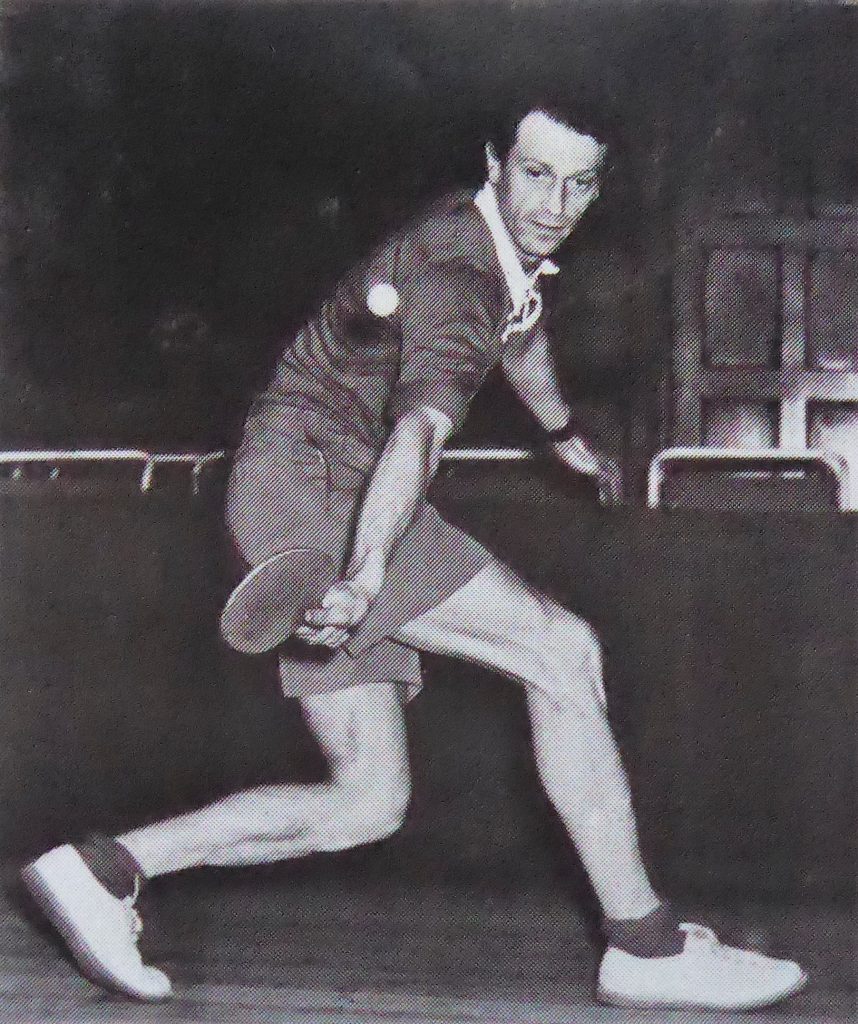
The other semi-final was a clash between Zarko Dolinar (Yugoslavia) and Ehrlich which the Pole won 18, 10, 14. After some epic matches in the earlier rounds the final was a rather straightforward win for Bergmann 7, 15, 18 giving him his second title and Ehrlich his third silver medal.
It was Ehrlich’s last year of freedom. During the war he was captured by the Germans and spent four years in Auschwitz before being sent to Dachau. He survived and continued playing after the war.
Women’s Singles
34 players entered but 10 scratched. Vera Votrubcova (Czechoslovakia) went straight through to the quarter-finals as she had byes in her first two matches. Here she lost to Pritzi 17, -12, 11, 17. In the other quarter-final matches Marie Kettnerova (Czechoslovakia) beat Egyptian M Cressati 15, 12, 15; Depetrisova beat Angelica Adelstein 22, -17, 17, -14, 15; and Samiha Naili of Egypt beat fellow Egyptian Dorea Fahmy.
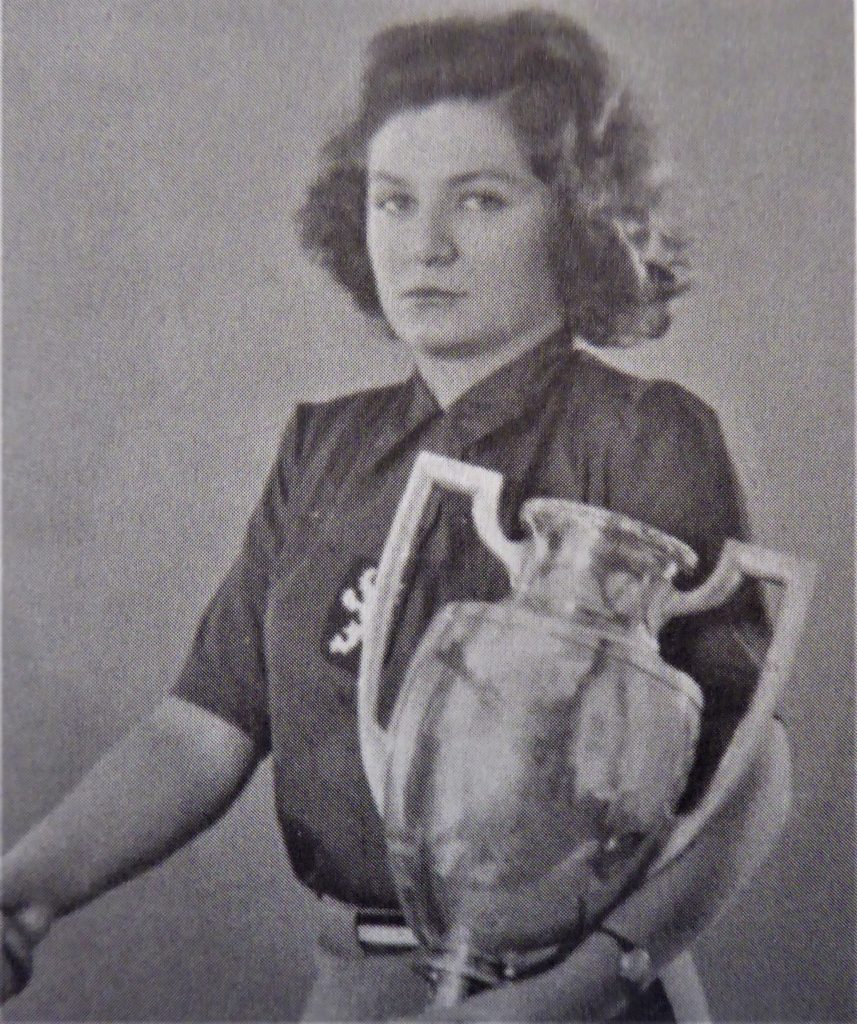
In the semi-finals, Pritzi beat Kettnerova 13, 20, 19; and Depetrisova beat Naili 20, 12 19. The final went all the way but was a rather tedious pushing affair which lasted an hour with Depetrisova making the occasional hit. She eventually won 19, -16, -16, 19, 9 (10/3). It was royalty stopped play at 13-15 in the third game when the King made his entrance into the arena.
Men’s Doubles
It was triumph for Barna & Bergmann in the Men’s Doubles. The only match that caused them any trouble was the semi-final against Hyde & Lurie which went the distance -15, 12, 13, -11, 13 and was a great credit to the two young Englishmen. All their other matches were three straight, including the final against the scratch pair of Miloslav Hamr (Czechoslovakia) & Josef Tartakower (Luxembourg) 11, 9, 12.
Hyde & Lurie had some excellent results, meeting Harangozo & Marinko in the first round which they won 17, 13, 15. Next they beat Tereba & Vana 20, -19, 10, 18 before meeting Egyptians E Ades & S Berkovitz who had a bye in the first round and met fellow Egyptians E Gagah &Heg Said in round two to reach the quarter-finals. It was 11, 10, 8 in the quarter-final clash to Hyde & Lurie.
In the lower half of the draw, Bubley & Stanley also reached the quarter-finals before going out to Raoul Bedoc & Michel Haguenauer of France 20, 14, 17. The French pair had put out Ostler & Wilmott in the first round in what was quite a tussle 19, -11, 21, -19, 7.
Women’s Doubles
There were 16 entries in this event, 11 of whom were Egyptian pairs and a further three pairs had one Egyptian player partnering a European. In the first round six of the Egypt pairs withdrew. The event did give Egypt their first medal when Samiha Naili, partnered by Marie Kettnerova, reached the semi-final, losing to runners-up Romanians, Adelstein & Sari Kolosvary 18, 20, -18, 13. They in turn lost in the final to Bussmann & Pritzi 17, 19, 14 who had beaten Depetrisova & Votrubcova 15, 20, -11, 17 in their semi-final.
Mixed Doubles
Mrs Rose who partnered her husband, was the only English lady to enter this event. Consequently, the English men teamed up with Egyptian ladies, similarly as there were no Germen men, their ladies also had Egyptian partners. Several other European players were in the same position.
Out in the first round were Bubley & N Smart, Hyde & F Aghion. Stanley & A Bellanti also lost in round one but had the misfortune to be drawn against the eventual winners, Vana & Votrubcova. Rose & Rose scratched.
Lurie & L Tadros made it into the second round as did Wilmott & K White of Palestine. Barna with O Pesarini had a good win at this stage, beating Poland’s Ehrlich & Egypt’s L Constantinidis -12, 19, -13, 15, 15. They then lost in the quarter-finals to Vana & Votrubcova. Bergmann with Samiha Naili (Egypt) also progressed to the quarter-finals where they lost to Tereba & Kettnerova 12, 10, 16. It was Czechoslovakia versus Germany and Egypt in both semi-finals with the Czechoslovakians winning both matches. Vana & Votrubcova beat Monsour Helmy (Egypt) & Pritzi 15, 17, -20, 11 whilst Tereba & Kettnerova beat Marcel Geargoura (Egypt) & Bussmann -18, 16, 23, 14. The final saw Vana & Votrubcova win -12, 16, 16, 17.
Two of the world’s best players, ever, Victor Barna and Richard Bergmann both played in Cairo under the English flag in the singles events. There achievements were gigantic and it is not possible to do either justice in only a few words. Full profiles will be in a later article.
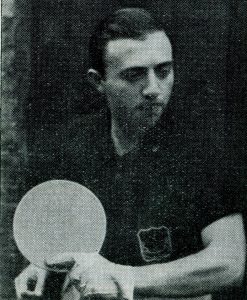
Ernest ‘Ernie’ Bubley
England No 1, world No 16, Ernie came a long way from his roots in Whitechapel, London where he was born on 1 August 1912. He was one of the few players who represented England in the Swaythling Cup and internationals both before and after the war. In 1938 the team were fifth, in 1939 they were ninth, in 1947 the team were seventh and in 1948 it was a fifth-place finish. His best individual result was in 1939 in the Men’s Doubles with a quarter-final place with Ken Stanley.
Ernie played international matches against France, USA and Wales as well as representing his country in the European Cup, West Zone against Switzerland and France. The winner of several Open tournaments including the Home Counties Open in 1935/36, a tournament sponsored by The Star newspaper with 5,000 entrants. In the London Closed, Ernie was runner-up in the Men’s Singles in the same season. In the English Open in 1939 Ernie nearly had the best win of his career when he was two up against Victor Barna in very quick time. Becoming overconfident, he lost the third in a close game and the last two went away from him, a mixture of frustration and exhaustion. However, he did beat Johnny Leach in a London League match in 1946, the first time Leach had been beaten in over a year.
With brother Eddie, Ernie, founded the Manhattan Club in 1934 with the aim to get young East End men off the streets. Originally, there were six members, four years later the club had expanded to over 1,000. He was so popular that at one tournament at the Manhattan Club there were so many people unable to gain entry that loudspeakers were set up outside in the street and a running commentary given.
His close to the table playing style developed as a result of lack of space at the Manhattan Club. A left-hander, his game was unorthodox which made him a challenging opponent. He was a half-volley expert with a deadly backhand kill and exceptionally heavy chop strokes.
As well as representing England at international level, Ernie played in the Maccabiah Games in 1950 after being seeded and undefeated in the English trials for the Games.
His ambition was to be a star of the variety stage, most of his performances were in social clubs but he did make an appearance on the Michael Barrymore show which at peak time had an audience of 12 million.
A talented violin player, Ernie was also an excellent bridge and snooker player.
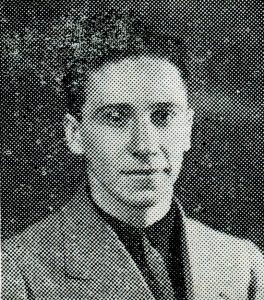
James Kenneth ‘Ken’ Hyde
From Prescott in Lancashire, Ken was born on 16 July 1915. He came from a table tennis family, his father, Gilbert Hyde was captain of the champion team in the St Helens Ping Pong League in 1912, believed to be the first official league in the world, his brother Eric was also an international player. Ken first started playing in Runcorn in 1928, he loved the spectacle of table tennis and could recall the Hungarian tours of England which regularly drew crowds of 10,000, the Merseyside Open would attract 6,000 as well. His ambition was to play like the Hungarians before huge crowds.
Ken was still at school when he was selected to play for England at his first World Championships in Paris in 1933. He played in five Swaythling Cup teams, finishing third, fifth, seventh twice and eighth. He was a Men’s Singles quarter-finalist in 1939, Men’s Doubles semi-finalist in 1939 and quarter-finalist in 1934 and a Mixed Doubles quarter-finalist in 1934. In Swaythling Cup matches he beat some of the world’s top players including Bohumil Vana, Miklos Szabados and Michel Haguenauer.
Ken’s England debut was in 1932/33, he played 124 international matches in total against France, Hungary, Irish Free State, All Ireland and Wales. He said playing for his country meant everything.
Ken had success at the English Open with a semi-final place in the Men’s Singles in 1934 and became a quarter-finalist in 1939. In the Men’s Doubles he was a runner-up with Andy Millar in 1934 and a semi-finalist in 1936 with his brother Eric. In the Mixed Doubles he reached the semi-finals with Joyce Bartholomew in 1934. Another regular on the Open circuit, he won around 30 titles.
Closed Championships brought further wins: the Cheshire County Closed (Singles and Men’s Doubles), Liverpool Closed (Men’s Singles x 3, Men’s Doubles x 4) and the Runcorn Closed (Men’s Singles and Men’s Doubles x 4, all with Eric).
Ken considered his best win was against Victor Barna in the Manchester Evening Chronicle International tournament in 1937, the first time Barna had lost to an Englishman in a competitive match. He had other good wins including in the Welsh Open against world class Alfred Liebster of Austria.
A multi-talented sportsman, Ken studied chemistry at Liverpool University and gained colours in football, cricket, tennis, squash racquets as well as table tennis. He represented the combined universities (UAU) cricket team at the end of the 1930s.
Ken joined the RAF in 1940 and served a total of six years, reaching the rank of Squadron Leader. Three of those years were in Africa during the war, returning to the scene of his 1939 exploits. Returning to England in 1946 he played little table tennis until 1948 where he was persuaded to play in a charity match. Unfortunately, he broke his Achilles tendon which finally finished his playing days but not his connection with table tennis. He stayed in touch with the game, was elected President of the Liverpool League in 1961 and remained in that position until 1990; he was also made a Life Member. Further honours came, Vice-President of Lancashire County and he was inducted into Liverpool University Hall of Fame in 2009, the year before he died.
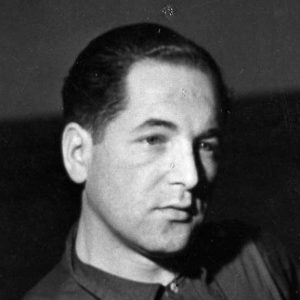
Hyman ‘Hymie’ Lurie
Born on 28 May 1918, Hymie was one of Manchester’s pre-war greats. He played in four World Championships, three of them in the Swaythling Cup team finishing third, fifth and seventh. He twice reached the semi-finals of the Men’s Doubles – 1938 with Eric Filby and 1939 with Ken Hyde. He was England No 1 in 1939 and with Les Cohen ranked at No 2 in the doubles. 1938 saw him at 21 in the world.
His first international match, aged 15 years old, was in 1934 and he played for England both before and after the Second World War with matches against France, Hungary, Irish Free State, Scotland, USA and Wales. He won over 30 Open titles and the Manchester Closed Men’s Singles in 1937, 1947, 1948 and 1949, the Men’s Doubles in 1935, 1936, and 1946 and the Mixed Doubles in 1938. At the time, Manchester was a hotbed of international talent with the league having multiple internationals. This is reflected in the League winning the Wilmott Cup in 1935, 1938 and 1948, on each occasion the team players were internationals.
Hymie won the Junior Boys’ Singles at the English Open in 1934/35, was a Men’s Singles semi-finalist in 1939 and Men’s Doubles semi-finalist in 1937 and 1939.
During the war he took part in the Normandy landings where he sustained serious chest wounds and it was his doubles partner, Les Cohen, who encouraged him to fight back and return to the table. Described by Jack Carrington: “Hymie Lurie of Manchester is one of the reasons we go to watch table tennis. To see him in action is to admire at one and the same time an artist and a precision engineer. The general flow of his game is artistic in its variety and moodiness; the use of angles, the variety of length, the choice between attack and defence, all seem to come into play just because our artist happens to feel that way at that particular moment.” He modelled his game on that of Victor Barna whom he defeated in one of the several Hungarian exhibition matches played during the late 1930s. In all, he beat four world champions.
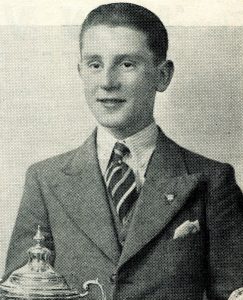
Ken Stanley
The youngest of the party that went to Cairo was 17-year-old Ken Stanley who was born in Hulme, Manchester on 19 February 1922.
Ken started playing table tennis when he was 11. He went to Manchester YMCA with a friend and saw Andy Millar and Charles Davies playing and from then on, he was hooked. Every evening after school he went to the YMCA and practised for four hours, learning by watching the top players. By the age of 12 he had won his first senior Open tournament.
He left school at 14 and became an office boy, he carried on studying two evenings a week and the rest of the time was devoted to table tennis. His ambitions were to play for England by the time he was 15 and be world No 1. He was 16 when he won his first international cap and could well have achieved both ambitions if the war had not intervened, many thought he would reach that exalted height.
Ken played in three World Championships – 1938, 1939 and 1948 – being a member of the Swaythling Cup team in 1939 which came third. He was a reserve for the team in 1948. His best individual result was a quarter-final place in 1939 with Ernie Bubley in the Men’s Doubles. Ken was told by his employer if he went to Cairo he would lose his job – he went, job lost.
International matches were played against All Ireland, Scotland and Wales with the first in 1938 and the last in 1952. At the English Open Ken won the Junior Boys Singles in 1936/37, 1937/38 and 1938/39. He had nearly 40 Open tournament titles at both senior and junior level, again both before and after the war, often partnering Benny Casofsky in doubles. His highest England ranking was six.
When war was declared Ken volunteered to join the RAF and became a physical training instructor, reaching the rank of Corporal. He was posted to India where he continued to play table tennis and at the All India Cup won the Men’s Singles, Men’s Doubles and Mixed Doubles.
Ken later took up several coaching jobs, in Scotland, in New Zealand and in Norway before returning to England and setting up his own academy in Burnley. He gained several coaching qualifications – Approved Coach 1950/51, Approved Senior Coach 1951/52, Basic Coaching Diploma 1955/56. This led to serving on the ETTA Selection and Ranking Committee, a Junior Panel Member and Registered Players Commission Member. He produced his own book Table Tennis, giving guidance and instruction for all levels.
In 1955 he became a football agent. One of his first clients was Denis Law. Others followed, including George Best, Jack Charlton, Gordon Banks and Emlyn Hughes. He covered other sports too – tennis (Billie Jean King), cricket (Geoffrey Boycott) and boxing (Muhammad Ali). The England Football team in 1970 who travelled to Mexico also came under his umbrella. He was behind the Esso World Cup Coin Collection and the recording of the well-known football anthem Back Home.
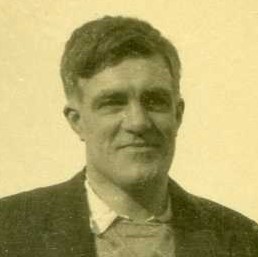
Arthur ‘Willie’ J Wilmott
Born on 31 December 1888 in Tottenham, London, Arthur gained his sole England cap against the Irish Free State on 18 January 1936 in Dublin, a match England won 10-1 with Arthur winning his singles and doubles with Joe Silto. He came into his own on the playing front as a veteran and won the Veteran Singles at the English Open in 1935 and the Veteran Men’s Singles in 1940. An enthusiastic player and watcher of table tennis, he just loved the game. He travelled the world to play in nine World Championships from 1932-1949 and continued playing as long as he could.
His name is perhaps better known through his donation of the Wilmott Cup which was first played for in the 1934/35 season. A national men’s team event between Local Leagues in England, it is still going strong today under the guise of the English Leagues Cup Competition (ELCC).
Ivor Montagu described him as one of the great pioneers of English table tennis who loved the game. He was an international legislator, serving on the ITTF Equipment Committee as its secretary from 1939 to1950. “All his scientific patience and ingenuity were brought to examination of the properties of table tennis equipment.”
He devised ingenious instruments to ensure balls were accurately measured. However, this did not help when he was in Paris at a World Championships. He carefully tested every ball putting those that he did not consider met the required standard in a box marked ‘B’ for bad. Unfortunately, the French took the ‘B’ to stand for ‘bon’.
In 1936 Arthur was made an ETTA Vice-President and in 1951 an ITTF Honorary Member.