
Milestone is perhaps best known for its authentic, licensed motorcycle games. As reliably consistent as these series are, they rarely take risks. Ride 6, its most recent release, attempted to infuse a Forza Horizon-style festival atmosphere, but was otherwise a safe, iterative sequel.
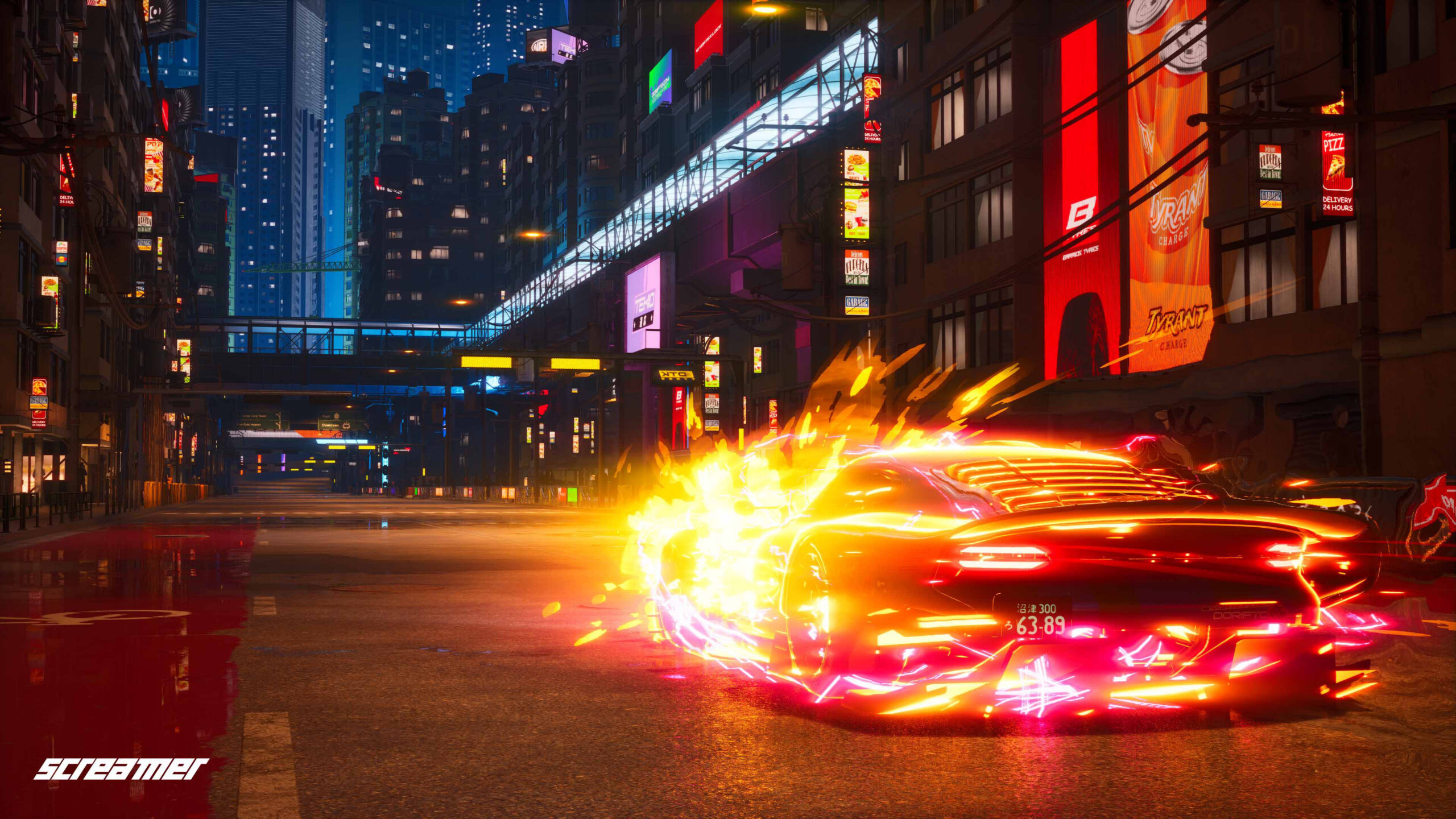
Screamer is the exact opposite. A reimagining of Milestone’s early 3D racing series of the same name, it’s an arcade racer like no other. With an anime-inspired narrative, slick visuals and unique fighting game-style mechanics, it’s shaping up to be the studio’s most ambitious and intriguing project yet.
During a preview event, we went hands-on with Screamer’s first six story events and Arcade mode.
Starting slow
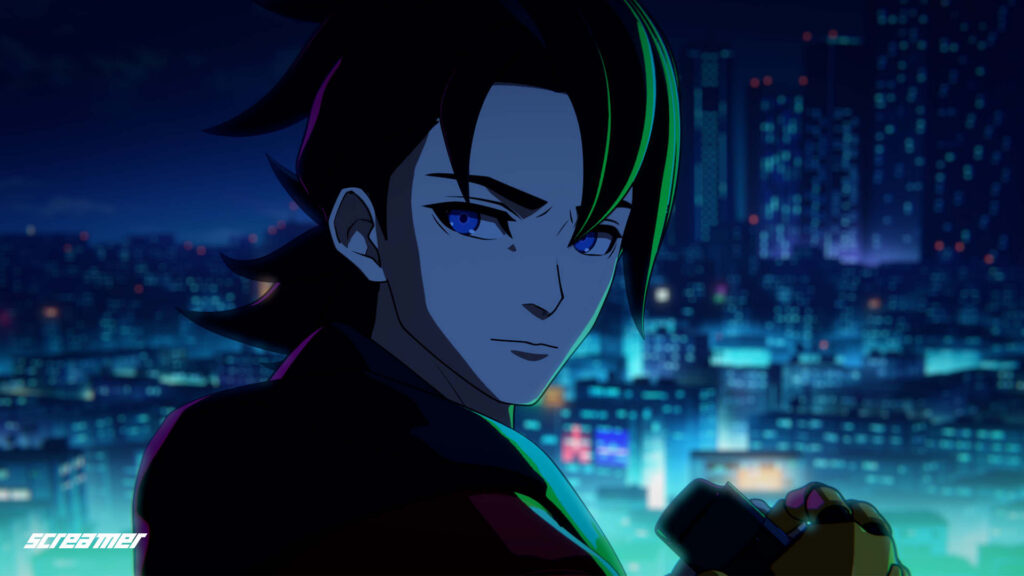
Milestone’s team are avid anime fans, and it shows in Screamer’s story mode inspired by shows like Akira, Ghost in the Shell and Bubblegum Crisis. In the opening chapters, you take the role of The Banshees, a ragtag team who enter ‘The Tournament,’ an illegal racing competition run by the mysterious Mr. A To cover their tracks, they compete under the guise of The Green Reapers.
With its animated cutscenes, striking art style and an eclectic voice cast, Screamer’s production values instantly impress.
However, while the intros are fully animated, most of the narrative is presented in 2D, visual novel-style cutscenes. Each character speaks their native language: as the exposition later explains, every human in this world has a universal translator installed in their temple.
The lengthy cutscenes sometimes drag, slowing the campaign’s pacing. However, Milestone encourages players not to skip them, as the narrative is integral to the experience.
“The idea is to slowly introduce you into the narrative, characters and gameplay mechanics,” Game Director Michele Caletti told Traxion. “The first few hours are meant to be a long and slow, but not boring, introduction.”
“At the very beginning, we need to lay the foundations,” he continued, explaining that the story elements are “more intensive” at first but “very present afterwards.”
“You get to know some characters, and we’re starting to build the network of relationships. Things that are going on with the characters will develop later. The first events are just a glimpse of what will shape the game.”
While the writing is sometimes hammy, each character has a distinct personality. Alongside team leader Hiroshi and French driver Frederic, the foul-mouthed Irish assassin Róisín is the clear standout in The Green Reapers.
A story with a dark side
With its anime styling, colourful visuals and brash car designs, Screamer looks like a family-friendly arcade racer on the surface. This made her constant cursing initially jarring and perhaps explains why the game carries a 16-age rating.
“She’s [Róisín] very angry and from the military. If you add it all together, she’s very nasty, but has a golden heart,” said Caletti. “She’s in a relationship with Hiroshi because he was the designated leader of the Green Reapers. So they play their own part.”
Likewise, the story’s tone takes some surprisingly dark turns. Although a $100 billion cash prize is on offer, the Green Reapers enter The Tournament with an ulterior motive. Seeking to avenge the death of their former teammate Quinn, the team plans to assassinate rival Gabriel by blowing up their car and making it look like an accident.
“There are many colours in the story,” said Caletti. “Some of them are light-hearted, some of them not so much. You can create good characters if they have something to fight for when they are suffering. But there’s a lot of change in the story as they try to resolve their pains and ambitions.”
Each character’s personality is reflected in a unique musical theme. Caletti explained how Milestone worked with multiple composers who have produced soundtracks for different game genres, from racing to action and fighting
“It’s very important to have different composers because it’s impossible that the same people can make these themes fit so many different styles,” he said.
“When you play the Anaconda Corporation Team, you’ll hear a heavy, menacing theme. When you play the Strike Force, you’ll hear upbeat J-pop.”
Story modes in racing games often feel like an afterthought, but Milestone believes that Screamer’s narrative will set it apart.
“We realised that if you want to do something memorable, you can’t only rely on the mechanics,” said Caletti. “Games we fondly remember have strong mechanics and a deep story because it’s very hard to build characters without a story. We wanted to do something bigger and more memorable.”
Milestone also assures that Screamer will have a complete narrative arc, with no story DLC expansions currently planned.
“I hate it when you can avoid using the brakes altogether in arcade racers”
When the story switches to in-game events, the unconventional controls may come as a surprise. Seemingly inspired by Inertial Drift, you steer with the left stick while using the right stick to drift independently.
With practice, swinging the back end out at the right time lets you navigate sharper turns. However, judging the correct entry speeds for corners isn’t immediately intuitive. We initially found ourselves slamming into the wall after attempting to drift what looked like high-speed turns.
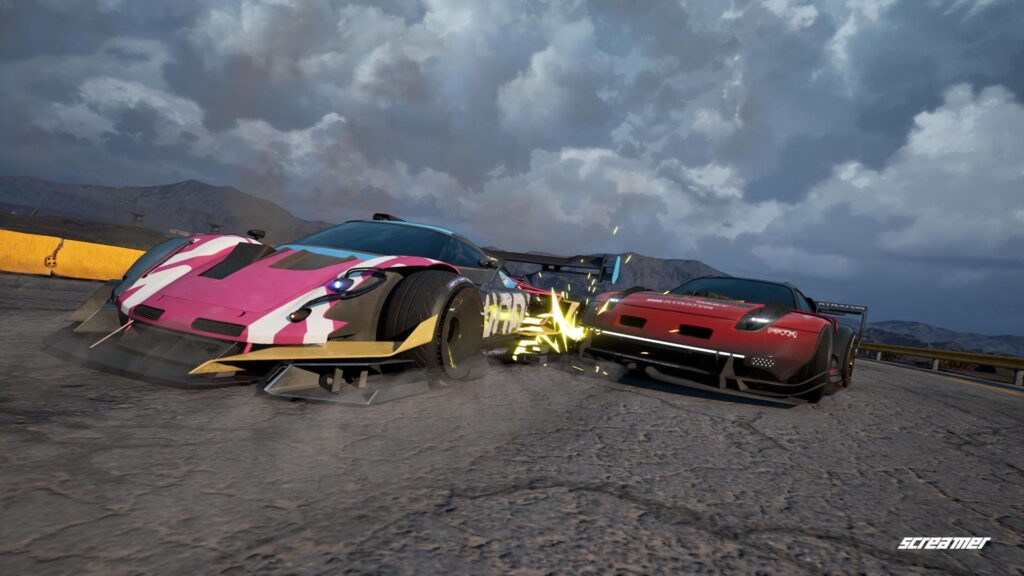
Screamer isn’t a simple arcade racer where you hold the accelerator and never slow down. Not every corner is suitable for drifting, while others require you to brake early. “I hate it when you can avoid using the brakes altogether in arcade racers,” said Caletti.
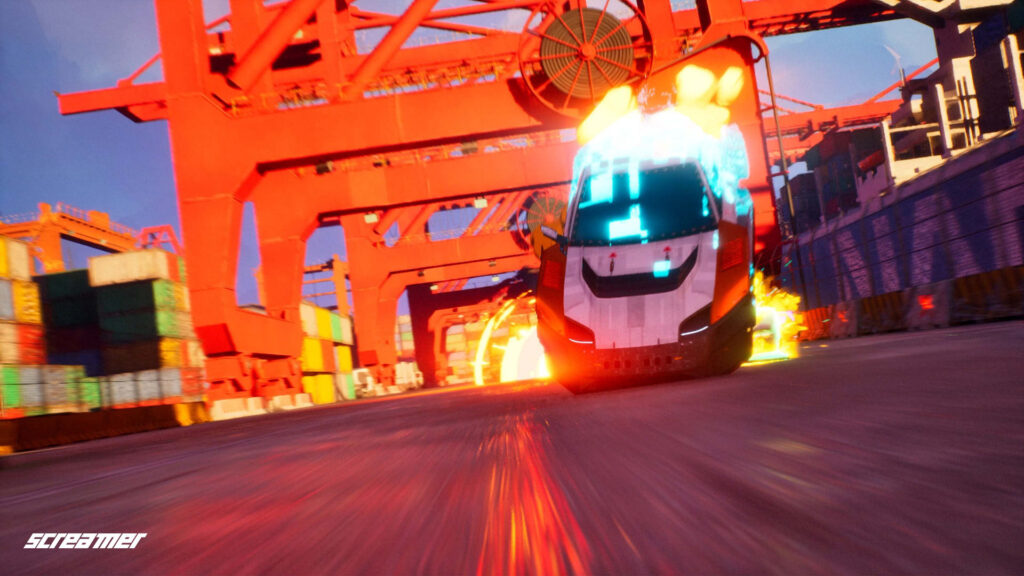
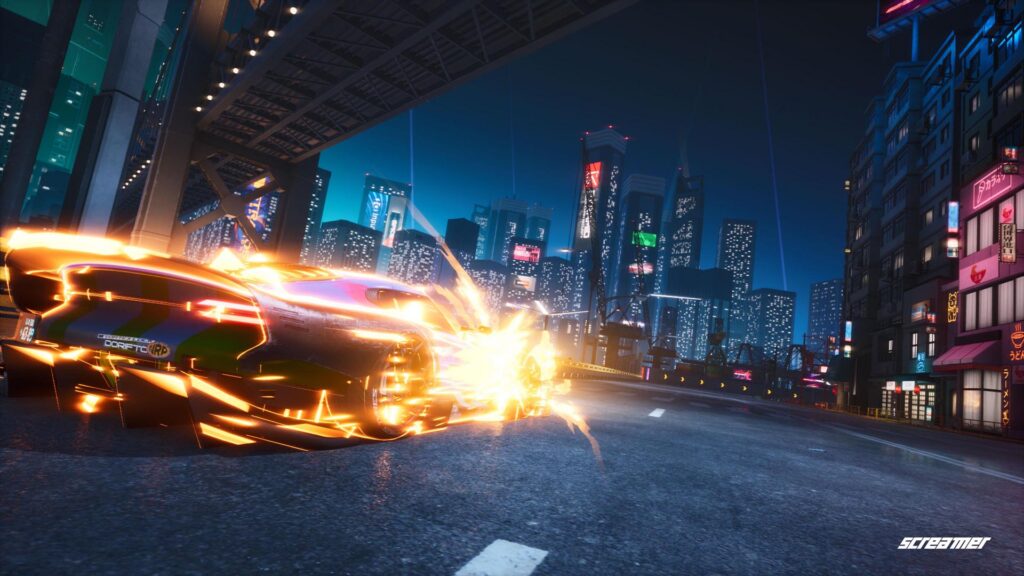
Set in neon-lit city streets and desert roads, the wide track layouts are seemingly designed to accommodate Screamer’s drift-focused handling. With only a small selection of tracks available in the preview build, the layouts became samey. However, Caletti teases some “very complex tracks” will unlock later in the game that will “put this set of skills under pressure.”
Part racing game, part fighting game
As well as anime, Screamer is heavily inspired by fighting games. At the top of the screen are two energy-style bars. The left represents your main resource, known as Sync. Once enough Sync is accumulated, you can activate a speed boost.
Energy from boosting is then transferred to the right bar and builds up Entropy, which is the game’s “dark energy.” Fill up two bars, and you can activate a Strike. This not only provides a temporary speed boost, but lets you take out an opponent if you hit them, causing them to explode in a ‘KO.’
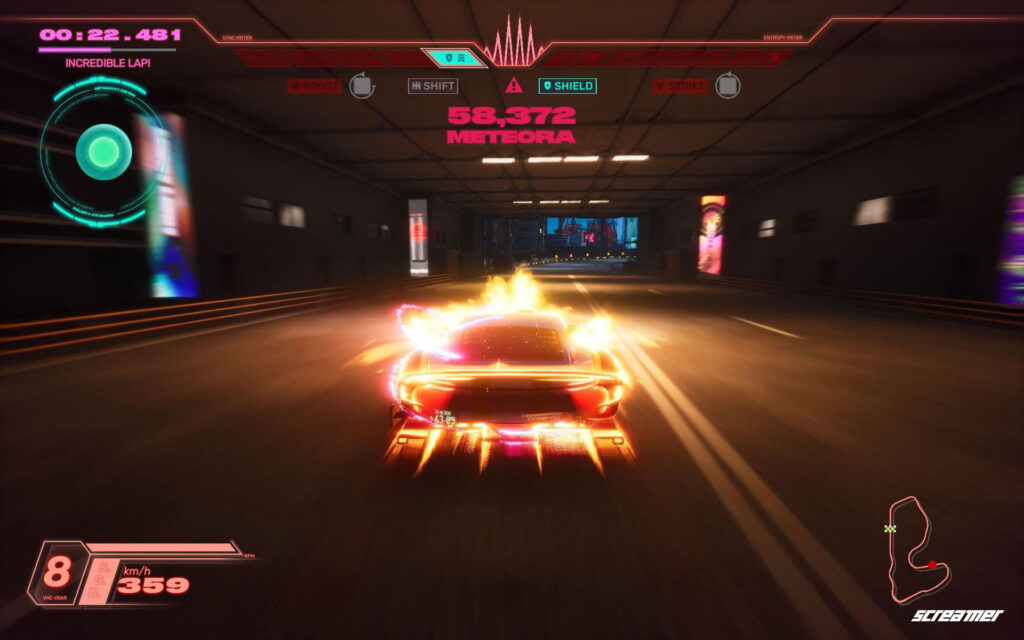
Strikes can also be countered by activating shields, or you can save up your energy and activate Overdrive, a more powerful Strike that turns your car into a moving fireball, taking out any opponent in your path. The caveat is that this makes you vulnerable: you instantly explode if you touch a wall. It’s a classic risk-versus-reward scenario.
On top of that, there’s also a minigame where shifting gears at the right RPM increases your Sync. Cars in Screamer are semi-automatic, so this is entirely optional, but it gives you an advantage.
In a short play session, managing the complex mechanics was sometimes overwhelming, distracting from the race. However, it should become second nature over time.
With more experience, timing boosts, attacks and defences should add a layer of tactical depth that’s often missing in arcade racers. It also helps that everything is introduced gradually, with the initial story chapters effectively serving as a tutorial.
“We were questioning whether to throw these elements into players very fast or to slowly add them,” said Caletti. “We resorted to introducing them slowly, because many concepts are new.”
The narrative contextualises the combat with the Echo, a gadget installed in every car that enters the Tournament. After reviving a car and its driver from an explosion, the mysterious technology attracts the attention of rival teams who believe its capabilities could change the world. With the story switching between teams, we’re intrigued to see how everything escalates.
Beyond the story campaign, there is an Arcade mode featuring solo races, team races and time attacks with all abilities unlocked. Event customisation options are surprisingly extensive, allowing you to set the number of rivals and enable or disable the fighting mechanics. Unlocking characters, music and cosmetic items should bolster the replay value, too.
A risky reboot
Screamer clearly has a steep learning curve. This could alienate some, but, like the best arcade racers, reward those who take the time to learn and master the intricate mechanics.
Whether these disparate elements can result in a cohesive or overly complex combat racer remains to be seen. But if it all comes together, Screamer could be a sleeper hit and one of the most unique arcade racers in ages. We’ll find out soon when it releases on 26th March for PC, PlayStation 5 and Xbox Series X|S. We’re also keeping our fingers crossed for a Switch 2 version as its arcade sensibilities suit Nintendo’s console.
A lack of brand recognition might be the most difficult hurdle to overcome, however. For those who didn’t play the original 1990s game, Screamer might as well be a new IP. This is refreshing in the landscape of unoriginal sequels, but releasing an arcade racer that isn’t part of an established franchise is inherently risky – just ask the developers of Split/Second and Blur.
Milestone is confident that Screamer will find an audience. “There are many sequels, but also new IPs that can get the spotlight because they are new, imaginative and original,” said Caletti.
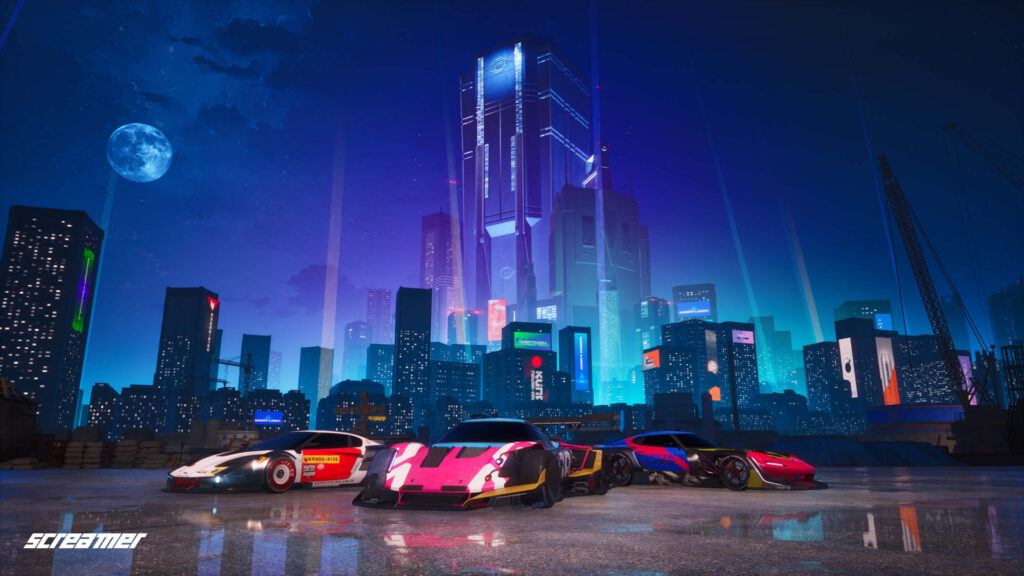
“We wanted to stand out in the landscape of racing games. So many YouTube comparisons pair the same car on the same Nürburgring track again and again. You have four or six on the same screen, and you only know which is which by the UI. You end up buying a new game and finding it’s not new at all. We didn’t want to do this.
“That’s why all the cars are created completely from scratch and unlicensed, and why all the tracks are fictional. We wanted to refrain from creating something that’s already been seen. So, if you make a game that stands out, works well and has a strong identity…why not?”