
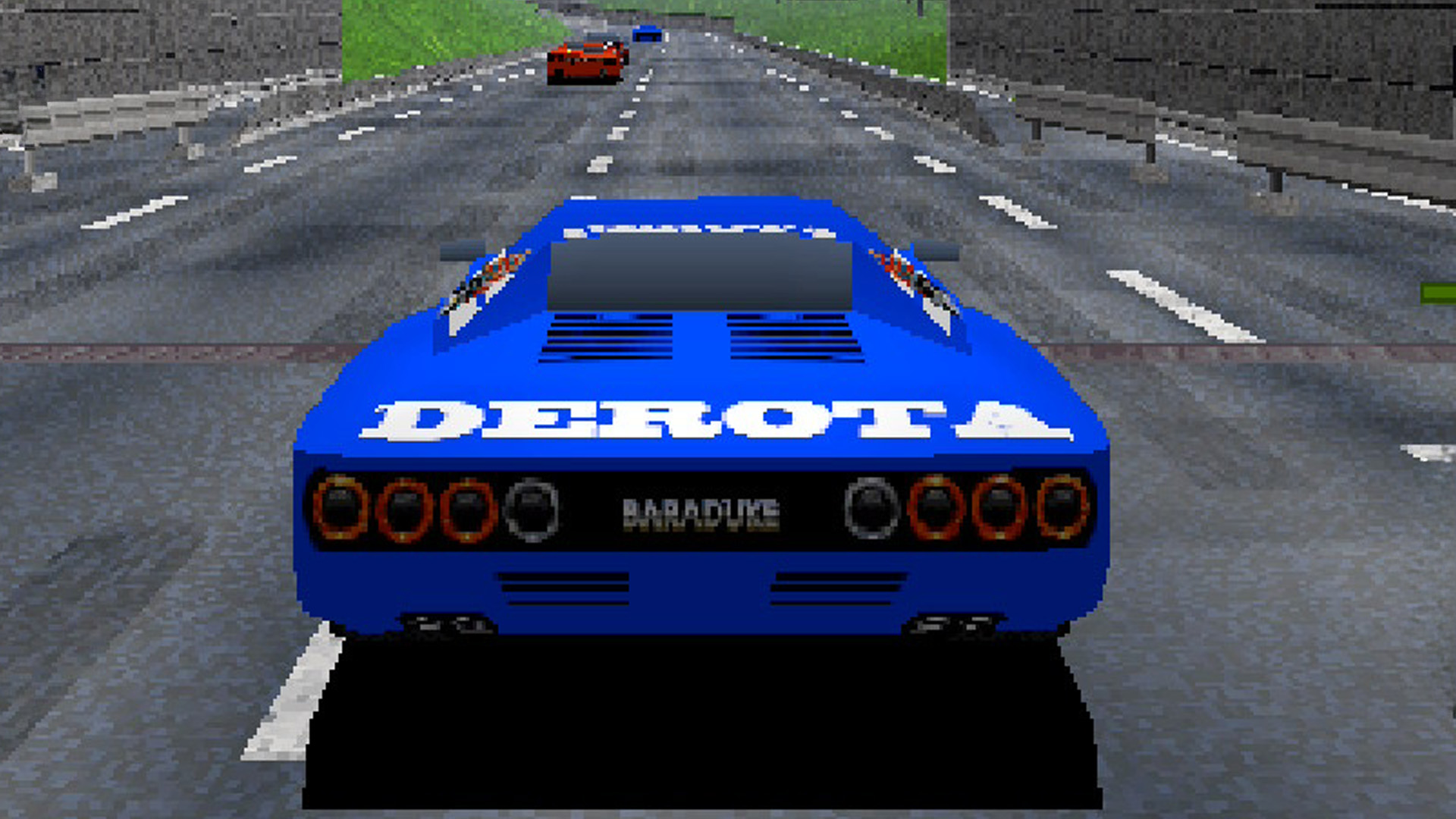
Rave Racer gets ported to home consoles a mere 31 years after its arcade release, thanks to the wonder of Arcade Archives II.
If you’re unfamiliar with this particular Ridge Racer entry, it might surprise you to discover Rave Racer is a missing link between arcade Ridge Racer and the drift-centric gameplay of the PSP and PS3/Xbox 360 titles.
Built for the same System 22 arcade hardware as the original, this coin-operated, checkpoint-based racer feels like an expansion mod of the original. So while you get a straight re-run of the beginner and expert courses from that game, you also get two unique, new tracks, which stretch the technology and track design to what arguably feels more like PS2 era gaming, some five years ahead of its time.
The graphics are a little more detailed here, with 2D beach babes and surfer dudes now standing by the seafront, grittier surface textures and a rear-view mirror.
When combined with a still-impressive draw distance, albeit with a few missing polys that can make the Seaside Route course look like its skyscrapers are floating in the sky, you start to see the city environment that was eventually realised in Ridge Racer V. It’s like the Buckingham Nicks studio album before Fleetwood Mac. The ideas are all there and enjoyable, just not quite in finished form.
There are immediately noticeable gameplay improvements, like improved collision detection between vehicles, and far superior analogue control on the JoyCon 2s. Gyro control is limited to the left Joycon only on 1P mode, and doesn’t feel great, so it’s better to go with the thumbstick. It controls really well, though some of the collision detection on corner apexes is disappointingly punishing.
You’ll likely find yourself giving apexes a wide berth to avoid knocks, which goes against everything the racer in you wants to do.
The drifting mechanism works almost identically but has been reworked since the original. It does, however, start to introduce the madness of the ‘be in a drift to get around any corner’ system of the PSP games.
It’s not mega-pronounced here, but drifting into a chicane will always see you come out the other side without hitting the wall, and drifting over jumps to literally land turning (surely impossible) is here in full effect. Mastering the drift becomes the long game here, but there is still a fair degree of traditional ‘driving’ to be done. As a result, it’s still solid to drive, but not quite as convincing as the original.
One inclusion I’ve never seen in any other core Ridge Racer game is the ability to fall off the road and land on another road beneath. The announcer shouts ‘Argh!’ as you slip from the Professional Course’s Turn 2, and then tells you to ‘get back to the race’, so you drive through an underground tunnel and emerge a little further on, rejoining at the chicane.
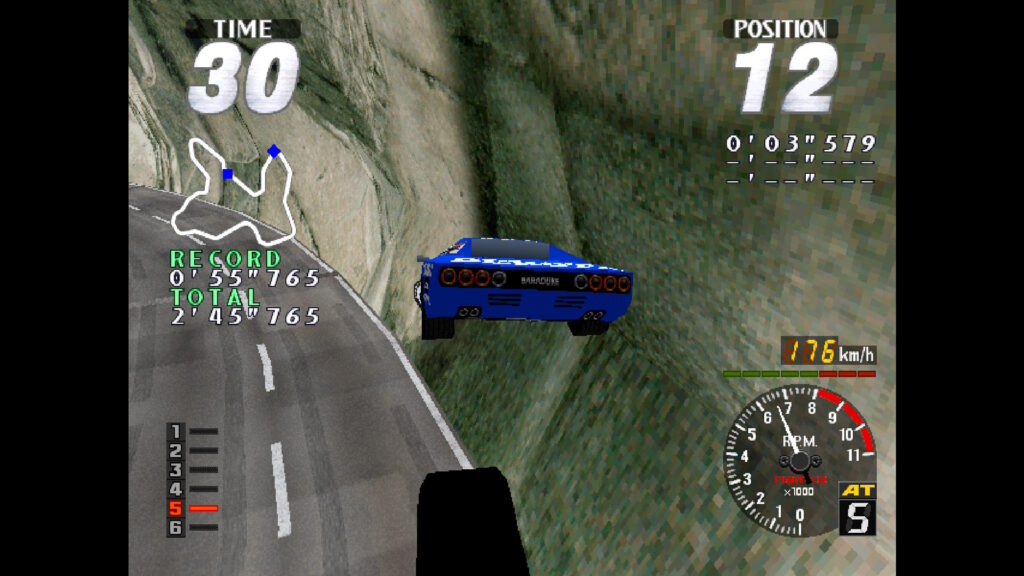
The technology involved in making that happen must have been quite something at the time, and it works surprisingly well, but it only happens on that one course. A very unexpected inclusion, but certainly exciting when it happens.
The time limit is very harsh – newcomers will be lucky to complete a single lap on the Professional course, though the difficulty can be changed in the options. Getting first place on all four tracks on default took me over an hour, but I needed all my skills to manage it. Once you’re winning races, you will find a genuinely rewarding racing game.
Give up before you ‘git gud’ and you might declare it just too shallow. Both verdicts are arguably true.
One big issue is that the sound grates after very few goes. The announcer is now female, and she is incredibly annoying, especially if you’re doing badly. If you remember the old “You must be one hell of driver, you gotta teach me!” of the original, somehow its replacement is even worse.
“Come on! Drive a smart race! There’s a lot of racing ahead!” Almost. Every. Time. You. Drift. Furthermore, get up to the front of the field and you’ll get some ’90s trash talk from a rival driver. Goodness only knows why you have him on radio.
There is a third, male voice, but his O.T.T. ‘dudebro’ delivery is painfully exaggerated. Finally, the music itself is very hit and miss. Some samples are pretty awesome, but the yodelling track needs to be fired into the sun. It’s dreadful.
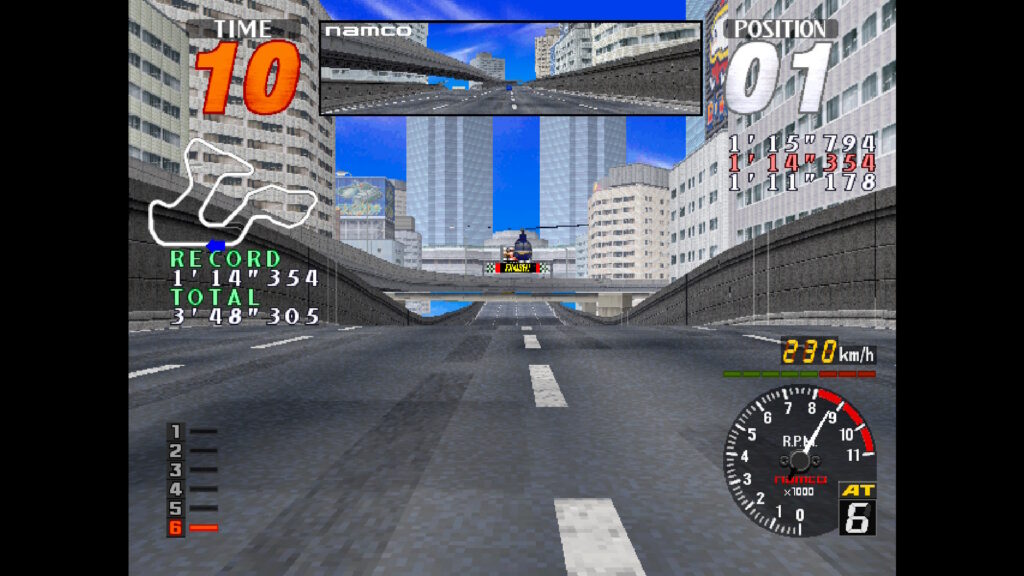
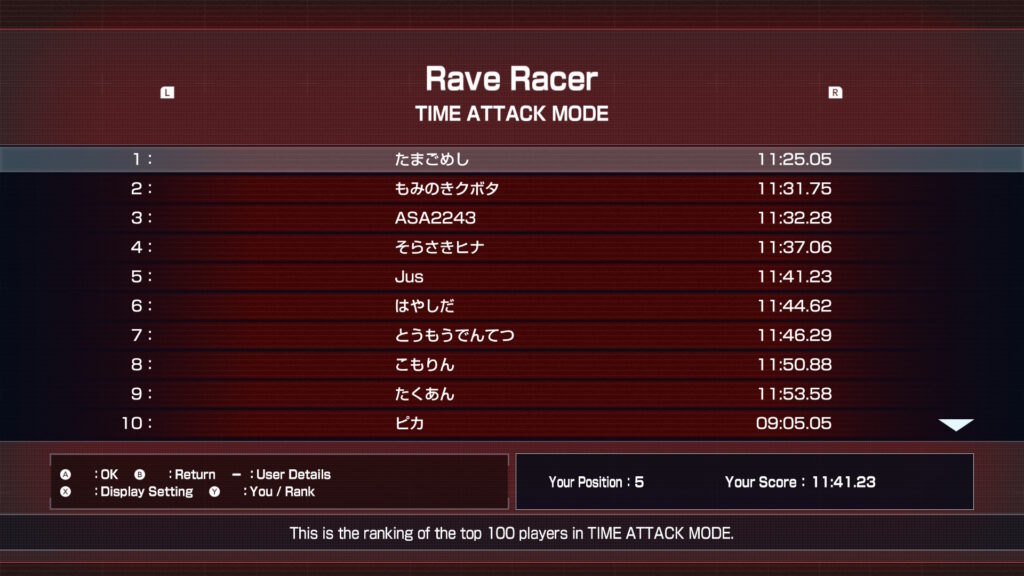
One very welcome addition is the ability to play two-player or even four-player split screen, with the entire arcade 4P link-up mode emulated on one Switch 2 screen. Glorious. You also get new Caravan and Time Attack modes with online leaderboards, plus a pretty great one-shot, four-race run, with all three laps on each track in turn.
I played the arcade version once in 1997, but I always assumed it was called ‘Rave Racer’ because it had coloured filters over the screen, making it look all trippy. The cab I played had the track graphics modulating pink, blue and yellow. I was 15 and knew no better, assuming it was some mid-90s club culture-based spin-off.
But having played this conversion now, I realise it must have just been a dodgy CRT on the cab I played, which makes me think Namco really missed a trick. Rave Racer with ravey visuals would have been awesome! Sadly, the CRT filters here only give you scanline, blurriness and a half-broken but colour-correct ‘failing’ option with a horizontal bar rising over the screen. They all look decent, but it’s hard-edged pixels all the way for me.
Rave Racer is undeniably an odd game. Annoyingly brash audio meets peak ’90s track design, all wrapped up in drift-centric racing. Ropy by today’s standards, it still has that magic ‘something’ that the era’s arcades seemed able to capture without apparent effort. Play it enough to get good and you’ll get at least one more sip of that ’90s magic. And that stuff is mighty rare now.