

Twenty years ago, Vernon Davis had one of the best combine performances of all time.
The former Maryland tight end had a near-perfect relative athletic score of 9.94, with numbers that didn’t make sense for his 6-foot-3, 254-pound frame. It catapulted Davis up draft boards before the 49ers took him with the sixth overall pick.
Oregon’s Kenyon Sadiq just did something comparable. My colleague Bruce Feldman had the hyper-athletic tight end as his No. 1 athletic freak to watch at the combine, hype that Sadiq matched. He set a tight ends record with a 4.39 40-yard dash, surpassing Davis’ long-standing mark.
Sadiq’s weight-adjusted speed score ranks behind only Davis and Kyle Pitts among tight ends in recent history, and both were rare top-10 picks at the position.
Like Davis in 2006 and Pitts in 2021, Sadiq is expected to be the first tight end off the board. Prior to the combine, our college football writers’ mock draft had the Eagles landing the “big-time blocker and good route runner” at No. 23. His time in Indy made it unlikely he’ll be available that late. 📈
He wasn’t the only tight end to show out. Vanderbilt’s 6-4 Eli Stowers set a record for the position with an 11-foot-3 broad jump — and had the second-best vertical by any player since 2003 (a staggering 45.5 inches). That could shrink the gap between Sadiq (No. 20) and Stowers (No. 48) in Dane Brugler’s top 100.
Remember, raw athleticism is more impactful at the tight end position than any other, as it’s apparently a position where everything else can be taught. As for their draft classmates …
Inside: Post-Indy risers and fallers, plus a flurry of trade and quarterback updates. Dianna will be along in a minute.
This article is from Scoop City, The Athletic’s NFL newsletter. Sign up here to receive it directly in your inbox.
Post-combine risers and fallers
📉 Carnell Tate’s speed, maybe. TateGate began after the Ohio State receiver’s official 40 time was 4.53 seconds, which would’ve ranked 27th among the 34 participating receivers. It was below team-recorded times of 4.45 seconds, so the 6-2 Tate’s agent made some calls, certainly.
Tate’s combine times are considered “official” because they come from the league, but Dane isn’t convinced:
💬 “The ‘official’ label for the 40-yard dash is a misnomer. It is great for TV, but in reality, teams use their own hand times more often than not, and their stopwatch is all that matters for them. Teams do that primarily for better consistency when they get times from pro days and other workouts.”
📈 Everyone else’s speed. Tate’s time seemed an outlier, as nearly every other position group — defensive backs, defensive linemen, linebackers, tight ends and running backs — logged their fastest average times since 2003. Targeted training? Better shoes? Morning sunlight thanks to Andrew Huberman?
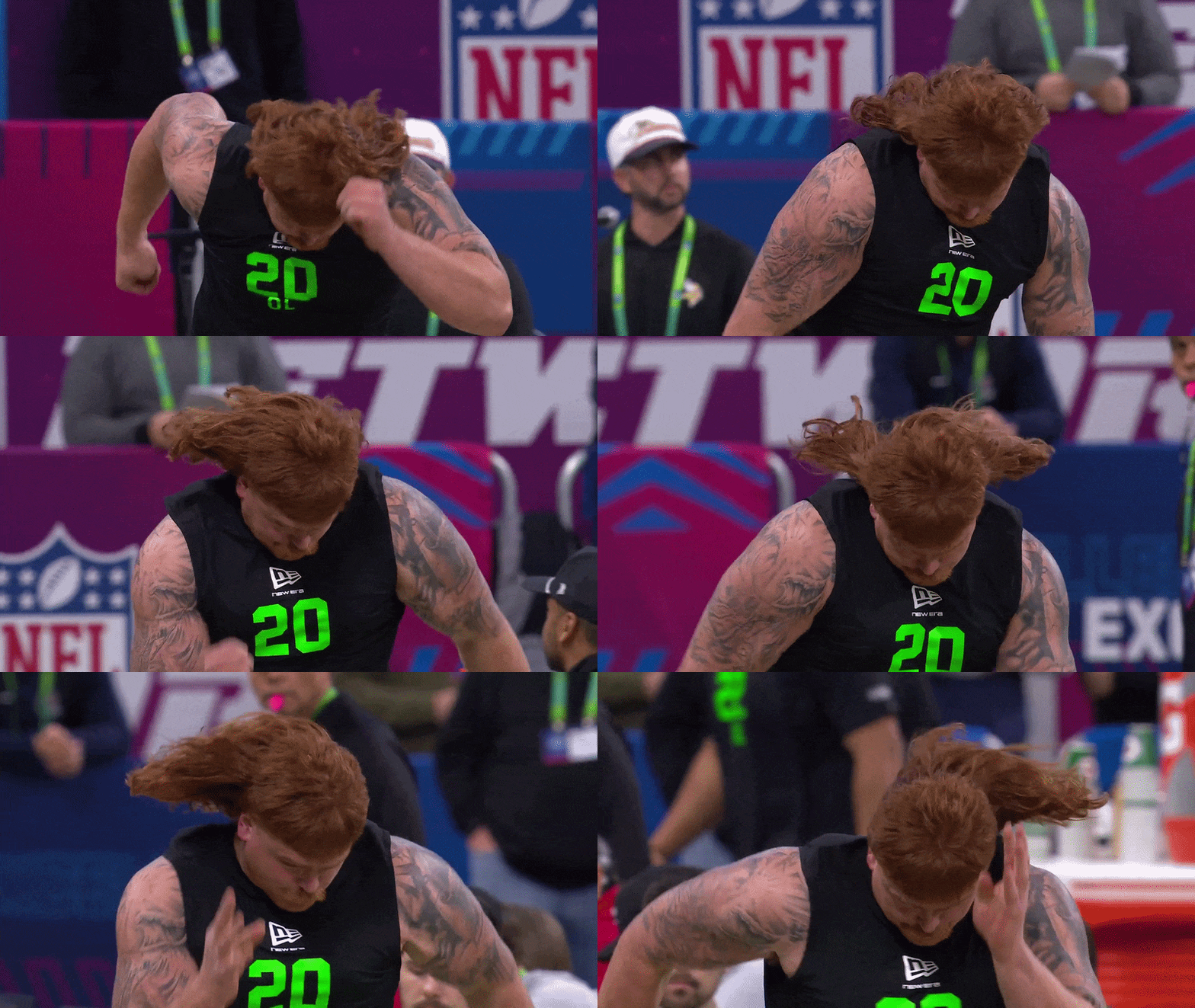
📈 Quality footage. A 6-9, 346-pound offensive lineman ran his 40 in 5.36 seconds. Rich Eisen was much slower. But the most important video of the combine was Iowa lineman Gennings Dunker’s flowing 40:
📈 Running backs. Arkansas’ Mike Washington Jr. burst into tears after posting the week’s fastest time at his position (4.33). Impressive, considering the group record. Dane’s top-ranked running back and No. 3 player, Notre Dame’s Jeremiyah Love, ran 4.36 — the same time as Jahmyr Gibbs, despite being 13 pounds heavier.
📈 The Styles brothers. Ohio State’s Lorenzo Styles Jr. set a record 40 time for a safety at 4.28 seconds, but his younger brother, Sonny, was among the combine’s biggest winners. The Buckeye linebacker measured in at 6-5 and 244 pounds, then ran an eye-catching 4.46-second 40 and had a 43.5 inch vertical jump, the second-best mark at his position since at least 1999.
📉 One short-armed edge rusher. Could historically short limbs sink standout Miami edge rusher Rueben Bain Jr.? His arms measured 30 7/8 inches, the third-lowest at his position since 1999. Oof. My wife measured mine this morning — I’ve also got 30-ish-inch arms, as does Bryce Young. Not good company.
I couldn’t find any pass rushers who recorded a sack in the past five years with arms under 31 inches, though Micah Parsons’ aren’t much longer.
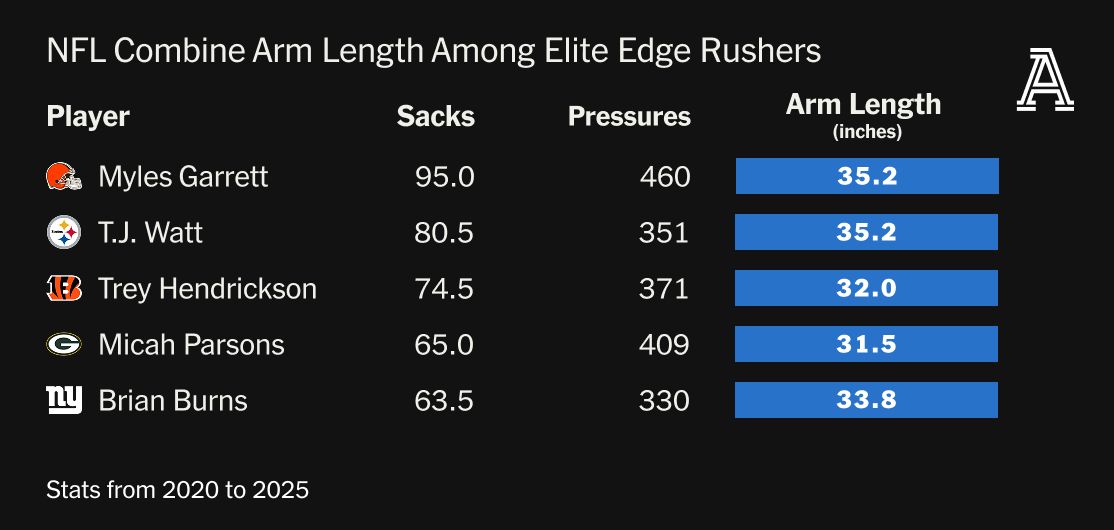
📈 Two other edges. Ohio State’s Arvell Reese (No. 1 overall on Dane’s board) and Texas Tech’s David Bailey (No. 6) proved ridiculously athletic, solidifying their positions as potential top-five picks. Since we’re talking arms, Bailey’s are 33 6/8 inches, and Reese’s are 32 1/2. No concerns.
And in news from Indy that isn’t about the combine itself:
📉 Tyler Linderbaum in Baltimore. The three-time Pro Bowl center received a “market-setting” offer from the Ravens, per GM Eric DeCosta. As our beat reporter Jeff Zrebiec noted, the typically tight-lipped DeCosta providing that detail suggests Baltimore and Linderbaum aren’t close to a deal. The Raiders and Chargers are expected to bid heavily for the 25-year-old.
📉 The “free Breece Hall” movement. As Zack Rosenblatt writes in our combine takeaways for each team:
💬 “If the Jets can’t come to an agreement on a contract — there is genuine interest in getting that done — then they are more likely to apply the cheaper transition tag (worth $11.7 million) rather than the franchise tag ($14.5 million) to keep Hall from hitting free agency.”
Daniel Jones could also be hit with the transition tag, a situation our reporters explained here. Before we look at the quarterbacks, over to Dianna for three trade updates.
What Dianna’s Hearing: Trading begins
Earlier today, the Texans agreed to trade for Lions running back David Montgomery, with Detroit securing fourth- and seventh-round picks and center Juice Scruggs in exchange for the 28-year-old.
Lions general manager Brad Holmes had acknowledged that Montgomery was unhappy with a diminished role in 2025, and now moves the running back and his cap hits to Houston. More on that deal here.
- It wasn’t the only trade the Texans were involved in today. They also agreed to trade offensive lineman Tytus Howard to the Browns for a fifth-round pick, and Cleveland is set to give the 29-year-old a three-year, $63 million extension.
We also saw the Jets and Titans swap defensive linemen last week. Defensive end Jermaine Johnson is heading to the Titans in exchange for defensive tackle T’Vondre Sweat.
- The 27-year-old Johnson will reunite with former Jets coach Robert Saleh in Tennessee, his coach when he was drafted in the first round of 2022.
- Meanwhile, the 6-4, 366-pound Sweat gives the Jets a strong run stopper to fill the void left midseason by Quinnen Williams, now in Dallas.
In turn, the Jets could replace Johnson by drafting an edge with the No. 2 pick in this year’s draft. As for Sweat, it didn’t seem like he was a fit in Saleh’s scheme. Back to you, Jacob.
New opportunities for QBs
Struggling quarterbacks have revived their careers with such regularity over the past few years that we’ve come to expect it from someone each season.
These jumps in performance typically follow a change (or three) in scenery. Players like Sam Darnold and Baker Mayfield broke out once they reached their fourth teams, while Daniel Jones just needed out of New York.
Based on combine chatter, a few more should get refreshes this offseason. And within a couple weeks, we might know several of the candidates:
Tua Tagovailoa. Under Tagovailoa’s current contract, he would lock in $20 million in additional guarantees on March 15, the third day of the new league year. The Dolphins are thus expected to part ways with him prior. His release would cost Miami a record-setting $99.2 million in dead money. (He also turned 28 today. Happy Birthday, Tua!)
Kyler Murray. He would add $19.5 million in guaranteed money for 2027 on that same date. The Cardinals are unlikely to stomach that. Cutting him prior would add $54.7 million in dead money but be offset by his nearly equivalent cap number, leaving a total cap hit of just $2 million. (Time for baseball? Remember the MLB’s Athletics drafted the now 28-year-old with the ninth pick in 2018.)
Geno Smith. He is scheduled to get $8 million guaranteed, which would make his total salary $26.5 million for the Raiders in 2026. The 35-year-old could help develop likely No. 1 pick Fernando Mendoza, but that’s a hefty price for mentorship.
The list of other options for quarterback-needy teams is long but uninspiring, including Joe Flacco, Aaron Rodgers, Russell Wilson and Kirk Cousins.
It’s led by the significantly younger (26) Malik Willis. He could reportedly get an average of $30 million per year, though I’d expect his number to land closer to the $20 million that the Jets gave Justin Fields last offseason. The question now is whether Willis can avoid the Browns.
Extra Points
👀 From the Eagles. Zack Berman shares what he heard out of the Philadelphia contingent in Indianapolis, including the hefty price tag for A.J. Brown.
🎙 Mendoza on Brady and the Raiders. We heard from the expected top pick on Las Vegas, as he emphasized learning and teamwork.
📺 Dealmaking happens at the legendary St. Elmo Steak House in Indianapolis. In this video, Michael Silver takes you inside.
📓 Inside our notebooks. Everything we learned from the 2026 combine, including how the Cowboys are shaking up their defense.
▶️ Last week’s most-clicked: Our top 10 free agents at each position, with plenty of familiar names at edge rusher.
📫 Enjoyed this read? Sign up here to receive The Athletic’s free NFL newsletter in your inbox.
Also, check out our other newsletters.