
Summary
Brazilian Jiu-Jitsu (BJJ) has been one of the most popular martial arts in the past two decades, thanks to its proven effectiveness as a fighting system. The ground-fighting system was developed to allow smaller, skilled practitioners to dominate larger, stronger opponents.
BJJ’s effectiveness as a fighting system that allows smaller fighters to defeat larger opponents was proven true during the early days of mixed martial arts. Royce Gracie and other members of the Gracie family, who modified traditional Jiu-Jitsu to create BJJ, dominated all comers.
Some would argue that the countless examples of BJJ players defeating bigger opponents prove that BJJ players don’t need to lift weights, but that’s a misguided conclusion.
Strength and conditioning play a massive role in any competitive sport, including Brazilian Jiu-Jitsu. Physical attributes like strength, speed, reaction times, balance, flexibility, and endurance can be considerable advantages in a BJJ match.
Key Takeaways
-
Technique comes first in BJJ, but strength gives you a clear advantage when skill levels are equal.
-
Smart strength training improves explosiveness, grip, injury prevention, and overall performance without sacrificing flexibility.
-
Two to three short strength sessions per week, focused on compound, functional movement,s are enough to enhance your BJJ game.
One of the most amazing things about BJJ is how efficient it’s designed to be. Your training teaches you to rely on leverage instead of brute force to gain dominant positions and force opponents to submit.
This makes technique the best weapon you have in Brazilian Jiu-Jitsu contests. Improving your techniques should always be your main priority whenever you step inside a gym.
That doesn’t mean being strong doesn’t make things easier for you on the mat. The stronger fighter typically has the advantage when two grapplers have equal technical ability. Being stronger than an opponent allows you to hold dominant positions for longer periods, power out of tight spots if your techniques are ineffective, and make your submissions more difficult for opponents to fight out of.
Most BJJ players have had moments where a stronger training partner could overcome their techniques with brute strength.
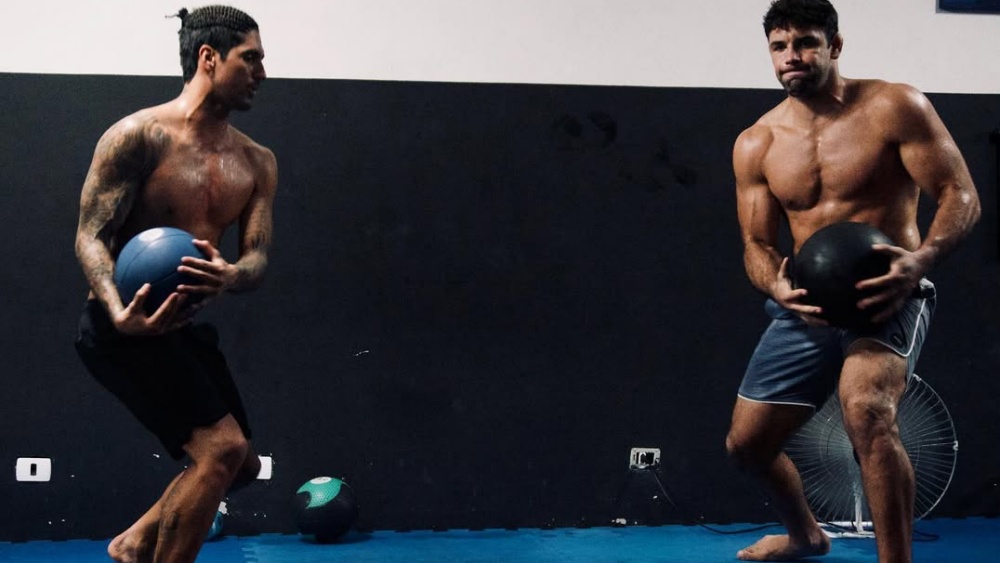
BJJ alone won’t help you develop the strength you need for some of the explosive movements used in grappling, like when you bridge and roll to escape the bottom mount position. Weightlifting helps to build muscle strength, which enhances many of the techniques used in Brazilian Jiu-Jitsu. It also helps to reduce the risk of injuries by strengthening your ligaments, tendons, and bones and improving joint stability.
The key to getting the most out of your strength training as a BJJ player is finding the right balance between muscle strength and endurance. Training like a bodybuilder won’t help much on the mat, so focus on increasing your grappling-specific strength.
Strength vs. Flexibility: Can You Have Both
There is a common misconception in BJJ circles that lifting weights will make your joints stiff as a board, but it couldn’t be further from the truth. Research shows that strength training can help to increase flexibility when done correctly. The key to increasing your flexibility with weight training is to prioritize exercises requiring you to use the full range of motion of the targeted joints, like squats. Such exercises stretch out your muscles while strengthening them simultaneously.
Lifting weights won’t hinder your ability to perform techniques that require high levels of flexibility, like the rubber guard.
The Best Strength Training Exercises For BJJ
Some strength and conditioning exercises are better for Brazilian Jiu-Jitsu than others. Your workout routine should focus mainly on compound exercises that simultaneously engage multiple muscle groups since such exercises help to build functional strength that will come in handy on the mat.
Here’s a short list of some of the best strength training exercises that will help improve your BJJ game:
- Deadlifts: Any experienced weightlifter will tell you deadlifts are the best exercise you can perform with weights since they engage virtually every muscle in your body. It’s an effective way to improve your functional strength. Deadlifts also help to improve your grip strength, which is vital for BJJ.
- Pull-ups: Pull-ups target most of the muscles in your upper back while improving your grip strength as you hold on to the bar. It improves your ability to pull things toward you, which is essential for many of the sweeps and submissions used in BJJ.
- Turkish Get-Ups: This exercise will improve your ability to scramble out of positions. It helps to strengthen your core and shoulder strength.
- Squats: Squats target most of the muscles in your legs and help to build the muscles that make up your core. Making your legs stronger will improve your ability to drive into opponents when shooting for takedowns.
- Kettlebell Swings: Kettlebell swings help to build explosiveness in your hips, which is crucial for executing many of the escapes, sweeps, and submissions used in BJJ.
- Hip Thrusts: Hip thrusts help strengthen your ability to generate explosive power with your hips, which improves your ability to perform techniques like the bridge and roll.
- Bench Press: This exercise strengthens your chest, shoulders, and triceps muscles. Strengthening these areas makes it easier to create space when grappling by pushing on your opponent’s body.
How Much Strength Training Is Enough?
Being dedicated to your BJJ training takes up much time, which might leave you wondering how to add a strength and conditioning routine to your packed schedule. The good news is that you don’t need to spend a lot of time on strength and conditioning since you have already trained BJJ.
About two or three 30-minute weekly sessions are sufficient to improve your functional strength considerably. You only need to target each muscle group once a week to see results.
Strength is only part of the equation; your conditioning also plays a vital role in how much success you have on the mats. BJJ is an endurance sport; you must roll for several rounds after classes and during competitions, pushing your conditioning to its limit.
The stronger or more technical fighter doesn’t always win a BJJ match. At times, the fighter who can compete for longer periods of time without becoming exhausted emerges victorious.
FAQs About Lifting Weights In BJJ
Q: Is Strength Important In Brazilian Jiu-Jitsu?
A: Yes, but technique comes first. Strength gives you an advantage when skill levels are similar.
Q: Will Lifting Weights Make Me Less Flexible For BJJ?
A: No. When done with a full range of motion, strength training can actually improve flexibility.
Q: How Often Should BJJ Practitioners Lift Weights?
A: Two to three 30-minute sessions per week are usually enough to build functional strength.
Q: What Type Of Strength Training Is Best For BJJ?
A: Focus on compound exercises like deadlifts, squats, pull-ups, and kettlebell swings to build functional, grappling-specific strength.
Final Thoughts
Technique will always be king in BJJ, but strength and conditioning are the trusty knights that can help you to power through tricky situations. You don’t need to lift weights to be good at BJJ, but doing so will take your game up a few notches.
You may also like:
What Is The Arm Trap And How To Utilize It For BJJ
Evolve Mixed Martial Arts® is Asia’s premier championship brand for martial arts. It has authentic World Champions in Muay Thai, Brazilian Jiu-Jitsu, Mixed Martial Arts, Boxing, Wrestling, and No-Gi Grappling. Named as the #1 ranked martial arts organization in Asia by CNN, Yahoo! Sports, FOX Sports, ESPN StarSports, Tokyo Times, and many other leading authorities, Evolve MMA aims to deliver the best martial arts instruction available anywhere on the planet.