
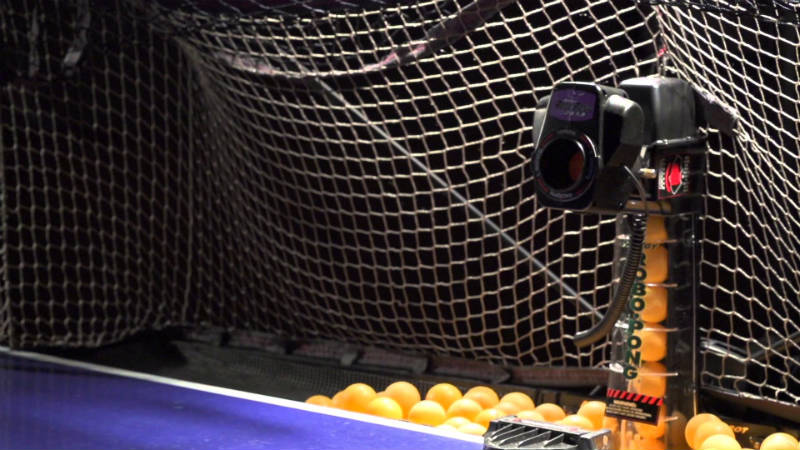
I like table tennis robots. Not everyone does, but I think they can be very useful if you use them in the right way.
My table tennis robot (Power Pong Omega) has helped me improve several areas of my game, including my topspin technique, rallying skills and footwork. Without doubt, I have become a better player by using my robot.
In this blog post, I look at the different types of table tennis robots you can buy. I’ve split robots into two main categories: entry level robots and professional level robots. I also make recommendations on which table tennis robots I think are the best and give links to where you can buy.
What can a table tennis robot actually do?
First of all let’s look at what a table tennis robot is capable of doing. Some come with just a few basic features, others are like powerful computer systems with loads of speed and spin variations and programmable training drills.
Here are some of the things a table tennis robot can do:
Ball frequency: You can change the frequency the robot shoots the ball at you. Most robots are capable of shooting 80 balls per minute. Some can do well over 100 per minute. That’s a lot of balls!
Placement: You can choose where the robot shoots the ball. Some basic robots may only shoot to two positions. Better robots can shoot balls to multiple positions and can switch between positions for each ball.
Speed: You can choose how fast the robot shoots the ball. Some robots can vary the speed of the ball. So you may get one slower ball and then one faster ball.
Spin variation: You can choose whether the robot shoots backspin, topspin, sidespin or float. Some of the entry level robots may not be able to do all of these. But the mid-range single-spin robots will be able to. And top-of-the-range multi-spin robots can also change the spin with each ball, which gives a more realistic table tennis playing experience.
Random play: You can get your robot to shoot balls in a random order. This could be random placement, random speed or random spin or everything completely random. Again, entry level robots will have more limited randomisation options. Whereas top-of the range robots will be able to do a lot more randomisation.
Service: You can tilt the robot head downwards, so that the ball bounces on the other side of the table first, replicating a table tennis serve.
Pre-set training drills: Some robots will come with pre-set training drills, where the robot will shoot the balls in a set sequence. Some pre-set training drills will also include a random element.
Programmable training drills: Some robots will allow you to programme your own training drills. You can choose the specific sequence of balls the robot shoots at you.
Ball recycling: Some robots (mainly mid-range or top-of-the-range), will come with a ball recycling facility, which is basically a collection net which funnels the ball back into the robot. This means that you don’t have to keep stopping to reload the robot. You can have continuous play.
Of course, not every table tennis robot can do all of the above. So you need to work out which features are important for you before purchasing. It’s not essential to have a robot which can do everything imaginable, but I think you will get the most out of a robot if you can (at a minimum) change the speed, spin, placement and do some random play.
Entry level table tennis robots
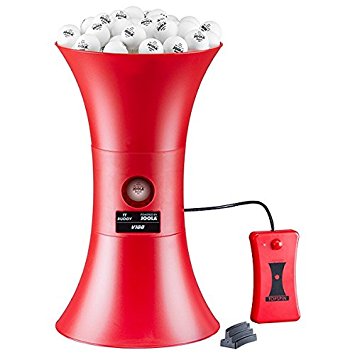
Entry level robots are best suited to a beginner player or players with a limited budget. They tend to have a few basic features, like being able to change ball frequency, placement and spin, but won’t have pre-set training drills and may not be able to do random play.
They are usually much smaller than professional robots. This has pros and cons. They are easier to set up and take less storage space. But as they are smaller, they don’t hold as many balls. So you will spend more time reloading your robot.
If you just want a robot so you can hit a few balls without doing anything complicated, an entry level robot will be good for you.
Price range:
Pros:
- Not very expensive
- Easy to set-up and use
- Easy to store or move to a different location (i.e. from home to club)
- Good for practising basic stokes
Cons:
- Limited features
- May not have random mode
- Can only produce one spin at time
- You will need to purchase a separate collection net
Recommendations
UK
USA
Professional level table tennis robots

Professional level robots have plenty of features to test both intermediate and advanced players. They have settings to change ball frequency, ball speed, and ball placement. They can also shoot the ball in a random sequence.
And of course, the really big advantage of these robots is that they can produce a different spin with each ball in a sequence. So the robot can shoot a backspin ball, which you loop. It then shoots a topspin ball, which you topspin/drive/hit (whatever your preferred playing style). This more closely replicates what actually happens when you play table tennis.
Some robots, such as the Power Pong Omega, come with pre-set training drills and allow you to programme your own training drills. You can even create your own personal drill database. You can name your drills and even group them with tags; such as; regular, irregular, service etc.
The other big benefit of these robots, is that they come with a ball recycling system. This sounds a bit fancy, but just means when you hit balls, they are collected in a net and then recycled into the robot. This allows you to keep playing and you spend less time refilling the robot or collecting balls from the floor.
For most amateur players, a professional level robot will offer you enough features to keep you practising for a long time. I own a Power Pong Omega robot, which I have had few years, and it still gives me a good workout, especially when I want to practice looping backspin balls and playing topspin rallies.
Professional level robots offer many more features, compared to entry level robots, but they are much more expensive. Because of the extra cost, you do need to consider whether it’s a tool you are going to use frequently. If you think you’ll be using a robot every week as part of your training schedule, then the extra cost of a professional level robot is going to be worth it.
Price range:
Pros:
- Huge amount of features to test every aspect of your game
- Can produce a different spin with each ball
- Collection net and recycling facility for continuous play
- Robot controlled by mobile phone / tablet app
- Will provide a useful practice partner for many years
Cons:
- Expensive – your bank balance will take a dent!
- Can take a longer to set up drills and learn how to use accompanying app
Price range:
Recommendations:
UK
USA
I personally own the Power Pong Omega robot, which I can highly recommend. You can read my review here.
Summary
Whether you choose an entry level robot or a professional level robot really depends on your budget, playing level and frequency of use.
If you are a beginner player who just wants to get some extra practice for basic strokes, then an entry level robot will be fine for your needs.
If you’re a more advanced player and plan to use a robot for regular training, it’s probably worth investing in a professional level robot. You will be able to set up drills to more accurately simulate real-match play.
Personalised equipment advice
If you would like personalised equipment advice, I recommend you join Tom’s TT Academy. In my academy, you can ask me anything about rubbers and blades and I will respond with my recommendations. You may also get recommendations from other academy members too.
In addition to equipment advice, you will also get access to a wide range of exclusive coaching content, including
- in-depth courses
- training drills
- tactical toolkit
- video analysis
- live sessions
- fitness videos
- robot training videos
- member discussions
- pro match analysis
- skill challenges
- and lots more!
You can access all this content for less than £1 per week. New content is added regularly. Join hundreds of table tennis players around the world today at www.tomsttacademy.com