
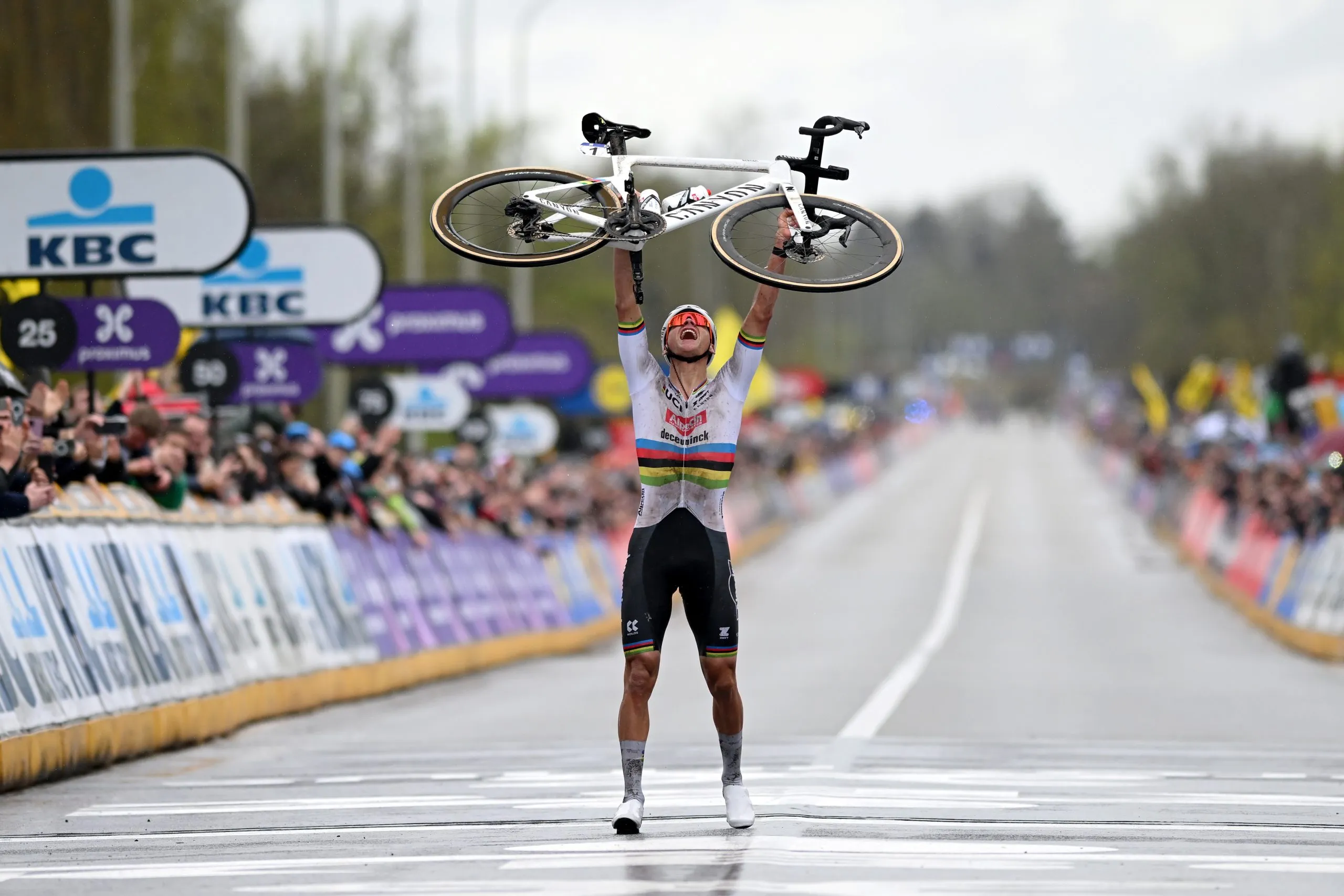
Mathieu van der Poel’s name is synonymous with success thanks to an extensive palmarès that puts him among the very best cyclists of all time across both road and cyclocross. This past winter, he spent several weeks torturing his cyclocross competitors in what would became a record-breaking season with 13 consecutive wins, in the midst of which he toppled Belgian giant Sven Nys to stand alone with most UCI World Cup wins and culminated his campaign with yet another rainbow jersey.
The 31-year-old is carrying this form onto the road once again in search of stacking yet more Classics wins. He began his tirade earlier than usual this year, making his debut at Omloop Nieuwsblad, where he predictably rode the final 16km alone on his way to victory.
However that success has brought with it an interesting conundrum Van der Poel goes in search of what would be a record-setting fourth Tour of Flanders victory later this spring: no man has ever won both Omloop and the Tour of Flanders in the same season. But I think he’s the man to break that curse.
The flying Dutchman
Van der Poel could – and probably should – be the one to break this pattern. Particularly when he’s embracing a pattern of his own. Every other edition of Flanders since 2020 has borne witness to him standing on the top spot of the podium. Given his third place last year, if history repeats itself, all signs point to victory. Something has to give, realistically the only man standing in his way is Tadej Pogačar.
It’s Van der Poel’s versatility that has brought him so much success in this race, with three Flanders victories to his name – the joint most wins ever in the Monument. He flies up the bergs, has the engine to go solo and maintains his strong sprint after the hardest days of racing. He opened his account in 2020 prevailing in a two-man sprint with eternal rival Wout van Aert. In 2022, he won a four-man sprint, after playing a game of chicken with Pogačar to bring two extra riders into the fold. 2024 was different. Instead of a sprint, he launched a 45km solo move on the Koppenberg at the same time many were forced to run up the slippery mud-slicken cobbles.
Looking back at his preparation in those winning seasons, removing the topsy turvy Covid year in 2020, he didn’t race much cyclocross in 2022 to recover from back issues and only returned to racing at Milan-San Remo; in 2024 he had a complete – and very successful – CX campaign, but again only returned for San Remo. He’s trying a slightly new recipe in 2026, but he needs to do something different to 2025 if he’s going to get the better of Pogačar. After all, Flanders is currently set to be only the third race day of the Slovenian’s season.
To win Omloop and Flanders in the same year, Van der Poel must also learn from the mistakes of others.
The escaping act
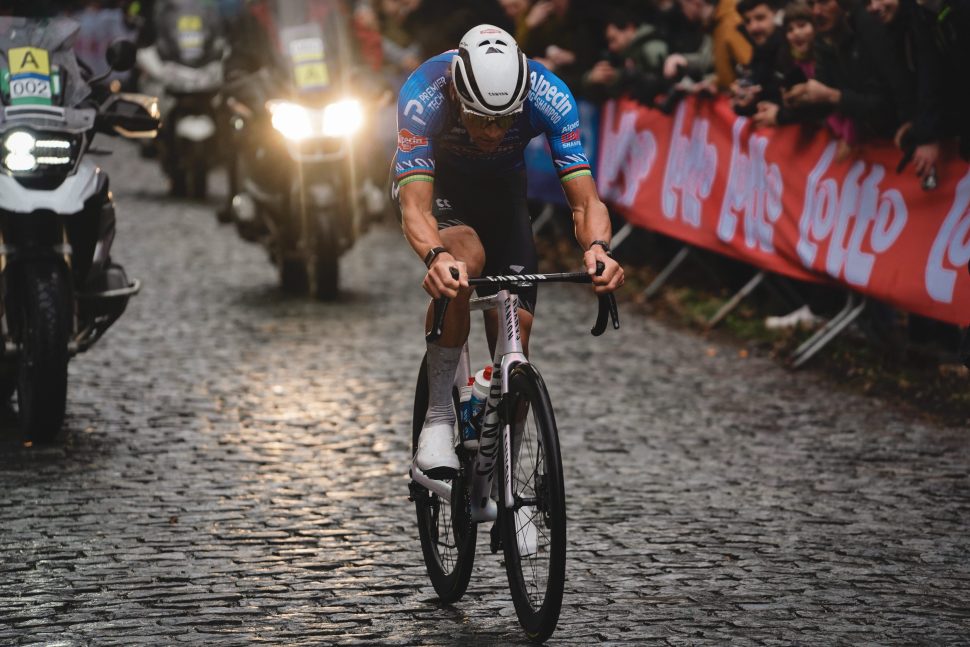
Doing the Omloop/Flanders double is a rare feat in the women’s peloton, only Lizzie Deignan and Lotte Kopecky managing to do so in 2016 and 2023 respectively, but no man has ever done it.
Tom Boonen and Greg van Avermaet are two that have come the closest. Boonen finished second at Omloop in 2005 behind teammate Nick Nuyens, but won Flanders with a solo attack in the final 10km. The same fate befell Tommeke in 2012, losing a sprint finish to Sep Vanmarcke at Omloop yet winning the first edition of Flanders with its rejigged parcours and new finish in Oudenaarde.
It was a rejuvenated race, the Muur van Geraardsbergen removed for a triple undertaking of an Oude Kwaremont/Paterberg circuit, but that’s important when considering the ‘curse’ of the Omloop/Flanders double. These races have evolved a lot and are still evolving, with Omloop adding even more former Ronde features this year like the Tenbosse.
Boonen never won Omloop, it’s the major Classic missing from his palmarès. In a head-to-head against Vanmarcke in the race, Boonen only beat his compatriot once out of six times. He misjudged the finish in 2012, telling Sporza that ‘this morning I checked out the finish area, but still I fooled myself. I thought I started my sprint at the right time but when I launched my sprint I ran out of gas. The race was 50 meters too long.’
What can Van der Poel learn from this? Apart from timing the sprint right, which he clearly can do, ensure a dangerous move doesn’t go close to the line, but with Pogačar at his opponent – himself looking to equal the record of three Flanders wins – it’s not that easy. But he doesn’t need to shake Pogačar off, he knows he has the better of the World Champion in a sprint, it’s just about sticking on his wheel to the finishing straight, just like he’s done in both Flanders and Milan-San Remo.
It certainly won’t be an easy task, but if anyone can break the curse it’s Mathieu van der Poel, especially with the prospect of becoming the most successful rider in Tour of Flanders history on the line.