

“Many a month has come and gone
Since I wandered from my home,
In those Pennsylvania mountains where I was born.
Many a page of life I’ve turned
Many a lesson I have learned,
But I find that in those mountains I still belong.”
—with apologies to Woody Guthrie
By Don Scheese — “You can’t go home again,” said Thomas Wolfe. Maybe, maybe not. But you can still certainly visit the area you once grew up in and where you spent some of your formative decades. And so, every October for the past three years I’ve combined visiting family in the general area where I was raised and participating in a wonderful gravel event called “UnPAved.” Held in the small Pennsylvania town of Lewisburg in the Susquehanna River valley, the event is the brainchild of Cimarron Chacon (you gotta love anyone with that name), who is also a co-creator of gravel races out West like True Grit in southwestern Utah.
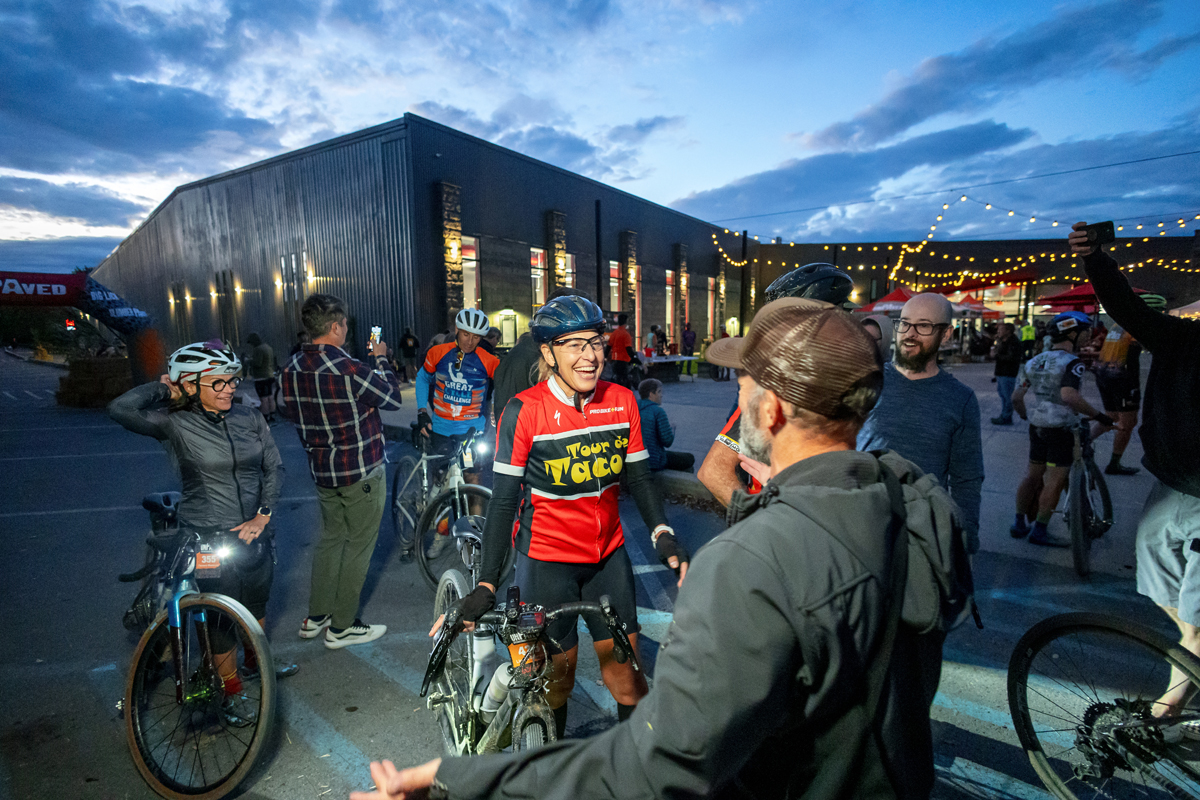
The event, which started in 2018, is held on the second weekend of October over three days. There are routes of varying distances: 30-50-70-100, and 200 miles, and even an overnight bikepacking trip to Poe Paddy State Park in which your gear is shuttled to the campground so you can ride as lightly as possible. There is no mass start; instead, several timed hill climbs decide who the “winners” are of the race. Organized pre-rides are available so you can recon parts of the courses, and there’s a gear expo and a gravel film festival the day before the race. A post-ride party completes the activities, where food and beverages are provided as part of your registration fee.
All told over 1000 riders participate, and the gravel event is held the same weekend as the Lewisburg Fall Festival, featuring food vendors and the works of various local artists and craftspeople. The small town with its charming colonial downtown historic district is the home of Bucknell University and has all the good vibes and amenities of a college town, including interesting restaurants and coffee shops (for great ice cream don’t miss the Old Mill Creamery a few miles west of town).
The forecast was looking iffy for race day on Sunday. I arrived on Friday, in time to get in a short recon ride on my excellent rental bike from Link Cyclery in town, a Giant Revolt Advanced 2, on the pancake-flat Buffalo Valley rail trail, a 10-mile straight shot from Lewisburg to Mifflinburg to the west through farmland and hardwood forest. With a Nor’easter roiling up the East Coast predicted to just scrape central Pennsylvania, it was disturbingly unclear how much rain would fall on Sunday. So, I chose to ride a version of the 50-mile route on Saturday, which promised fair weather for that day. That way I could (hopefully) stay dry, avoid the crowds of gung-ho racers, and enjoy relative solitude on the trail and roads. Then Sunday, weather permitting, I could still get in a shorter ride with the hordes of gravel-riding aficionados who’d be trundling along that day. As it turned out, my plan worked to perfection.
The first four miles of the route were on the Buffalo Valley gravel path. Pennsylvania can boast of many such rail trails, abandoned railroad lines once purposed to serve the coal mining industry for which the state is famous, and relatively recently transformed into non-motorized recreational corridors for walkers, runners, cyclists, and equestrians. My father worked in the underground coal mines for over 30 years, before strip mining took over and put many miners out of work in the early 1960s. I very much liked the idea of riding on routes once used for hauling coal out of the mountainsides; it represented a nostalgic return to my roots.
I saw and heard bluejays and cardinals through the forest patches, as I passed groups of young Mennonite girls on bikes, their long flowy dresses and white bonnets distinguishing them from other trail riders. At the junction of Strickler Road I met up with a group of women heading out for the “Slumber Party,” the overnight bikepacking trip, whose enthusiastic whoops of joy announced their arrival. We would pass and re-pass each other the next couple miles over the undulating backroads as the route wound through lovely pastoral landscapes of well-maintained farms and fields.
The undulating roads leading to the base of Jones Mountain in Bald Eagle State Forest are no joke: with short gradients as much as 13% they are an effective warm up for the longer climbs to come. I passed Amish horse-drawn buggies and piles of horseshit on the smooth backroads, part of the ‘local color’ of bike riding in these parts. With little vehicle traffic, this was proving to be an idyllic experience on a lovely sunny, cool, calm morning.
I had the route uploaded to my Garmin, and the turns were marked on the road’s surface with bright orange arrows. Somehow though I managed to miss a turn on a sudden fast descent and wound up on Steffen Road with a (I kid you not) 20% gradient! Grinding away in my lowest gear, I crawled up the punchy climb, then cursed as I quickly lost the elevation I had just gained, descending to another creek valley. At the junction with Centennial Road, I stopped to consult my paper map of the area (an avowed old-school kind of rider, I always carry paper maps of any area I ride through during a gravel event in unfamiliar territory). I’d come too far to backtrack, I reasoned, so the only option was to carry on and rejoin the official route somewhere ahead. I figured out that if I took Centennial Road north (which I’d crossed earlier), then briefly headed west on busy Buffalo Road, I could get on Jones Mountain Road for the one and only truly ‘epic’ climb of the entire route.
Which is exactly what I did. And make no mistake: Jones Mountain is a challenging climb. Over 3 miles it rises some 1200’ with steady gradients in the 10-13% range. As the road surface changed from pavement to gravel in the state forest, and quickly reared up to formidable steepness, I settled into a comfortable rhythm after letting out some of the air in my tires for better traction. Now I was entering the deep woods of my youth: a riot of vegetation in peak fall foliage, hardwood trees looming, thick understory, sprinkled with occasional dark patches of mountain laurel, the state flower of Pennsylvania. The colors only grew more intense the higher I climbed.
A word about Pennsylvania gravel. As a relocated Westerner who’s ridden on many chunky, rutted, rocky stretches of gravel roads in national forest and BLM lands, the gravel back East is ‘gravel lite’: hard-packed, relatively smooth with only occasional potholes. This is great for gravel-grinding but be forewarned: It also means drivers of vehicles don’t have to take it too slowly on these well-maintained roads. And while I would only meet with perhaps a dozen vehicles in the 20-30 miles of state forest land, most of them I encountered drove too fast and refused to yield to cyclists on narrow stretches and blind corners. The stereotype of “impatient Easterners” clearly proved true in these parts, so using headlights and taillights is not a bad idea.
Continuing to grind away, I eventually rejoined the official route (which comes in from Brandon Road). Nearing the summit I encountered event signs like “THIS IS NOT THE TOP” and “EASY ON THE EYES, HARD ON THE LEGS”—examples of wry ironic humor for which UnPAved is well known. Just past the official high point one of the few vistas of the entire route opened, where I met with another group of women doing the slumber party option. Their laughter and chatty conversation indicated they were having a good time. The sublime view reminded me of this nostalgic passage from Edward Abbey’s essay “Mountain Music,” as he reminisces about the landscape of his youth:
“Where does the line ‘High on a windy hill’ come from? I cannot remember.
But it evokes at once the spirit and the atmosphere of those skyward
excursions. Clouds soaring by, the soft and melting clouds of Pennsylvania
on the gentle Watteau blue of the Pennsylvania sky. Down below—far below
I would have said then—I could see the red barns, the white farmhouses, the
green and yellow fields, the meanders of a creek, the winding ways of the
country roads passing among the hills from farm to farm….”
Indeed. Like Abbey, I was a Pennsylvania native who also emigrated to the American West in his early twenties to find his second, perhaps truer home, one reason I developed such a deep affinity for this influential writer and environmentalist.
The road plunged down from the Jones Mountain vista through a forest that became increasingly darker and wilder. Hardwoods were replaced with Eastern hemlock trees and Eastern white pine, interspersed with bright yellow patches of beech and elm leaves. Chickadees and nuthatches chirped from the dense woods, and I even heard the wild cries of a pileated woodpecker. The route continued to roller-coaster like this for another 10 or so miles before reaching the junction of Stony Run Road, where the first official aid station is located. My mouth watered as I thought of the savory hot dogs, pierogies (dumpling like pasta stuffed with potatoes and/or cheese), and cold Cokes that would be served tomorrow by dedicated volunteers. Ruefully munching on a Clif bar, I thought of the obvious disadvantage of not riding the route on race day. Oh well…. the solitude and quiet made up for the gustatory disadvantage I faced.
“Run” is a geographical term back East used to denote creeks and streams. Stony Run featured a shady, shallow watercourse I followed upstream for a couple miles to the next junction. It too was dark and mysterious, making for more introspective riding. I reminisced about the forts we used to build in the woods as kids and the battles we would carry out between rival groups with crabapples as our main weapons. Much more gradual than the Jones Mountain climb, it was easy to fall into a comfortable rhythm on this ascent.
More challenging came the climb after the turnoff on Buffalo Mountain Road, which climbed up to the next and only additional viewpoint of the route, Hobo Vista (I’d love to know how it had acquired such an intriguing name). Here again I stopped to refuel and recover, this time enjoying complete solitude and quiet. Giant slabs of rock were conveniently placed along the turnout to recline on, and as I took in the view I again (ever the former English professor) thought of Abbey and countless other writers who once evoked the sublime feelings one gets from encountering an unexpected prospect.
Mercilessly, the road continued to climb back up to over 2000’ before topping out in more hemlock and pine forest. Thoroughly soaked in sweat In the East Coast humidity and 60-degree temps, I made sure to zip up my vest and long-sleeve jersey before the final plunge back down Shingle Road to “civilization”—scattered cabins and houses niched into the Pennsylvania woods. Then it was on to more paved backroads through yet more farmland (Pennsylvania, I’ve been told, has more miles of paved roads than any other state in the nation). More local color ensued as I rode through a picturesque, well-maintained covered bridge over Buffalo Creek. Then I cautiously crossed busy Highway 45, and headed east again on Swengel Road back to 45, with a decent shoulder providing adequate protection from traffic the last few miles to Mifflinburg, where I regained the Buffalo Valley trail.
Only 10 miles back to Lewisburg. But before that a break at the Rusty Rail tavern with good homebrew and hot food. Then a rewarding tailwind to boot!
Ride totals: 57 miles, 3900’ of climbing, 9.9 mph average.
On Sunday, contrary to the earlier forecast, the weather proved fair and inviting, so I did a 30-mile route of my own design, with 1100’ of climbing in the foothills. On the return loop near Mifflinburg, I joined up with scores of other riders and imbibed the free local samples of beer provided by the Rusty Rail. Seeking some input and perspective on the event, I accosted the first pretty girl on a bike I could find and asked her some questions. Thirty-something Valerie from Philadelphia, splendidly attired from head to toe in Rapha kit, mounting a fancy bike, positively loved the event, citing its “chill vibe” yet challenging routes, as well as the diversity of riders, and decided then and there to return in future years. Definitely a satisfied customer.
It left me with a good vibe too, as I crossed the finish line back in Lewisburg later that afternoon. At the conclusion riders are presented with swag like a mug, musette, t-shirt and, best of all, a whoopie pie! (You will have to research that yourself to learn what it is.) Plus, a meal of barbecue, mac ‘n cheese, and two local beers.
As I ate my meal, always the contemplative over-thinker, I wondered: was it worth traveling 1000s of miles, spending 100s of dollars, to ride a bike in new surroundings, when I could have ridden the same mileage at home, spending far less time and money to travel? What does it all mean, what did the experience amount to? I recalled some lines from Elizabeth Bishop’s poem “Questions of Travel”:
“Is it lack of imagination that makes us come
To imagined places, not just stay at home?
Or could Pascal have been not entirely right
About just sitting quietly in one’s room?
Continent, city, country, society:
The choice is never wide and never free.
And here, or there…No. Should we have stayed at home,
Wherever that may be?”
Here’s the only answer I can offer: we humans have been wandering for millions of years, ever since we left the African savannah. Wandering is still an integral part of our DNA.
Perhaps the answer is as simple as this: the meaning is in the motion.
P.S. Testifying to the good gravel grinding readily accessible in the area, a new “Gravel Adventure Field Guide” has just been published for the Susquehanna River Valley in central Pennsylvania, featuring 10 different routes varying in length from 25 to 100+ miles. See my review of the current guidebooks in this series in the Spring 2025 issue of Cycling West.
Event Info:
October 11, 2026 — UnPAved of the Susquehanna River Valley, Lewisberg, PA, Cimarron Chacon, [email protected], unpavedpennsylvania.com
(Visited 14 times, 14 visits today)