
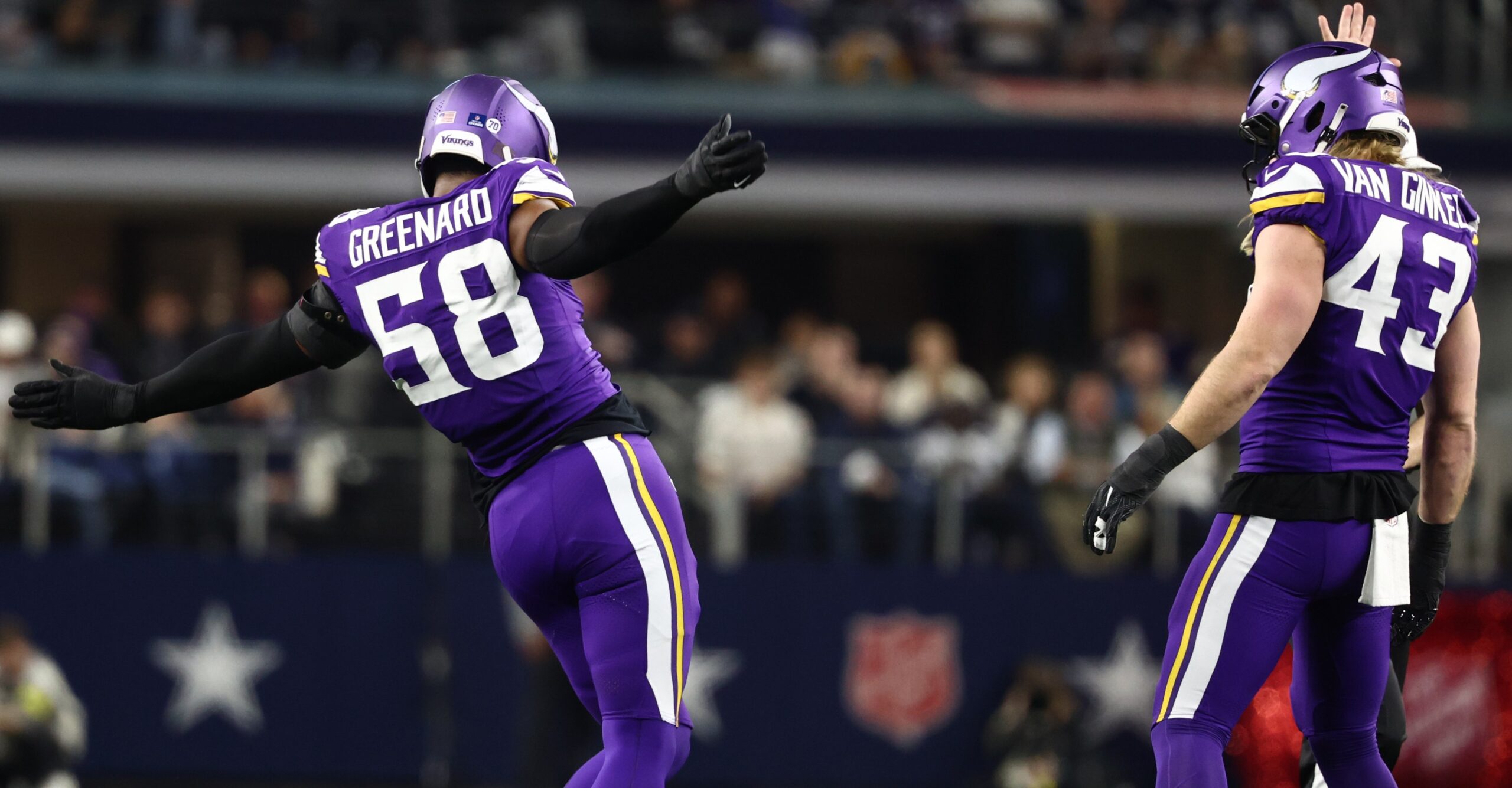
According to recent reports, the Minnesota Vikings are exploring the possibility of trading standout edge rusher Jonathan Greenard. While it would hurt to see a good player leave the organization, perhaps the incoming trade compensation could ease that pain.
Greenard is a productive player in his prime on a relatively cheap contract, given the market rate for edge rushers. So what’s his trade price?
Seahawks reporter Corbin K. Smith revealed on social media, “Re: Vikings pass rusher Jonathan Greenard… I’m told by a reporter with inside knowledge of the team that Minnesota has received inquiries from ‘half the league,’ including #Seahawks. He’s going to be in demand, but sounds like a second-rounder and Day 3 pick is the sweet spot.”
The Super Bowl champs have inquired. A reunion with 2024 free agency classmate Sam Darnold could be on the table. Either way, Greenard would bring the Vikings a 2nd-rounder and another pick on Day 3 if Smith’s report is accurate.
It’s traditionally hard to get a hold of a 1st-round Draft pick, especially for a player that’s not quite considered elite. Furthermore, Greenard is reportedly asking for a raise, which lowers his market value.
Albert Breer of SI commented about the situation: “The Vikings’ situation with OLB Jonathan Greenard is a bit complex—Greenard is seeking a market correction to his contract, per sources. He’s due $19 million and would like a raise. Minnesota is comfortable with him at his current number. The team views him as one of their best players, and won’t just let him go. But if someone comes with a big offer, a deal could be had.”
Indeed, Greenard is underpaid in the NFL landscape, ranking 17th among edge rushers at $19 million a year. Nowadays, the top rushers get north of $40 million.
That rapidly rising market is one reason situations like Greenard’s can become complicated. Players who outperform their contracts often seek adjustments, while teams must decide whether to reward that performance or maintain financial discipline. Those competing priorities sometimes lead to trade discussions, even involving highly productive players.
Our own Dustin Baker noted, “Greenard earns the aforementioned $19 million per season. When joining the Vikings two years ago, that number was fair and aligned with market value. Now, the veteran EDGE probably deserves a bump near $27 million, give or take. For context, Micah Parsons in Green Bay earns $46.5 million annually. Parsons is certainly a better defender than Greenard, but he’s probably not $27.5 million per season better.”
He has undoubtedly been productive, though his sack numbers in 2025 didn’t match that, as QBs annoyingly wiggled out of his grasp several times.
In his first season in purple, Greenard sacked opposing passers 12 times, and he added 59 tackles (18 tackles for loss) and 22 QB hits. In the regular season, Greenard ranked third among edge defenders in QB pressures with 80 and first in QB hurries with 59.
His second season wasn’t as dominant, but still solid when healthy. His shoulder injury cost him five games, and he wasn’t at his best in some others, but he played through the issue until the club was eliminated. Greenard recorded 3 sacks, 47 pressures, and 36 hurries. His pass-rush win-percentage was comparable to his previous season.
The Vikings must weigh the potential salary-cap relief and additional draft capital against the loss of one of their top defenders and locker-room leaders. If he’s out, Brian Flores would — barring a massive acquisition — turn to 2024 1st-rounder Dallas Turner, who played quite well in his sophomore season, especially when Greenard was sidelined.
Ultimately, the decision may come down to how aggressively the Vikings want to reshape their roster this offseason. Moving Greenard would be a bold step, but it could signal that the front office is willing to make difficult decisions in order to gain financial flexibility and future assets.
Editor’s Note: Information from PFF, Over The Cap, and Sports Reference helped with this article.
