
When the latest editions of the Copenhagenize Index and the annual rankings from PeopleForBikes started reshuffling the usual North American suspects, a pattern emerged. It’s no longer just about which city has the most bike lanes per capita. It’s about where infrastructure, culture, density, and street life intersect.
Montreal and Vancouver regularly top global and continental lists. Minneapolis quietly posts some of the highest bike commuting rates in the U.S. New York continues to expand its protected network at scale. Portland remains one of America’s long-standing cycling leaders. But zoom in closer and the real story isn’t citywide — it’s hyperlocal.
These are the coolest cycling neighborhoods where bike lanes don’t just move people. They anchor café culture, shape retail strips, and redefine how urban space feels at 15 km/h.
Plateau-Mont-Royal — Montréal, QC
Montréal consistently ranks as North America’s highest-placed city on the Copenhagenize Index, thanks to aggressive expansion of its Réseau Express Vélo (REV), winter maintenance, and high everyday ridership. But numbers only tell part of the story. The Plateau is where it all becomes tangible.
Avenue du Mont-Royal hums with bike traffic at almost any hour. Cyclists glide past corner dépanneurs, vintage shops, and terraces at Café Olimpico, where espresso culture and cycling culture overlap seamlessly. On nearby streets, murals bloom across brick façades, and bike racks are as common as street trees.
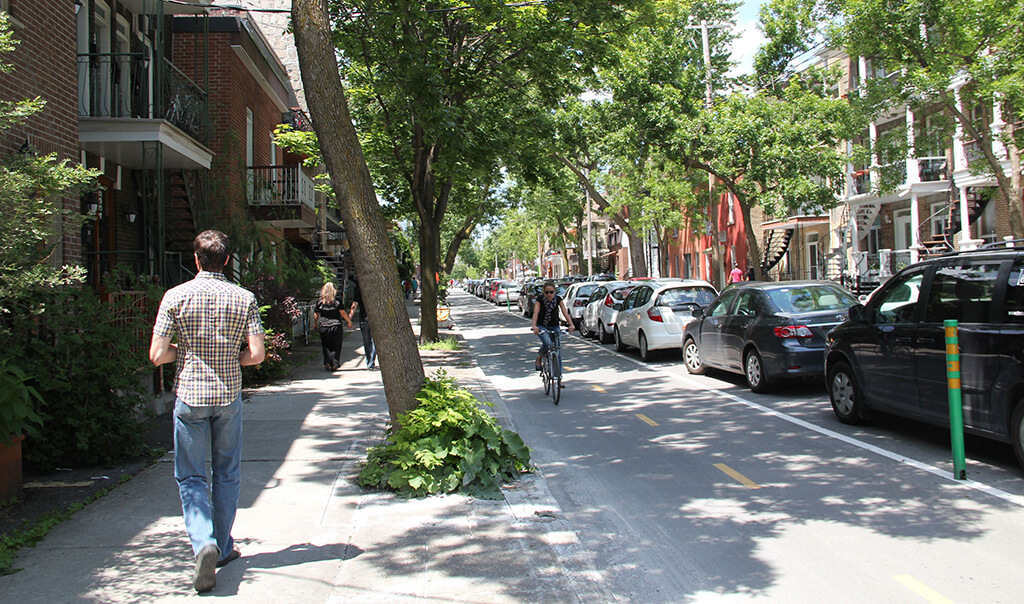
Parking-protected bike lanes in Montreal’s Plateau neighborhood
The REV Saint-Denis corridor slices cleanly through the district, protected and direct. Families ride side-by-side. Students pedal to UQAM. Cargo bikes haul groceries home from Jean-Talon Market. The infrastructure works because the density works. And the density works because the neighbourhood is built for human scale.
Even at night, the Plateau feels like a cycling salon. Riders lock up outside Dieu du Ciel! for craft beer or spin toward Parc La Fontaine for a dusk loop before heading home.
Kerns — Portland, OR
Portland has long ranked among America’s most bike-forward cities, with one of the country’s most mature networks of neighbourhood greenways and protected lanes. But if you want to see where cycling culture meets internationally recognized cool, head to Kerns.
Time Out named Kerns the fifth coolest neighbourhood in the world — and the coolest in the United States — describing it as a place that “feels like a perfectly-formed small town” inside a major city.
That assessment tracks on two wheels.
NE 28th Avenue is the district’s spine, a low-stress corridor threaded into Portland’s greenway system. Cyclists cruise between brick storefronts housing Music Millennium, the cozy German beer hall Stammtisch — ideal for a late-afternoon lager — and the beloved vintage cinema Laurelhurst Theater.
Just to the southeast, Laurelhurst Park draws cyclists for picnic loops and summer events. Riders stock up at Providore Fine Foods, grab charcuterie from Olympia Provisions, or cheese from Cowbell before coasting toward the duck pond.
Portland’s cycling infrastructure — calm neighbourhood greenways, bike-specific wayfinding, and a culture that treats everyday riding as normal — makes Kerns feel porous and accessible. The cool isn’t performative. It’s lived-in. Bikes lean against nearly every storefront. And nobody looks surprised.
Railtown & Mount Pleasant — Vancouver, BC
Vancouver regularly places in the top tier of global bike-friendly cities, and its protected lane network continues to expand. But the cool factor lives east of downtown, where industrial heritage meets design-forward reinvention.
Railtown’s converted warehouses now house studios, tech firms, and breweries like Strathcona Beer Company. Cyclists flow through on the Adanac Bikeway, one of the city’s most comfortable east–west connectors. It’s not flashy infrastructure. It’s simply consistent, legible, and protected where it matters.
From there, riders drift toward Mount Pleasant, where bike corrals overflow outside 49th Parallel Coffee Roasters and patios buzz along Main Street. Vancouver’s Seawall may be the postcard ride, but this is where daily cycling culture breathes.
The city’s commitment to protected lanes along Cambie and Hornby has made riding feel mainstream. And in these neighbourhoods, that translates to something palpable: streets that feel alive without feeling chaotic.
Northeast & North Loop — Minneapolis, MN
Minneapolis routinely scores near the top of PeopleForBikes’ U.S. city ratings and remains one of the only American cities ever recognized by the Copenhagenize Index. Its secret isn’t flash. It’s connectivity.
The Midtown Greenway — a former rail corridor turned bike superhighway — channels riders straight into the North Loop, where converted brick warehouses now house spots such as Freehouse and design boutiques. Commute traffic mixes with brewery-hoppers and families in trailers.

The Midtown Greenway in Minneapolis
Across the river in Northeast, mural-splashed buildings and artist studios line low-stress streets. Cyclists pop into Spyhouse Coffee Roasters before looping around the Chain of Lakes — one of the most beloved urban recreational circuits in North America.
Minneapolis proves a crucial point: when protected lanes, off-street trails, and traffic-calmed neighbourhood streets interlock, cycling stops being a “route.” It becomes the default.
Williamsburg & DUMBO — Brooklyn, NY
New York City’s protected bike lane mileage has more than doubled over the past decade, and nearly all Brooklyn residents now live within close reach of the network. But if you want to see cycling culture in its most cinematic form, head to the waterfront.
In DUMBO, riders roll over cobblestones beneath the Manhattan Bridge before locking up near Time Out Market New York. The Brooklyn Waterfront Greenway carries cyclists north toward Williamsburg, where patios spill onto Berry Street — now redesigned as a traffic-calmed corridor prioritizing people over cars.
On warm evenings, bikes outnumber taxis. Riders coast past Other Half Brewing, before tracing the East River path at sunset.
Don’t forget a stop at the legendary bike cafe Principles GI Coffee House, and if you’re planning a visit, consider a plan to hit the famous Brooklyn Bike Jumble.
What makes it cool isn’t just the skyline backdrop. It’s that cycling feels woven into daily life — commuters, families, fixie kids, delivery riders — all sharing a network that’s increasingly protected and politically defended.
The Mission District — San Francisco, CA
San Francisco’s hills may intimidate, but the city’s expanding protected network — including Valencia Street improvements and the enduring Wiggle route — has reshaped how people move through the Mission.
Valencia is lined with bike racks outside Ritual Coffee Roasters and taquerias that fuel late-night spins. Murals along Balmy Alley form a kind of open-air gallery ride.
The Mission thrives on density and proximity. The Slow Streets program, introduced during the pandemic and now partially institutionalized, gave residents a taste of what calmer neighbourhood roads could feel like. Many didn’t want to go back.
Cycling here isn’t about Lycra. It’s about accessing culture at human speed — bookstores, bakeries, dive bars — without circling endlessly for parking.