
2026 Strade Bianche Donne • Siena to Siena • 133km
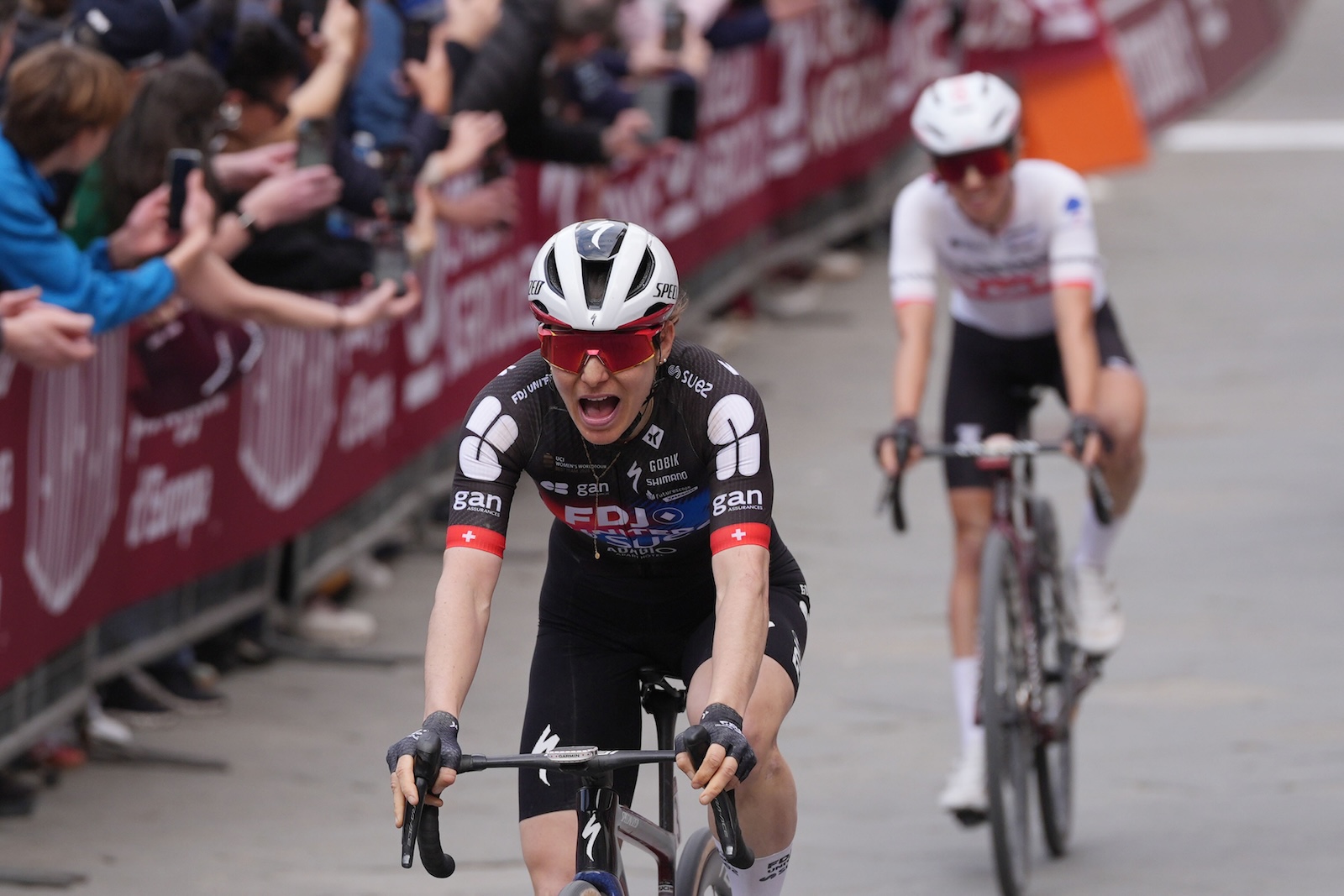
SIENA, Italy (March 7, 2026) — Elise Chabbey darted through a gap that existed for barely a second, swept past three riders who had spent the entire final kilometer trying to destroy each other, and sprinted to the biggest victory of her career at the 2026 Strade Bianche Donne. The Swiss rider from FDJ United-SUEZ, who began the day as a domestique for Demi Vollering, finished it as a champion in the Piazza del Campo—the unlikely beneficiary of a race torn apart by mechanicals, a wrong turn, and the kind of chaos that only 133 kilometers of Tuscan gravel can produce.
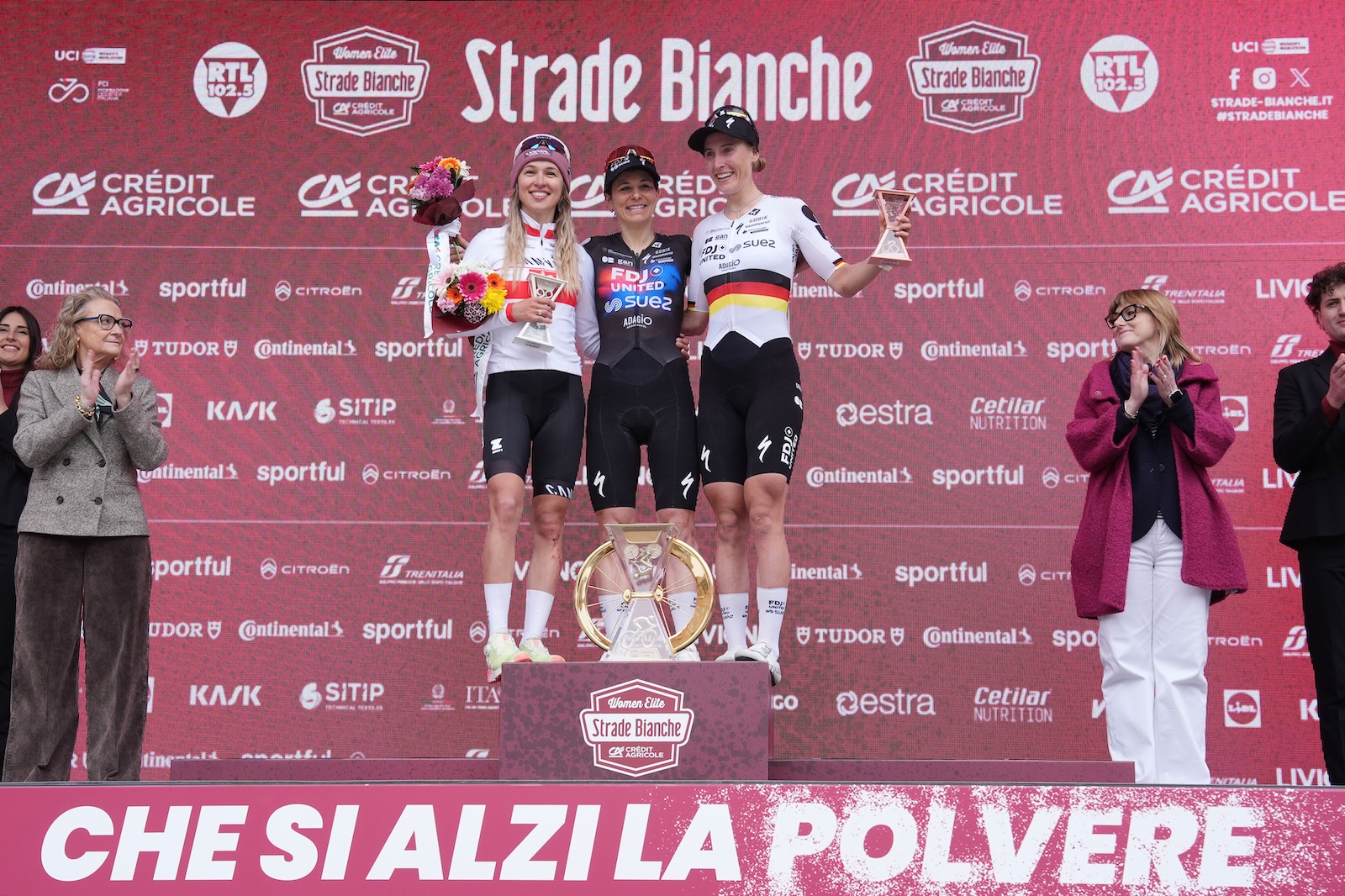
Kasia Niewiadoma of CANYON//SRAM zondacrypto took second for the fourth time at this race, while Chabbey’s teammate Franziska Koch completed the podium in third. Elisa Longo Borghini, who had done as much as anyone to animate the finale, finished fourth. World champion Magdeleine Vallieres rounded out the top five.
A Race of Elimination
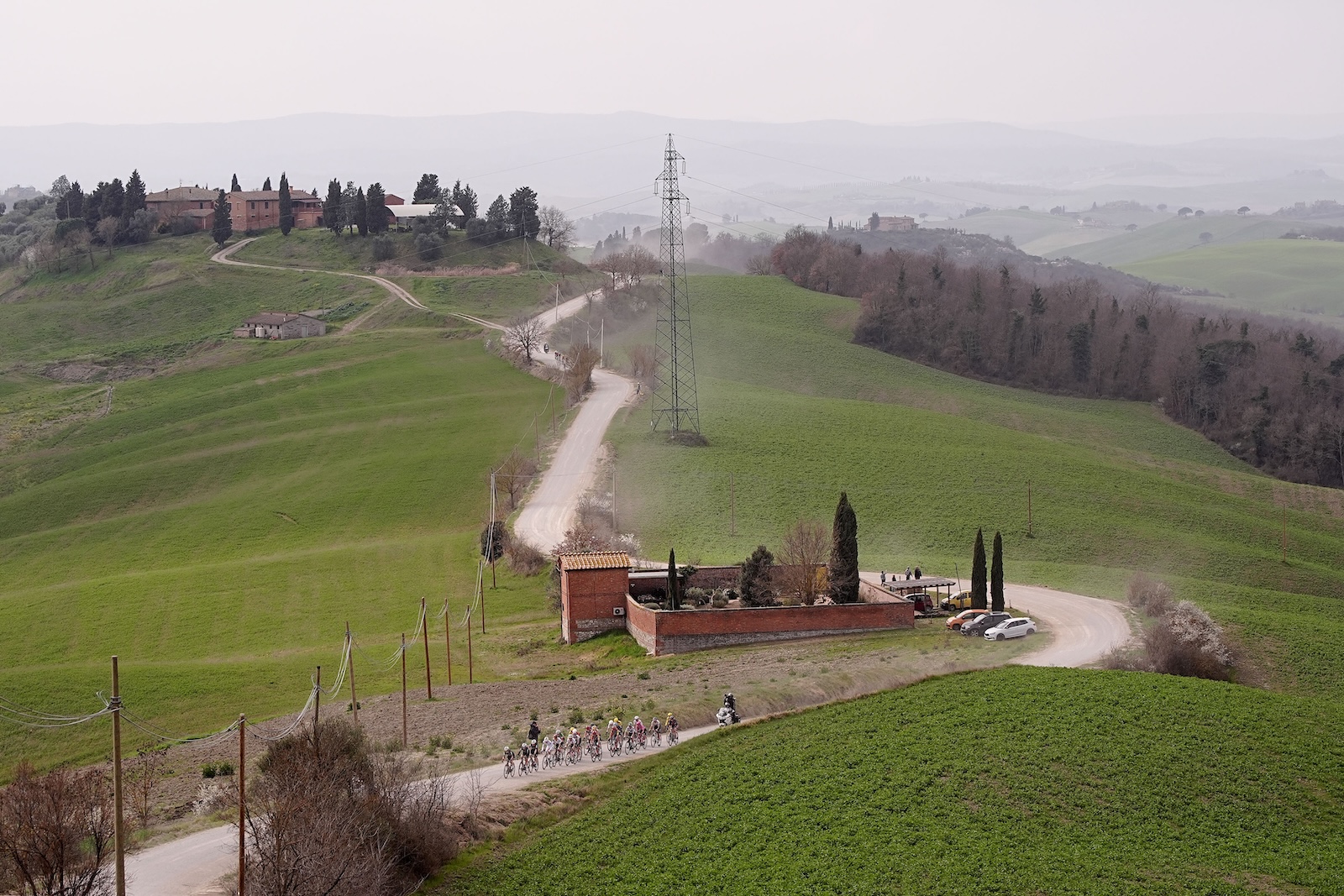
The 12th edition of the women’s Strade Bianche unfolded under the same dry, mild skies as the men’s race, the spring warmth baking the white roads into fast, dusty ribbons through the Tuscan hills. Organizers had trimmed two gravel sectors from the route and cut five kilometers from the distance, leaving eleven sectors and 33 kilometers of sterrato across 133 kilometers. None of it calmed the racing.
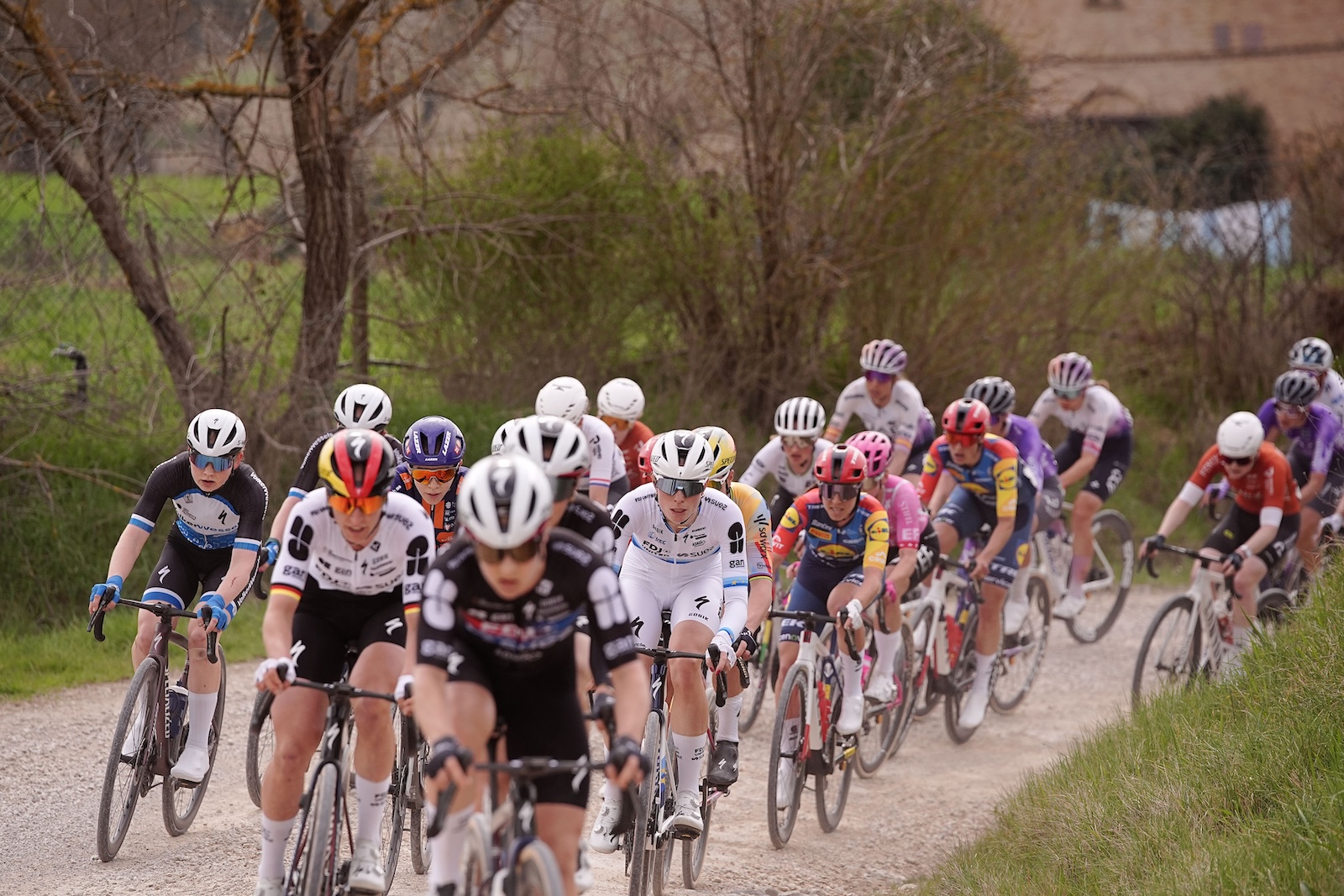
Unlike the men’s race, no breakaway ever established itself. The big teams—FDJ United-SUEZ, Visma-Lease a Bike, Lidl-Trek, and EF Education-Oatly—rode the front from the gun and kept the pace high enough that no escape gained breathing room. Alison Jackson, the former Paris-Roubaix champion, tried her luck with 85 kilometers to go but the peloton swallowed her within seconds. Crashes on the first gravel sector split the peloton into three groups before they had traveled twenty kilometers. A further crash on San Martino in Grania, the longest and hardest sector of the day, caught riders from EF Education-Oatly, Movistar, and CANYON//SRAM zondacrypto, with Niewiadoma herself going down but remounting quickly. Anna van der Breggen suffered a mechanical in the same sector. By the time the field emerged from the five-star gravel, only about twenty-five riders remained at the front.
FDJ United-SUEZ still had five riders in that group, a show of strength that appeared to guarantee control of the race for Vollering. Then the sterrato ate the script.
The Puncture, the Wrong Turn, and the End of the Favorites
Chabbey lit the fuse on the first passage of Colle Pinzuto, the steep four-star sector that the riders would tackle twice. She attacked at the base and Dominika Włodarczyk of UAE Team ADQ latched onto her wheel. The pair built a gap of twenty-five seconds while behind them the group fractured under attacks from Marianne Vos. Lotte Kopecky, the two-time champion battling back problems all season, lost contact.
Worse was to come. On the first passage of Le Tolfe, Pauline Ferrand-Prévot—the reigning Tour de France Femmes and Paris-Roubaix champion—suffered a mechanical and had to wait for the team car. Moments later, Vollering had a problem of her own at the top of the same climb and began slipping backward through the field. The defending champion, who had won Omloop het Nieuwsblad just a week earlier, found herself riding alone, chasing the group that contained her own teammates.
Then came the episode that will define this edition. With roughly 33 kilometers to race, the chase group containing Vollering, Kopecky, Ferrand-Prévot, and others followed a race motorbike that turned right instead of left, leading them down a gravel track that was not part of the course. By the time they realized the error and climbed back to the road, nearly three minutes separated them from the front of the race. Their chances of winning evaporated on a stranger’s mistake.
Vollering eventually finished twentieth, more than six minutes down. She celebrated her teammate’s victory at the finish line.
Thirteen Became Eight
At the front, the lead group of thirteen riders contained those who had, by luck or design, avoided every incident: Chabbey and Koch from FDJ, Niewiadoma, Longo Borghini and Włodarczyk from UAE, Vos from Visma, Pieterse from Fenix-Premier Tech, Vallieres and Noëmi Rüegg from EF Education-Oatly, Van Anrooij and Niamh Fisher-Black from Lidl-Trek, Liane Lippert from Movistar, and Monica Trinca Colonel from Liv AlUla Jayco.
Włodarczyk rode selflessly on the front for fifteen kilometers without once asking for help, setting up Longo Borghini. Fisher-Black attacked with 22 kilometers to go. On the second passage of Colle Pinzuto, Longo Borghini and Chabbey went clear, but the Swiss rider refused to pull through—Koch waited patiently in the group behind, and Chabbey had no interest in towing the Italian champion to a solo victory. Longo Borghini drove the pace regardless, fueled by frustration and ambition.
On the final passage of Le Tolfe, Longo Borghini pushed ahead again, this time with Niewiadoma. Pieterse was dropped on the climb but fought her way back after the summit. With 6 kilometers remaining, Vallieres, Chabbey, Koch, and Vos bridged across, and Trinca Colonel joined soon after. Eight riders entered the final approach to Siena together—a rare sight in a race built to break groups apart.
The Final Corner
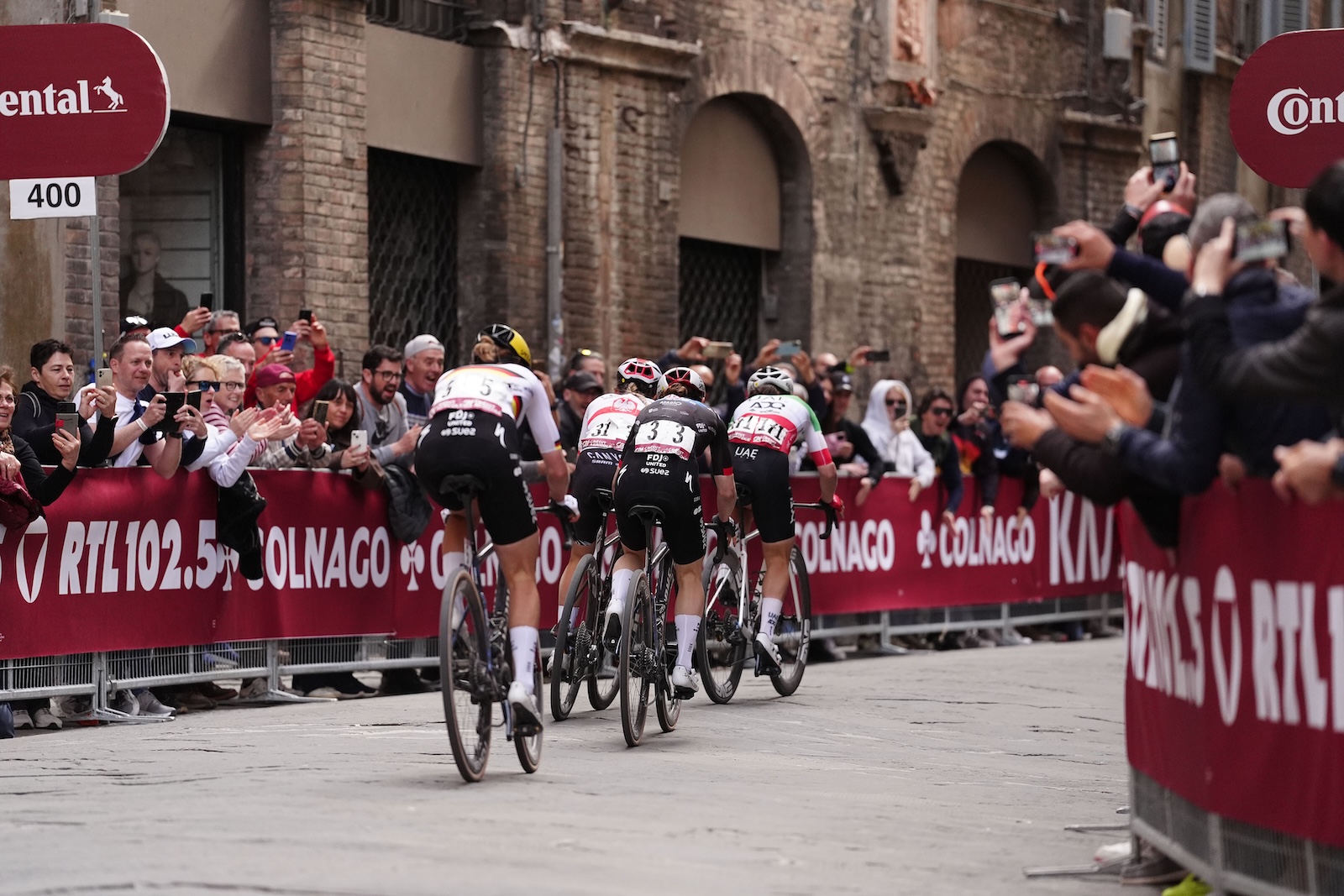
Via Santa Caterina rears up at gradients that touch 20 percent in the final kilometer, and it shed Vos and Trinca Colonel immediately. Vallieres drove the pace before the steep section, then Pieterse moved to the front as the gradient bit. Longo Borghini attacked with 400 meters to go, stringing out the remnants, and Niewiadoma matched her. Koch and Chabbey clung on. Pieterse and Vallieres could not.
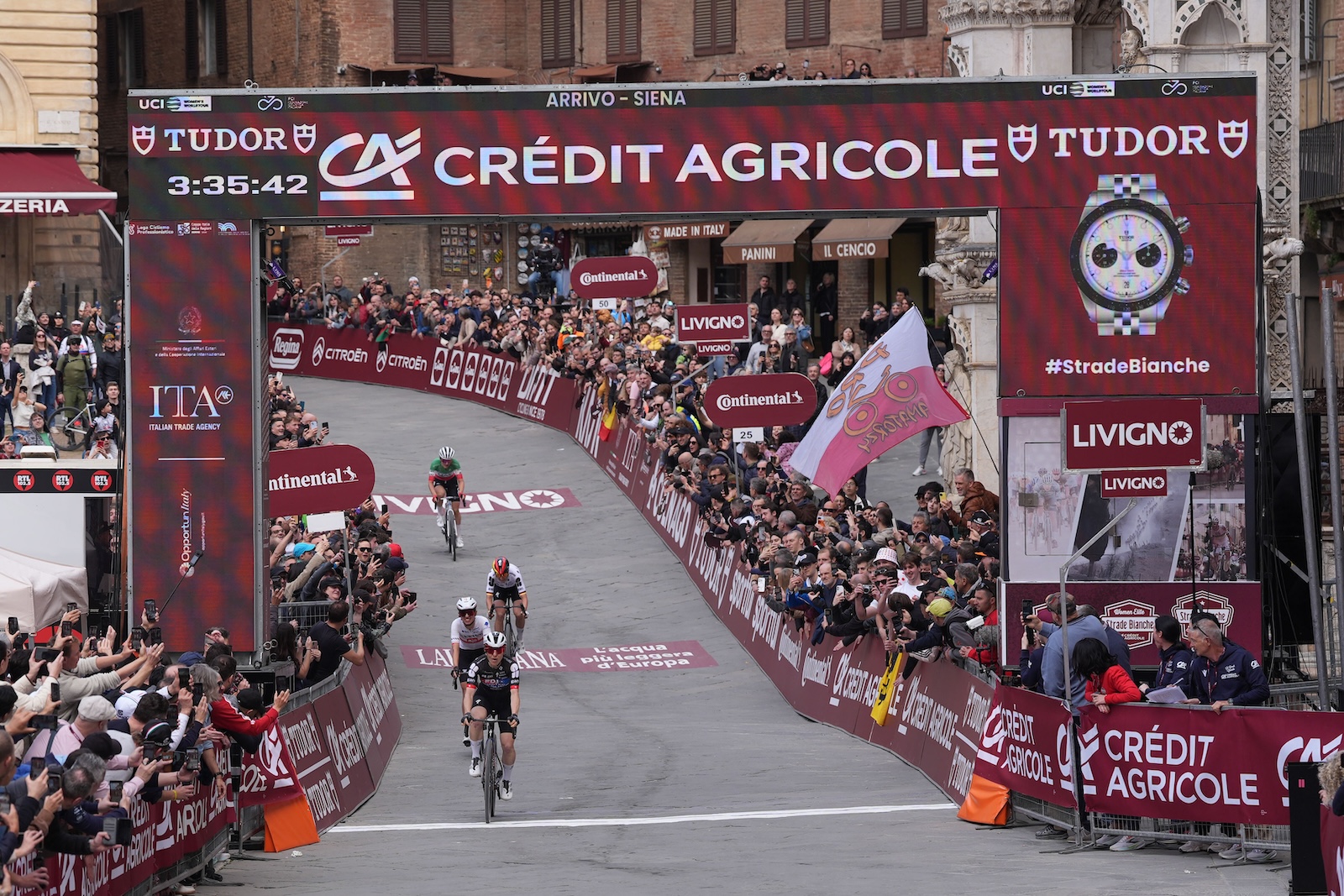
What happened next took three seconds and decided the race. Koch dove around the outside of Niewiadoma and Longo Borghini in a left-hand bend, all three riders ran wide and lost momentum, and Chabbey—sitting in fourth, invisible until this moment—carried her speed through the inside of the corner, slotted past all three, and hit the front with 250 meters to run. She never looked back. Niewiadoma came closest but could not close the gap. Koch held on for third.
Koch’s move, which looked like it might cost FDJ the victory, turned out to be the opposite. “I opened up the corner for Elise,” she said afterward. “It was perfect for the finale. Elise took the last corner in first position, that’s the way to win.”
The Dust Settles
Chabbey became the first Swiss woman to win Strade Bianche—and the first Swiss winner of either edition since Fabian Cancellara’s final triumph a decade ago in 2016. Her sixth professional victory, and first since the Tour de Romandie Féminin last August, made her the second-oldest champion in the race’s history at 32 years and 10 months, behind only Annemiek van Vleuten.
“This win brings so many emotions that it’s hard to realize what I’ve achieved,” Chabbey said at the finish. “Strade Bianche is one of my favorite races. We had put such a strong team together today, originally for Demi, but she faced some problems and it came down to me. I was at the limit so many times. But I wanted to win for Demi and all my teammates.”
In the press conference, she elaborated on the tactical pivot that defined her afternoon. “The plan was to win with Demi. I had to anticipate, and when we realized she couldn’t come back to us anymore, we decided to change our plan and just try to survive until the finish line. Franziska and I did a great job and in the final I decided to give it everything on pure instinct. I knew that if I came out of the last corner in the lead I would win, and that’s exactly what happened. It will take some time to fully understand what I’ve done.”
For Niewiadoma, a record-equaling fifth Strade Bianche podium—matching Longo Borghini’s tally, though neither woman has won the race—was bittersweet. “I don’t know if I’d say I’m satisfied,” she said. “Obviously coming second and celebrating a win are very different. The win here is something I’ve been chasing for many years. It’s a little heartbreaking but on the other hand it’s also beautiful to stand on the podium.” She spoke warmly about the atmosphere on the gravel. “It was so loud on Le Tolfe! For us women to experience such a vibe is what we train for. It makes the pain go away.”
Koch, who wore the German national champion’s jersey on the podium—the first German woman to stand on one at Strade Bianche—framed the result as validation of her move to FDJ. “I’m very happy with my beginning of the season. Joining a new team gave me a lot of motivation. The podium here confirms it’s a very positive change for me.”
The absence of Vollering, Kopecky, and Ferrand-Prévot from the finale—three of the strongest riders in the world, removed by punctures, mechanicals, and a motorbike’s wrong turn—left an asterisk hovering over the day that Chabbey did not deserve but could not avoid. Yet her race had been anything but passive. She attacked on the first passage of Colle Pinzuto, drove the break with Włodarczyk, sat in shrewdly behind Longo Borghini, and then found the decisive gap when it mattered. She rode an aggressive, intelligent, complete race. The inside line was not luck. It was the reward for everything that came before it.
Results
| Pos | Rider | Nat | Team | Time |
| 1 | Elise Chabbey | SUI | FDJ United-SUEZ | 3h 35’ 42” |
| 2 | Kasia Niewiadoma | POL | CANYON//SRAM zondacrypto | s.t. |
| 3 | Franziska Koch | GER | FDJ United-SUEZ | s.t. |
| 4 | Elisa Longo Borghini | ITA | UAE Team ADQ | + 0’ 03” |
| 5 | Magdeleine Vallieres | CAN | EF Education-Oatly | + 0’ 06” |
| 6 | Puck Pieterse | NED | Fenix-Premier Tech | + 0’ 16” |
| 7 | Marianne Vos | NED | Team Visma | Lease a Bike | + 0’ 34” |
| 8 | Monica Trinca Colonel | ITA | Liv AlUla Jayco | + 0’ 37” |
| 9 | Shirin van Anrooij | NED | Lidl-Trek | + 1’ 21” |
| 10 | Niamh Fisher-Black | NZL | Lidl-Trek | + 1’ 47” |
Strade Bianche Donne, Siena–Siena, 133km, 11 gravel sectors (33km). Dry, mild conditions, 16°C.
(Visited 30 times, 4 visits today)