
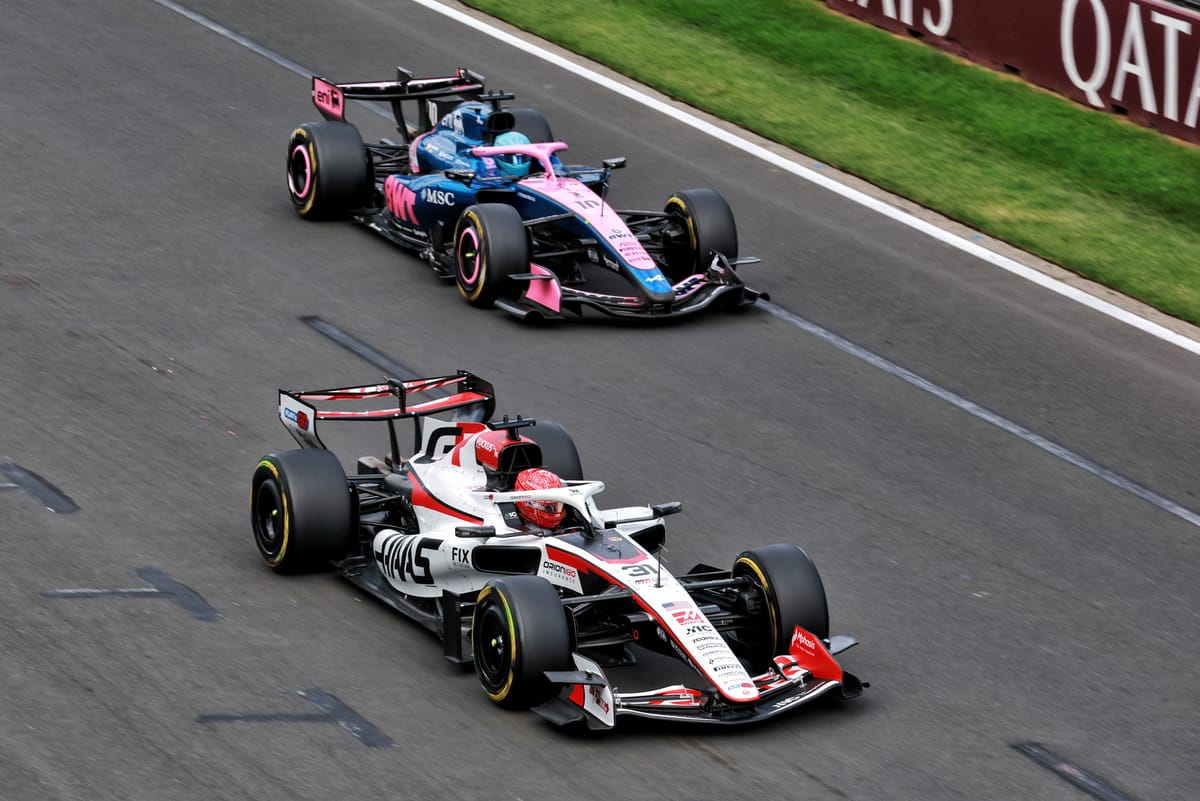
Formula 1 proudly touted the near-tripling in the number of overtakes in the 2026 Australian Grand Prix compared to last year’s race as proof there was, according to its post on X at least, “action EVERYWHERE you looked”.
Overtaking statistics are to be handled with the utmost caution. They are distorted by circumstances; conflicting strategies, how disordered the race is, fast cars out of position owing to problems, so you are rarely comparing apples with apples. Plus, all passes are not equal and to produce a genuinely useful, audited number for ‘proper’ overtakes with absolute certainty would take an inordinate amount of time.
While there is very often correlation between the number of overtakes and how dramatic a race is, there are many celebrated grands prix that produced low quantities. Some races – Nigel Mansell menacing Ayrton Senna’s McLaren in the closing stages of Monaco 1992, or Michael Schumacher’s chase of Fernando Alonso’s Renault at Imola in 2005 – are celebrated primarily because there was no overtake, merely the tantalising prospect of one.
Sometimes, less is more, but other times, more is more, because the perceived quality of racing is about far more than the bare data.
That said, for a social media post there’s nothing wrong with drawing that conclusion and it’s irrefutable to say the 2026 race had its dramatic moments. The George Russell versus Charles Leclerc battle that raged in the early laps alone proves that, and even the most committed critic of the regulations shouldn’t attempt to deny that this was gripping entertainment. If F1 could bottle that and splash it over every race it could rightly celebrate a job well done with the regulations.
However, there are two problems: firstly, the question of what has F1 sacrificed to make that scrap possible; and secondly, how repeatable will it really be?
Want even more expert insight from our F1 team? Join The Race Members’ Club, where right now you can get 90% off your first month
It’s all a result of the energy regime of these cars. With a 4MJ battery that must constantly be recharged and deployed, and the notional 50/50 split of electric and V6 power, even qualifying laps are compromised by the need to harvest. That means lift and coast, super clipping and, most concerningly, in the fastest corners such as Turn 9 in Australia driving inside the limit of grip to allow harvesting.
This means that conventional differentiators in driving are overwhelmed by the need to adapt your driving to optimise harvesting. Add to that the fact that there’s automation in deployment and, as the evidence of Australia showed, in qualifying team-mate comparisons there are cases where chunks of time are gained and lost by the amount of deployment on straights. This is often to the bafflement of the drivers involved.
It was particularly bad at energy-poor Albert Park. Drivers have always had to adapt, I have no problem with that, but it’s what they are adapting to and the loss of the other challenges they face that troubles me.
It’s true progress will be made, but there are hard limits teams cannot develop around. Factors such as the amount of braking opportunities on the circuit to harvest and therefore the amount you need to do on the straights, the vast performance benefit of every extra fraction of a second of deployment and the limits on battery capacity, harvesting and deployment create laws-of-physics problems.
Even though harvesting rates could be tweaked slightly, for example by upping super-clipping charging from the current 250kW limit to 350kW, and deployment could maybe be lowered to mean a reduced power output that will last longer, that’s mitigating rather than eliminating problems.
However, the very characteristics that make the circuit bad for Saturday created the conditions for the dramatic lead battle in the early laps. When you were not deploying electrical power and harvesting, you were way down on power and the car slowed on the straight. The driver making the pass would be on the boost button or using overtake mode and get ahead. But the “yo-yo” effect Russell talked of is that you will have overspent energy and Leclerc gets back ahead not long afterwards.
It was frustrating that the virtual safety car broke up what became first a three-car skirmish when Lewis Hamilton joined in, and that Kimi Antonelli later latched onto. Watching Russell trying to solve the equation of how to get a quicker car ahead and not give Leclerc an energy advantage he could use to repass across the next lap was fascinating. It’s what led to moves at multiple different corners, not to mention his dramatic lockup at Turn 1 while making a pass. It’s encouraging to see that it also created contested braking zones.
The trouble is that were that exact race to be staged again, it’s likely the racing would be far less frenetic. Not only would Russell have far more knowledge of how it plays out, but so too would the team. There will be myriad simulations that are crunching or have crunched the data to work out the optimum passing strategy, probably in the form of ‘you need to be ahead at this corner, with this level of battery relative to the other car and you will have enough to consolidate the position and then use your car pace to pull away’.
Throughout the field, there were hints this was happening by the second half of the race anyway, although grands prix always tend to get less disordered and calmer late on, meaning that’s not yet a robust conclusion.
So the question is, can F1 really sustain that kind of battle? I would argue that if you could have the style and intensity of racing we had for the lead in the first dozen laps regularly replicated then it might be worth it. We need more races to play out to confirm this, but F1 teams are very good at getting on top of maximising the efficiency of such fights so it seems impossible this is anything close to sustainable.
That’s the case with any set of regulations, but the cost here is significant. Based on the evidence of Australia, it seems that the driver’s overall contribution to the competitive equation has never been smaller given the small details, the extra dab of apex speed, the better initial rotation, the ability to detect and control tyre slip – the countless details that define how fast a driver is – are now overwhelmed by the energy regime.
Yes, there is also skill to that and I’m looking forward to building up a comprehensive picture of which drivers master it or struggle, but the performance advantage is disproportionate.
Every ruleset will be a tradeoff. I hope I’m wrong, but everything I’ve seen so far suggests that any gain in on-track racing drama will be largely short-term but come at tremendous cost to F1’s status as a great challenge of driver skill.