
NVIDIA has outlined an ambitious vision for the future of gaming graphics, suggesting that upcoming GPU architectures powered by AI and RTX technologies could eventually deliver up to a 1,000,000× improvement in path tracing performance compared to earlier generations.
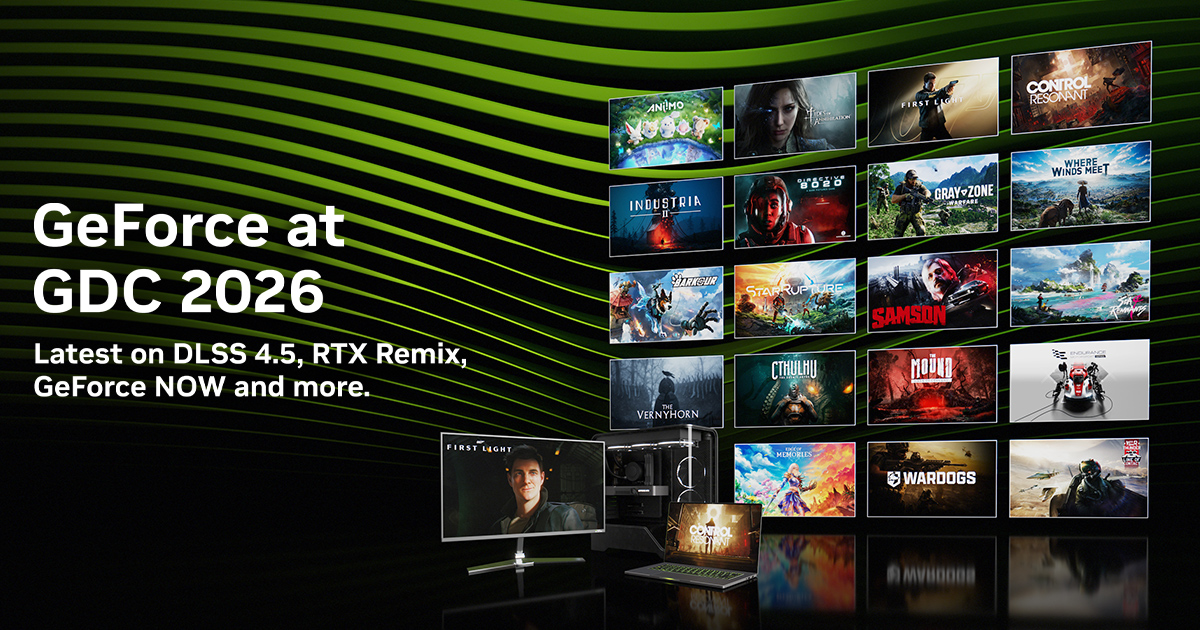
The claim was shared during GDC 2026, where NVIDIA executives discussed the long-term roadmap for graphics rendering and the role artificial intelligence will play in shaping next-generation gaming experiences.
While the number represents a theoretical long-term target rather than an immediate generational jump, it highlights how NVIDIA expects AI-driven rendering techniques to dramatically reshape the future of game graphics.
Why Path Tracing Matters for Gaming
Path tracing is widely considered the most accurate method for rendering realistic lighting in computer graphics. Unlike traditional rasterization or standard ray tracing, path tracing simulates how light bounces across surfaces in a scene, producing highly realistic reflections, shadows, and global illumination.
However, the technique is extremely computationally intensive and historically impractical for real-time gaming.
Modern GPUs have begun making path tracing feasible through hardware acceleration and AI-assisted rendering technologies. NVIDIA’s RTX platform introduced dedicated RT cores for ray tracing and Tensor cores for AI processing, enabling real-time ray-traced graphics in modern titles.
From Pascal to Blackwell: The Evolution of RTX
During its presentation, NVIDIA showcased how GPU architectures have progressed over the past decade.
The timeline begins with the Pascal architecture, which powered the GTX 10-series GPUs released in 2016. While revolutionary at the time, Pascal relied on software-based ray tracing, making real-time path tracing impractical.
The major turning point came with the introduction of the Turing architecture in 2018, which launched the RTX platform and added hardware-accelerated ray tracing alongside AI-powered DLSS (Deep Learning Super Sampling).
Subsequent architectures continued improving these capabilities, culminating in the latest Blackwell-based GPUs in the RTX 50-series, which feature newer generations of RT cores and AI Tensor cores designed to handle complex graphics workloads.
According to NVIDIA, the current generation already delivers around a 10,000× improvement in path tracing performance compared with Pascal GPUs, thanks to advancements in ray tracing hardware, DLSS, and other rendering technologies.
AI Will Drive the Next Leap
Despite significant progress, NVIDIA believes traditional hardware scaling alone will not be enough to reach the next level of graphical realism.
Executives noted that Moore’s Law, the historical trend of doubling transistor performance every few years, is slowing down, making purely hardware-based improvements increasingly difficult.
Instead, the company is focusing on AI-assisted rendering, where neural networks help reconstruct and enhance images that are partially rendered by the GPU.
Technologies such as DLSS already use deep learning to upscale lower-resolution frames into higher-quality outputs, allowing games to maintain performance while delivering advanced visual effects.
Future rendering pipelines could rely even more heavily on neural networks, combining traditional graphics processing with AI-generated frames and lighting calculations.
If NVIDIA’s roadmap proves accurate, the next decade of GPU development could fundamentally change how games are rendered.
Instead of relying primarily on rasterization, the technique used by most current games, future titles may shift toward fully path-traced environments, where lighting behaves much closer to real-world physics.
Such improvements could bring cinematic-level visuals to real-time gameplay, enabling:
- Fully dynamic global illumination
- More realistic reflections and shadows
- Highly detailed environments with complex geometry
- Advanced lighting effects without manual optimization by developers
Several modern games have already experimented with partial path tracing, including visually demanding titles like Cyberpunk 2077 and Alan Wake 2.
NVIDIA’s long-term vision suggests that this approach could eventually become the standard across the gaming industry.
A Long-Term Vision for Graphics
Despite the dramatic claim of a 1,000,000× improvement, NVIDIA’s roadmap reflects a gradual evolution rather than a single breakthrough. Each generation of GPUs is expected to combine improved hardware with increasingly sophisticated AI-driven rendering techniques.
If these technologies mature as expected, the future of gaming graphics could be defined not only by raw GPU power but also by how effectively artificial intelligence can reconstruct and enhance complex visual scenes.
For players and developers alike, the shift could mark the beginning of a new era in AI-accelerated graphics rendering.