
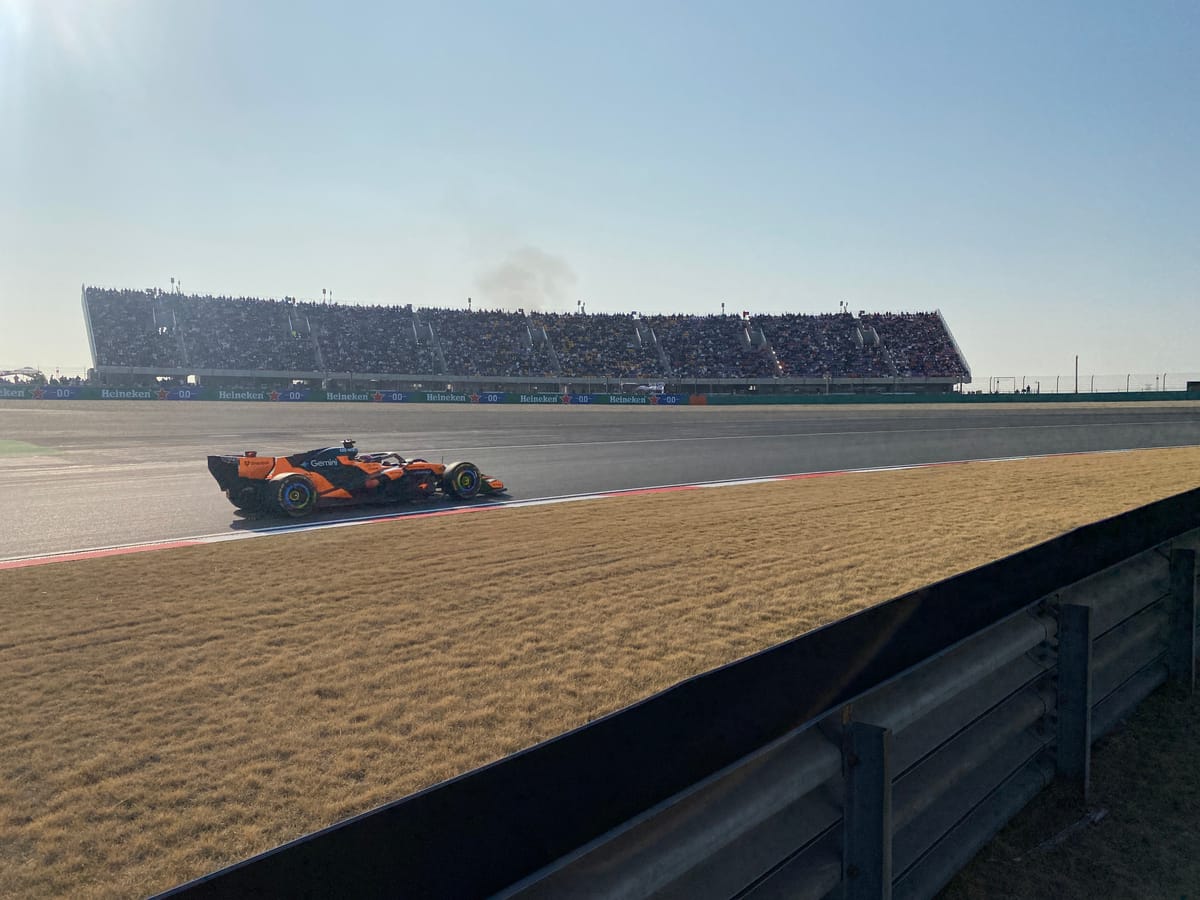
Sprint qualifying at the Shanghai International Circuit shows us the best yet of this new generation of Formula 1 cars thanks to what is, relatively speaking, an energy-rich circuit inhibiting the drivers and machinery less than Albert Park or the scattered run plans of Bahrain testing.
That becomes emphatically clear watching trackside.
This does not wipe out the justified concerns about the limitations of these cars, but given Shanghai is at the opposite end of the spectrum to Melbourne in terms of energy demands, a contrast of the car behaviour at the two tracks gives us a reasonable idea of the two ends of the spectrum that these cars work in.
Taking into account the rapid-fire nature of sprint qualifying, watching from the infield between Turn 1 and Turn 3 is the logical choice as it offers a variety of perspectives and immediate access to what is technically four turns.
First is the fast entry to the long Turn 1 right-hander. This is, in many ways, the ideal corner for these cars as the tightening radius demands you bleed off speed.
That makes it perfect for super clipping, and although the sound of the cars lacks the usual edge, the speed is there and it remains an eighth-gear turn.
This corner has always been at its most spectacular at the entry before it turns into a long, front-left-torturing test of endurance. The cars look as spectacular as they did last year at the entry.
Then comes the real business end of this section, the Turn 2 right-hander and the Turn 3 left-hander that follow in quick succession. Here, the improved agility of the cars is noticeable compared to last year.
The exit of Turn 2 is always a compromise. If you are as wide as you would naturally be to carry the speed, it puts you in trouble for Turn 3.
On the first fast laps in SQ3, at least for the five cars (two Mercedes, two Ferraris and Max Verstappen) that opted for two rather than a single attempt, George Russell is noticeably more conservative here and had the car exiting Turn 3 markedly further to his left than team-mate Kimi Antonelli did.
That opens up the entry to Turn 3 and allowed Russell to glide through, with no sign of the front end limitations or instabilities of other cars. You can see the difference between the silky smooth Russell and the more attacking Antonelli.
Come the second lap, Antonelli has learned. He moves closer to Russell’s line and that adds up to a more stable car, and a less marked difference between their approaches.
The Ferrari looks responsive out of Turn 2 and into Turn 3. Lewis Hamilton seems able to carry a fraction more speed through the corner thanks to being able to get the nose in, even if that means an ostensibly more cautious entry.
However, team-mate Charles Leclerc is a little less content, on his first SQ3 lap trying to carry more speed into Turn 3 without success. The result is that after forcing the car into the corner he’s hooked on the inside kerb, mid-turn, sliding off it and giving the floor a whack.
He slightly backs that off for the second attempt, albeit being too aggressive on the throttle, though not to the extent that it compromised his launch onto the following straight in any meaningful way.
On Lando Norris’s sole SQ3 lap, the rear briefly breaks traction as he yanks the car to the right exiting Turn 2 to position the car for Turn 3. His is a more hustling approach, one that works in the short term but leaves him compromised for the exit of Turn 3. Oscar Piastri gets on the power earlier having rotated the car quicker.
As for the Red Bulls, both look lazy compared to the other members of the ‘big four’ teams. Verstappen is smooth enough, but looks limited by the front end, while Isack Hadjar is slightly more disconnected, begging the front to give him that little more, but ultimately asking the car to do more than it’s willing to do.
It looks every bit the midfielder here, a little more stable on the brakes into Turn 3 than Pierre Gasly’s Alpine perhaps, but sometimes understeer can make you too stable. That in itself underlines how marked a difference there is between the lead pack – three teams here rather than the four in Melbourne – and the rest.
The final impression of the cars as they head out of sight is how impressive they look launching out of the corners. At the point the full power kicks in, you can see just how much torque there is.
These cars have their limitations, but this section of track on this day shows that these machines can, at their best, match or even in a given instant eclipse the previous generation.
This doesn’t solve the problems that contain the drivers in many other situations, but through Turn 2, 3 and 4 (the latter effectively an extension of the exit of 3), these 2026 F1 cars are a winner.