
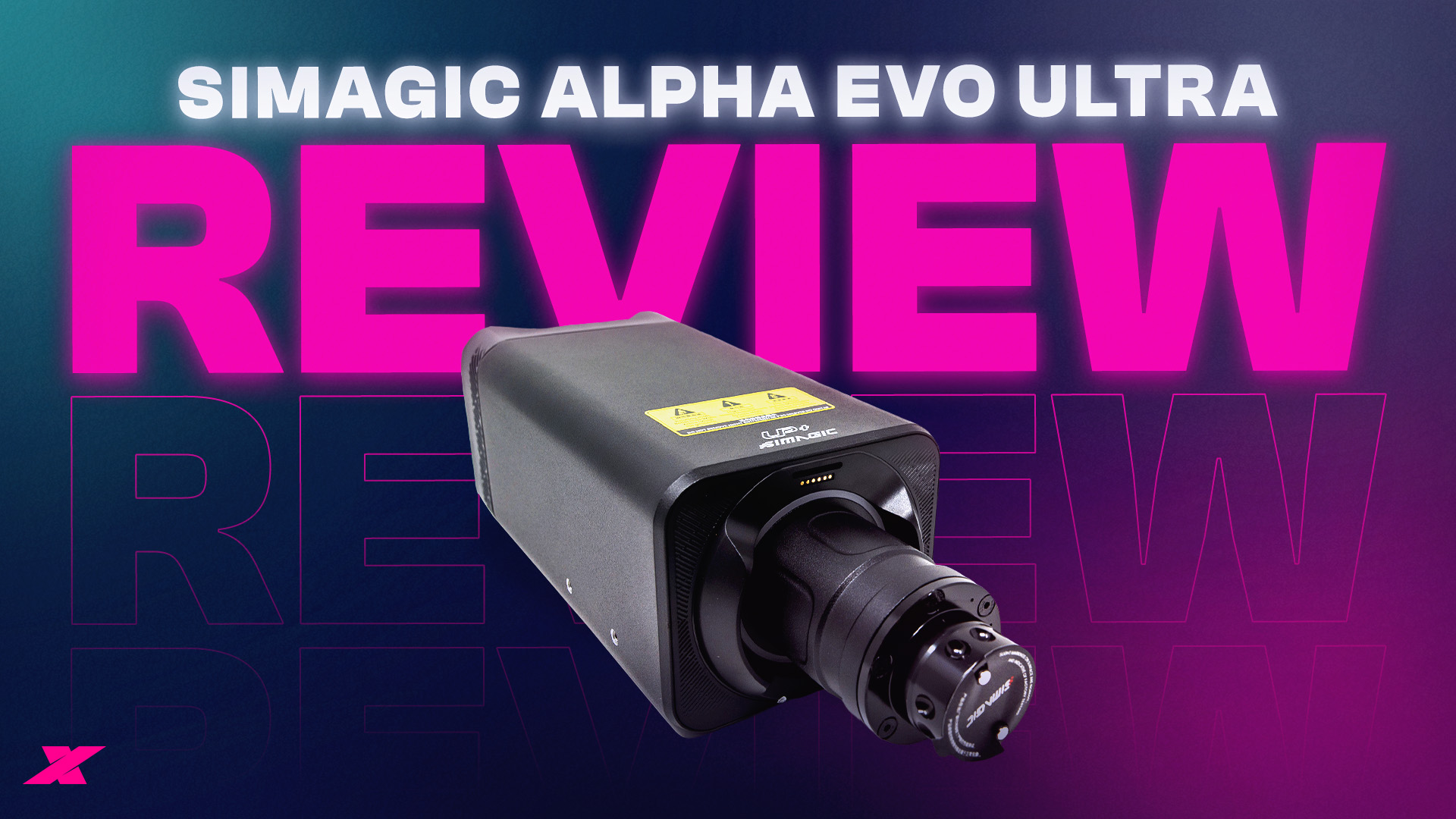
The Alpha Evo Ultra is the latest flagship wheelbase from Simagic, offering a huge 28 Nm of torque and ‘ultra-low inertia tech’.
It now sits atop the Alpha Evo range of wheelbases, competing against Asetek’s 27 Nm Invicta ($ 1,349), the 28 Nm AccuForce Xtreme ($1,199), Moza’s 25 Nm R25 Ultra (£899) and the 25 Nm Simucube 3 Pro (£1,399.00 – £1,482.35). However, the Chinese company’s trump card is its price, which sits well under most of its competitors’ at $969.
But does this mean Simagic has compromised on quality?
Setting up
Simagic extolls the virtues of its zero-cogging technology, which eliminates the notchiness you sometimes feel when using a direct drive wheelbase, and it’s matched this with a small-diameter rotor, which also reduces inertia. This should allow smooth and speedy responses to your inputs: basically, what you need from a wheelbase.
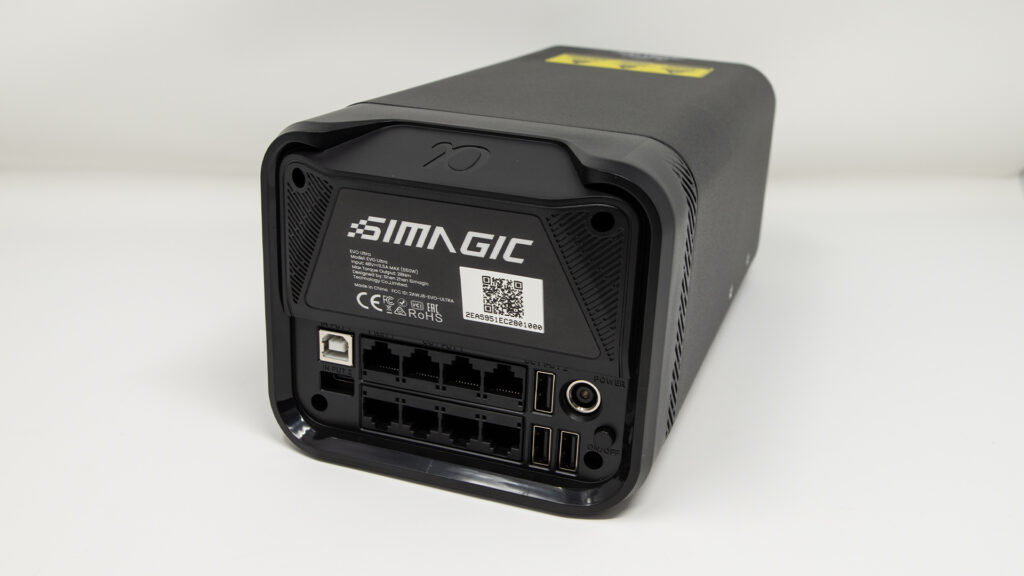
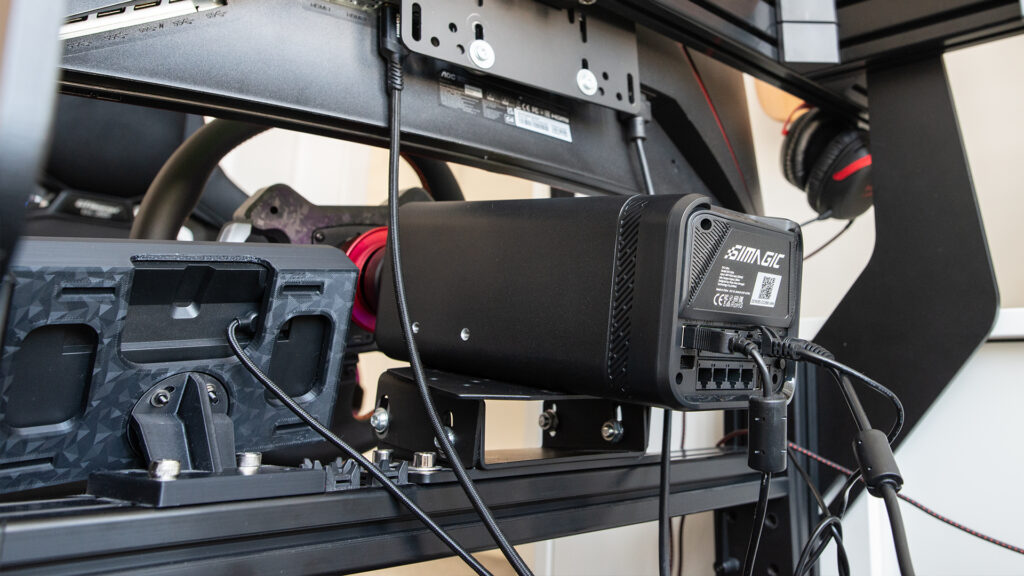
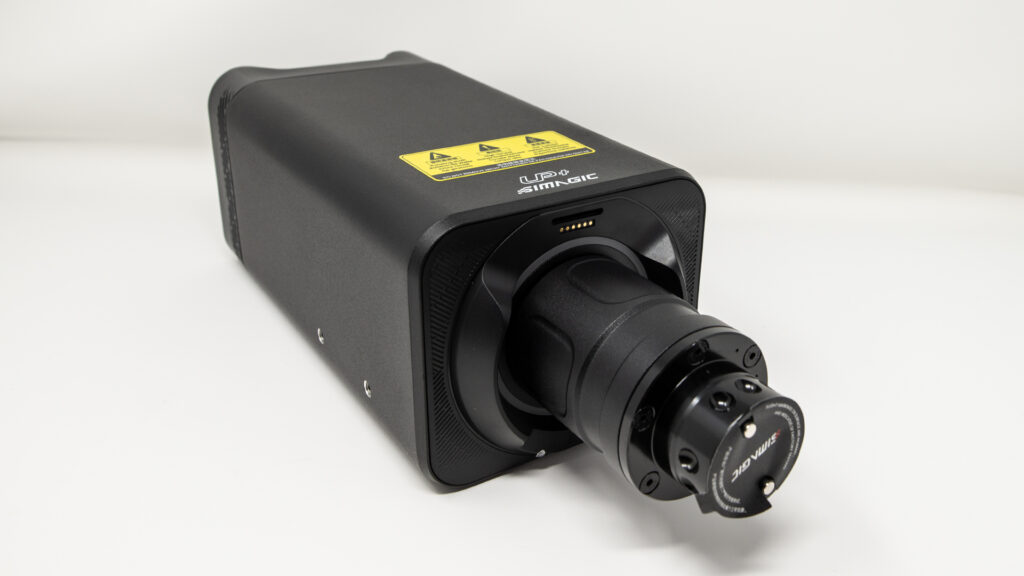
The Ultra’s chassis is mostly constructed from alloy, with a plastic rear section housing inputs and outputs, with a faceplate – also plastic – that houses Simagic’s Halo ring light feature, common to the Alpha Evo range.
It’s a weighty item at 11 Kg, so it needs a bit of care when mounting (side, front, and bottom mounting points are available if you buy the correct Simagic brackets), especially since it’s also 359 mm long. There’s no doubt about its sturdy construction, however.
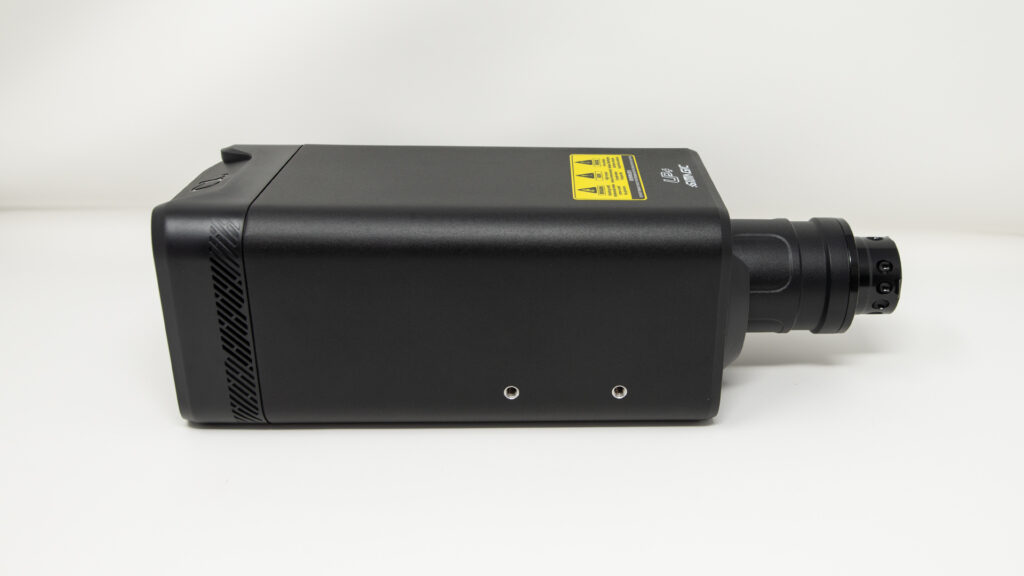
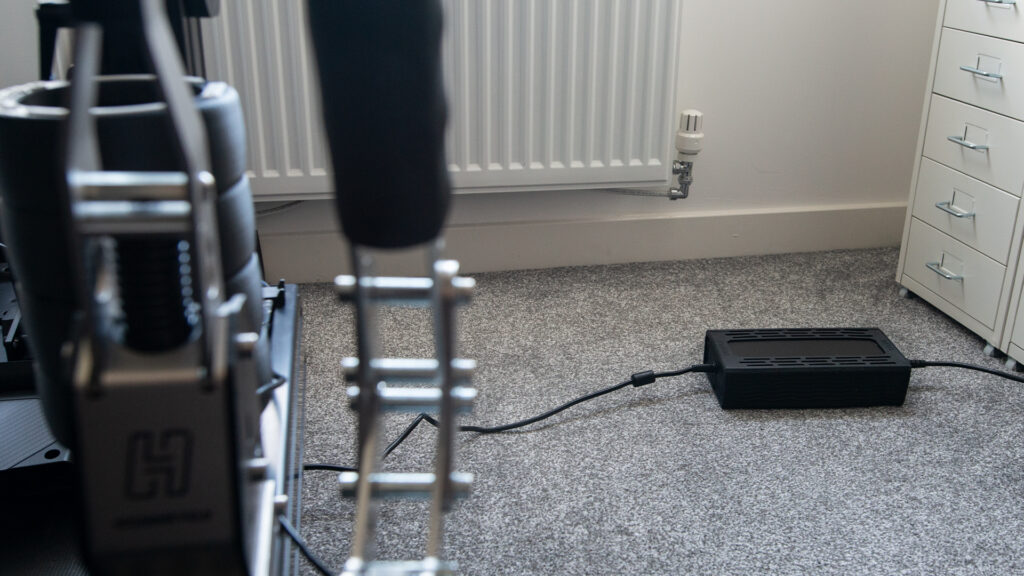
The supplied power pack is also rather chunky, and it needs to be, considering its 550W power demand. It draws 7A, too, so I’d advise plugging it into a separate socket to avoid overloading a multi-adapter.
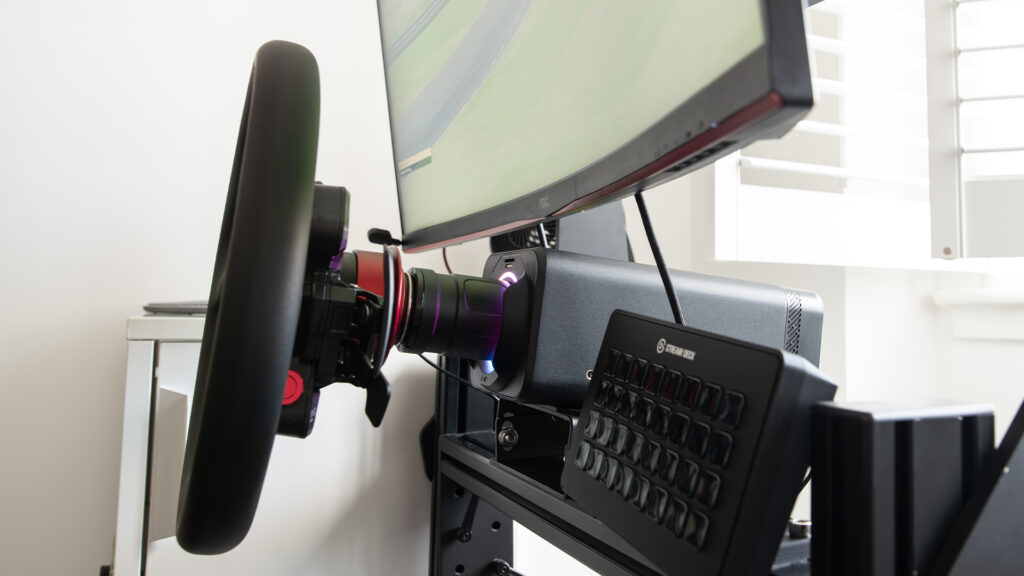
The Ultra doesn’t feature passive cooling like many higher-end Moza and wheelbases, but the noise from the fans is pretty much non-existent during normal operation. Surprisingly, it also has a much lower profile than my outgoing Moza R21 Ultra wheelbase.
Overkill?
Now, 28 Nm is absolutely overkill for most sim racers. Simagic is well aware of this fact and has pitched the Ultra at serious enthusiasts. Even still, it’s a lot of torque to deal with, but the perk of this is that there will be almost zero force feedback clipping (essentially the wheelbase being overwhelmed, reducing the overall clarity of the effects you feel).
The theory is that your wheelbase has ample headroom to provide a range of effects to your fingertips, with fewer details lost between the sim and your steering wheel. A higher torque figure should also help provide more FFB detail when using larger steering wheels (like the Neo-X 330T I used for this review).
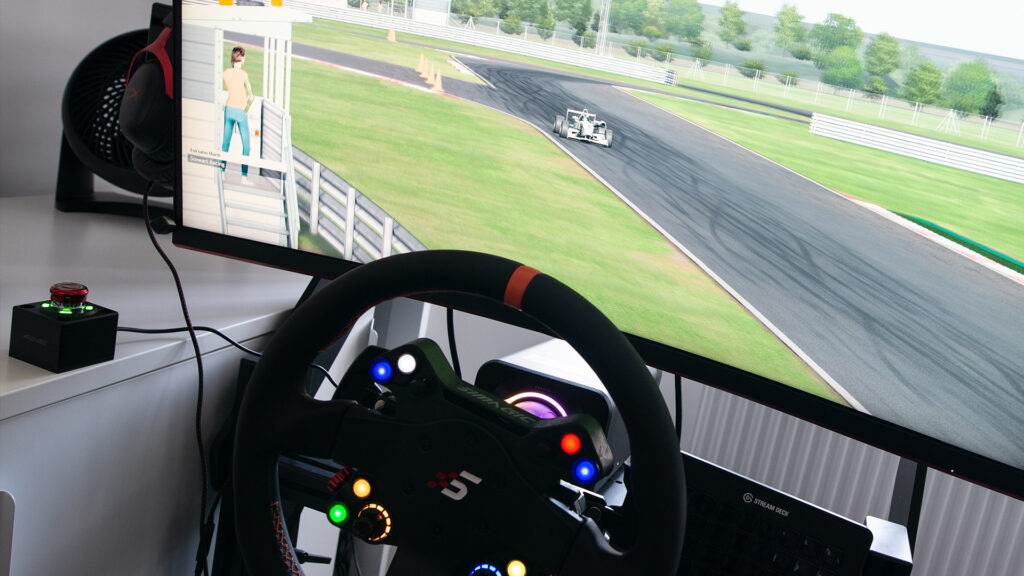
Potentially, higher torque ‘bases can be quite dangerous, so Simagic has helpfully supplied a kill switch with the Ultra. It comes with T-nuts and screws, but these were too short for my GT Omega Prime Lite rig, so it remained unsecured during my testing.
Feels
I received some benchmark settings from Simagic and took to the track in the sim racing classic, Automobilista. My formative laps in the game’s Formula 3 car at Snetterton were revelatory, and it responded instantly to my inputs.
Grabbing the car by the scruff of the neck and immersing myself in the sim’s incredible handling model prompted a fizz of excitement: this is why I love sim racing.
I could clearly feel when understeer approached, with the compression through the Bombhole providing a satisfying jolt through my hands. AMS’s physics still hold up 10 years on from its release, but what would the Ultra feel like in more modern titles?
I switched to Assetto Corsa Evo, sampling the Mazda MX-5 Cup car around Watkins Glen. Previously, AC EVO’s handling model hadn’t wowed me, with cars feeling like they’re constantly flirting on the edge of grip. Happily, using the Ultra, I was able to better predict when this sudden loss of grip would occur, making it that little bit easier to find the limit.
However, I found that the wheelbase made a high-frequency buzzing effect. After a bit of fault-finding, I traced this back to AC EVO’s ‘Road effects’ FFB setting. Turning this off seemed to eliminate the issue (see my FFB settings below).
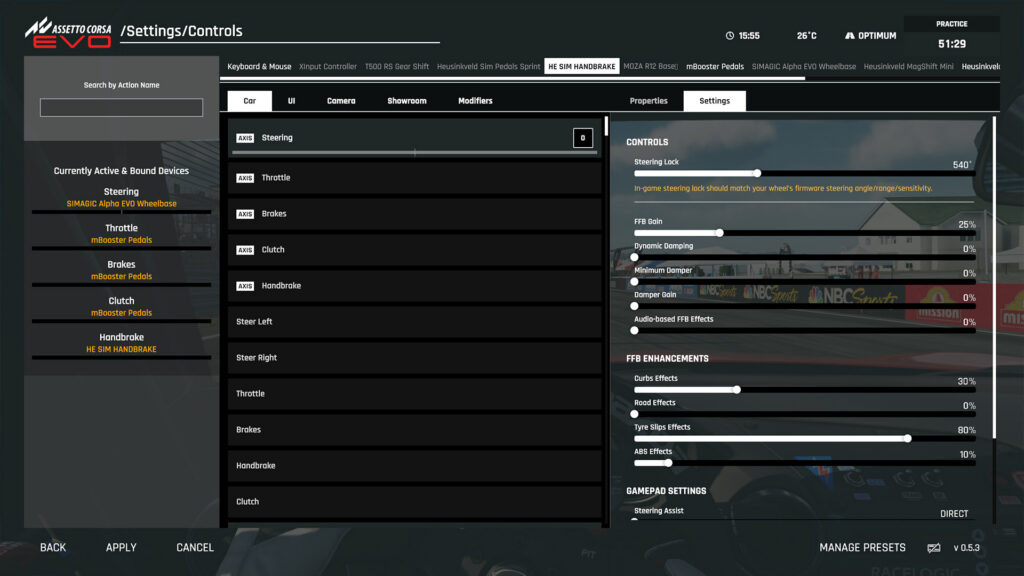
The main takeaway here is that AC EVO has never felt this good for me, though it’s not on the same level as AMS in terms of sheer driving pleasure.
On the other hand, iRacing has offered the most powerful default FFB of any sim in my opinion, and I duly toned it down to improve usability. Driving the Dallara IL-15 car around St. Petersburg was quite the workout, then, with the street circuit’s bumps and gullies making the wheelbase earn its keep.
I was able to detect and respond to subtle road-texture details and real-time handling issues, and it didn’t feel like steering a tumble dryer. I was always wary of the wheelbase’s 28 Nm after smacking St. Pete’s concrete walls, however.
It even worked beautifully in Richard Burns Rally, serving up oodles of feel and just the right level of self-centring to control gravelly drifts. The Ultra somehow knew exactly which details to amplify to give me the best chance of keeping my car on all four wheels and out of the boonies.
Software
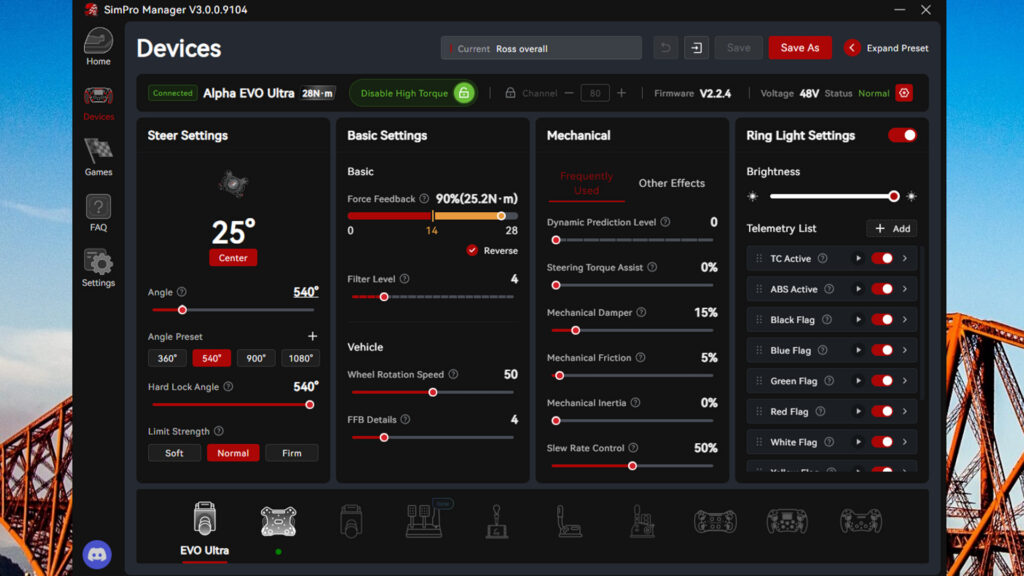
For the release of the Ultra, Simagic unveiled the latest version of its SimPro software.
SimPro 3 looks and operates much like its predecessor, and I found it straightforward to navigate and tweak the settings on my Simagic steering wheels. It allows you to change everything from the colour of LED button backlights to intricate FFB settings, as well as the behaviour of the Halo ring light.
However, the latter is one of the Ultra’s – and the whole Alpha Evo range’s – weak points, in that it’s next-to-useless in practice.
Just like with the Pro, I found that I couldn’t see the Halo light most of the time, as the steering wheels I used (in this case, the Neo-X 330T circular rim and the Formula-style FX Pro) blocked it out. It’s meant to display telemetry-powered information like ABS or traction control use, but it feels poorly conceived.
Also, once again, there are no compatible digital display units for this or other Alpha Evo wheelbases. A special magnetic strip is featured at the front of the Alpha Evo range, which is designed to hold Simagic’s forthcoming MagicDash 4. Nearly a year on, and there’s still no release date. A DDU would go some way to alleviating the Halo light’s shortcomings, in my opinion.
Pro vs Ultra
When reviewing the Ultra’s predecessor, the Pro, in 2025, I was suitably impressed by its performance but disappointed by some of the design decisions, many of which have carried over to the Ultra.
For example, the use of plastic is disappointing but doesn’t affect the wheelbase’s performance; the Halo ring light is again largely ineffective; and there’s still no DDU available to complement the Alpha Evo range of wheelbases.
But there are a couple of crucial differences between the two.
The first is the most obvious: it’s power. 10 Nm is a huge step up, more so when you consider the jump starts from an already mighty 18 Nm, and it’s a step most sim racers will never need to consider.
Put simply, 28 Nm is overkill for most applications, and this wheelbase is meant solely for the sim racing aficionado. I can also envisage a scenario in which it sits on the rig of a real-world racing pro as a training tool. In most cases, though, 12-15 Nm of torque is more than enough.
The biggest difference between the Pro and Ultra, is how much clearer the FFB feels from the latter. When reviewing the Pro last year, I enjoyed how it felt for the most part, but raised concerns about an invisible damping force that seemed to take away some of the granular driving detail.
Verdict
For me, the Ultra doesn’t have this, providing clean FFB at high torque rates across all of the sims I’ve tested. Indeed, despite having to route its beefy power pack cabling across my home office, I’m going to keep it on my rig: the extra hassle is worth it (I’m also going to see if I can find longer screws for the kill switch).
In these terms, the Moza R21 Ultra is a large step up from my incumbent wheelbase, delivering 7 Nm more torque. It just feels more precise in providing its FFB.
If you look at value for money, the Ultra undoubtedly offers the best bang for the buck on the market right now and has to be a serious consideration for those looking at the upper echelons of torque providers.
If you own a wheelbase in the 15-21 Nm zone, is it worth upgrading to? I would say no, as the majority of products in this region are extremely competent as it is. If you really must have a high-torque wheelbase, though, then the Simagic Alpha Evo Ultra is easy to recommend.
Now, I’m off to play Automobilista…
If you wish to purchase Simagic products, you can help support Traxion by using our affiliate link here. Alternatively, you can use the specific Simagic Alpha Evo Ultra link here.
You can also claim 3% off Simagic products by using the coupon code ‘TRAXION’ at checkout.
Traxion has affiliate partnerships through which we may earn commissions on products or services purchased via affiliate links. These do not influence editorial content.
Traxion’s affiliate policy