
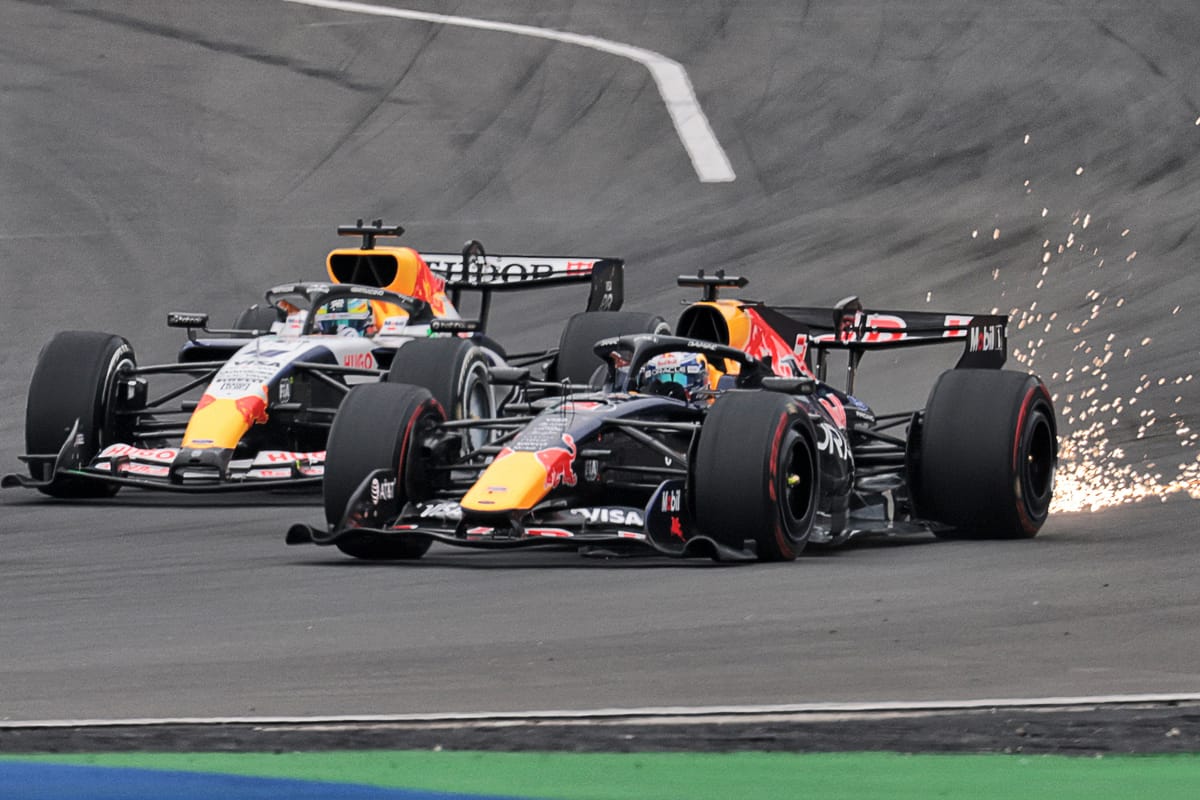
Max Verstappen’s biggest attack on Formula 1 2026 yet after the Chinese Grand Prix included a big swipe at anyone who likes the kind of racing in the process.
What winds Verstappen up about the new rules seems to get under his skin regardless of what actually happens in the race, though.
Verstappen’s made his disdain for the 2026 rules very obvious for a long time and his vocal criticism shows no sign of slowing down. In fact, it’s only got worse, as he labelled the racing “terrible” and said it’s a “joke” that it is all about driving past people depending on your battery levels.
“If someone likes this, then you really don’t know what racing is like,” he added.
It should go without saying that Verstappen is entitled to his opinion but if he is going to make such a claim, and be so derisive to whatever tranche of fans genuinely enjoyed either of the season-opening races, then his claims merit scrutiny.
And, overall, China did not quite play out the way Verstappen experienced. I shared his view that what we saw in Australia was artificial and problematic. I also noticed, with dismay, how much parts of the Shanghai qualifying lap were being influenced by superclipping, too.
I even accept Verstappen has a point in China in how he dismissed Ferrari’s early disruption of Mercedes’ victory march out front as just a consequence of its mega starts, before it “takes a few laps to sort it all out”. There is no great, sustained racing for victory on display here.
But reducing everything that happened in the China races to being solely down to the battery situation – and going as far as claiming viewers who took enjoyment in it do not understand racing – is not fair or accurate.
What kind of racing you like isn’t just divided into ‘are you a new fan or an old one?’. There’s variation in opinion regardless of how long you’ve watched F1 for. If Verstappen doesn’t like this, fine, he doesn’t have to – but there’s no need to insult people who do. That way lies a polarising and ultimately unproductive discourse around the rules.
I’m happy to fall into the category of people Verstappen thinks doesn’t know anything about racing when I say there was actually some stuff to like in China.
In my view, the overall racing did not play out exactly as he experienced – and I think this is an important distinction because it is not that drivers like Verstappen are somehow being dishonest or hypocritical.
I can well believe their own experience is diluted and I share the frustration to an extent. There’s still way too much randomness at the start, potential for a false order created by technical variables that go beyond driver skill, and some big differences in battery usage that make for some very low-stakes, low-meaning drive-bys back and forth.
But the ratio of that to more satisfying racing was at least better in China, which showcased the more enjoyable side of the 2026 rules more: the cars. Across the sprint and the grand prix the action shifted more from the straights to where it should always count most, the corners. Cars were vying for position under braking, running wheel-to-wheel, cutting back quickly, and generally just racing more dynamically than the ground-effect era tended to allow.
Lewis Hamilton and Charles Leclerc fought wheel-to-wheel a lot during this race and the Ferrari team-mates were keen to make it clear how much fun that was. Hamilton even went as far as describing it as “the best racing I’ve ever experienced in Formula 1” – probably a step too far in the other direction, but still.
Plenty of other drivers – especially in the midfield with Verstappen – disagree with that take, but maybe that points to where the problem is. When there’s so many cars in close proximity, the impact of the battery swings is probably exaggerated.
Perhaps in more isolated fights, especially when cars are on similar or the same deployment strategies, the demands switch and then we get the best of slightly smaller, lighter, nimbler cars.
Does that excuse all the other ills? Absolutely not. And F1 shouldn’t get smug that a better spectacle, some fun if brief fighting at the very front, and a lot of overtakes made this a roaring success all of a sudden.
Where Verstappen has the strongest case at the moment is in a warning to F1 about what should drive its decision-making from here.
Some of the stakeholders have either been actually convinced that the majority of fans genuinely love F1 2026, or they know they are being very selective in what they use to make that judgement. Wolff, for example, claimed that “all the indicators, all the data, say people love it” – and that message is coming from F1 itself.
Given so many fans were in uproar at the notion of F1 ‘censoring’ them by hiding negative replies on social media after Australia, it’s stating the extremely obvious to point out that the rules remain divisive and are not universally enjoyed by engaged fans.
If a more casual viewership is the reference, or the total number of people watching F1 races is being contorted into proof that people love what they are seeing, then maybe it could be argued there is more enjoyment than there is scepticism overall.
If F1 genuinely thinks this spectacle is better for a wider, more casual audience, and that is worth not making any rule changes for, Verstappen’s warning should be heeded: “It will come and bite them back in the ass.”
But the jury’s still out on whether or not these same rules, this kind of racing and this level of division will all persist through 2026.