
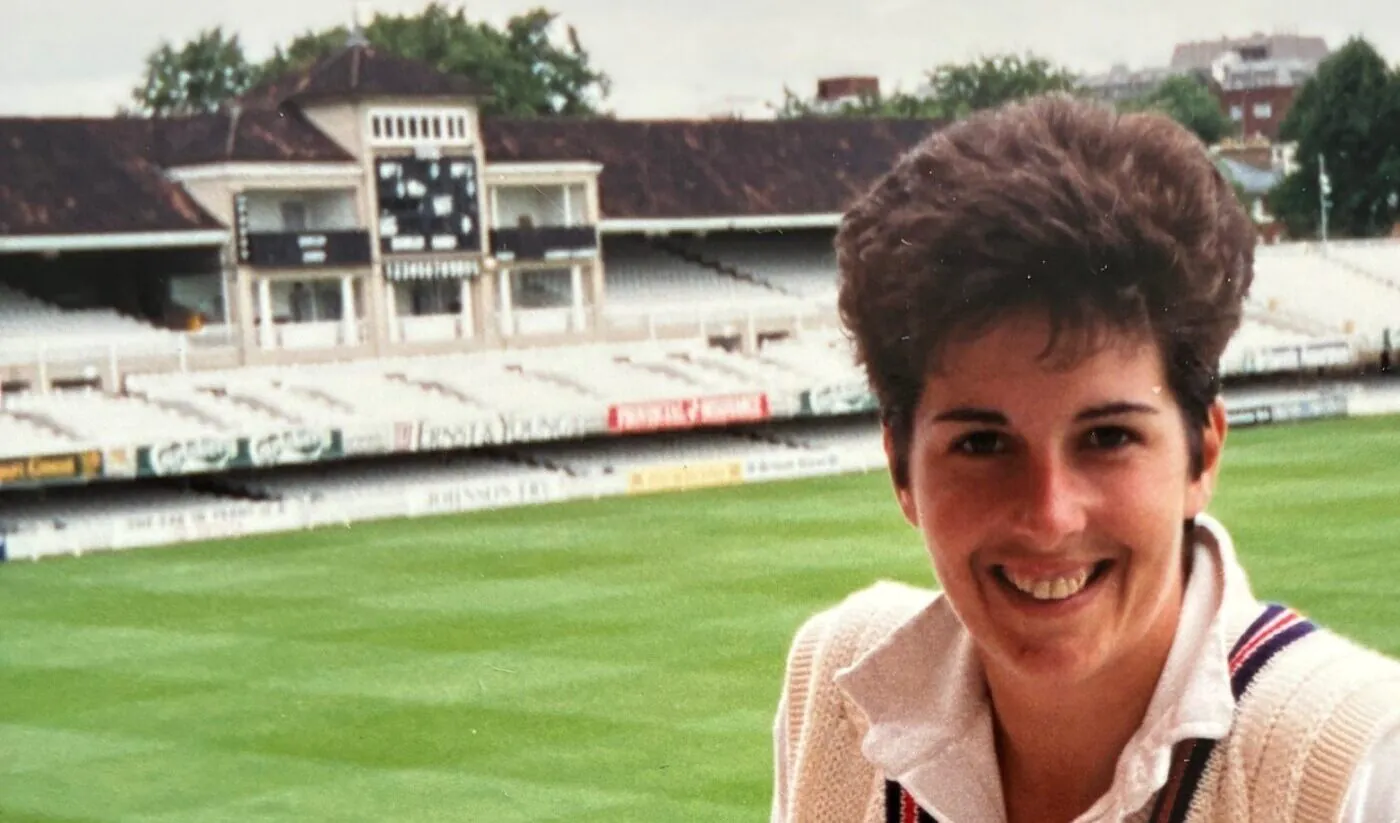
Picture courtesy of Gill Smith. Gill was presented with her Yorkshire cap in June 2024.
Gill Smith, the former Yorkshire women’s fast bowler, has turned from World Cup winner to writer having penned two soon-to-be-released books.
Smith played in two World Cup finals in 1988 and 1993, at arguably the game’s most iconic venues.
She played the first against Australia at the Melbourne Cricket Ground, the hosts winning by eight wickets. The second, was against New Zealand at Lord’s, and the left-armer played a central role in a glorious triumph. It was England’s second of four current 50-over world titles, with Smith taking three wickets to down the Kiwis.
That actually proved to be her final game of senior cricket, aside from an exhibition game at Lord’s 10 years later.
And now, the Middlesbrough native – retired from a life working in both local government and IT – has taken to the laptop to co-write two cricket books entitled What Cricket Means to Me and What Yorkshire Cricket Means to Me.
They will both be released on March 27.
“They’re both basically odes to the game of cricket and to Yorkshire Cricket,” said Smith.
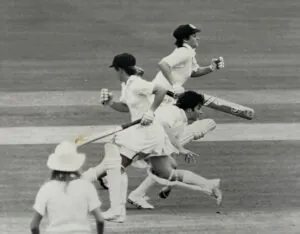
Picture courtesy of Gill Smith. Gill fields off her own bowling in an ODI for England against Australia at Lord’s in July 1987.
“It started when I met a guy at the golf club where I play in Northumberland, Burgham Park. He’s called Neil Brinsdon and he had written a book called ‘What Football Means to Me’.
“Anyway, I jokingly said to him, ‘It’s good, but cricketers have got a lot more about ‘em!’
“So he said, ‘Ok, let’s do a cricket one for charity’. And we have.
“We actually started off doing a nationwide one for the Professional Cricketers’ Association, but then I got chatting to Jane Powell, who then asked me would I think about doing a Yorkshire one as well.
“So, we have, and that one will be raising funds for the Yorkshire Players’ Association.
“They do some brilliant work for both the women’s and men’s game.”
Smith first got into cricket by playing on the boundary at Crathorne Club, and she went on to play for the Ingleby Cross and North Riding clubs.
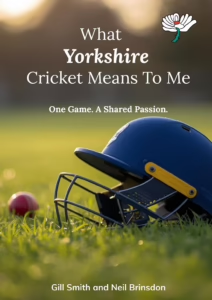
What Yorkshire Cricket Means to Me is one of two books to be released on March 27 by Gill Smith and Neil Brinsdon.
She also played hockey, netball and tennis as a junior, but cricket was numero uno.
Smith played for Yorkshire in the County Championship between 1984 and 1986 before moving on to Middlesex.
“I had to work for a living,” she explained. “I was playing for Yorkshire while I was still at college, and once I finished I got a job down at Hammersmith and Fulham Council. I couldn’t come back up and train, so I moved to Middlesex.
“It was all amateur back then, and Hammersmith and Fulham were brilliant with me. They let me go on tour to Australia, we also had a lot of European Cups back then.
“I then moved to a company called the Local Government Management Board, who also understood my cricket background and let me go off and train and play.
“Then, as I finished my playing career, I went down Tottenham Court Road, bought myself a laptop and taught myself IT and got myself into the world of IT, more around the implementation and training side of things.
“I did that through various jobs and then set up my own business doing similar, mainly in health and social care IT.
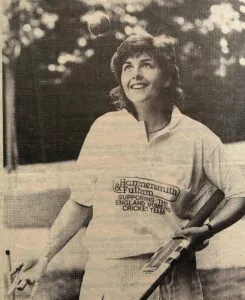
Picture courtesy of Gill Smith. Gill played for Yorkshire, Middlesex and England.
“I retired in 2020, during Covid, and started to play more golf.”
Smith remains close to cricket. She has been asked to join the Yorkshire Players’ Association steering group and will be heavily involved in “keeping the Yorkshire Cricket family together, keeping that sense of community amongst the ex-players”.
She describes playing in the 1993 World Cup as her career highlight.
As aforementioned, England beat New Zealand in the final at Lord’s, with Smith taking 14 wickets in seven matches. She was the joint second leading wicket-taker in the competition.
Her haul included an eye-catching 5-30 from 12 overs in a group stage win over Australia at Guildford and 3-29 from 12 in the Lord’s final, which saw the hosts comfortably defend their 60-over total of 195-5.
Smith played four Test Matches as well as 31 ODIs, including a Test against India at Collingham near Wetherby in 1986.
She said: “The whole thing about it being a home World Cup was very special. We had a lot of friends and family there, and we beat Australia on the way to the final.”
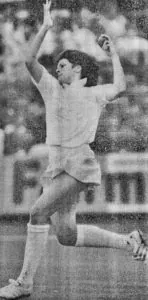
Picture courtesy of Gill Smith. Gill claimed 14 wickets in the 1993 World Cup triumph in England.
Smith was pretty unlucky not to have been named as player-of-the-match in the final.
“Well, Jo Chamberlain won that. She had a really good day as well. She scored 38 with the bat off not many balls, took a wicket and brilliantly ran out their most dangerous batter, the opener Debbie Hockley.
“It’s funny because the other day, I was writing to somebody and was saying, ‘The team’s more important than the individual’.
“I must say that team was the best I ever played in for that. We all had each other’s backs. It was such an amazing time.
“I think the final was the biggest Sunday crowd at Lord’s, John Major was Prime Minister at the time and was there. It was just a phenomenal day and the culmination of a lot of hard work.
“I obviously took a great amount of pride from taking the wickets to support the team effort. I think the five I took against Australia was my best ever performance.
“The game has moved on so much to where it is today, but there are still things which remain true now such as bowling in partnerships. And that is what we did so well during that tournament.”
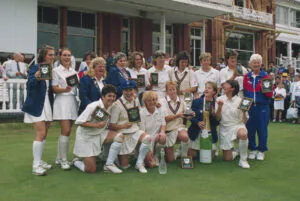
Picture by Adrian Murrell/Getty Images. The England team, including Gill Smith – bottom left – celebrate their 1993 World Cup triumph on the Lord’s outfield after beating New Zealand in the final.
That particular World Cup provides a nice comparison to the modern, showing how much the game has moved on.
Last week, Headingley-based Sunrisers Leeds paid £190,000 for the services of all-rounder Dani Gibson ahead of this year’s Hundred competition.
The 1993 World Cup almost didn’t happen but was saved by a grant of £90,000 from the Foundation for Sports and Arts.
“How much the game’s moved on – the opportunities the women and girls are getting nowadays, it’s amazing,” added Smith.
“I don’t begrudge it at all because there’s so much more scrutiny on the players now.
“Look at the Australia tour last winter.
“They lost and didn’t perform to the level of professionalism that they’re supposed to have. They came back home, and the press and media were after them.”