
Motorsports rulemaking is a tough business–trying to maintain parity across all manner of different vehicles prepped by competitors with varying priorities. Add to that an aftermarket that is constantly introducing new products with no regard to the rules season of a given sanctioning body.
So it wasn’t a huge surprise to read of NASA’s mid-season course correction on tire rankings for its Super Touring road racing and Time Trials programs.
Over the past six months, a number of new tire models have come to market, and only recently have we and others been able to get scientific comparative testing results published. So the initial 2026 rules involved quite a bit of guesswork based on manufacturer marketing claims, some of which have turned out quite differently in reality.
NASA’s Super Touring and Time Trials rules are based on power-to-weight ratios, with modifiers for various prep allowances. But given that listed allowances affect performance of every vehicle differently, a key part of building a winning car is picking and choosing those mods that help your preferred vehicle the most.
This also allows you to build any car the way you want and still have reasonable competitiveness. It’s a clever system but requires constant tweaking.
Tires are ranked into groups with attendant modifiers to the power-to-weight equation. Running slower tires allows more power and/or less weight.
We get asked often about which tires are the quickest in each group, and to some degree it depends on the vehicle, class, type of competition and budget. Here’s our best advice on how to select.
For the fastest classes (ST1-3), where power often greatly exceeds traction, the stickiest tires are typically going to provide the optimal benefit. For most, this has meant the Hoosier R7 and A7.
With the new rules, the new Hoosier TrackAttack Race R8 and A8 will replace them at no additional factor change. Our recent testing has shown the R8 to be more consistent than its predecessor but not significantly quicker–so that’s a natural progression.
Hoosier R8 and A8. Photography courtesy Tire Rack
The A7 to A8 transition has been a little trickier. While the Hoosier A-series was originally designed as an autocross tire and later adopted for time trials, some folks in lightweight cars were able to find better road racing pace with them than the R-series Hoosier, especially in cooler conditions.
With the A8, Hoosier has leaned into that capability, allowing more cars to take advantage of this in more conditions–good news for road racers. But it appears that Hoosier has done so at the expense of the one or two megalaps that the A7 could provide in a TT situation. So those folks may wish to stash away some A7 tires while supplies last.
For the cost-conscious, the other option is to choose from one of the other groups that offer cost savings through higher durability and lower pricing. Grip levels are lower, however, so drivability of a higher-horsepower car may be compromised.
Further, if you want to stay in the same class optimally, you’ll need to take advantage of the power-to-weight breaks given in those groupings. This increases acceleration capability, though, putting corner-exit traction at even more of a premium. A better answer when using the lower-grip tires is often to stay at the same power and weight but drop down a class.
The ST1-3 groupings for these lower-grip street tires are almost the same as those you’ll see below for ST4-6, but the factors for using them are much larger. The picks for each group still apply.
For the slower ST/TT classes (ST4, 5, 6), wheelspin off the corner is much less of an issue, even on the least grippy tires. Those classes also have more specific modifiers for bigger aero.
This opens up way more options to dial in the best combination of power, weight, aero and tires. Note that autocross compounds like the Hoosier A7/A8 are not allowed in these classes–nor are they needed.
Within the 2.0 modifier group–tires we call Endurance 200s–the BFGoodrich g-Force Rival + and Continental ExtremeContact Force are the quickest. Both will provide a cool-tire flyer lap or two for TT and then settle into consistent laps just a tick slower for road racing. They also provide very long life.
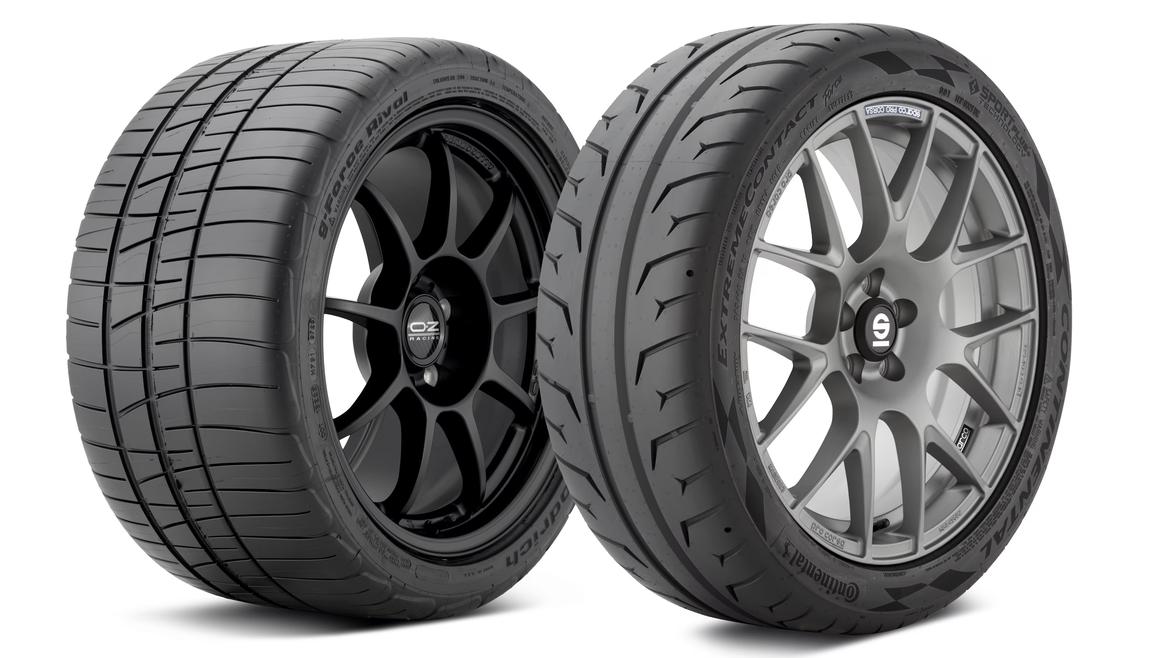
BFGoodrich Rival + and Continental ExtremeContact Force. Photography courtesy Tire Rack.
The 1.4 modifier group brings together all of the slower Super 200s–we sometimes call them Tweener 200s–as well as a couple of Endurance 100s.
Again, BFGoodrich tops the time trial pace chart with the g-Force Rival S 1.5, followed just behind by the Falken Azenis RT660+. Both of these tires fall off a little after their cool flyer laps, while the super-consistent Kumho Ecsta V730 and Toyo Proxes R then move ahead for the longer sessions of road racing.
The 1.0 group is new with the recent update, pulling out the faster Super 200s from the previous 1.4 group. Of these, the Hoosier TrackAttack Pro has been quickest on our ND Miata test mule but less so on one of our more powerful track cars. If you can make it work, it’s easily the best choice.
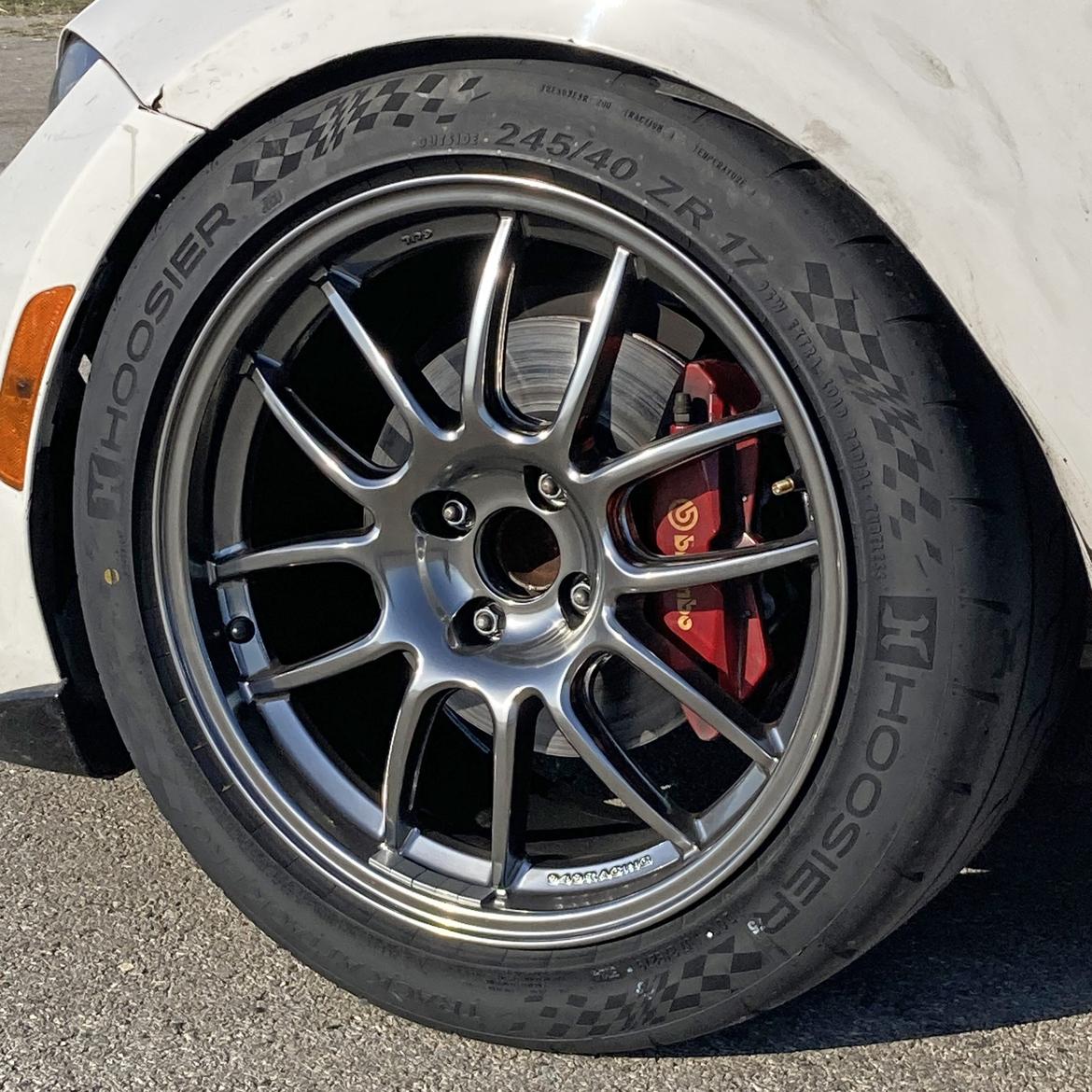
Hoosier TrackAttack Pro. Photograph by Andy Hollis.
If not the Hoosier TrackAttack Pro, the Bridgestone Potenza RE–71RS, Nankang Sportnex CR-S and Yokohama Advan A052 are all very quick for time trials. You’ll want them shaved or worn to lower depths for best pace. Those tires can also work for road racing at those lower depths. The CR-S is the most durable and resistant to heat soak, with the A052 being the opposite.
Note that the Bridgestone RE–71RS is being phased out of production in favor of the new RE–71RZ, which gets a less advantageous factor grouping. We have found no significant pace advantage with the new tire, so stock up on the RE–71RS while supplies last.
The small group of tires at a modifier of .5 might as well just be one, the Goodyear F1 Supercar 3R. We’ve run these at the Thunderhill 25 Hours to great effect. For time trials, you’ll want tire warmers, a hot track surface or plenty of warmup laps. But once up to temp, they are magic–one of our favorite track tires.
The only downside to the Goodyear F1 Supercar 3R is availability: They are quite often sold out in the non-OE fitment sizes. Goodyear makes them in periodic batches, and the popular sizes get sold as soon as they arrive at retail. We’ve been waiting on a set ourselves for six months.
This brings us to the R-comps with a 0 modifier. We just did two rounds of testing on these, and the Yokohama Advan A055 continues its unbeaten streak when compared against equal physical sizes. But fitments are limited, so they may not work for your application.
The Hoosier R7 has the widest range of sizes, so for sure you can find something there, and it might even be faster than the available A055s if it’s larger. Note that the Hoosier R7, A7, R8 and A8 are all physically wider than typical tires for a given marked size. Be sure to check NASA templates for compliance where sizing is part of your classing formula.
Also note that the Hoosier R8 is currently grouped by itself at a -1.0 rating, which renders it less competitive than its predecessor. So far, we have not found it to be significantly quicker than the outgoing R7.
Photograph by Tony Politi
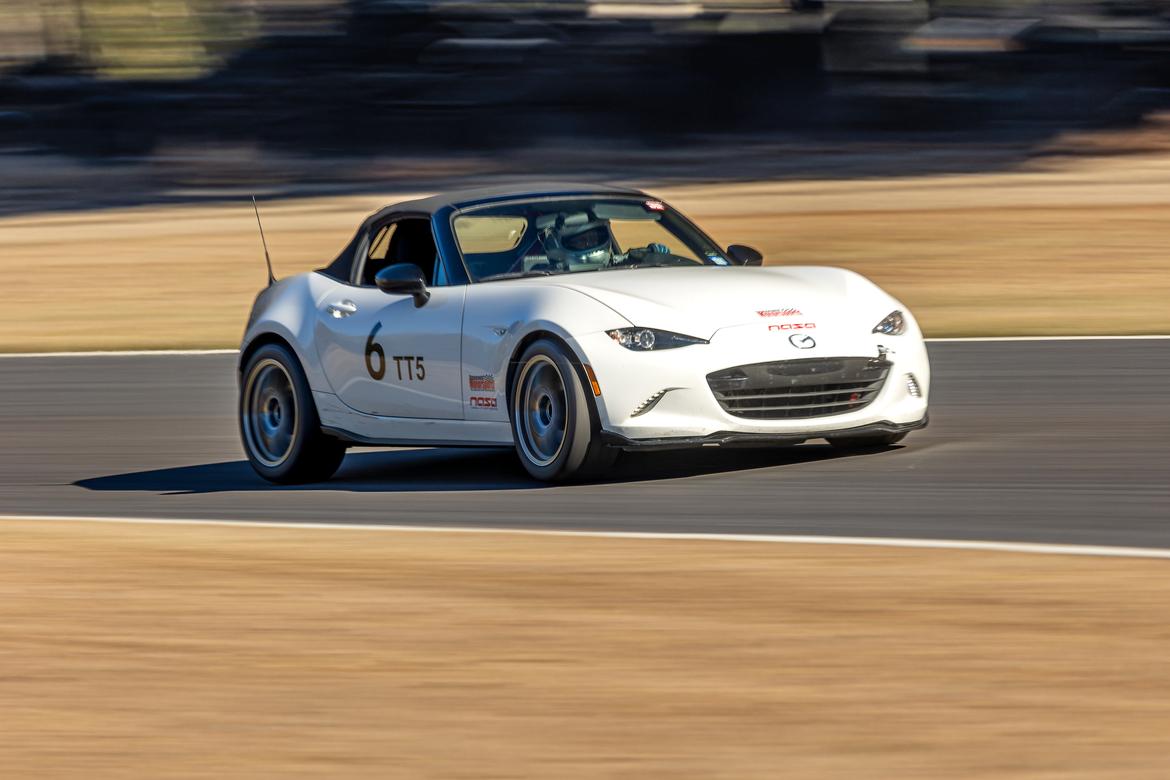
It’s good that there are so many groupings, as some of these slower classes have some very specific vehicle eligibility rules. For example, our Triple-Threat ND Miata could fit into TT6 based on power-to-weight, but it’s not allowed there. At stock power in TT5, it can run full aero plus 0-modifier R-comp tires and still fit within the TT5 limits. No street tires for us.
Be sure to reference our Ultimate Track Tire Guide, where TT pace is listed on an absolute basis and then sorted within each category. For road racing, the heat tolerance column will give you an indication of falloff to ultimate consistent pace. The tread depth sensitivity rating will give you an idea of how much further benefit in pace and consistency can be gained through tire prep. From there, drill down to individual testing results to get all the nitty-gritty of how each tire drives. Happy tire shopping!
Comments
View all comments on the GRM forums
You’ll need to log in to post.