
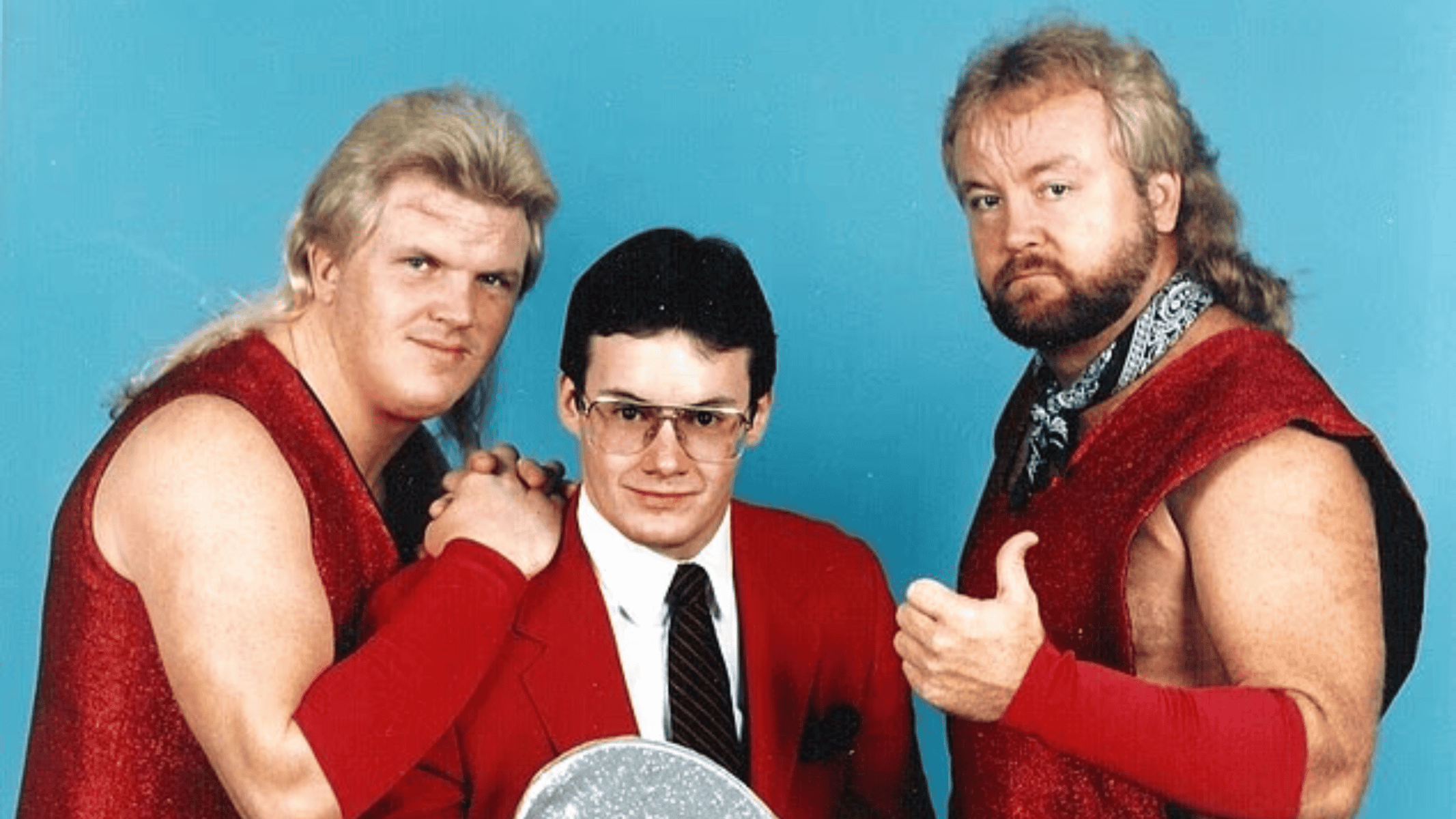
Jim Cornette paid tribute to the late Dennis Condrey on the Jim Cornette Experience. As everyone knows by now, Condrey, founding member of the Midnight Express, died on Friday, March 20.
Cornette described what happened in detail. Condrey’s wife Teresa, who works in nursing, was at work that day. She texted him at four o’clock as she was about to get off, and he did not answer. “That was unusual,” Cornette said. “And as she looked out in the parking lot, he wasn’t there. Then she knew something was wrong.”
Teresa called a neighbor and told him where the key was hidden so he could check on Condrey. “Dennis had fallen in their hallway, and not like downstairs or off of anything,” Cornette said. “Whether he had tripped is possible, or whether, as I think about it, it may have been more something that he had some kind of dizzy spell where he couldn’t catch himself on the way down. And in the way he fell, he broke his neck and severely damaged his spinal cord.”
Cornette said the neighbor found Condrey on the floor and was able to turn him over. “He was cognizant of what was happening, but by the time the ambulance got there, they got him to the hospital, a number of things happened. He was paralyzed at that point from the chest down, and with the injuries that he had sustained, they didn’t really have to make a decision. He was on a respirator, but that wasn’t going to last.”
Cornette acknowledged the cruel irony of how Condrey died. “People are going to say, what the f**k? Dennis Condrey took bumps for 50 years, he trips in the hall and breaks his neck,” Cornette said. “But you got to think, not only the years of bumps, but also two cancer battles and multiple surgeries. They took his voice box out. The cancer started in his neck, spread to his throat, chemotherapy and all of the procedures. Who knows what kind of shape his neck was in to take any kind of a blow at this point, being 75 years old.”
Nine Days From Retirement
Cornette said the timing made the loss even more devastating. Teresa had been planning to retire at the end of March so they could spend more time together. “He had been bugging Teresa about retiring, because she’s only 67 but that’s her full Social Security retirement age,” Cornette said. “He had been bugging her about retiring so they could spend some more time together, and they had some plans, and the last day she was going to be at work was the end of this month, nine days away.”
Cornette said Condrey had been in the best spirits of his life in recent years after beating cancer and reconnecting with the wrestling fan community. “Not only getting a second chance at life almost 10 years ago now, but also just seeing the fan fests and the things, he spent a long time thinking that nobody remembers me,” Cornette said. “And to see the way the people still remember him.”
“Your Favorite So-and-So’s Favorite So-and-So”
Cornette said the outpouring of tributes confirmed what the industry had always known about Condrey’s place in wrestling history. “When Ric Flair or Arn Anderson and the Hardys and Nick Aldis say Bob Eaton and Dennis Condrey were the best heel tag team in the business and we learned from them, they’re not just making that up,” Cornette said.
Cornette quoted Paul Heyman’s tribute, in which Heyman said he was eternally grateful for the patience Condrey showed in dealing with him in 1989 and compared Condrey to Ray Stevens. “He just got it,” Cornette said.
“It Wasn’t Smooth, It Was Seamless”
Cornette spent an extended portion of the podcast describing Condrey’s in-ring abilities. Co-host Brian Last called Condrey “smooth,” but Cornette pushed back on the term.
“It wasn’t smooth, it was rough. Sometimes it looked rough. But it was seamless, because you couldn’t figure out where it was put together, where did they make this magic,” Cornette said. “He always knew where he was, to the point where, if he’s feeding the babyface a comeback, and as he’s starting toward the babyface, the babyface decides to go another direction and do something else, he could just somehow stagger and change directions, or drop to a knee, and make it look like he meant to take four extra seconds to then take whatever. It is amazing.”
Cornette told a story about Condrey working with a green babyface who did not realize he was being fed a hip toss. “Dennis hip-tossed himself off the guy, grabbing the guy’s arm on the way by to make it look like he threw him,” Cornette said. “You couldn’t tell. Everything was precise. If it was a mistake, he could figure out a way where it didn’t look like it. I don’t know how else to explain it. You’d have to just sit and look at the films like the Zapruder films.”
Cornette said Condrey’s strikes looked devastating but never actually connected. “Everything looks like he’s hitting you as hard as he can. He never touches you,” Cornette said. “Out of all those hundreds and hundreds of matches, they never knocked anybody out where they were unresponsive. I don’t remember either Bobby or Dennis ever getting accidental juice, busting anybody open. There were no injuries, because they did this shit over and over, night after night, and knew how to do it and didn’t do shit they didn’t know how to do.”
Cornette described Condrey’s body language as being readable from the top row of the bleachers even when his face was turned away. “You could tell what the expression on his face was if you were in the top row of the bleachers in a big building and he was facing away from you, because the rest of the body indicated that expression,” Cornette said. “Whether it was shock with a start, or frustration with a momentary put the hands on the hips and turn and almost kick the ground like he’s a baseball player, or any emotion that he had to convey, he could do it with his whole body.”
Condrey Was the Leader
Cornette said Condrey was the leader of the Midnight Express from the beginning. When the team moved to Bill Watts’ Mid-South Wrestling in 1984, Cornette said he and Bobby Eaton were essentially rookies at the main event level.
“If he’d have said, ‘Jim, you pump the gas. Bobby, you go get all of our drinks. I’ll sit here,’ we would have done that, because he was the smartest one to the business,” Cornette said. “I could chapter and verse recite where everybody had ever wrestled. I had absolutely no idea of what it was from the inside looking out at the top, in the main event. Bobby had worked either for Nick Gulas or Jerry Jarrett his entire career. So now we’re in the big leagues getting our turn at bat, and we need somebody to tell us what the fuck we’re doing here, and that was Dennis, because he had, by that point, 10 years.”
Cornette said Condrey called the matches and served as the conductor for the team’s in-ring work. “As Dennis used to say, ‘We made them laugh, and now we’re going to make them mad, because we made them quit laughing,’” Cornette said.
The Scaffold Matches
Cornette recalled the Starrcade 1986 scaffold match against the Road Warriors. He said Condrey understood the business reality of being in the main event of the company’s biggest show, even if the match itself was limited by the format. But he was not happy about the danger.
“I’m glad they weren’t miked as well as they are today, because he was screaming, ‘We’re dumb. We’re dumb motherfuckers. We are stupid,’” Cornette said.
Cornette said Condrey was the only member of the team who never got hurt in scaffold matches. “He would drop, land on both feet, crouch down, and then take a flat back bump and shake his legs in such a manner that it looked like he’d fractured himself in half, and it was the safest scaffold bump he could take,” Cornette said.
Why He Left in 1987
Cornette said he did not learn the full reason for Condrey’s abrupt departure from Jim Crockett Promotions in March 1987 until the team reunited at a convention approximately 15 years later. Condrey dropped them off at their cars after a spot show, said “I’ll see you in the morning,” and they did not see him again for a year and a half.
“We didn’t go into details until we reunioned 15 years later at the fan fest,” Cornette said. “It had nothing to do with either Bobby or myself or the wrestling business in particular. It didn’t have anything to do with drugs or a personal problem that he had. It was something that was beyond all of our, anybody else’s control, except he just needed to relocate. And it worked out.”
Dennis and Teresa
Cornette said he was amazed at how Teresa transformed Condrey’s life. “I didn’t think he could be that domesticated to that degree, but he just loved her,” Cornette said. “Teresa is tougher than Ronda Rousey, because she tamed Dennis Condrey.”
They had been together for approximately 33 years. Condrey had been living as a regular person for decades, with his only connection to the wrestling business being occasional fan convention appearances that meant more to him than anyone realized.
“He spent a long time thinking that nobody remembers me,” Cornette said. “And to just do the ones he’s done has meant something, to see the way the people still remember him.”
The GoFundMe
Dax Harwood of FTR set up a GoFundMe for Teresa Condrey. Cornette said Harwood personally asked Teresa for the honor of setting it up. Contributions have come from Tony Khan, the Young Bucks, Chris Jericho, Cody Rhodes, and many others.
Cornette said Condrey had been using the royalties from the Midnight Express action figures to pay off their house but had not finished. “Every month when he gets the check, he calls as soon as it comes in the mail, because that’s been a big deal for him,” Cornette said. “But we hadn’t done it all yet.”
Cornette said the money Condrey made in wrestling was decades ago and they live modestly. “The big money that Dennis made in wrestling was 35 years ago,” Cornette said. “They have been very happy with their regular lives. But at this point, when a guy’s 75 and has had multiple health issues, it’s not easy.”
Cornette said any amount matters. “If it’s $10, if you can’t, you can’t, but you can just show that he entertained you or he meant something,” he said.
The GoFundMe can be found at gofundme.com/f/in-memory-of-dennis-condrey.
“Nobody Works Like Dennis Condrey”
Cornette closed the tribute by saying Condrey’s influence extends to every wrestler working today. “The wrestlers you like learned how to do something from this guy,” Cornette said. “And I wish that more of them would learn how to do more of those things, because nobody works like Dennis Condrey in the business these days and hasn’t, hasn’t ever.”
If you use quotes from this article, please credit the source and include a h/t to WrestlingNews.co for the transcription.