
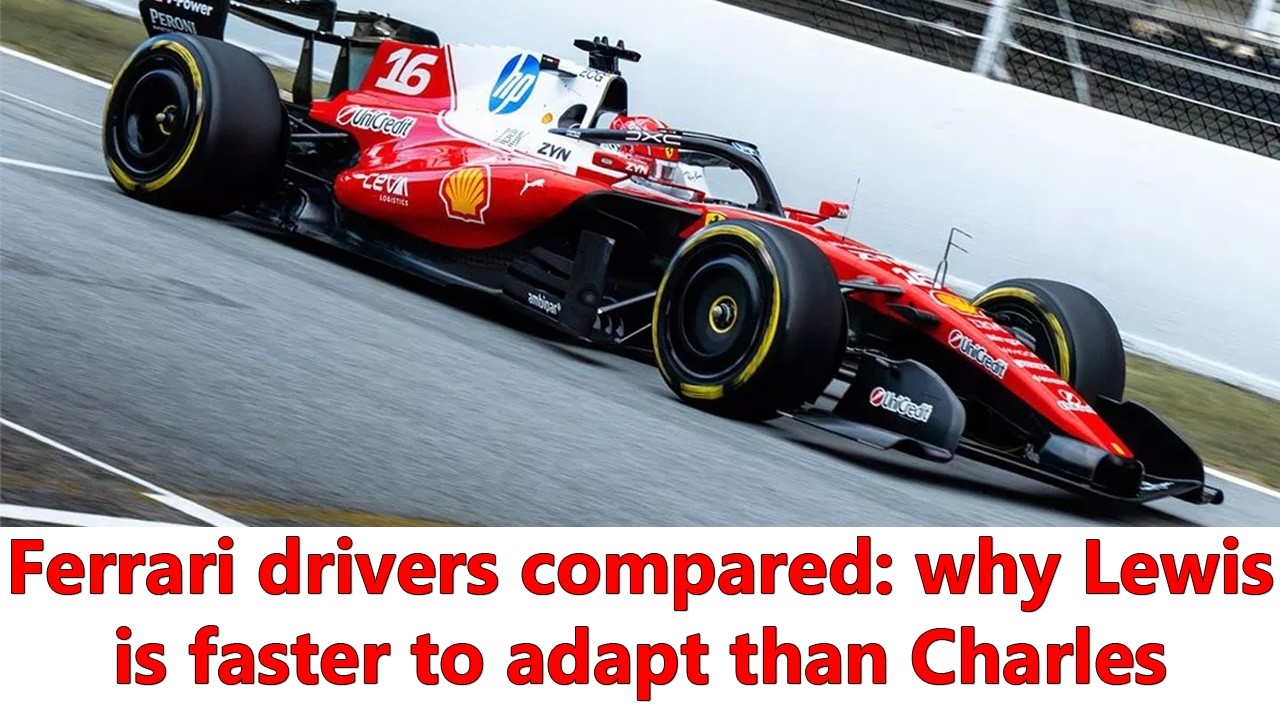
First of all, it is important to clearly underline that this discussion is not intended to alarm Ferrari supporters or create unnecessary sensationalism simply to attract attention or generate easy engagement. That is not the intention here, nor does it reflect the editorial direction. The title should instead be understood as a concise summary of a broader and more nuanced topic that deserves a deeper and more detailed explanation.
Charles Leclerc’s difficulties
Charles Leclerc has not yet fully adapted to the 2026 generation of Formula 1 cars. This is not merely an external interpretation or a narrative built by observers, as the Monegasque driver himself has repeatedly acknowledged this reality on several occasions: first, after the pre-season testing session in Bahrain, then following the Australian Grand Prix in Melbourne, and once again after the race weekend at the Shanghai International Circuit. In China, Charles Leclerc, for the first time this season, had to concede ground to a more confident and more decisive Lewis Hamilton, who appeared increasingly comfortable within the Ferrari environment.
Ferrari team principal Frédéric Vasseur also confirmed after the Chinese Grand Prix that Charles Leclerc is not yet extracting the maximum performance from the Ferrari SF-26 at this stage of the 2026 Formula 1 season. According to Frédéric Vasseur, this is not a matter of lack of talent or speed, but rather a natural phase of adaptation that some drivers experience differently depending on their driving style and technical preferences.
This situation does not appear to be linked to a fundamental limitation of the car itself, but rather to the characteristics of this new generation of Formula 1 machinery. Frédéric Vasseur explained that Charles Leclerc’s adaptation process may require a longer period of time because it involves a shift in driving approach, as well as a modification of certain ingrained habits developed over previous seasons. The Monegasque driver is progressively making adjustments, working session after session to better understand the car’s behaviour, but at the present moment he does not yet seem completely at ease or fully confident with the Ferrari SF-26.
The Ferrari team principal also emphasized that this generation of cars may not perfectly match Charles Leclerc’s natural driving style, at least in this early phase. However, this is not seen as a long-term limitation, as the 28-year-old is actively working to bridge that gap. His strong analytical skills and his well-known ability to interpret car behaviour represent key strengths that should allow him to eventually reach the desired level of comfort and performance. At this stage of his career, Charles Leclerc is an experienced and mature driver, fully equipped with the technical understanding required to overcome such challenges.
What is becoming increasingly evident, however, is that Lewis Hamilton appears to have adapted more rapidly and more effectively to this new generation of Formula 1 cars. Various analyses, including those published recently, have highlighted how the seven-time Formula 1 world champion looks fully engaged, deeply involved, and highly motivated within the Ferrari project. His contribution to the development of the SF-26 single-seater, through detailed technical feedback and continuous interaction with the engineering team, has already been noticeable.
That said, this aspect should not lead to misleading or simplistic interpretations suggesting that Ferrari has been working in a way that favours Lewis Hamilton over Charles Leclerc. Such claims would not accurately reflect the reality of how a Formula 1 team operates. Driver input is an integral and essential component of car development, and both drivers play a crucial role in shaping the evolution of the car. Charles Leclerc, just like Lewis Hamilton, has been actively providing feedback and contributing to the ongoing development process.
Looking back at the 2025 Formula 1 season, in direct comparisons between the two drivers, Charles Leclerc benefited from a greater level of familiarity with the Ferrari environment. He had a deeper understanding of the Maranello team’s internal processes, the characteristics of the car, and the specific behaviour of the power unit, which differed significantly from the Mercedes engine that Lewis Hamilton had been accustomed to during his previous years. This familiarity allowed the Monegasque to maintain a certain advantage in terms of immediate performance.
The 2026 season, however, represents a complete reset across multiple technical areas. With new regulations affecting power units, aerodynamics, and chassis design, all teams and drivers effectively started from scratch. This “clean slate” scenario has naturally reshuffled the competitive dynamics within teams, including Ferrari.
Ferrari does not favour one driver
Within this new technical framework, Lewis Hamilton seems to have found his reference point more quickly. The characteristics of the 2026 cars appear to align slightly better with his driving preferences. Compared to the previous generation, these cars are less sensitive to ride height variations, feature a more precise and responsive front end, and offer a more stable and manageable rear. These traits are generally compatible with Lewis Hamilton’s driving style, although it is important to note that his style is not dramatically different from that of Charles Leclerc.
It is also essential to remember that we are still at the very beginning of a new regulatory cycle. The current generation of Formula 1 cars is still in an early stage of development, and teams are continuously working to refine and optimize performance. In such a context, a period of adaptation is not only expected but also inevitable.
While Lewis Hamilton has adapted more quickly during these opening races, this does not imply that Charles Leclerc will not be able to close the gap. On the contrary, when looking purely at performance metrics, the Monegasque remains very close to the seven-time world champion. For example, during the Australian Grand Prix in Melbourne, Charles Leclerc managed to finish ahead of Lewis Hamilton, demonstrating that the performance difference between the two drivers is still minimal.
At this stage of the season, Charles Leclerc is fully focused on understanding every aspect of these new cars in depth. His work involves not only improving his own driving adaptation but also contributing to the direction of car development. The goal is to guide the evolution of the Ferrari SF-26 towards a configuration that better suits his natural driving characteristics, while maintaining overall competitiveness.
This ongoing process should not be misinterpreted as evidence of preferential treatment towards one driver. Ferrari operates as a unified team, and both Charles Leclerc and Lewis Hamilton are working towards the same objective: maximizing performance and achieving the best possible results on track.
Finally, it is also important to consider the characteristics of specific circuits. Charles Leclerc has never hidden the fact that he does not particularly enjoy tracks like Albert Park in Melbourne and the Shanghai International Circuit. These circuits do not perfectly match his driving preferences and have historically presented certain challenges for him. On the other hand, Shanghai, in particular, has often been considered almost a “home track” for Lewis Hamilton, where the British driver has traditionally performed at a very high level.
Looking ahead, Suzuka could represent a turning point in this early phase of the season. The Japanese circuit is widely regarded as one of the most technical and demanding tracks on the Formula 1 calendar, and it may suit Charles Leclerc’s driving style more effectively. This could provide him with an opportunity to reverse the current trend and reassert his competitiveness within the team.
For now, the situation remains open and evolving. The next race weekend in Japan will offer further insights into the balance between Charles Leclerc and Lewis Hamilton at Ferrari, and it will be particularly interesting to see how the dynamic between the two drivers develops as the 2026 Formula 1 season progresses.

Let other Scuderia Fans know about us


