
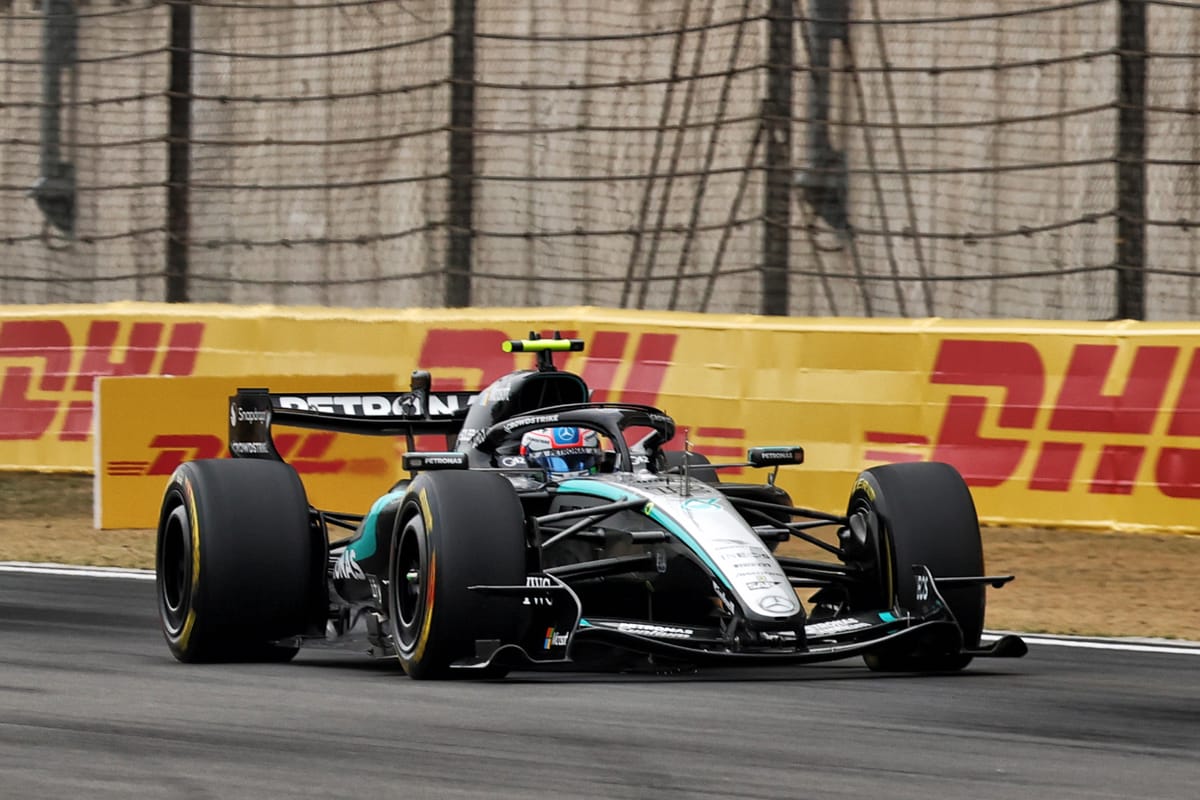
Mercedes came under the spotlight after Formula 1’s Chinese Grand Prix for the strange behaviour of its front wing’s active aerodynamics.
Video footage of race winner Kimi Antonelli’s car caught the attention of rival teams for what appeared to be a multi-stage transition between the car’s straight and cornering mode.
Moving images showed that the wing ran completely flat on the straights and, as it transitioned to corner mode, ran briefly in a halfway state initially under braking.
Then, on the final approach to corners such as the hairpin at the end of the back straight, it finally popped all the way up.
This behaviour appeared to go against the rules, which impose a minimum time of transition between wing states. Article 3.10.10 of F1’s technical regulations stipulates that the transition time between the two modes of the front and rear wings can be no longer than 0.4 seconds.
The movement observed, of being longer than 400 milliseconds (as the article officially states) and of there being more than two fixed states, triggered a number of rivals to take a closer look at what was going on.
It was also enough for at least one team to contact the FIA to check that what was being observed was within the boundaries of the regulations.
But although the wing’s behaviour triggered theories about a trick exploitation of the rules, the truth is that there was no deliberate act from Mercedes and a simpler explanation has been signed off as satisfactory by the FIA.
A miscalculation
The answer for what was going on with the front wing was that its slower return to corner mode was a mistake, the result of a miscalculation by Mercedes of the forces required to switch wing modes.
The Mercedes front wing is one that operates with hydraulic pressure being used to push the wing element into corner mode, rather than having a system that gets it pulled down for straightline mode.
In Shanghai, the team got its calculations wrong in terms of how much hydraulic pressure was required to close the wing at maximum speed because of the forces being pushed against it as the car travels through the air.
The result was that then when the corner mode was activated, there was not enough hydraulic pressure to push the wing back into its final fixed position when the car was travelling above a certain speed, because the forces it needed to counter were too high.
It was only when the speed came off, so the forces experienced by the wing travelling through the air were less, that it was fully able to close.
Mercedes first became aware of the wing problem in qualifying in China, and it was that experience that prompted a front wing change for George Russell during that session.
It believed that fixes had been put in place for the race to prevent a repeat, but those were clearly not enough as Antonelli suffered similar problems.
Sources have revealed that work has been done at Mercedes’ Brackley factory since the China race to improve its hydraulic systems and make it more robust, with the hope being that there will not be repeat problems in Japan this weekend.
The Race has learned that the FIA, in response to the queries from rivals, did discuss the situation with Mercedes and is satisfied by the explanation that was given.
The fact that Mercedes has put so much effort into addressing the front wing system to prevent a repeat has also convinced the FIA that there is nothing nefarious going on.
Furthermore, analysis has suggested that rather than there being a benefit from a wing that is slow to retract, it is actually worse in terms of laptime because of the impact it has in the braking phase for corners.
The FIA is clear that the regulations are definitive in there being a 400ms transition that must be adhered to between two fixed points.
And, with the Mercedes situation having now alerted teams about such a strict definition, any repeat of strange, multi-stage wing movements would likely open the door for action to be taken.
What the theories said
The way the wing behaved wing prompted a host of theories about Mercedes having employed clever design tactics to exploit grey areas in the rules to allow the double transition.
It was suggested that having the rear wing fully activated with the front wing only partly so could move the car’s aerodynamic centre of pressure towards the rear, which would bring a couple of benefits.
The first is that it could in theory allow the energy harvesting under braking to be more aggressive, and the second is that it would give the sensation to the driver of greater stability. This could then allow them to more comfortably brake harder and thereby be more efficient in harvesting energy for the battery.
This idea was backed up by data from the first two races that suggests the Mercedes harvests more quickly than the identically engined McLaren, and a trick front wing could, it was suggested, help contribute to that.
There could also have been straight aerodynamic benefit from having a front wing that steadily changed its angle of attack.
As the front wing completes its transition, so the centre of aero pressure will move forwards, giving greater resistance to front locking as the downforce bleeds away at the square root of the speed.
This would also give a more progressive transition to the car’s dive under braking, thereby reducing the plank wear and allowing for a softer, more compliant front suspension and/or a front ride height which could be set lower – thereby potentially offering greater underfloor downforce.
The theories were certainly intriguing, but the reality is that the explanation for what was happening with the front wing in China was much less exciting.