
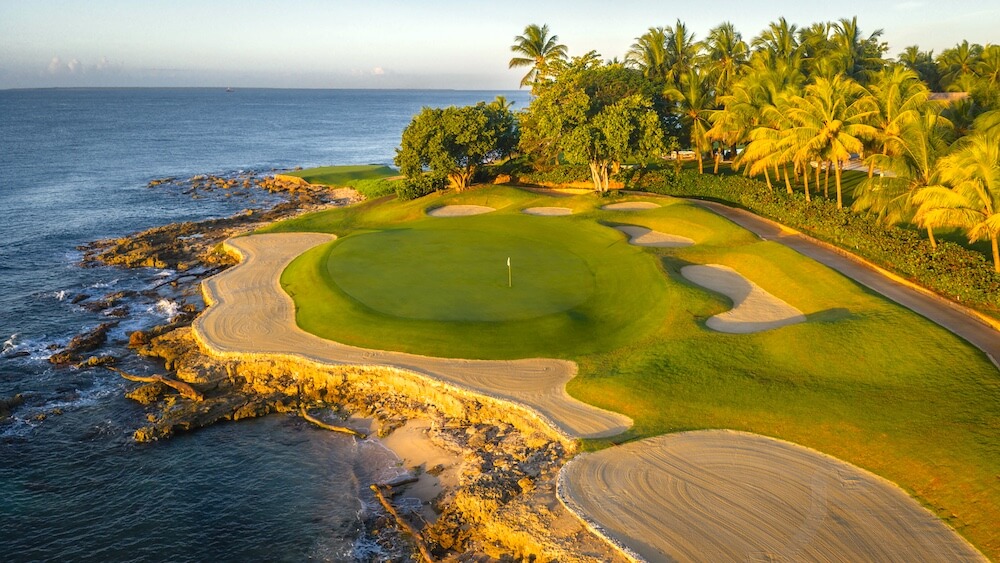
LA ROMANA, DOMINICAN REPUBLIC | When it comes to understanding golf course architecture, it is important to note that layouts are living, breathing things that change over the years. That means even the most artfully crafted courses can benefit from proper upgrades. And those are often necessary to ensure that designs remain true to their initial intents as they also adapt to developments in the game, such as the greater distances many golfers are hitting their shots today.
Case in point is the recent renovation of the 55-year-old Teeth of the Dog track at the Casa de Campo resort on the southern coast of this Caribbean land. Completed in January after a nearly 11-month shutdown and orchestrated by Jerry Pate – who has enjoyed a successful second act as a course designer after a competitive career that included victories in a U.S. Amateur and a U.S. Open by the time he was 22 years old – the work has enhanced one of the late Pete Dye’s greatest creations as a venue for elite events like the Latin America Amateur Championship, which it is expected to host for a fourth time in 2028, and also a getaway for recreational players. And the hope is that the refurbishing of Casa de Campo’s centerpiece will also elevate the already strong stature of what is arguably the finest golf destination in Latin America and among the very best in the world.
“Teeth of the Dog is a great work of art by Pete Dye,” Pate said as we played the four seaside holes on its front nine during the official reopening earlier this month. “And we did not make any major changes. It’s still Pete’s course. The routing is the same, and so is the basic strategy. We just sharpened the features and did some things such as sand-capping the entire layout to improve the course conditioning and installing a new irrigation system. We also cut down several trees, cleaned up the edge of the golf holes and regrassed all the tees, greens and fairways with Pure Dynasty paspalum, which is saltwater tolerant and does very well in the heat and humidity of the Caribbean.”
Having worked at Casa de Campo since 1980, Gilles Gagnon, the resort’s director of golf emeritus, knows Teeth as well as anyone.
“It was time to do this, and I think the course looks great,” he said. “There is a lot more definition to the holes. Many of the 120 bunkers on Teeth had settled down over time, and you could no longer see them the way Pete wanted you to. But they have become much more visible.”

According to Pate’s design associate, Steve Dana, the architects also returned most of the greens to their original sizes and shapes; relocated several bunkers to bring them into play more often; added a handful of tees to increase distance on certain holes; and rerouted all the cart paths so they are not as conspicuous as they once were.
The project also included the addition of two new comfort stations, each of which features fully stocked bars and bathrooms.
As for the total cost of the renovation, it is said to have approached $8 million. That’s a lot of dinero, to be sure. But the consensus now that Teeth has reopened is that it was money very well spent.
It was in the summer of 2023 that the owners of Casa de Campo announced they would be renovating Teeth, taking it out of service for most of 2025 to do so. They also revealed then that Pate would lead the project. That decision surprised some but made perfect sense to those who were aware of the long relationship Pate had enjoyed with the resort as well as with Dye – and understood that the golfer, who has been running his own course design firm for more than 30 years, has been serving as Casa de Campo’s architectural consultant for the past decade.
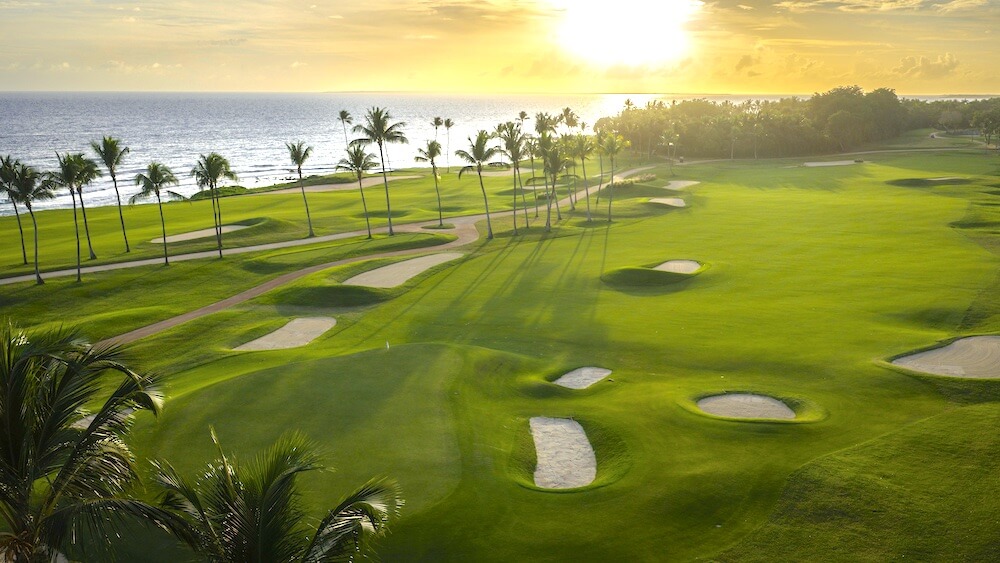
Pate knew the resort, and the owners of that sun-drenched, 7,000-acre retreat knew and trusted him.
“Jerry was the perfect person for the job,” said Bob Kelly, the former CEO of Nicklaus Golf and a longtime consultant to the owners of Casa de Campo who served in many ways as their eyes and ears during the renovation project. “He had the relationship with the owners, and he was very familiar with the course and Pete’s work. Jerry also understood the mission, which was to make Teeth better while also making sure it was still very much Pete’s course and something that would keep resort guests happy while still being able to hold events like the Latin America Amateur.”
Pate smiles as he recalls his first visit to Casa de Campo.
“It was in 1974, and I had come down here for the World Amateur Team Championship,” he said. “It was the first big tournament ever held at the resort, which was then owned by Gulf + Western, and Teeth was the only golf course here. The water was no good, so we just drank Presidente beer. There were four of us, George Burns, Gary Koch and Curtis Strange and me. We ended up winning the team championship, and I was co-medalist.”
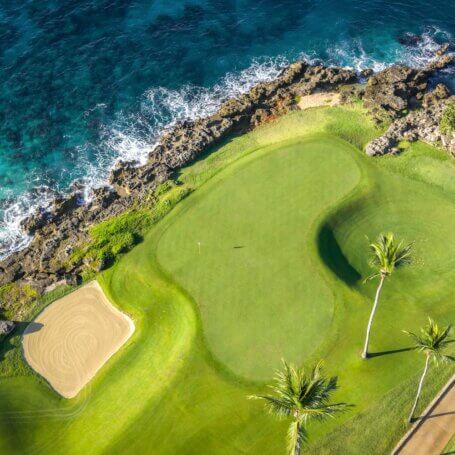
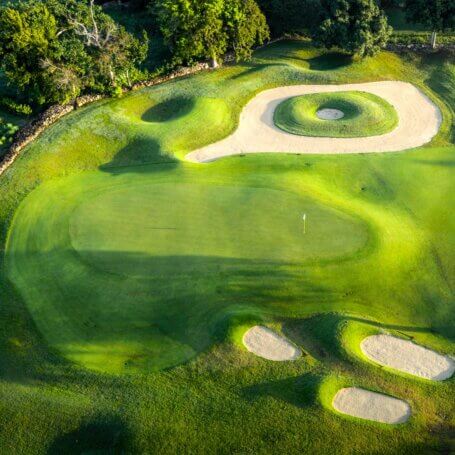
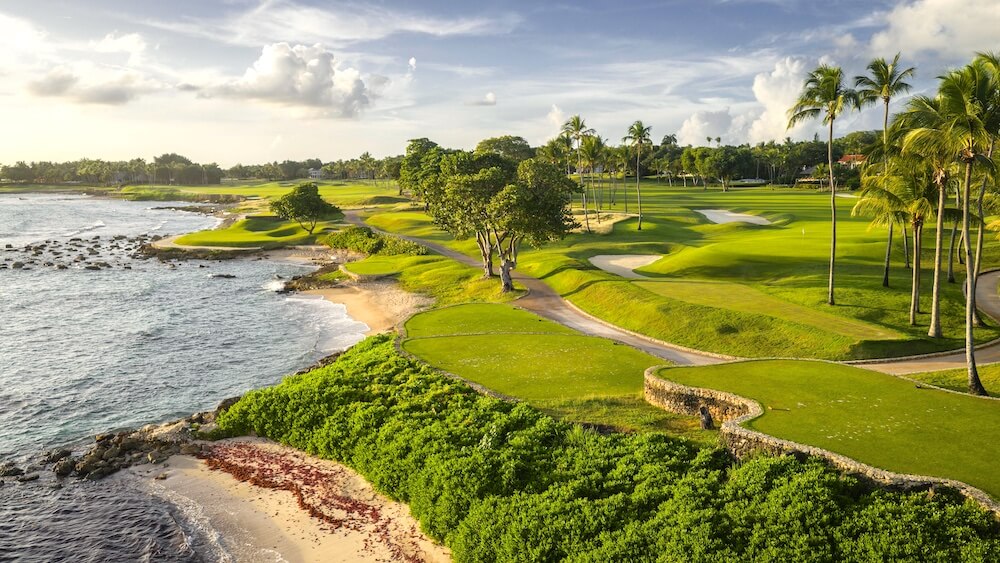
From any angle, Teeth of the Dog is an eye-catcher.
Two years later, Pate played in what was still called the Bing Crosby National Pro-Am at Pebble Beach with a Cuban-American sugar magnate named Alfy Fanjul.
“We had a great time together and some years after, in 1984, Alfy called to tell me that he and his brother Pepe had purchased Casa de Campo,” Pate recalled. “Not long after that, he flew me down to play Teeth of the Dog with Pete.
“Pete and I knew each other pretty well by then,” Pate continued. “After all, I had thrown him into the pond by the 18th green of TPC Sawgrass two years before when I won the first Players Championship ever held there.”
Pate says that his old Crosby playing partner took him to Casa de Campo several times after that first game.
“And it was on one of those trips, maybe 10 years ago and with Pete also on the plane, that Alfy asked me to take over as the architectural consultant, by which time the resort had grown to include 81 holes, all designed by Pete and his wife, Alice,” he said. “Pete had a home down there, off the seventh tee, and he was constantly tweaking his courses.”
Dye was also getting up there in years, having recently turned 90, and the Fanjuls no doubt felt they needed a succession plan when it came to taking care of those layouts, which they recognized as being the most important assets at Casa de Campo. So, they passed the baton.
The carefully considered work that Pate has just performed on Dye’s masterpiece proves that was a very wise move, indeed.
Photos: Patrick Koenig, Casa de Campo
© 2026 Global Golf Post LLC