
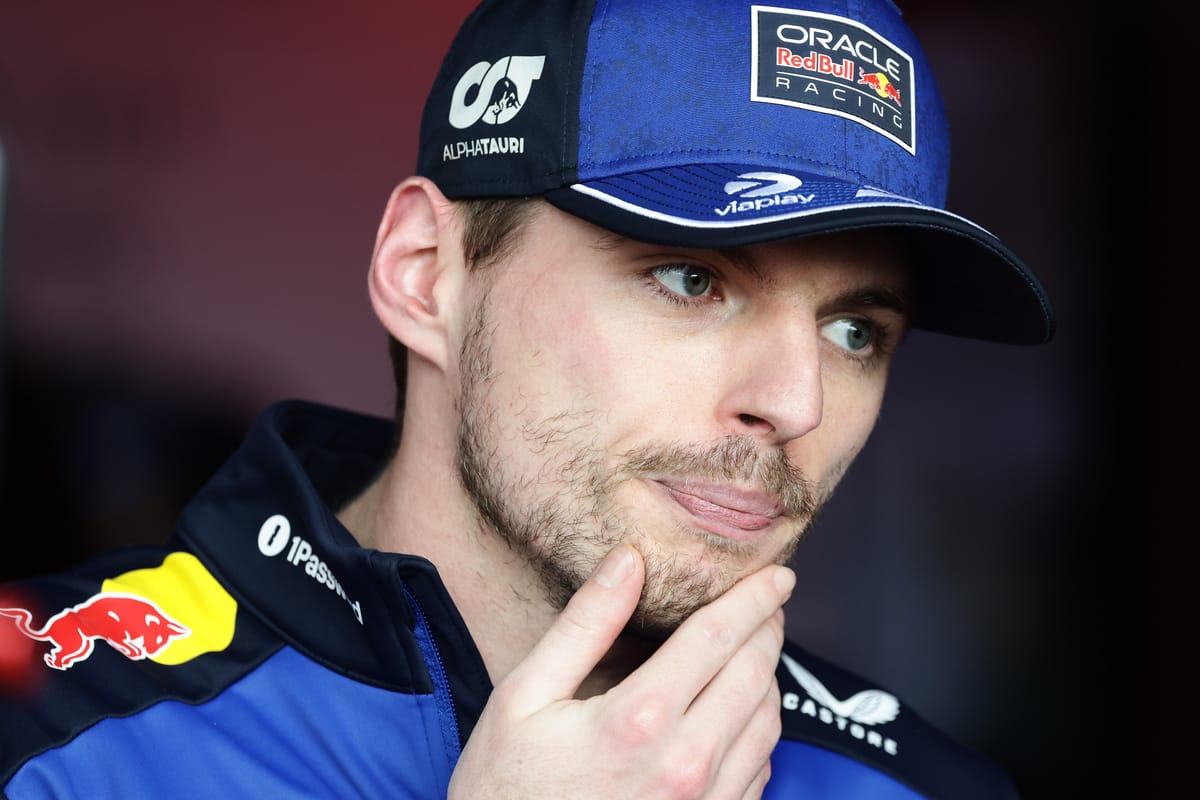
The beginning of Formula 1’s unplanned April gap marks the start of a crucial few weeks and months Max Verstappen says will decide his immediate F1 future.
The prospect of Verstappen quitting F1, or at least pausing his grand prix racing career, has grown since the introduction of new engine rules in 2026 that the four-time world champion has intensely criticised.
Verstappen only admitted he has a choice to make about staying in F1 several times during the Japanese Grand Prix weekend, perhaps no more overtly than in a post-race interview with BBC Sport in which he was asked if he could walk away at the end of the season.
“That’s what I’m saying,” Verstappen replied. “I’m thinking about everything inside this paddock.”
It is no coincidence that Dutch media very close to the Verstappen camp also began reporting on Sunday night he is seriously considering walking away from F1.
Everything, not least Verstappen’s own comments doubling down on his situation Sunday night, indicates the Red Bull driver is closer than ever to quitting F1.
In Japan the narrative went well beyond having to read between the lines or interpret his unusually resigned body language after qualifying.
Suzuka marked a sudden shift from tacit suggestions to much more overt remarks.
Verstappen’s father Jos warned in an interview that he fears his son will lose motivation to continue.
Max then moved the needle on Saturday, when he publicly admitted for the first time he needs to “figure out” his future and was considering “life here” in F1.
He then reiterated after the race that he was weighing up whether it was “worth it”, openly discussed the arguments against continuing, and implied in multiple interviews that he must find ways to encourage himself.
After being asked for probably the umpteenth time about his motivation post-race, Verstappen’s head briefly dropped, and when the Japanese journalist who asked the question apologised, Verstappen replied: “No, it’s a valid question.
“Every day I wake up, I convince myself again. And I try.”
The timeline for a decision
Verstappen is under contract with Red Bull until the end of 2028, but there is no scenario in which he will continue racing in F1 to that time if he decides he does not want to.
It will not come to a contract buyout, though. Verstappen has exit clauses in his contract that give him an out based on Red Bull’s competitiveness.
This was the centre of speculation last year around a possible Verstappen switch to Mercedes. Then, Verstappen could have left if he was not in the top three of the drivers’ championship by the summer break.
For 2026, though, this is understood to be different – if Verstappen is not in the top two by the date in the contract, he can leave. This was presumably stipulated based on the 2026 rules to give Verstappen the option to hunt for a better seat in 2027 depending on the competitive order.
Verstappen is currently ninth in the drivers’ championship with just 12 points, 51 behind second in the standings George Russell.
Given Mercedes’ strong start to the season – its drivers are already moving clear at the top of the table – and Red Bull’s struggles with its car and adapting to running its own engine for the first time, it is extremely likely Verstappen will have a clear contractual route to leave Red Bull this year.
Furthermore, it is understood Verstappen does not need to notify Red Bull of his decision until October. So he also has plenty of time to see what changes – not just in Red Bull’s competitive situation, but with F1’s new ruleset.
New rules needed to keep him?
Verstappen does not enjoy the near 50/50 split between internal combustion engine and electrical power that is key to the new rules and the demand on energy management it has created.
He has made regular criticisms about this – like calling the speed differences triggered by different battery states in F1 a “mushroom mode” on Sunday, in a reference to the Mario Kart game that has become a favoured mocking comparison of choice.
There is an acknowledgement among F1’s stakeholders that qualifying in particular needs addressing, as there are too many high speed corners being compromised by the need to charge the battery.
And moments like the cars slowing down significantly at the end of the lap at Suzuka, which world champion Lando Norris said “hurts your soul” in the car, are also underwhelming to watch.
The division comes over how big a change is needed. The rulemakers hope that this generation of car and engine can be refined rather than overhauled. But Verstappen’s much publicised belief is that F1 needs to reverse out of this switch to greater electrification entirely.
“They know what to do,” Verstappen said of F1’s stakeholders.
While this year is all about what can be adjusted within the rules and more importantly the physical engines manufacturers have already designed and built, Verstappen hopes that a bigger set of changes will be tabled for 2027.
F1’s argument will be that it is bigger than Verstappen and he should be wary of walking away from something that always finds a way to move on when its best drivers depart.
But Verstappen is widely regarded as the best driver in F1, has time on his side, and holds massive influence within Red Bull.
So it stands to reason that if F1 cannot put together a compelling set of changes for 2027, or even 2028, Verstappen would be able to take a one or two-year sabbatical, then return if or when F1 fast-tracks a brand new set of rules to replace the current engines entirely.
When, not if, he leaves early
Even in the context that every driver has to stop racing in F1 eventually, an early Verstappen career exit has always been a matter of when, not if. The likely timing now just feels accelerated.
Some in the F1 paddock even started asking at Suzuka if Verstappen could leave in the middle of this year, if he grew truly exasperated with the state of F1 as he sees it.
Even discounting his competitive desire to do the best he can this year,
Verstappen’s loyalty to Red Bull would surely preclude him dropping that kind of grenade into Milton Keynes.
And that strength of feeling means Verstappen would almost certainly not cut all ties with Red Bull if he were to leave F1.
There are ways to honour his contract to 2028 as a Red Bull athlete and ambassador – a well recompensed one, too.
As Verstappen enters a month that gives him plenty of time away from the F1 he’s grown disenchanted with, he will have time to start weighing this up properly.
It’s not just the push factors that could drive him away from F1. It’s also the pull factors outside – his young family, his social life, his other racing ambitions, his growing racing team.
In his BBC interview, Verstappen said: “Privately I’m very happy. You also wait for 24 races. This time it’s 22, but normally 24.
“And then you just think about is it worth it? Or do I enjoy being more at home with my family? Seeing my friends more when you’re not enjoying your sport?”
Ultimately, Verstappen’s had a long-held promise not to extend his F1 career excessively. He has no intention of staying beyond his peak years because he also wants to enjoy other forms of racing.
Verstappen is already dabbling in this with his Nurburgring exploits, but the list of events he wants to tackle is much longer.
So what once looked like a question of ‘when will Verstappen retire from F1, to give himself time to explore other races?’ might be shifting more to ‘will Verstappen take time out to race elsewhere now, then still have time to return to F1 if he wants to?’.
Either way it seems his F1 career really could end or at least pause, and it is significant that Verstappen has made his peace with it being a realistic possibility.