
Jannik Sinner defeated Jiri Lehecka 6/4 6/4 in the final of the Miami Masters to become the eighth man to complete the Sunshine Double. The Italian improves to 19-2 on the season and closes the ranking gap with world number one Carlos Alcaraz.
Back in mid-February there was talk of Sinner having a “slump”. He’d just lost to Jakub Mensik in the Doha quarterfinals — his first event since a five-set upset loss to Novak Djokovic in Australia. The Italian was unperturbed in his post-match presser:
I’ve had two incredible years and now I’m having a little downturn, but it’s not something that worries me. I know I can play better tennis.”
In that same interview the Italian revealed that Roland Garros is a major goal in 2026, having come agonisingly close last year, losing a bonafide classic to Carlos Alcaraz:
“One of my biggest goals will be Roland Garros, but that goal is still far away… The confidence to play good tennis is there. Indian Wells is usually a tournament where I struggle a bit, we’ll see what happens there, while in Miami I’ve always played well.
Sinner has not lost a set of professional tennis since that interview. Twelve matches and 24 sets.
The scary part is: this is business as usual. It was just last fall, after a four-set loss to Carlos Alcaraz in the US Open final, that Sinner went on a tear, running up a 24-1 win tab, including an 18-match streak to finish the season, dropping just one set along the way to Alexander Zverev in Vienna.
But while the P&L sheet is back to Sinner-standards, the means have been a little different in 2026. I touched on Sinner’s “meh” baseline game in Indian Wells:
Dare I say the Italian’s baseline game in Indian Wells has been a little underwhelming when using his “I’m a computerised slingshot sent from the future to destroy you” yardstick.
In the desert, Sinner made up for it with obscene serving accuracy.
Well the same thing happened in Miami, but to an even greater extent. The numbers:
-
11.7 aces/match (52-week avg. is 6.7)
-
70% first-serves in (avg. 66%)
-
86% first-serve points won (avg. 81%)
-
52% first-serves unreturned (avg. 44%)
-
126 mph first-serve speed (avg. 123 mph)
-
4 double faults for the whole tournament
What is upstream of these numbers is the lethal accuracy. Sinner made a technical serve tweak after a disappointing performance during the US Open, showcasing a better coil in Beijing, but it wasn’t until Paris that Sinner had some sort of serving epiphany (~match 16). In 2026 he’s averaging 46 centimetres from the lines.
Ok that’s a lot of Sinner serve chat recently. Let’s talk about his groundies.
In this age of liquified internet you get endless takes of so-so’s performance, and my socials have definitely had more of a “Sinner is hitting his forehand shit” vibe than usual in recent weeks. Numerous theories abound:
He’s adding more spin for clay season. (negligible)
His forehand grip is more extreme now. (it isn’t).
He’s adding more height for clay season…
Thanks to Courtside Advantage, what I can tell you is true is that compared to 2025 hardcourt data, Sinner’s forehand in 2026 has been slower (down 3 mph), and is indeed being hit higher over the net (up 6 cm), but for fewer winners and more errors. Erm, so maybe the vibes are right? Or maybe this is all part of Sinner’s Roland Garros plan.
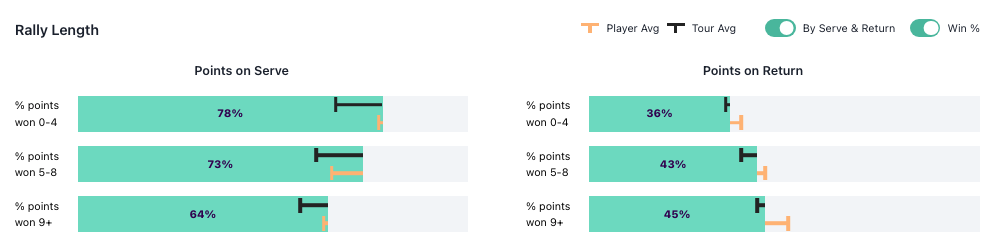
Yet one of the worrying trends for Sinner fans — especially in light of Roland Garros aspirations — has been his return points won trend in 2026. Compared to 2025, Sinner is winning less points on return at every rally length, but making up for it on serve (except in 9+):
If we combine serve and return numbers and just look at overall win-% by rally length on hardcourts, here’s Sinner since 2023. He was a 9+ god in 24/25:
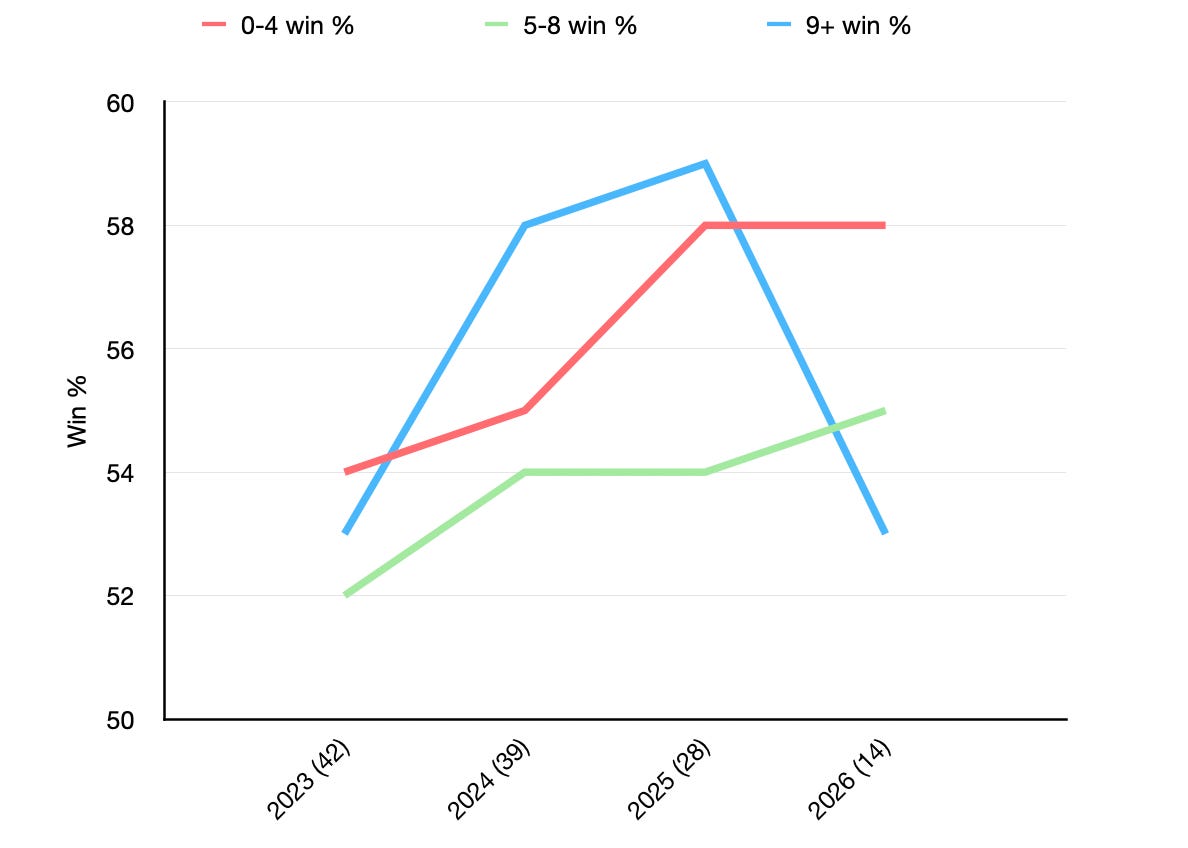
Something to keep in mind for the upcoming clay season, when the aces can dry up, and the rallies skew a little longer (but not much, really).
Ok we had a match last night, and Sinner had an opponent: Jiri Lehecka. The Czech has all the sheen and musculature of a racehorse, his tear-dropped quads unrivalled on tour. He plays how he looks: he hits the shit out of the ball. He used it to great effect in the semifinals against Arthur Fils, rushing the Frenchman with impeccable early and aggressive returning.
He started with similar designs against Sinner:
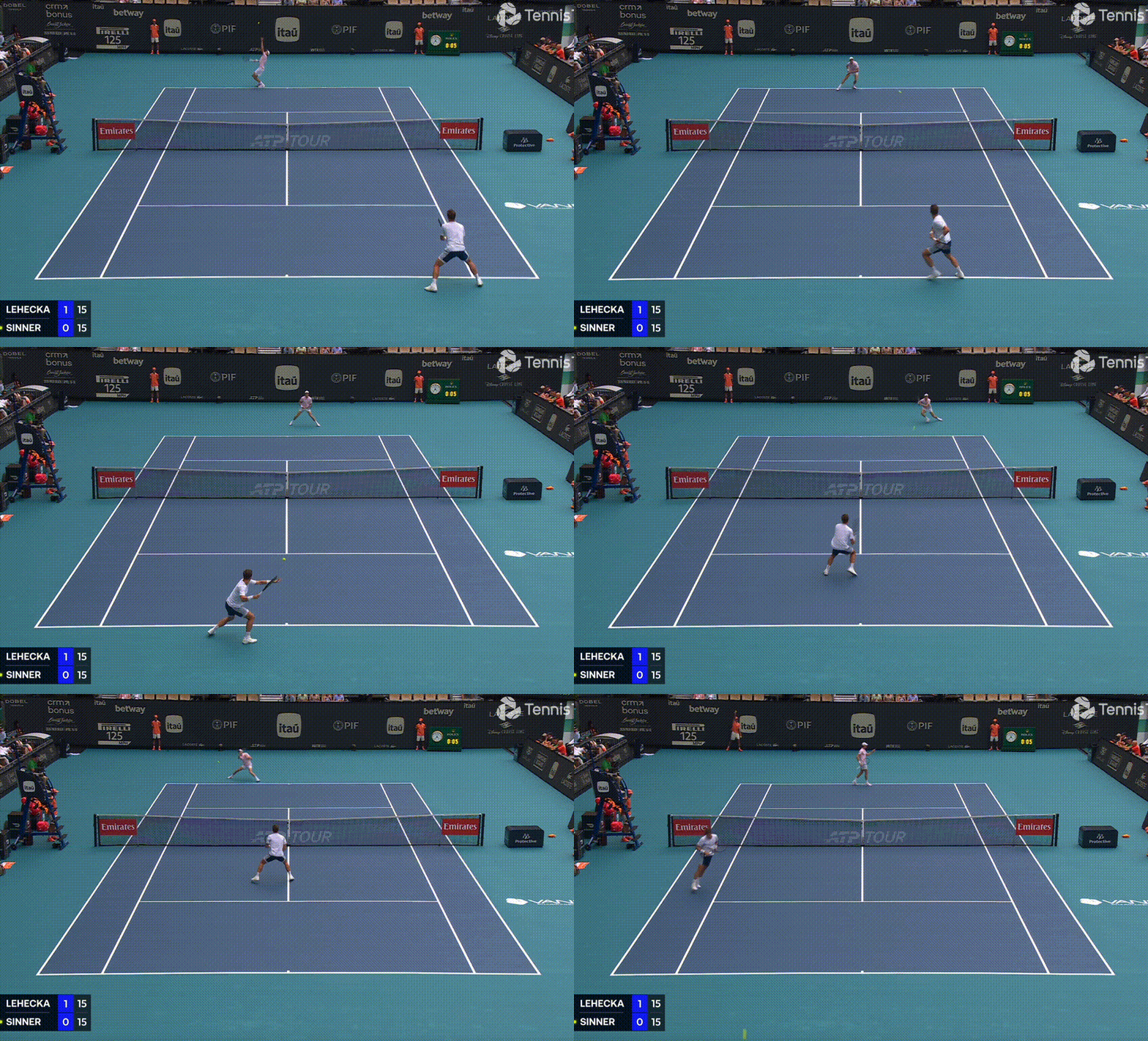
In addition to his power baseline game the Czech was the first player to reach a Masters 1000 final without dropping serve since Novak Djokovic in Shanghai 2018.
But Sinner didn’t take long to end the streak, keeping the ball deep middle as the Czech’s forehand unravelled with errors in just his second service game.
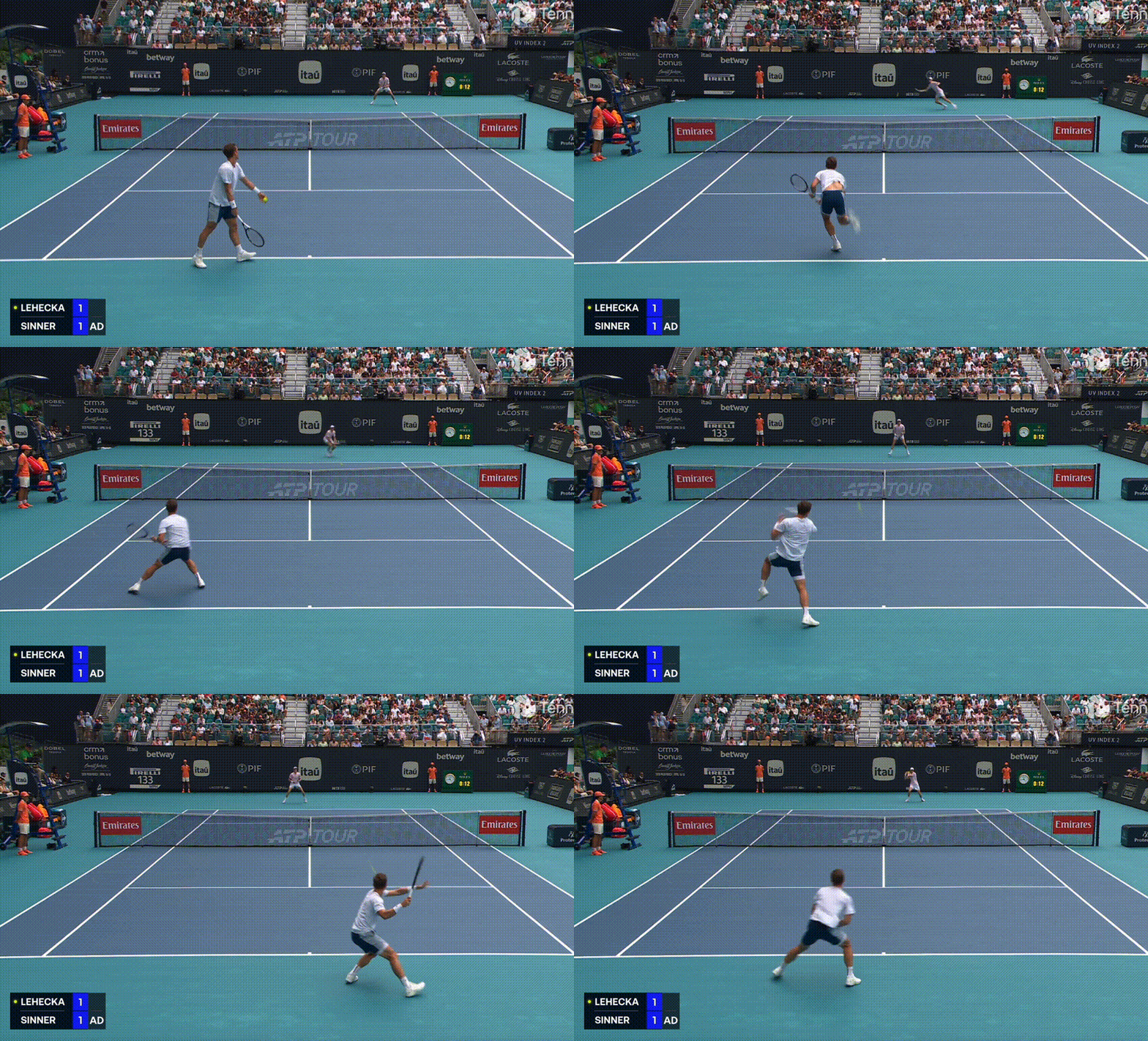
But Lehecka was committed to playing attack, and was rewarded in the very next game with triple break point, courtesy of more aggressive returning:
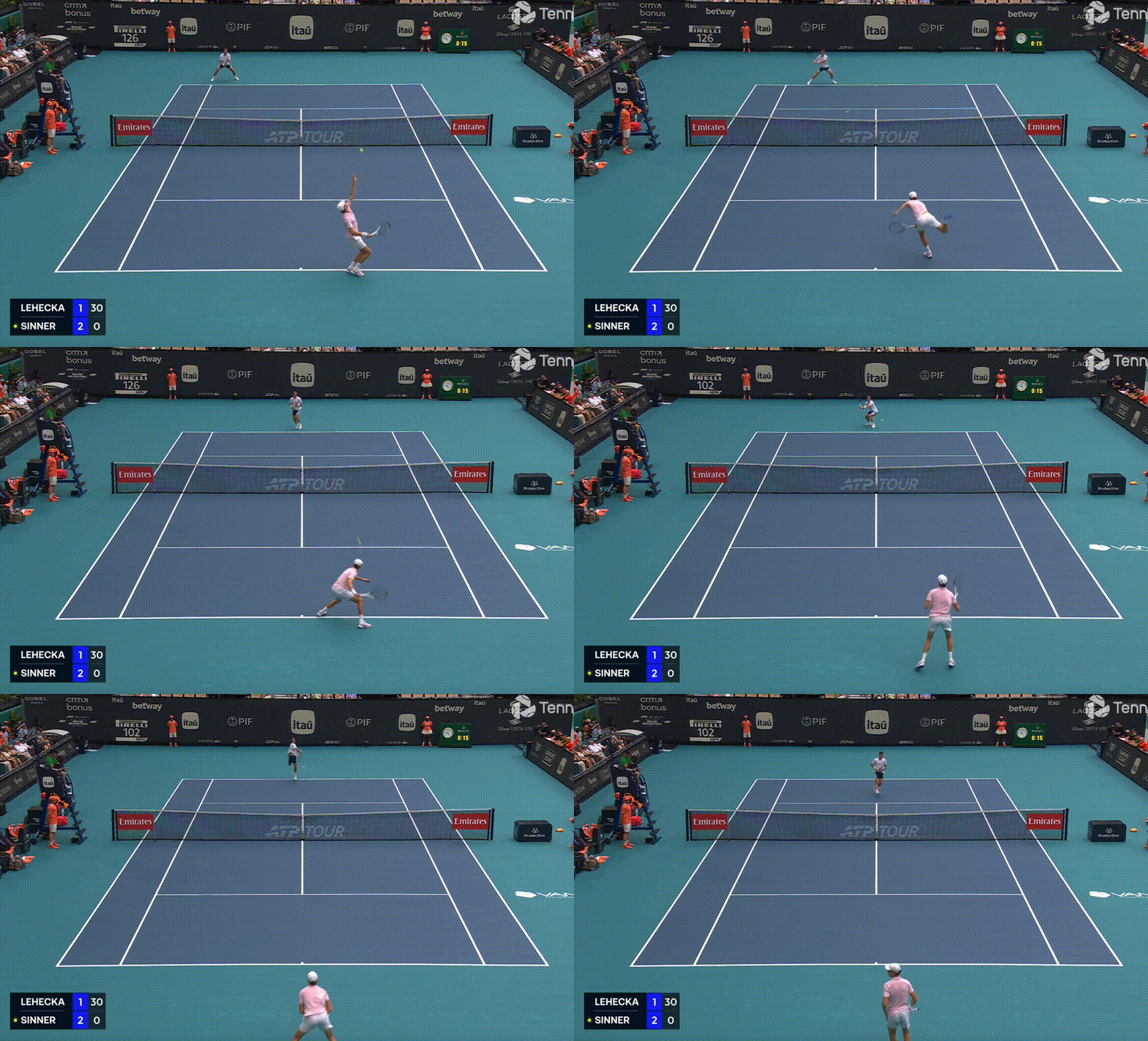
Given the aforementioned serving from Sinner, the commentators were confident enough not to curse the Italian from 0-40:
“And you wouldn’t put it past him, would you, to just clock down three first serves”
Three?
Pfft. Try five. All unreturned.
It’s been a trademark during the Sunshine Double, where Sinner saved 83% of break points across the two events, up from his 70% average.
“It’s why sometimes, we talk about numbers, but we have to be careful sometimes to put it into context. He’d only made 3/9 first-serves, and then in the biggest moments…five wonderful first-serves to get himself out of trouble. That’s a champion mentality.”
— Tennis TV
What was great about the Miami final was the frequent court-level perspective on offer, which helped to highlight just how flighted Sinner’s forehand was at times, making it difficult for Lehecka to ply his linear power game:
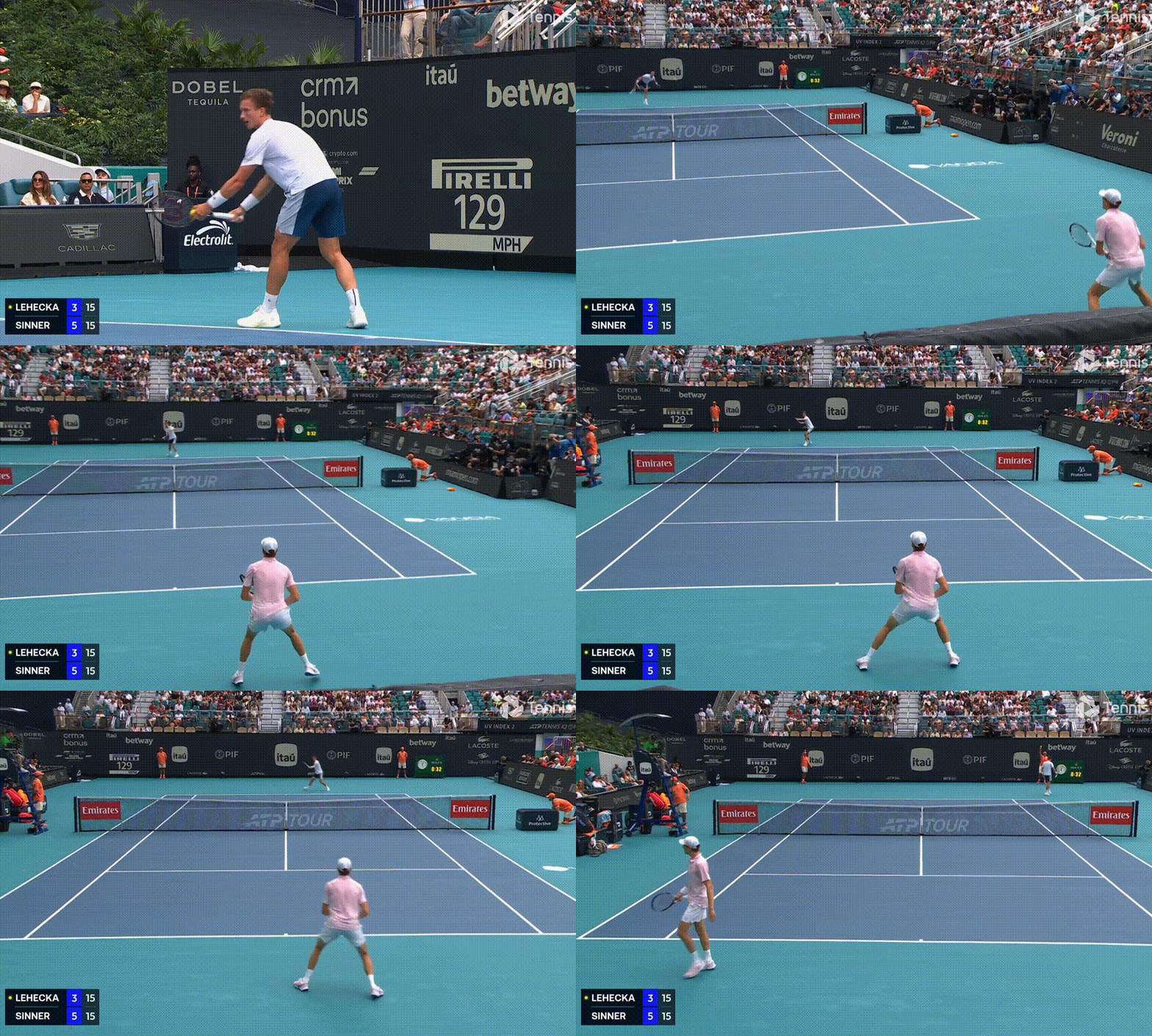
Of course, one of the special things about Sinner is that his backhand is about as forehand-y as a two-hander can get: massive spin and power. It means he’s tactically flexible, and can play the same strategy from deep ad-side returns:
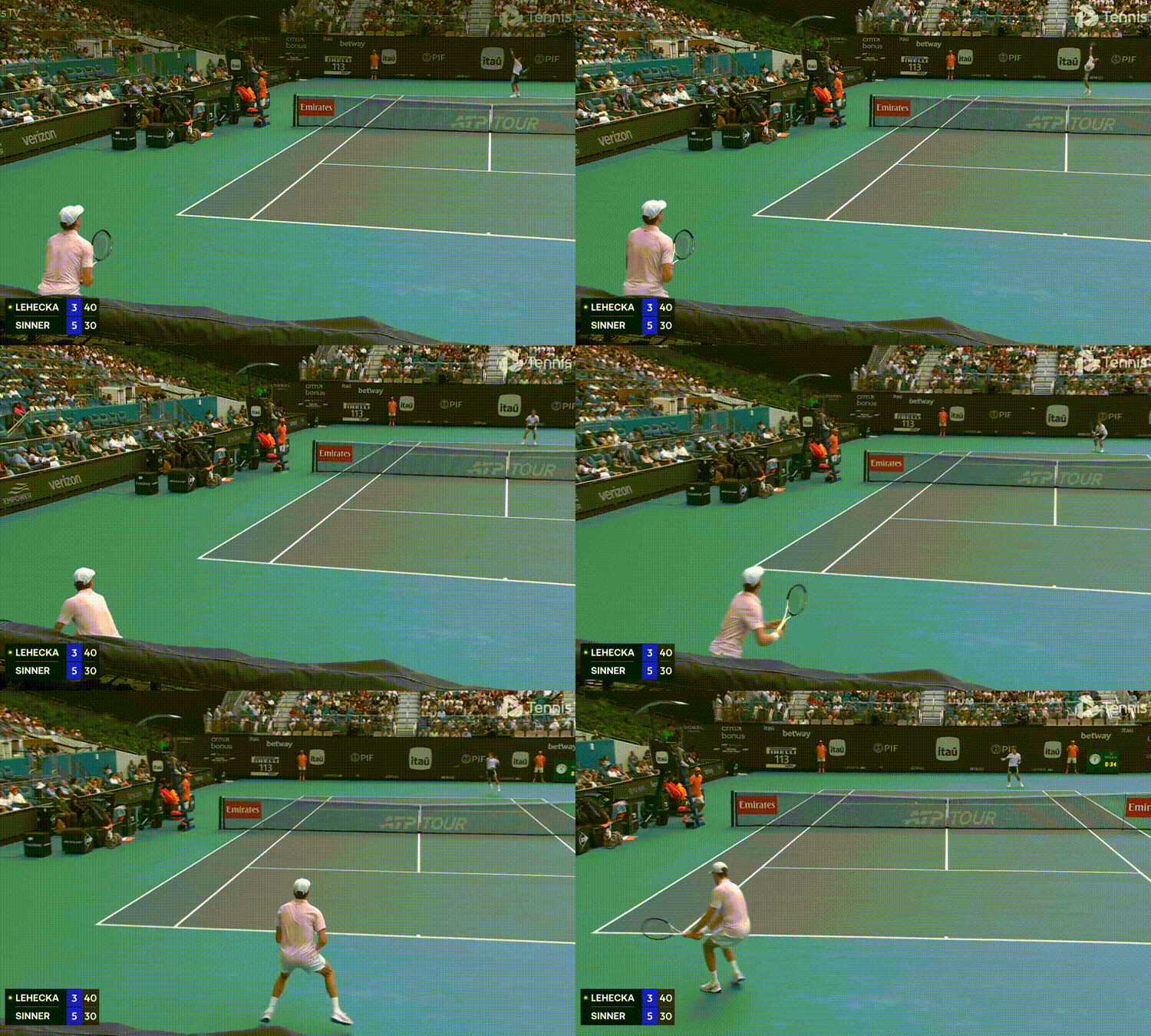
As a result of Sinner’s deep return positions, Lehecka tried to serve-and-volley, but Sinner is one of the hardest players to S&V against, as Gill Gross mentioned: he’s got great reach, and he rarely chips returns, meaning he’s getting balls back faster and lower than your average tour player, plus he’s able to dip balls with wicked spin from both wings.
On top of all that, Lehecka is still raw in his net skills. The touch is lacking:
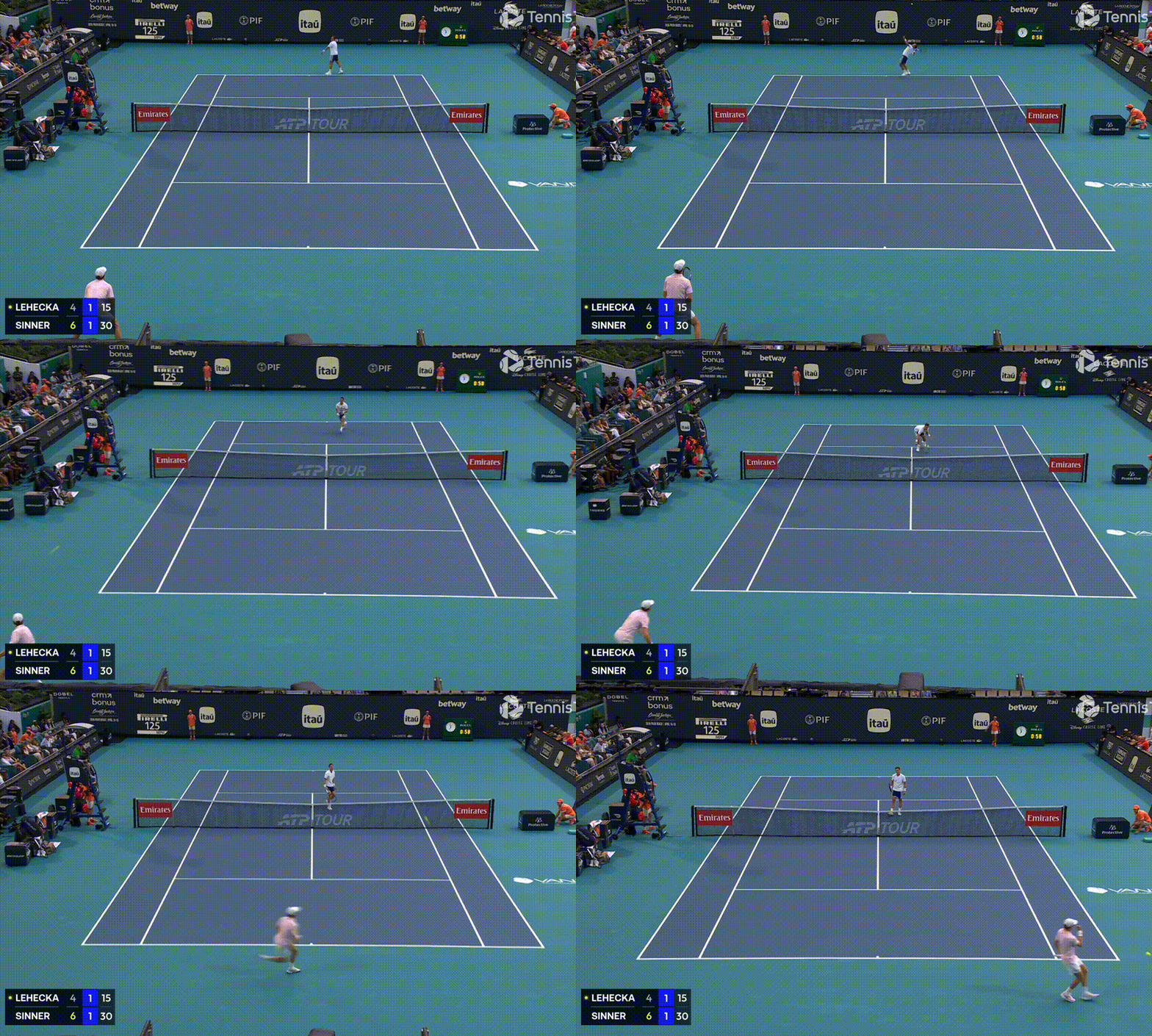
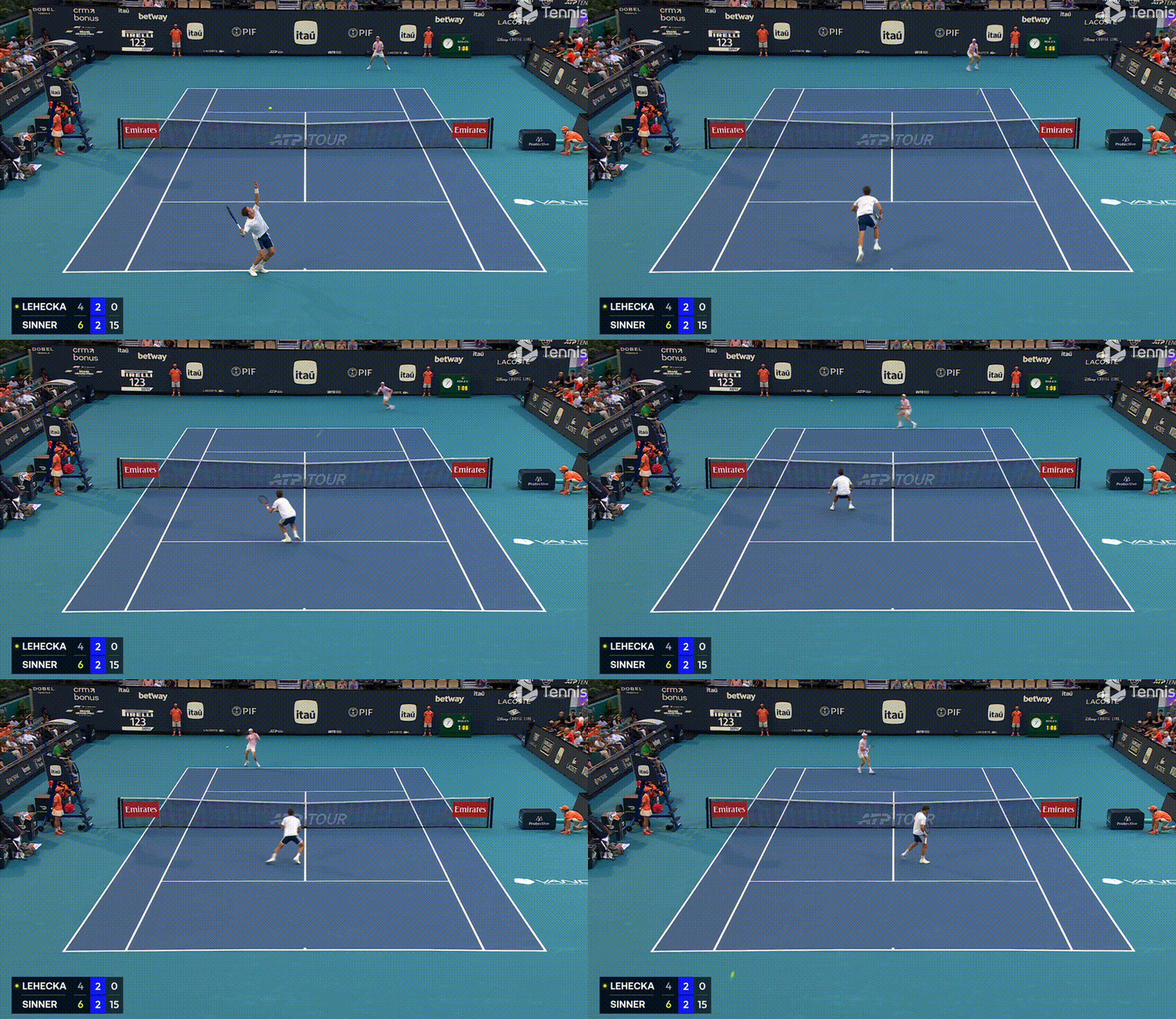
Lehecka managed to stave off break points in his 1-1 and 2-2 service games, and would get his best look of the match returning at 4-3 0-30 in the second set, but from here what stood out at various points in the game was the lack of movement ability from the Czech.
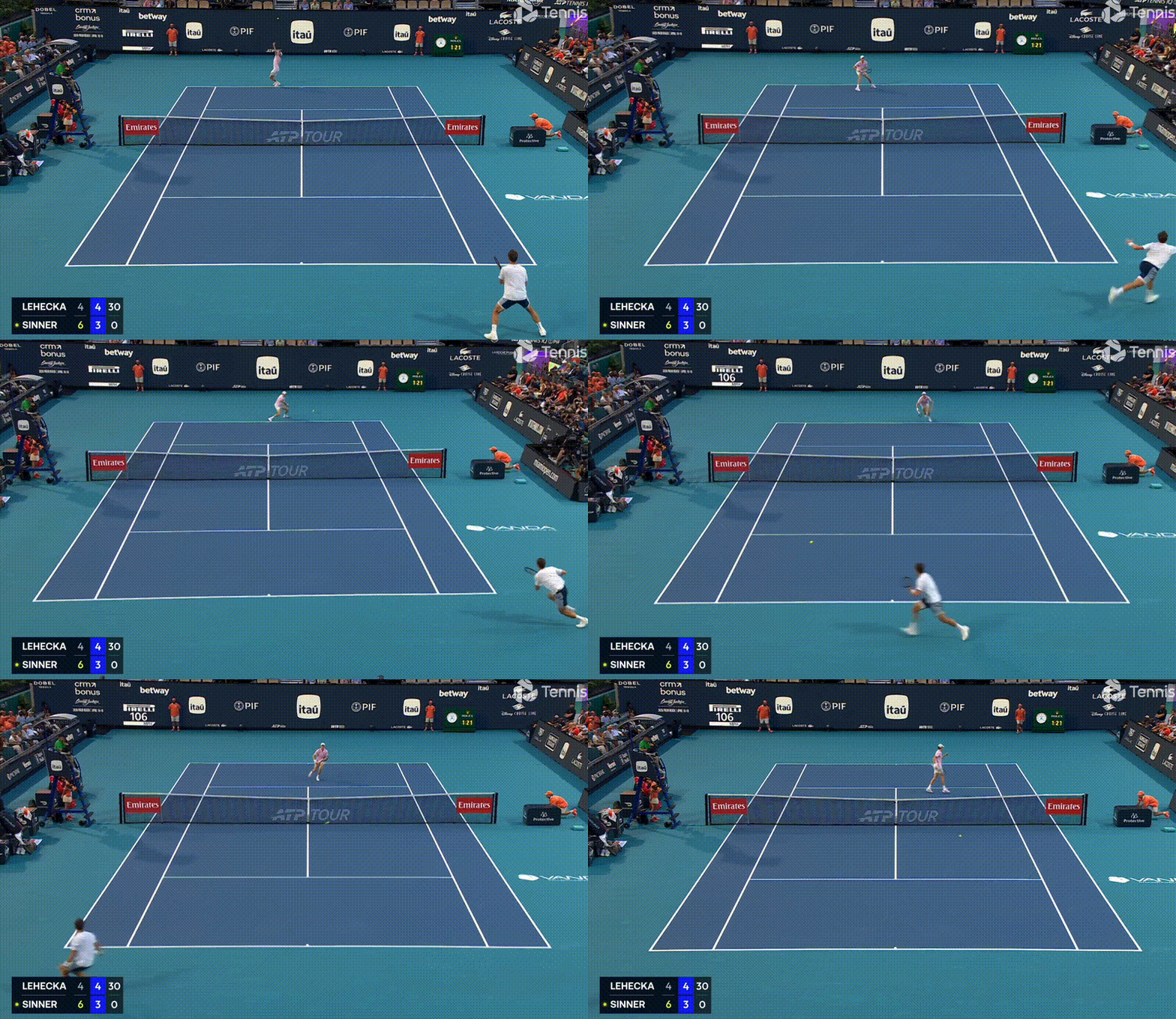
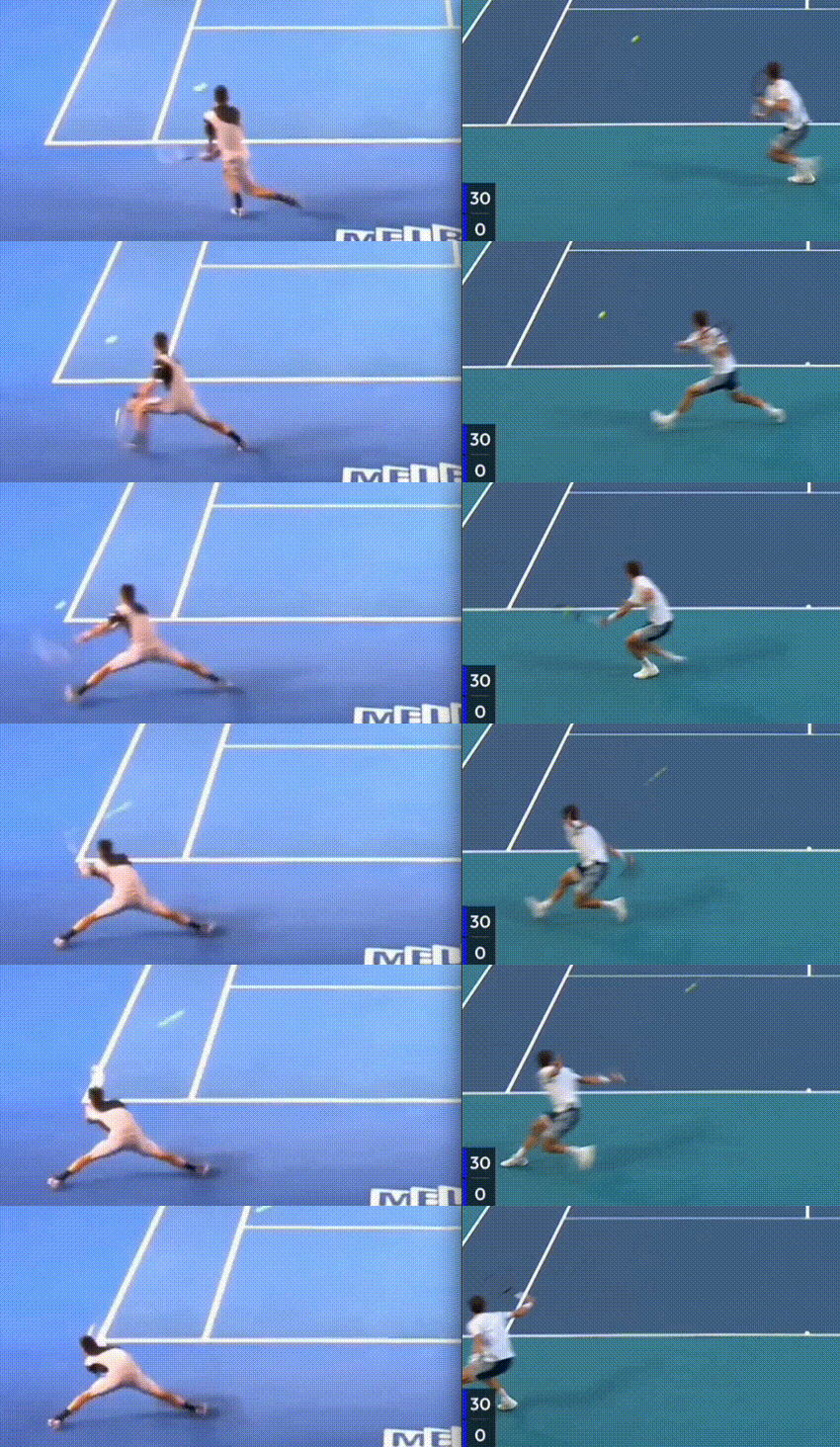
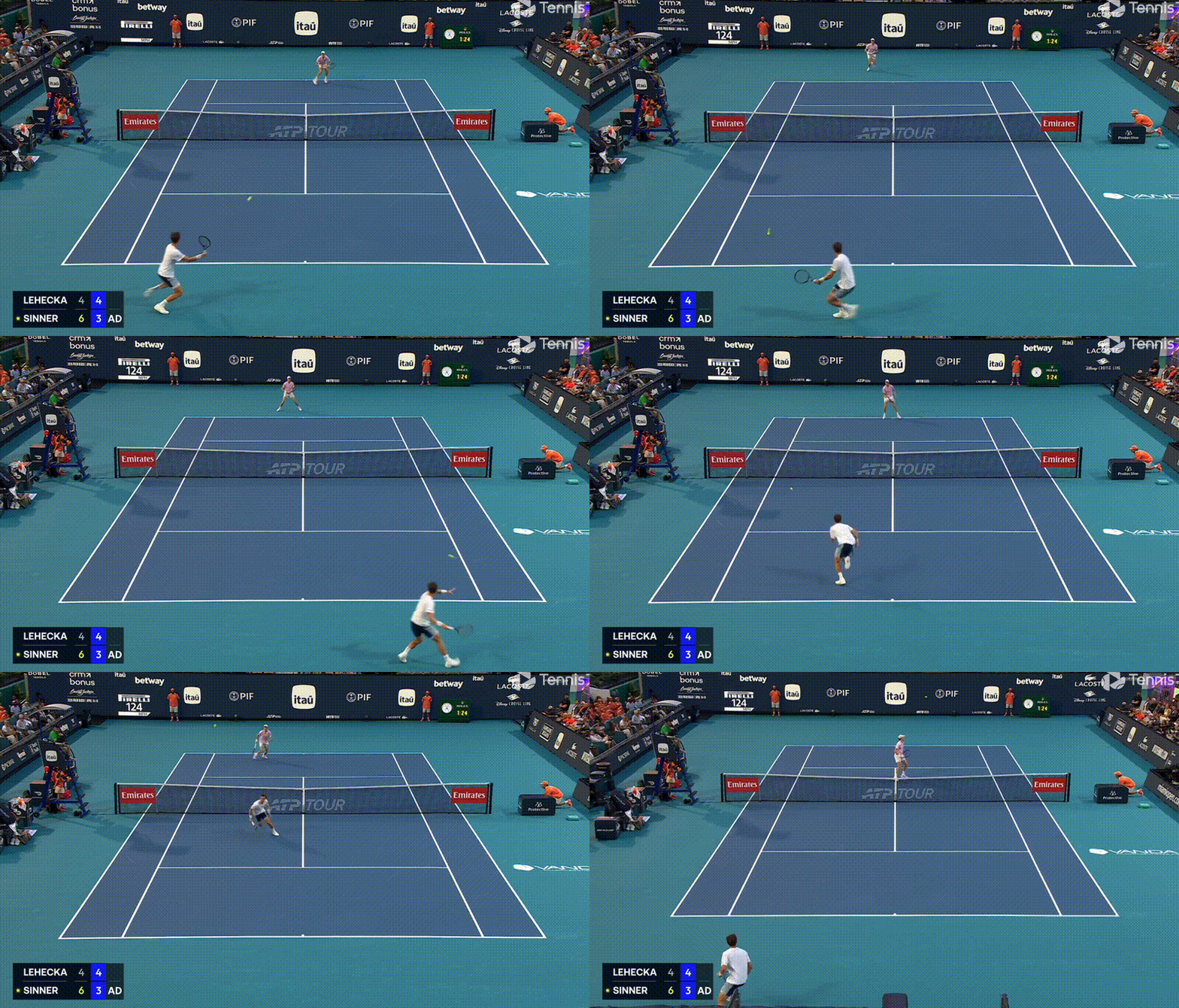
I’ve highlighted how not all players have open-stance sliding abilities (Shelton), and Lehecka is certainly in that category of big-and-stiff-to-a-fault in terms of being able to plant the outside leg wide enough to create an effective slide and deceleration. A genuine top-tier mover would have got there and played something akin to Djoker below: two-hands, with the slide helping to facilitate a quick recovery for the potential two-shot pass:
And look at Jiri over-run this drop shot chase:
Here’s Alcaraz in Rotterdam last year combining slides in both of the two-shot pass:
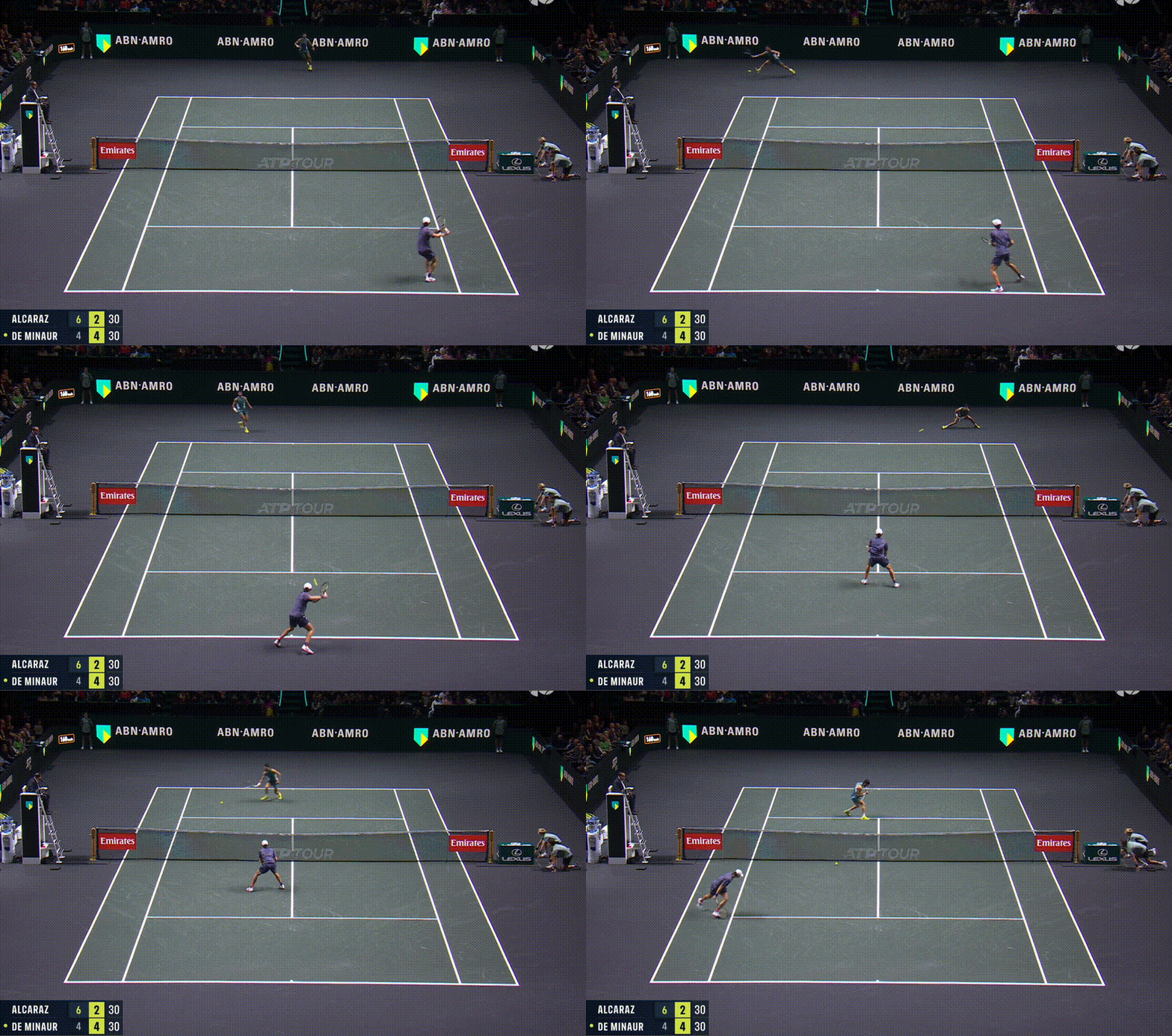
These are the little one-percenters that tip 15-30s into 0-40s. Holds into breaks, breaks into holds. Lost sets into won sets.
The difficulty for the tour is that Sinner and Alcaraz have been stacking these one-percenters at a vicious pace: serve updates, groundstroke tweaks, tactical adjustments, ball flight changes… by the time you catch up you realise you’re already behind.
And perhaps the scariest notion is that maybe Sinner was hitting his groundstrokes with Roland Garros in mind during this Sunshine swing, sacrificing immediate effectiveness in pursuit of reps for clay? What happens if he finds 2024/2025 return levels again combined with this serve?
That would be your move, Carlos. Looking forward to seeing when these two finally meet in 2026.
Clay season beckons.
I’ll see you in Monte Carlo, and in the comments. HC