
We’ve just had the last 2026 Formula 1 grand prix weekend for five weeks, and it told us plenty – from F1’s best driver close to quitting to a big safety issue being exposed.
Red Bull’s lost…
Red Bull was defeated by Alpine in Japan and even though Max Verstappen suspected he was “a tiny bit faster”, this was another race he and Red Bull spent firmly in F1’s midfield group.
Worse still, Red Bull’s drivers don’t think the team has a clear direction out of the current problem.
It reflects poorly on Red Bull’s car that the introduction of a brand new, in-house engine for the first time, built to very challenging new rules, is not its main problem at the start of 2026.
There’s “definitely a lot more work to do on the car,” Verstappen said.
He and Isack Hadjar complained about an unpredictable, ever-changing balance throughout the Suzuka weekend that just imposes a low ceiling on what Red Bull is capable of.
Verstappen’s not sure a new upgrade package introduced on his car worked either.
And after failing to score points due to energy management struggles in the second half of the race, Hadjar was withering in his assessment of the chassis, calling it “terrible” and warning: “We have no lead on how we can make the car faster.”
He even went as far as to call the RB22 “dangerous” after the race to Canal+.
…and it really could lose Verstappen
The contrast in Verstappen’s demeanour after qualifying and after the race was razor sharp at Suzuka.
On Saturday, he seemed deflated. Not even in Dutch did he have the words to really describe how he felt. We couldn’t remember seeing or hearing him sound as resigned as he did talking about his F1 future and his ongoing disappointment with the 2026 rules.
On Sunday, he was relaxed and even trading jokes in his media appearance. The result was not good but Verstappen moved forwards and it helps that F1 2026 is a less frustrating experience on Sundays.
That should not be taken to mean light at the end of the tunnel, though. Verstappen wasn’t looking for silver linings. He reiterated in other interviews that he is seriously considering walking away from F1.
Maybe on Sunday, his more jovial mood was a mix of the weekend being over, and his apparent acceptance that it might not be “worth it” anymore has made him more relaxed.
After all, it feels like he’s closer to quitting F1 than ever before.
F1’s stakeholders will discuss making changes to the 2026 rules during the unexpected gap, and Suzuka exposed a key safety priority that you’d imagine will be at the top of the agenda.
While you can argue that both Ollie Bearman and Franco Colapinto could have avoided their frightening incident, it was ultimately a product of the extreme closing speeds these regulations produce.
It’s exactly the kind of accident that some drivers and teams have been warning against since pre-season testing. Fixing it won’t be easy, however.
“I don’t think a simple solution exists,” was McLaren team boss Andrea Stella’s view on Sunday.
“But we have the expertise, the engineers, there’s the variables to put in place some actions. I think this will be something that will be looked at in the meetings that will happen during the break between FIA, the teams and F1.
“This should jump at the top of the agenda.”
Bearman’s Haas team boss Ayao Komatsu said: “We, as an F1 community together, have got to look at this. We cannot ignore it.
“I cannot say right now what the solution should be…I’m sure we’ll be working closely to make sure we improve the safety as well as the racing.”
Mercedes had two new start problems
The Mercedes drivers usually lose positions off the line in 2026, so it wasn’t surprising to see Kimi Antonelli and George Russell drop to sixth and fourth, respectively at the start.
However, the reasons for their poor getaways were different to each other and to those of earlier in the season; for example they had nothing to do with the lack of battery energy as in Australia.
Antonelli’s bad start was down to being a little too aggressive on the clutch at the start, then wheelspin when the power kicked in on tyres that weren’t at the optimum temperature.
“I’m a bit disappointed with how the start went,” said Antonelli. “It’s an area where I need to work a lot, because it’s definitely not good enough and I’m just making my life a lot harder.”
As for Russell, his initial launch wasn’t bad, but there was a problem with the brake used to deal with the incline on the starting grid trailing unexpectedly. That’s understood not to have been down to the driver.
Improved McLaren was flattered by the track
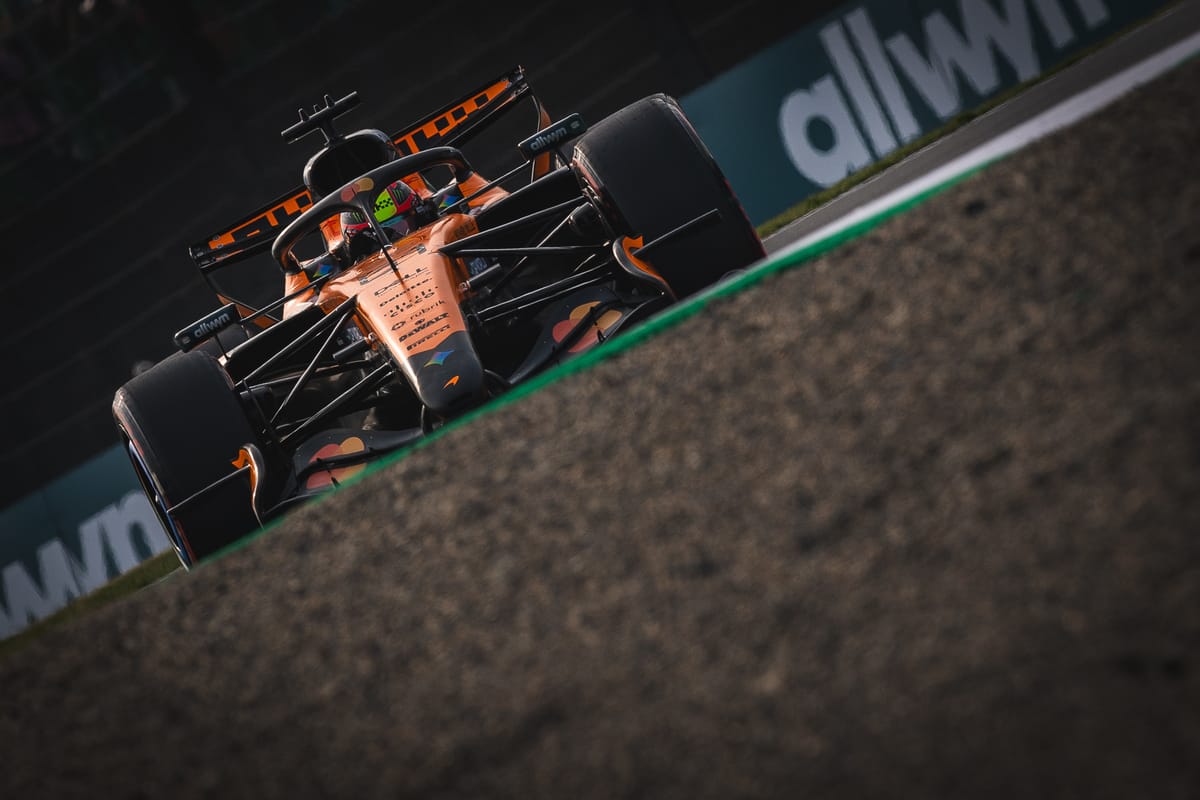
McLaren has made gains in terms of what team boss Stella calls “power unit exploitation”, allowing it to be closer to Mercedes and take its first podium of the year.
In percentage terms, the single-lap deficit was well under half its previous best – 0.399% off in Japan compared to 0.888% down in China.
However, it would be a mistake to assume this will automatically be replicated because there were certain aspects of Suzuka that masked its weaknesses.
This includes the strength of the Mercedes power unit relative to the Ferrari, which was exposed a little more at Suzuka.
McLaren still thinks it has a weaker chassis than Ferrari and Suzuka hid McLaren’s front graining weakness that had hurt it in Australia and China.
“When we look at the overlays in the race, you can see that Ferrari still retains some advantage in the corners, definitely their car is able to generate more grip than our car,” said Stella. “I think we benefit from a power unit that overall is more competitive.
“One more factor is that here in Suzuka, there was no graining, and in the previous races like Australia and the sprint in China we have seen that when there is front graining, we seem to be slightly more susceptible to this phenomenon than Ferrari and Mercedes. So there’s a combination of factors that allowed us to stay in the race today.”
McLaren will be hoping its sizeable Miami upgrade will allow it compete with Mercedes and Ferrari at every circuit type.
Aston Martin ticks one box on very long list
Honda’s home race ended with one of Aston Martin’s cars making it to the finish and being classified for the first time.
That’s the small crumb of comfort for the embattled new partnership. Honda was spared the ultimate embarrassment at its own track as while Lance Stroll retired with a water leak the engine held up for the first time this season.
Reliability countermeasures have worked. But as chief trackside officer Mike Krack said, the mood is not celebratory. Fernando Alonso was a lapped 18th, half a minute behind the lead Cadillac – which was again a genuinely faster car here.
Honda bears the bulk of the responsibility for the troubles so far but the AMR26 got exposed too. It is a heavy car that’s weak in high speed corners.
No wonder Krack called the result just one box ticked on a very, very long list.
Audi can’t fix a big problem anytime soon
If Ferrari is regarded as having the gold standard race starts in Formula 1, then it is Audi that takes the wooden spoon.
In fact after another poor double getaway in Japan, Gabriel Bortoleto admitted their performance in this area is simply “terrible”.
Getting the turbos spooled up with the 2026 cars has been a challenge for everyone, but it appears Audi’s headaches are bigger than most because of some key fundamental engine concept choices.
It is understood to have a very big turbo, which makes it both more challenging to get into the right window for the launch and requires more MGU-K to help fill in any gaps once up to 50km/h.
While the team admits the issue is now a top priority to fix, the problem it faces in solving it is one of design fundamentals than requiring more consistency from drivers. So it’s a long-term project.
As Bortoleto said on Sunday night: “We can improve a bit, but not in the short term to get to the Ferraris. I think it’s very difficult also with the Mercedes. I think we are still going to struggle a bit.”
Russell feels hard done by
Having patiently waited until his eighth F1 season to lead the F1 drivers’ championship, Russell understandably wasn’t all too happy to lose at Suzuka after just two weekends.
“That is pure luck. If that was one lap later, we’d have won the race,” Russell said of the safety car timing that dropped him from the lead fight to third.
“If there was no crash, maybe we would have regretted not pitting at that point. Racing sometimes goes for you, sometimes goes against you.
“It feels like, at the moment, the last two weekends, every issue we’re having, it’s on my side and I’m the one sort of…going through that pain.”
Russell was compromised in China as he lost his first Q3 run to a technical problem and was baulked by the Ferraris in the grand prix while team-mate Antonelli bolted clear.
“We’ve not had a single issue of practice this whole season. I’ve had the problems in qualifying,” Russell said.
“Lando [Norris] hasn’t had any problems in qualifying; he’s had all the problems in practice.
“So it’s just luck and the draw with these new cars. But it’s race 3 of 22, I’m not concerned at all, it’s all here. I know I’ve got what it takes to bounce back.”
Of bigger concern to Russell than any bad luck will be Antonelli having the performance edge on him throughout the Suzuka weekend.
That remains in his control and his biggest focus for the April gap if he’s to make the most of finally having a title-challenging F1 car.
Why yo-yo racing disappeared (mostly)
After two races where the new trend of yo-yo racing had taken centre stage, the Japanese Grand Prix had much less position swapping.
Suzuka has never been an easy track to pass on – as the dearth of moves 12 months ago proved – and once again it proved to be quite difficult for drivers to find a way past their rivals.
But in a year where drivers at one point had been almost apologetic for how easy the 2026 cars had been to get past each other in Australia, for example, a better understanding of the new dynamics of racing came into play at Suzuka that served to calm things down.
That first toe in the water exercises in Australia and China exposed to drivers that there was little point burning energy for a pass in one place if only a couple of corners later you were exposed to get overtaken again because you were out of battery.
And this experience became something that was taken into Suzuka. With only two places where passing made sense – into the chicane and into Turn 1 – the options were not great plus they were in consecutive corners.
So it became very obvious very quickly that if you did use up battery pulling off a move into the chicane, then you were simply left a sitting duck into Turn 1 – so it wasn’t really worth it.
The trick in the end became more tactical; try to get a move just pulled off into the chicane without using up all the battery, and hope that that then left you enough energy to hold on into Turn 1.
F1’s yo-yo style of racing has certainly calmed down, but its prevalence will depend a lot on the circuit.