
[Editor’s Note: This article originally appeared in the April 2001 issue of Grassroots Motorsports.]
When Stan and Paula Whitney were looking to build a new autocross ride to replace their aging yellow D Prepared Honda CRX, they couldn’t help but notice how well Mazda’s Miata was performing in SCCA Solo II‘s Stock and Street Prepared categories. The …
From Wreck to Racer
After the damaged bodywork was removed and set aside, Stan stripped the shell to its bare essentials in his cramped garage in Grapevine, Texas. He then built a custom roll cage that was designed to connect the entire chassis together into one solid unit, from the rear suspension mounts to the front upper A-arm attachments.
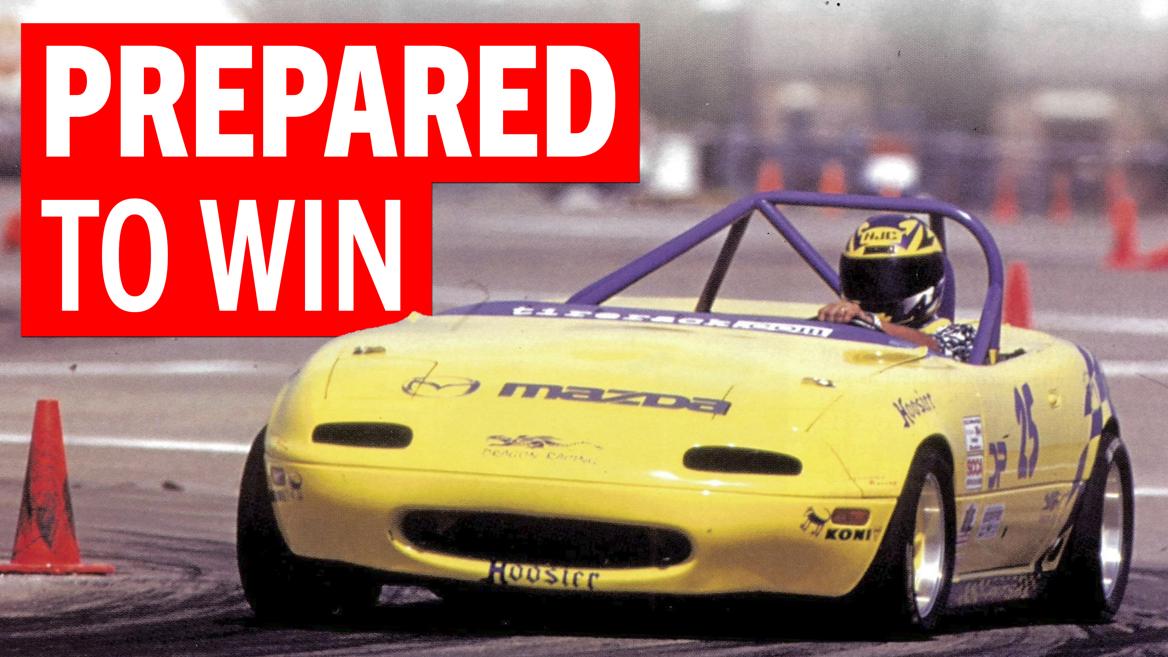
The stripped shell was then brought to their local Maaco paint shop, where the car was sprayed a brilliant shade of yellow. This was coupled with the Whitneys’ signature purple accents on the roll cage, engine and custom graphics.
“The body is nearly all stock,” Stan reports. “Other than the usual trim removal, we cut out the wheel wells slightly for tire clearance at full bump, and gutted the doors.” For the 2001 season, they will be running Mazda Competition’s E Production road racing body kit.
The Miata’s engine was updated from the original 1.6-liter to a 1994- ’97-spec 1.8-liter built by Stan. The new engine features a cold-air intake that feeds a lightly-ported, but stock-sized ’99 Miata throttle body and intake manifold. A ’99 1.8-liter cylinder head, also ported by Stan, tops a short block built with J&E 11.6:1 forged pistons as well as a balanced stock crank and set of rods.
“For cams, we ran with the stock ’99 cams, springs, and pulleys-surprising to most folks,” Stan explains. “We will be testing some other designs from Toda and Bob Boig this year.”
An Unorthodox Racing crank pulley helps reduce parasitic drag, while a custom trigger wheel sends impulses to the crank-fire Electromotive TEC-11 engine management system. Magnecor KV85 plug wires bring the spark to the combustion chamber, while a Mazda RX-7 fuel pump and Mitsubishi Eclipse Turbo injectors bring an adequate fuel supply.
After the big bang, spent gases exit the rev-happy four with the help of a Bob
Baig-designed 4-into-l header. A custom side exhaust was constructed by Stan to deal with the realities of having little or no ground clearance; it exits the Miata right in front of driver’s-side rear wheel, allowing extra ground clearance over other setups.
The Mazda’s power–dyno tested at 155 horsepower and 128 lb.-ft. of torque at the rear wheels–is fed through a Toda Racing super-light steel flywheel and a Mazdaspeed clutch to a Mazda Competition limited-slip differential. The stock 1.6-liter ring and pinion (4.30:1 ratio) is used for its extra punch off the starting line.
Unusual for a Prepared class car, this Miata features its original power steering. While this seems odd considering how much care was taken to reduce other sources of power loss, it becomes perfectly clear as you drive the car on course. You can easily twist the very wide and sticky Hoosier 20×9 .5x 13 R45 tires around the cones. The steering wheel becomes more of a precision instrument rather than a heavy, blunt object. The driver can remain much more focused on the proper line and driving technique, rather than fighting the steering wheel on course.
“The power steering was a must after Paula and I wrestled front-wheel-drive Prepared and Street Prepared Hondas for two years,” Stan explains. “Everything was made adjustable so that it would comfortably fit both of us, up to personalized quick-release steering wheels!”
The Miata was blessed by its Mazda designers with legendary kart-like handling, so care was taken to only enhance its abilities, rather than simply throwing wads of cash at it to make it slower. Koni model 8216 shocks damp the Eibach springs, with rates between 600 and 700 lbs.fin. up front and 275 to 350 lbs.fin. at the rear. “A little soft for a Prepared car, but necessary for the bumpy surfaces we mostly run,” Stan explains.
Racing Beat and stock anti-roll bars are used in various combinations depending on the racing surface condition, while the suspension also features modified stock control arms and BrainStorm Delrin bushings. Suspension geometry was not changed and works extremely well, the Whitneys report. Great pains were made to follow sound engineering principles: keep it simple, light and low to the ground.
A Tilton cockpit-adjustable brake bias valve helps the otherwise stock 1990 Miata brakes do their job. “Brakes just slow you down,” Stan says.
Building a car like this takes a lot of work, and the Whitneys acknowledge the help of several key companies: Mazda Competition Parts (everything), Hoosier and Mid-Atlantic Motorsports (tires), Toda Racing (flywheel, cam gears), Unorthodox Racing (underdrive pulleys), Rotary Performance (dyno tuning), www.2ThePits.com (import performance parts) and BrainStorm Products (Miata-specific performance parts). They also thank their good friend/crew chief Chris Starita–who also drives the SCCA’s Solo II rig to all the national events.
“Everyone has provided great products and advice to help us along our way,” Stan says. The Whitneys have themselves to thank as well, as the entire project was completed by them in their garage-with the exception of the paint and the engine machine work–in only five months. Quite a feat considering the jewel-like result of their efforts.