
On Executive Order 260401, the return of the Tour de Trump, and what a sixty-metre hill in New Jersey tells us about the relationship between power, memory, and the indifference of mountains.
By Claude Aurillac-Issoire
Clermont-Ferrand, France (01 April 2026)
Translated from the original French.
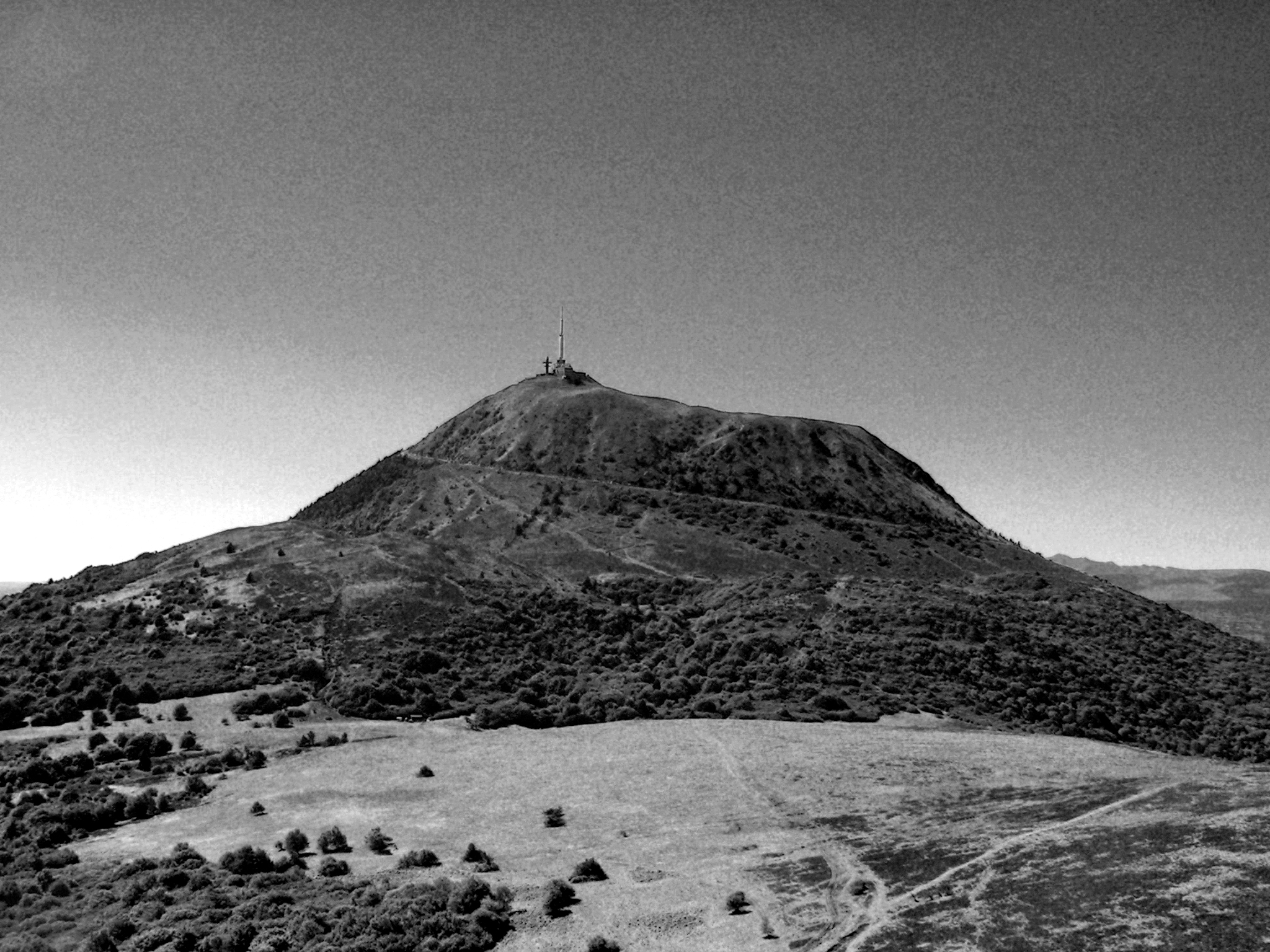
My mother grew up in the shadow of the Puy de Dôme. My father raced as an amateur in the Allier valley in the nineteen-seventies — nothing serious, club races, a few regional events, once a small criterium in Vichy where he finished fifth and told the story for the rest of his life. I learned to read in a house where the yellow jersey was not a metaphor. When I tell you that the Puy de Dôme rises 1,415 metres and that the final kilometre averages 12.8 percent and that Jacques Anquetil and Raymond Poulidor duelled on its upper slopes in 1964 while an entire nation held its breath, I am not reciting statistics. I am describing the landscape of my childhood.
The Bedminster hill is sixty metres tall.
I read the Executive Order this afternoon, the document having been forwarded to me by four colleagues within twenty minutes of its release, each with a different subject line. The most accurate was simply: “Claude.” The order is eight pages long and divided into thirteen sections. Section Seven reads, in its entirety: “The Bedminster climb is very challenging. Do not let anyone tell you otherwise.”
I read it twice. Then I poured more coffee.
I had expected, I think, a few paragraphs of the American President’s characteristic grammar dressed in governmental formatting — a Truth Social post amplified into official language. What I found was a document of genuine structural ambition, written by someone tasked with making a series of unpublishable ideas sound publishable, who had done their considerable best. Section Four requires all riders to use American-made bicycle frames — or those from countries the Secretary of Commerce has designated as Fair Trade Cycling Partners, a list that does not currently include Italy, France, Belgium, Spain, or Taiwan — and bans Campagnolo components outright. Section Five prohibits drafting for more than thirty consecutive seconds on the grounds that sheltering behind another rider is inconsistent with American values of self-reliance. Section Eight threatens Switzerland — its watches, its chocolate, its banking — if the UCI does not grant the Tour de Trump Grand Tour status within thirty days.
Section Nine, subsection (c), notes that Campagnolo “has been warned. Multiple times. Internally.”
I called Stefan Schoofveldt in Ghent. He had read it at a café near the Vrijdagmarkt, between a double espresso and a tartine he had not finished. Stefan has covered professional cycling for nineteen years, including every major one-day race in Belgium, three editions of the Tour de France, and a criterium in Aalst that was interrupted by a cow. He was, he told me, not angry.
“I am too old for outrage,” he said. “And too Belgian for surprise.”
He paused. I have known Stefan long enough to know that a pause from Stefan is not empty. “The second sentence of Section Seven,” he said, “is not the language of governance. It is the language of a man who knows, somewhere he cannot reach by executive order, that someone will tell you otherwise. That everyone will tell you otherwise.”
He then paid for his coffee and went home.
✦
I then called Chatham George Paulson-Thomas in London, who had been awake since five in the morning and who was, when I reached him, in the careful and slightly dangerous mood he enters when something has annoyed him sufficiently that he has decided to be precise about it.
“Let me be clear about the mechanism,” he said, “because I find that precision is the only reliable defence against the interpretive drift this situation invites. The mechanism is real. The tariff threat is real. The UCI cannot receive a unilateral instruction from a single government and comply without effectively dissolving its credibility as an independent international body.”
He granted — Chatham always grants — that the underlying frustrations were not without basis. That American cycling has been underserved by international governing structures. That the UCI’s record on doping enforcement and rider welfare is not a record anyone would defend in full. That these are real issues.
“They are not addressed by this order,” he said. “The order is not about the governance of cycling. It is about the reinstatement of a brand.”
Another pause. “What I find most dispiriting is the response it requires. Someone has to take this seriously enough to respond to it. Someone has to appear before cameras and be asked, with a straight face, whether Bedminster compares favourably to Mont Ventoux. And in the time that takes, other things do not get done.”
“The mountain does not care what you believe about it. It will exact from
you precisely what the mathematics say it will exact, whatever you thought
before you began climbing.”
I find I cannot quite share Chatham’s dispirited mood. What I feel instead — and I have been trying to identify it precisely since the order arrived this afternoon — is something closer to a helpless, liberating hilarity. Not at the expense of America, which has produced magnificent cyclists. Not even at the expense of the President, who has the distinction of being the only head of state in history to issue a formal federal document certifying the difficulty of his own golf course approach road. What I find funny — what I find, on reflection, genuinely, structurally, almost classically funny — is the nature of expertise.
The Tour de Trump ran for two years. It went through New Jersey, Delaware, Virginia, New York, Pennsylvania. It was a real event. It produced real winners. Dag Otto Lauritzen, who took the inaugural edition, was a professional of genuine quality. The race mattered to American cycling in its time, in the modest and sincere way that all races matter. And the man whose name was on it appeared at the start lines, smiled for the cameras, said it was tremendous. He ran the race in the limited sense that a man who once owned a restaurant has run a kitchen. The pot never touched his hand. The spoon never left the drawer. But the story was his.
And now, thirty-five years later, from that story — from two seasons of mid-Atlantic stage racing, from a handful of start-line photographs, from the fact of having once been in the same zip code as a professional peloton — he has constructed a total, comprehensive, unassailable expertise. He knows cycling better than the riders. Better than the directeurs sportifs, the race organizers, the governing bodies, or the sport’s entire one-hundred-and-fifty-year institutional memory. He knows it the way he knows many things: completely, effortlessly, and without the burden of having learned it.
I find this funny because it is, in a very precise way, the opposite of what cycling teaches you.
Cycling teaches you that the mountain does not care what you believe about it. You can be convinced, absolutely convinced, that you are capable of a certain wattage on a certain gradient in a certain wind, and the mountain will simply present its kilometres and its percentage signs and wait. The mountain is not impressed by your certainty. It is a fixed quantity of altitude, spread across a fixed quantity of distance, and it will exact from you precisely what the mathematics say it will exact, no more and no less, whatever you thought before you began climbing.
This is why cyclists tend to be, in my experience, somewhat humble people. Not always — there are exceptions, and some of them won the Tour de France multiple times and were stripped of the results. But in general, the sport produces humility because the sport’s primary feature is a series of non-negotiable physical realities that do not respond to confidence.
✦
I have met Christian Prudhomme three times. Once at a start village in the Dordogne, once at a race organisation dinner in Paris where the wine was excellent and the speeches were not, and once in a corridor at the Palais des Congrès in 2019 when he was moving quickly and did not have time to stop. On each occasion he was courteous, precise, and utterly unreadable. He is a man who has spent thirty years in the diplomatic layer between professional cycling and the rest of the world, and he has become very good at occupying that layer without ever quite revealing what lies beneath it. I understand he held a press conference this afternoon. I understand it went well, in the sense that he gave them nothing to use against him. This is, with Christian Prudhomme, always the goal.
I know this face. I am from Clermont-Ferrand. We learn it young.
I read Campagnolo’s statement from Vicenza. It was a model of corporate serenity — ninety-three years of precision manufacturing distilled into three sentences of impeccable restraint. They have survived wars, recessions, the rise of Shimano, and the cycling industry’s periodic infatuation with electronic groupsets. They will survive a tariff. What I found more telling was the product photograph they chose to accompany the statement: a Super Record groupset. Not a press release photo. Not a logo. A groupset. At four thousand eight hundred euros retail. The Italians have their own way of making a point.
Stefan, whom I texted this afternoon, replied in three words: “The groupset speaks.”
My father raced his criterium in Vichy in 1973. He finished fifth. He told the story for forty years — the race, the road, the riders who beat him, the café afterwards where someone bought him a beer. I am not unsympathetic to the impulse. A man wants his race to matter. A man wants the thing he touched, however briefly, however glancingly, to have been great. This is human. This is, in its way, rather moving.
But there are limits, and the limits are geological. The Bedminster hill is sixty metres tall. The Executive Order says it is very challenging. The Executive Order is incorrect in the way that a man can be incorrect about a mountain he has only ever driven, and the mountain will wait, patient and absolute, for the moment of reckoning it has been waiting for since before the race existed, before he signed the order, before someone took the photograph at the start line thirty-five years ago in New Jersey.
There is a climb I know in the hills above Clermont-Ferrand. It is nothing compared to the Puy de Dôme, nothing compared to the Galibier or the Stelvio or any of the climbs that have decided races and ended careers. It is a local road, not quite four kilometres, maybe seven percent average. I have ridden it perhaps two hundred times. On every occasion it has been exactly as long and exactly as steep as it was the time before. My belief about it, on any given morning, has had no effect whatsoever on its gradient. This is what cycling teaches, and it is a lesson the mountain delivers without sentiment, without variation, and without any particular interest in who is on the bicycle.
I spoke to Chatham again an hour ago. He had written fourteen hundred words of analysis and deleted them. “Someone has to take this seriously,” he said. “I know,” I said. “I’m sorry.” Stefan, for his part, has not replied to my last message. He is probably home by now, or out on the bike. He has a very good bike. Campagnolo, as it happens.
I am going outside. The light over the Auvergne is still good. It is a good evening to ride.
(Visited 86 times, 85 visits today)