
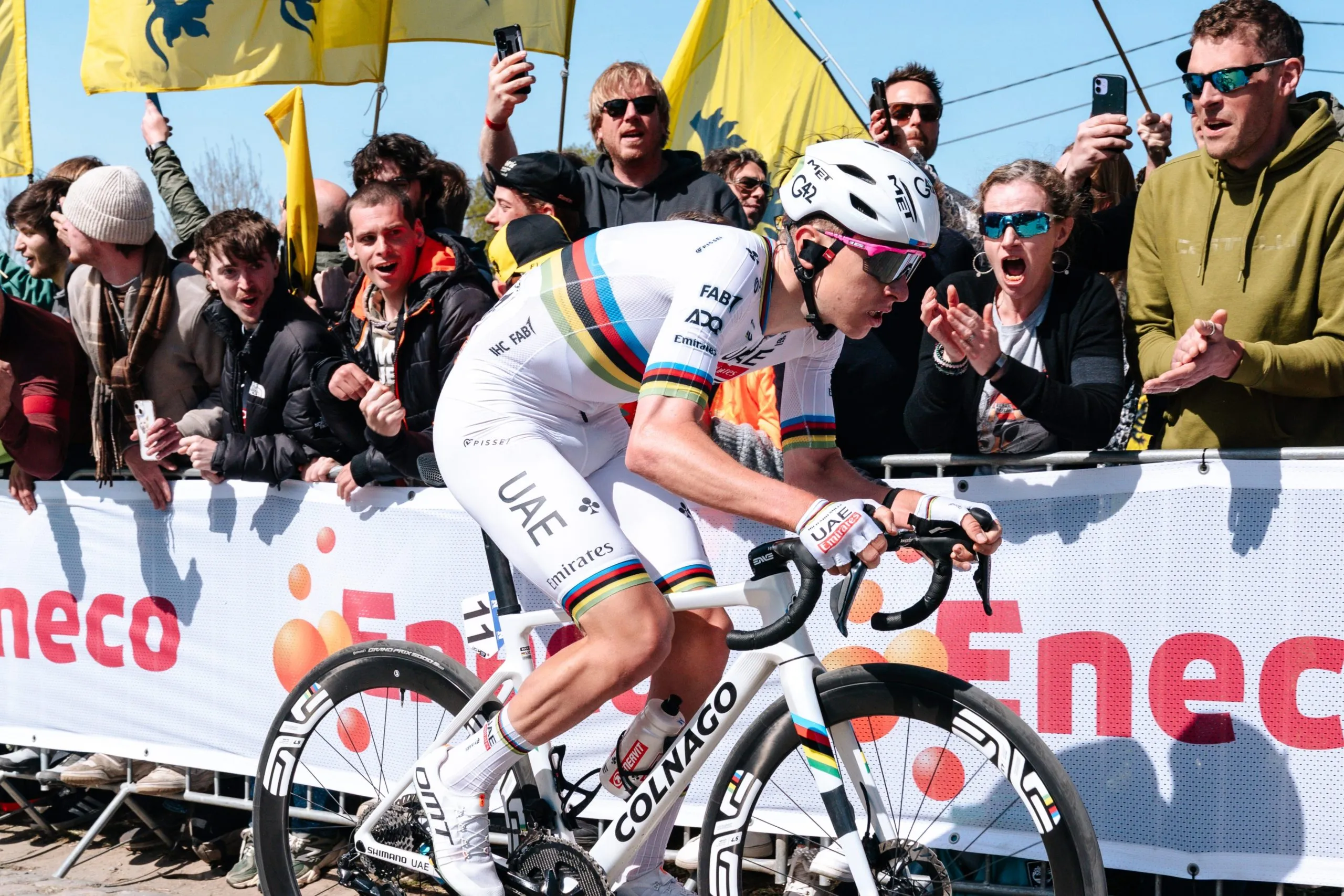
The 2026 men’s and women’s Tour of Flanders – or Ronde van Vlaanderen – is the second Monument of 2026, with the racing set to take place on Sunday 5th April.
Defined by its steep cobbled climbs, the Tour of Flanders will, as usual, be largely played out in a small part of Belgium known as the Vlaamse Ardennen, or Flemish Ardennes. Over the years, it has developed a reputation as a favourite for both spectators and riders alike, such is the atmosphere that accompanies the race as it winds its way through crowded country lanes and rowdy beer tents.
It was a rainbow Ronde last year, as world champions Tadej Pogačar and Lotte Kopecky claimed a pair of Monument victories in Oudenaarde. The pair will return to defend their crowns this year, but with added competition from the likes of Mathieu van der Poel, Demi Vollering, Wout van Aert and Pauline Ferrand-Prévot.
In 2026, the men’s race will start in Antwerp, making a change from last year’s visit to Bruges. The race covers 268.9km and will finish in Oudenaarde once more, with the cornerstone climbs of the Koppenberg, Paterberg and Oude Kwaremont all on the agenda. The women’s peloton scales the cobbled bergs of Flanders on the same day, although on a shorter course of 168km, starting and finishing in Oudenaarde. Like the men’s race, it’s still the one-two punch of the Oude Kwaremont and Paterberg that will shape the race’s finale.
Tour of Flanders 2025 key information
- Date: Sunday 5th April 2026
- Start: Men’s – Antwerp, Belgium; Women’s – Oudenaarde, Belgium
- Finish: Oudenaarde, Belgium
- TV coverage: HBO Max, TNT Sports, Sporza, FloBikes, SBS
- Distance: Men’s – 278km; Women’s – 164km
- 2025 winners: Tadej Pogačar (UAE Team Emirates XRG), Lotte Kopecky (SD Worx-Protime)
Men’s Tour of Flanders 2026 route
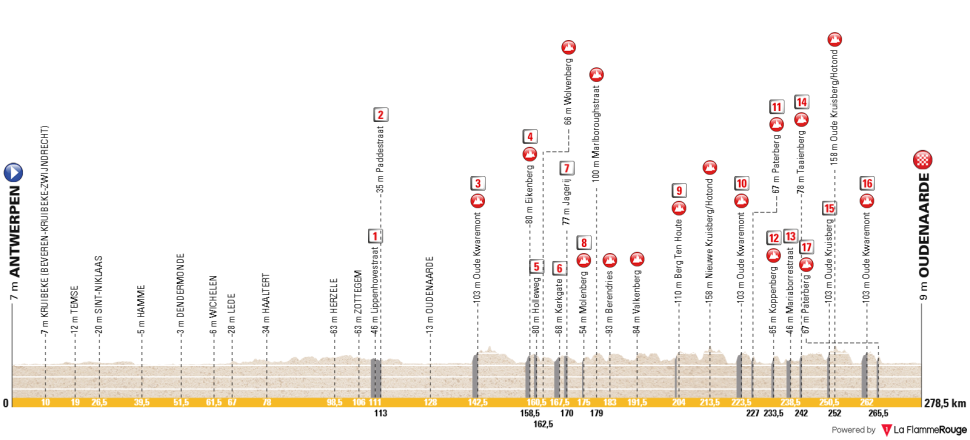
Bruges and Antwerp now alternate hosting duties for the Tour of Flanders. This year, it’s the turn of Antwerp, Flanders’ biggest city, to welcome the men’s peloton. After a neutralised roll-out, the official start comes just before Beernhem. The first 100km are tame, with the first cobbles coming after 111km at the Lippenhovenstraat.
The first climb of the race is the Oude Kwaremont (2.2km, max 11.6%), which will be tackled on three separate occasions throughout the race. From there, the parcours enters a circuit that’ll tick off a host of big name cobbled sectors and climbs in the Flemish Ardennes.
There are 16 cobbled hellingen (climbs) in total, including the Wolvenberg, Valkenberg, Koppenberg, Taaienberg and Kruisberg to soften the legs and split the race to pieces before we head into the finale.
Shorter than Oude Kwaremont but viciously steep with gradients of up to 20%, the Paterberg is tackled first at 219km and is the race’s final climb at 13km to go, with a flat run-in to the iconic finishing straight afterwards.
Women’s Tour of Flanders 2026 route
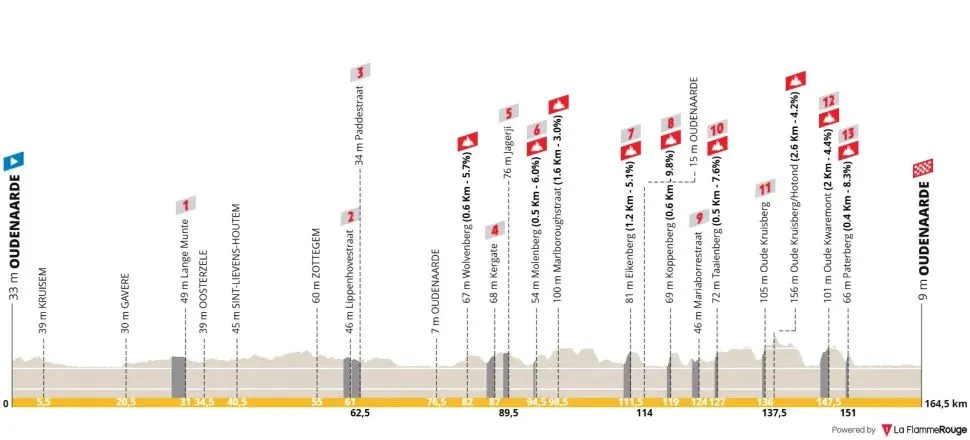
The women’s route is similar to the men’s, albeit over 100km shorter and both starting and finishing in Oudenaarde, with the same Kwaremont/Paterberg one-two punch headlining the action.
The women’s peloton will tackle 13 bergs including Wolvenberg, Valkenberg. Koppenberg, Taaienberg and Kruisberg before the Kwarement/Paterberg finale and flat run-in from there.
Tour of Flanders 2026 favourites
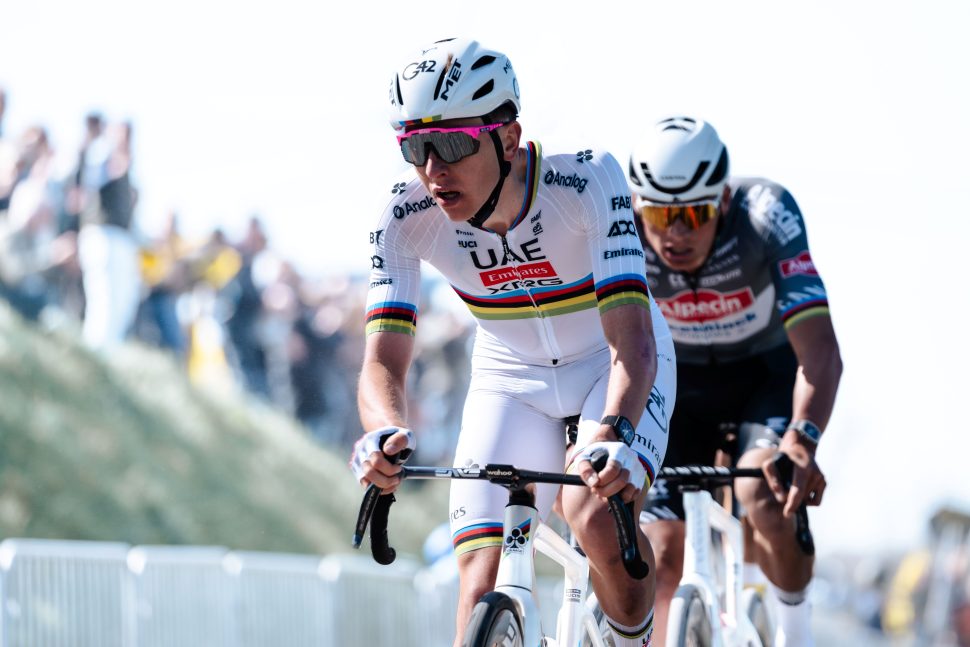
The men’s race has a stacked startlist, including Mathieu van der Poel, Tadej Pogačar, Wout van Aert and Mads Pedersen. If Van der Poel wins, he will become the first rider in Tour of Flanders history to win on four occasions. However, if Tadej Pogačar takes home the trophy, he’ll equal the record currently held by his Dutch rival on three titles. Keep an eye out for Filippo Ganna, the recent winner at Dwaars door Vlaanderen, he’s been in good form this spring. Remco Evenepoel is also a last minute addition to the startlist for his Ronde debut, with many fans optimistic about his chances in containing Pogačar’s attacks.
In the women’s race, three-time winner Lotte Kopecky will start as the co-favourite alongside Demi Vollering, who has run a reduced programme during the cobbled Classics. That said, she bagged a big win at Omloop Nieuwsblad and has a strong team featuring the in-form Elise Chabbey. Beyond the pair, Pauline Ferrand-Prévot returns to Flanders after her second place finish last year, with Elisa Longo Borghini’s UAE Team ADQ in good shape too.
Cyclist’s ratings: Men’s race
- ★★★★★: Mathieu van der Poel (Alpecin-Premier Tech), Tadej Pogačar (UAE Team Emirates-XRG)
- ★★★★: Wout van Aert (Visma-Lease a Bike), Mads Pedersen (Lidl-Trek), Remco Evenepoel (Red Bull-Bora-Hansgrohe)
- ★★★: Florian Vermeersch (UAE Team Emirates XRG), Filippo Ganna (Ineos Grenadiers)
- ★★: Matteo Trentin (Tudor Pro Cycling), Christophe Laporte (Visma-Lease a Bike)
- ★: Arnaud De Lie (Lotto-Intermarché), Jonas Abrahamsen (Uno-X Mobility), Anthony Turgis (TotalEnergies), Romain Grégoire (Groupama-FDJ United), Gianni Vermeersch (Red Bull-Bora-Hansgrohe), Alec Segaert (Bahrain Victorious), Kasper Asgreen (EF Education-EasyPost), Mick van Dijke (Red Bull-Bora-Hansgrohe)
Cyclist’s ratings: Women’s race
- ★★★★★: Lotte Kopecky (SD Worx-Protime), Demi Vollering (FDJ United-Suez)
- ★★★★: Pauline Ferrand-Prévot (Visma-Lease a Bike), Elisa Longo Borghini (UAE Team ADQ)
- ★★★: Lorena Wiebes (SD Worx-Protime), Noemi Rüegg (EF Education-Oatly), Puck Pieterse (Fenix-Deceuninck), Eleonora Gasparrini (UAE Team ADQ)
- ★★: Karlijn Swinkels (UAE Team ADQ), Kim Le Court-Pienaar (AG Insurance-Soudal), Shari Bossuyt (AG Insurance-Soudal), Elise Chabbey (FDJ-Suez)
- ★: Marlen Reusser (Movistar), Elisa Balsamo (Lidl-Trek), Marianne Vos (Visma-Lease a Bike), Letizia Borghesi (AG insurance-Soudal), Millie Couzens (Fenix-Premier Tech), Shirin van Anrooij (Lidl-Trek)
How to watch the Tour of Flanders 2026
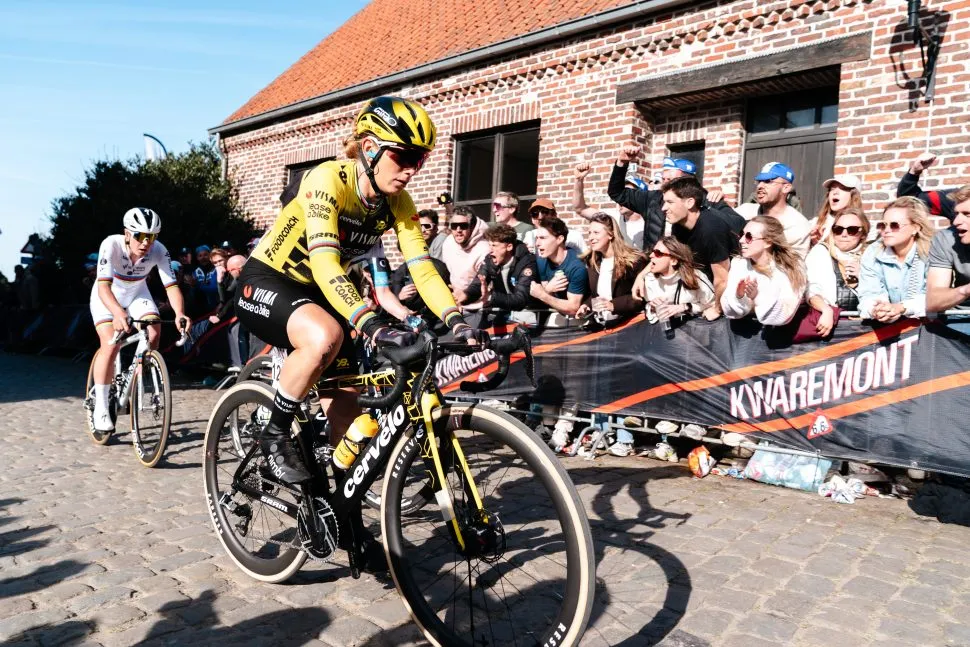
‘De Ronde’ takes place on Sunday 5th April and you can catch the Tour of Flanders races in the UK on TNT Sports and HBO Max. On TV, the men’s race will be broadcast on TNT Sports 1 from 8:30am, with the women’s event on air via TNT Sports 4 from 2pm.
In the USA and Canada, coverage is on Flobikes. In Australia, the Tour of Flanders is available live and on demand on SBS. Throughout Europe, the racing will be broadcast on Eurosport and HBO Max.
If the race isn’t being broadcast in your country or you are travelling abroad, a VPN will allow you to hide your device’s location to access content that is normally geo-blocked.
Tour of Flanders 2026: UK TV times
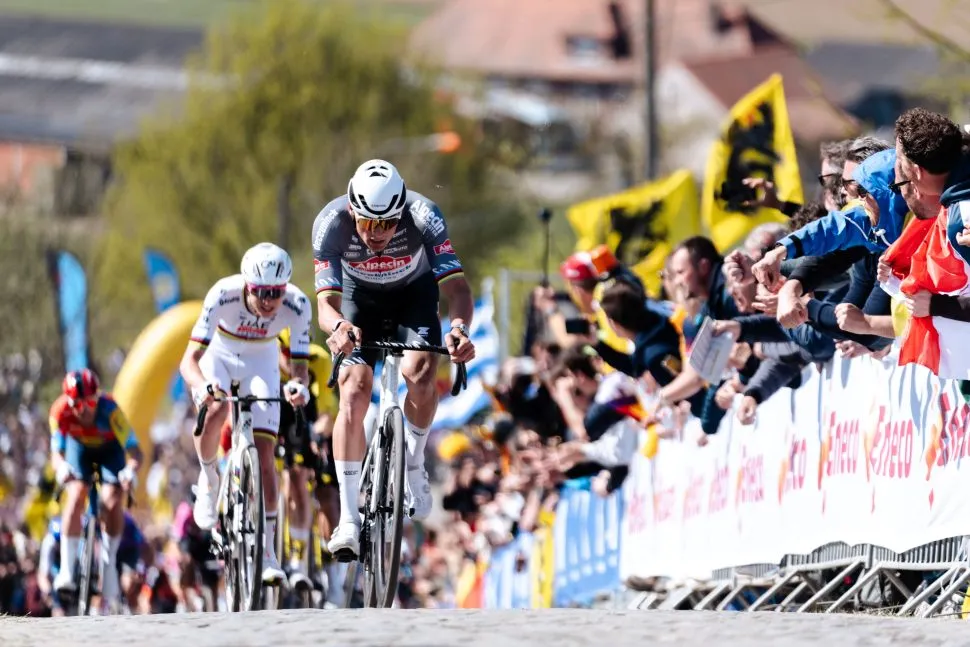
Men’s Tour of Flanders 2026
HBO Max: 08:30 – 16:15
TNT Sports 3: 08:30 – 16:15
Women’s Tour of Flanders 2026
HBO Max: 14:00 – 17:30
TNT Sports 4: 14:00 – 17:30
TV schedule in UK time and subject to change by the broadcasters.
Full list of broadcasters
- RTBF & VRT: Belgium
- RAI: Italy, San Marino, Vatican City
- NOS: Netherlands
- Czech TV: Czech Republic
- RTVS: Slovakia
- SRG: Switzerland
- TV2 Denmark: Denmark
- TV2 Norway: Norway
- FloBikes: USA, Canada, Australia
- ESPN: Argentina, Bolivia, Chile, Colombia, Ecuador, Paraguay, Peru, Uruguay, Venezuela, Brazil, Belize, Costa Rica, El Salvador, Guatemala, Honduras, Nicaragua, Panama, Mexico, Anguilla, Antigua and Barbuda, Aruba, Bahamas, Barbados, Barbuda, Bermuda, Bonaire, British Virgin Islands, Cayman Islands, Curacao, Dominica, Dominican Republic, Falkland Islands, French Guiana, Grenada, Guadeloupe, Guyana, Haiti, Jamaica, Martinique, Montserrat, Saba, Saint Barthélemy, Saint Eustatius, Saint Kitts and Nevis, Saint Lucia, Saint Vincent and the Grenadines, Suriname, Trinidad and Tobago, Turks and Caicos Islands
- Sky: New Zealand
- SBS: Australia
- Supersport: Angola, Burundi, Benin, Botswana, Burkina Faso, Cameroon, Central African Republic, Chad, Congo, Cape Verde, Ivory Coast, Comoros, Democratic Republic of the Congo, Djibouti, Equatorial Guinea, Eritrea, Ethiopia, Gabon, Gambia, Ghana, Guinea, Guinea-Bissau, Kenya, Lesotho, Liberia, Madagascar, Malawi, Mauritius, Mayotte, Mozambique, Mali, Mauritania, Namibia, Nigeria, Niger, Réunion, Rwanda, South Africa, Eswatini, Sao Tome and Principe, Saint Helena and Ascension, Senegal, Sierra Leone, Seychelles, Socotra, Tanzania, Togo, Uganda, Zimbabwe, Zambia
- Eurosport/Discovery: Pan-Europe, Asia-Pacific (excluding China, Australia, and New Zealand), Japan & Indian subcontinent
Men’s Tour of Flanders 2026 start list
Women’s Tour of Flanders 2026 start list
The following contains contributions from the wider Cyclist team
Tour of Flanders 2026: Key climbs
Oude Kwaremont
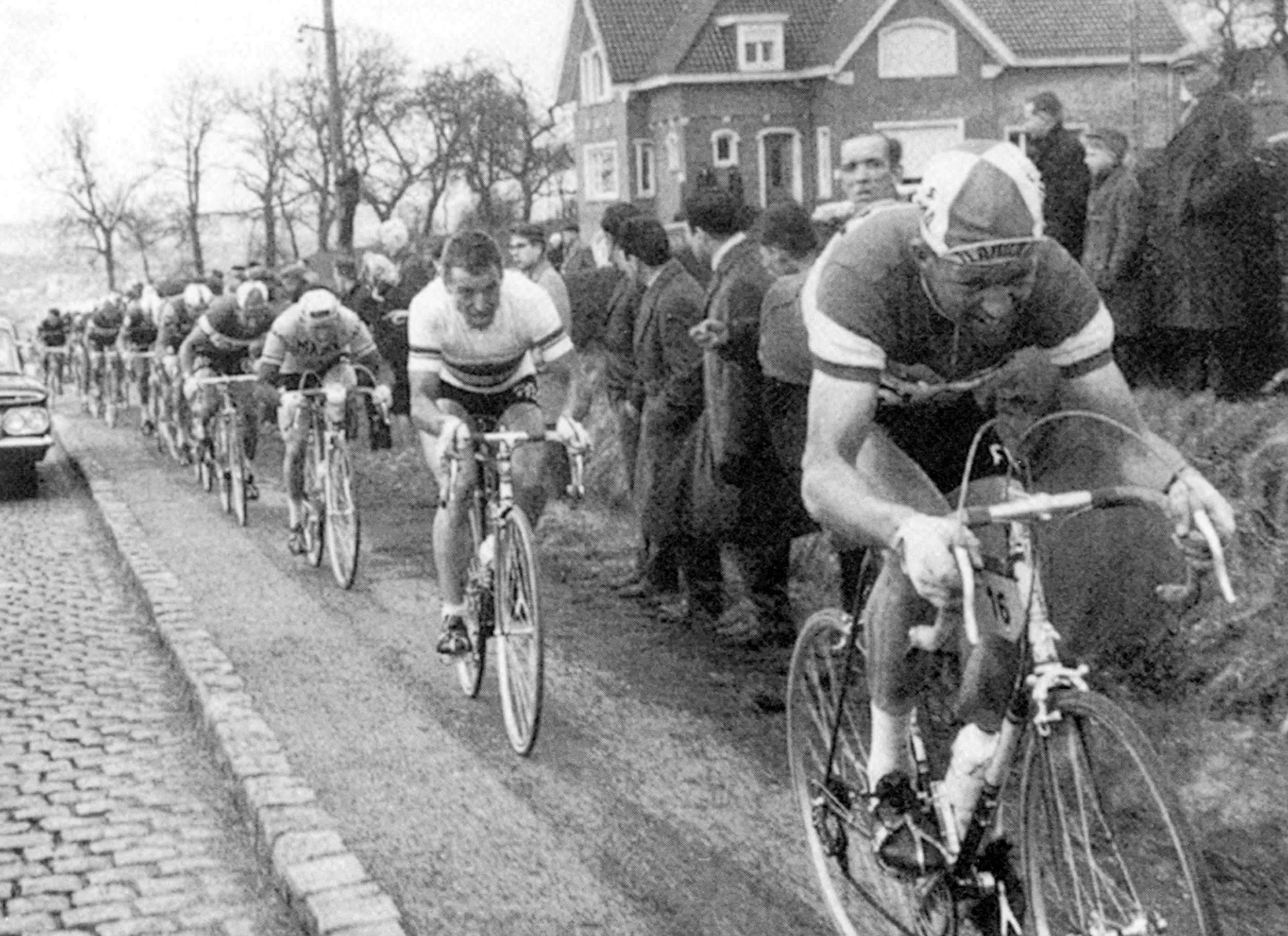
The Oude Kwaremont is an important climb at the Tour of Flanders, as it appears three times over the course of the race. The final appearance is 16km from the finish, so serves as the perfect place to grind out an attack.
Although it’s not especially steep (average 4%), it is 2.2km long and has ramps up to 12%.
Paterberg
The Paterberg appears twice in the Tour of Flanders, just 3km after the Oude Kwaremont and is the final climb in the race just 13km before the finish line.
Although the Paterberg is less than 400m long, it averages just under 13% and has ramps up to 20.3%. This is the final place for riders to make a big attack – Fabian Cancellara used the final few metres to gap Peter Sagan in 2013, before soloing away to claim victory.
Koppenberg
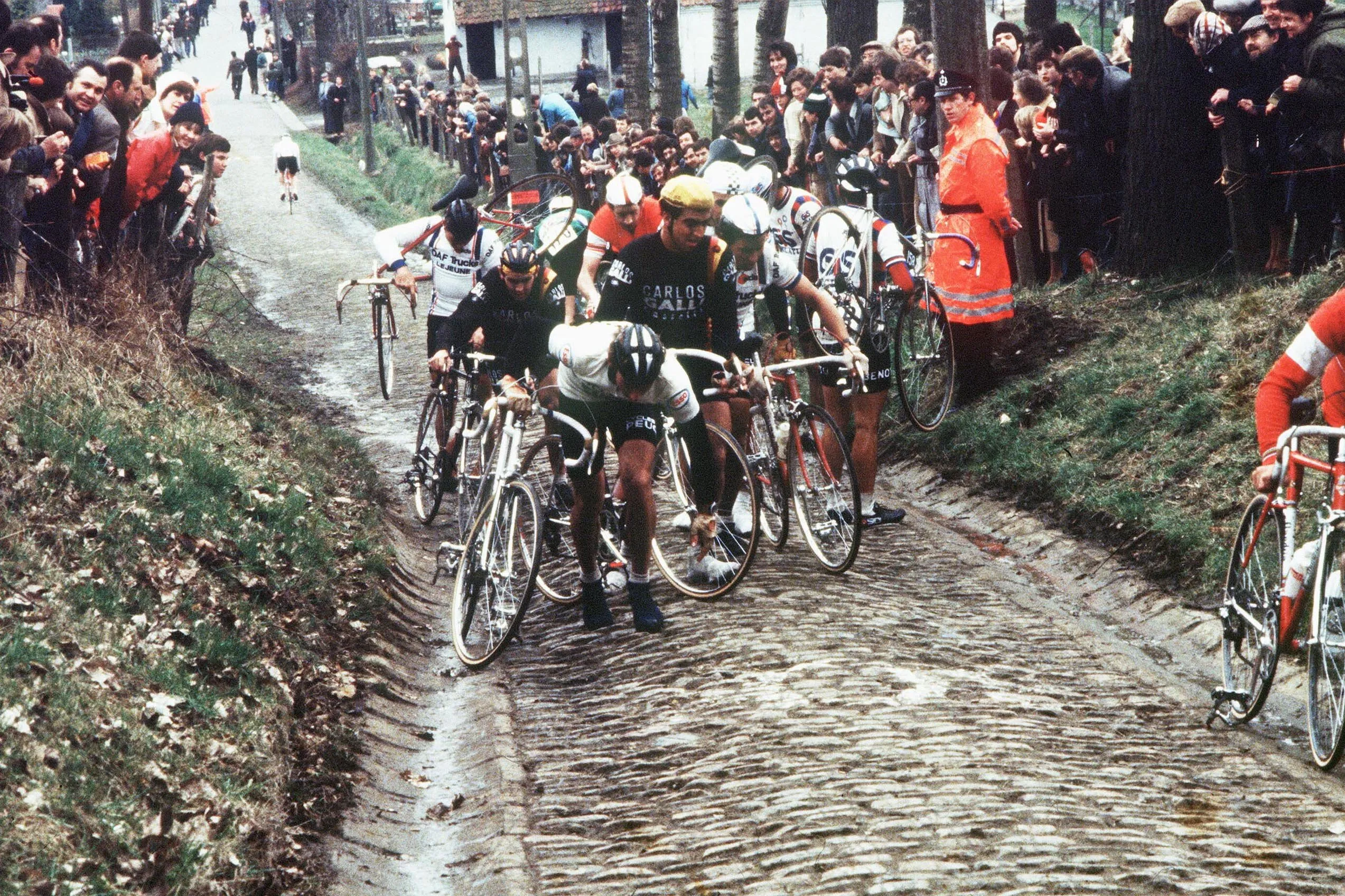
Despite its infamy, the Koppenberg only appears once at the Tour of Flanders, 226km into the race. The Koppenberg is steep (average 11%, max 22%) and narrow, but with 44.6km of racing to go is too far away from the finish to be a likely place to mount a race-deciding attack.
That said, the racing here is manic as riders do not wish to be caught at the back, where you usually end up walking, ending your race.
Tour of Flanders: History
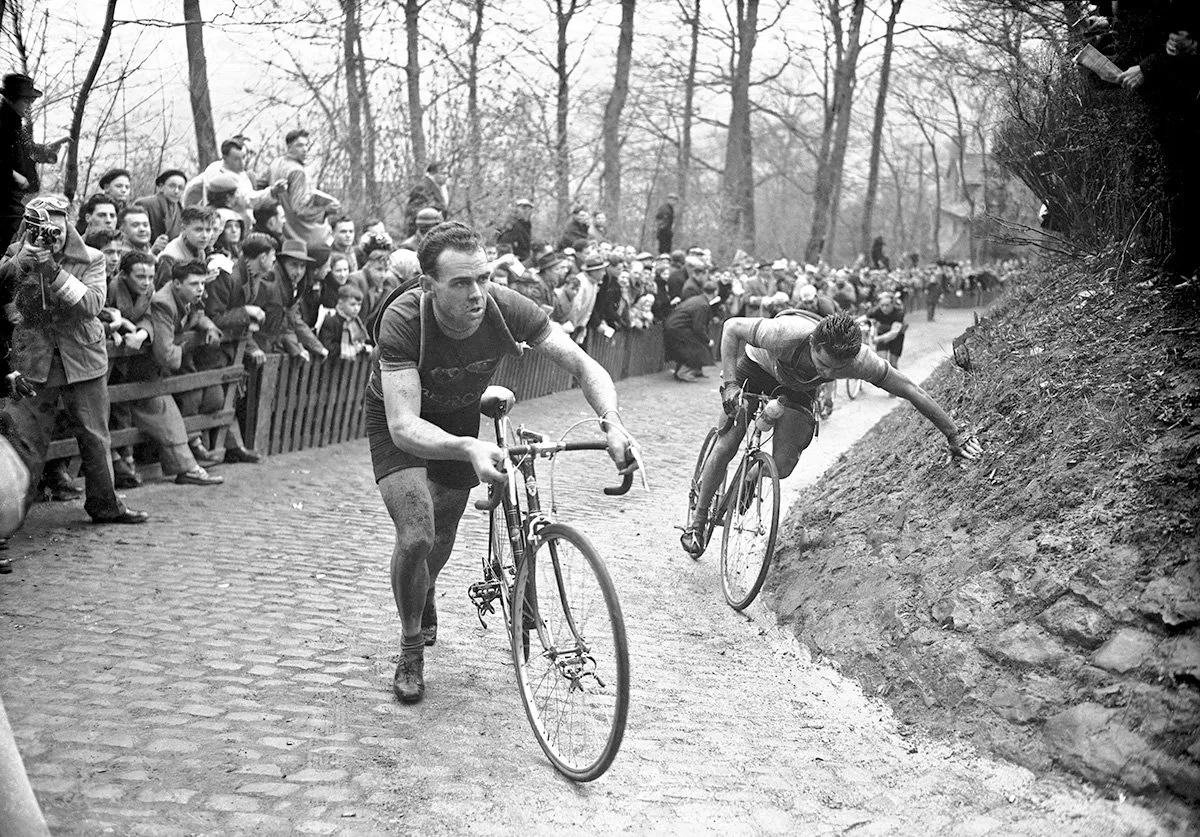
The Tour of Flanders, or Ronde van Vlaanderen, the second of five Monuments in the professional racing calendar, can trace its history back to 1913. Most classic races were started to create headlines for a newspaper, and the Tour of Flanders is no different.
The race was first conceived by Léon van den Haute, who wrote for Sportwereld, as a celebration of the Flemish region as the other major Belgian race, Liege-Bastogne-Liege, was held in the French-speaking region of Belgium.
The first edition of De Ronde left Ghent at 6 am on the 25th of May 1913 and wound its way to a wooden velodrome in Mariakerke through 330km of badly kept roads. The first winner was Paul Deman, aged 25, outsprinting a group of six after over 12 hours of racing.
Although the first few editions were successful, the race still struggled to attract a lot of entries, and financial sponsorship with it. The race really gained popularity in the 1930s, perhaps as a result of shortening the race to 264km, and by 1933 there was 164 riders on the start line.
The first 40 years of the Tour of Flanders is also famous for not allowing the riders any mechanical assistance. In the ‘30s the rules were changed so that a rider could accept a pump, or spare tyre, but only in an emergency and entirely at the commissaire’s discretion. Bike changes were only permitted if the frame, wheel or bars broke while riding.
Over the course of the 1950s, the rules were changed to bring the Ronde more in line with other professional races.
The 1960s was the decade that cemented Flanders in cycling history. Tom Simpson became the first British winner in 1961, followed by a huge popularity surge in 1962 that saw the finish moved to Gentbrugge to cope with the spectators. 1969 marked the emergence of Eddy Merckx, who won the race by 5’ 36” over Felice Gimondi – the race’s largest ever winning margin.
Era of the ‘Bergs’
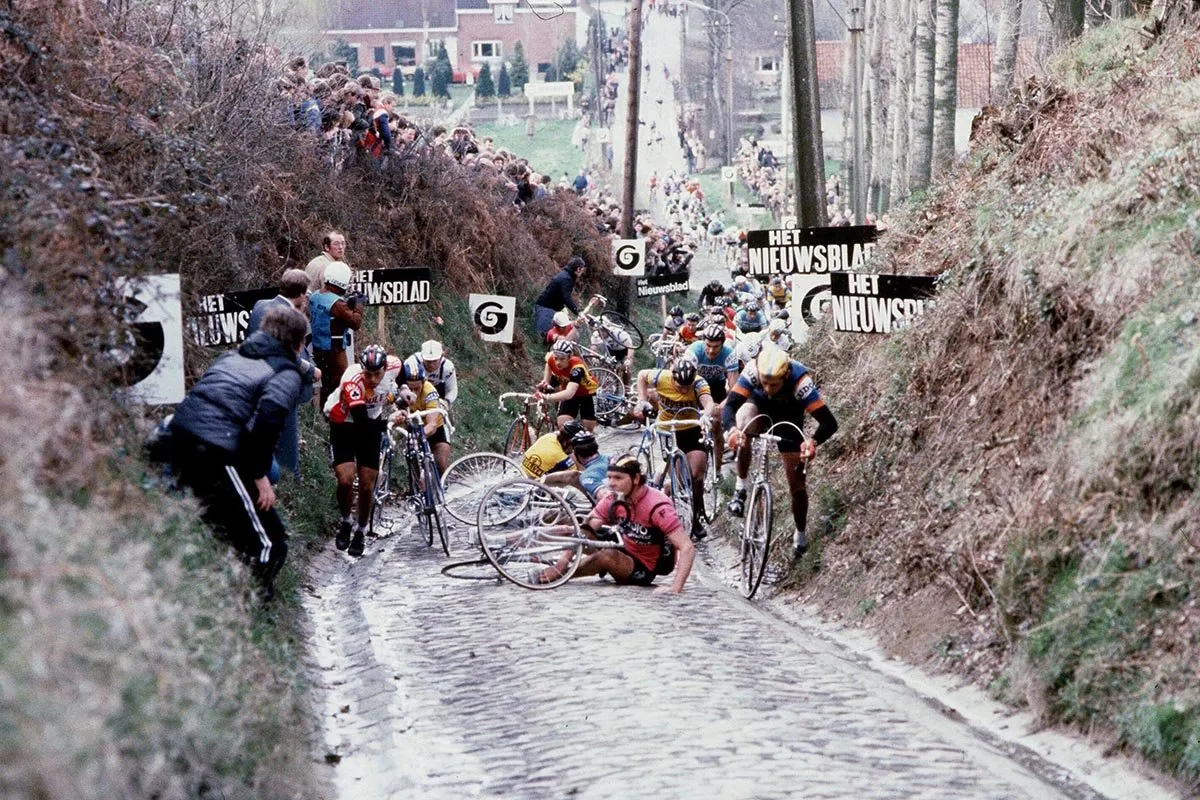
Flanders made more big changes in the 1970s – the race was known for its tough course but many of the original roads had been paved over, making the course considerably easier.
In 1973 the finish was moved again, this time to Meerbeke, close to the Muur van Geraardsbergen, which became a legendary part of the race. In 1976 the Koppenberg was included, feared by many due to its 22% cobbled ramps, and was the location of the beginning of Roger De Vlaeminck and Freddy Maertens’ bitter rivalry.
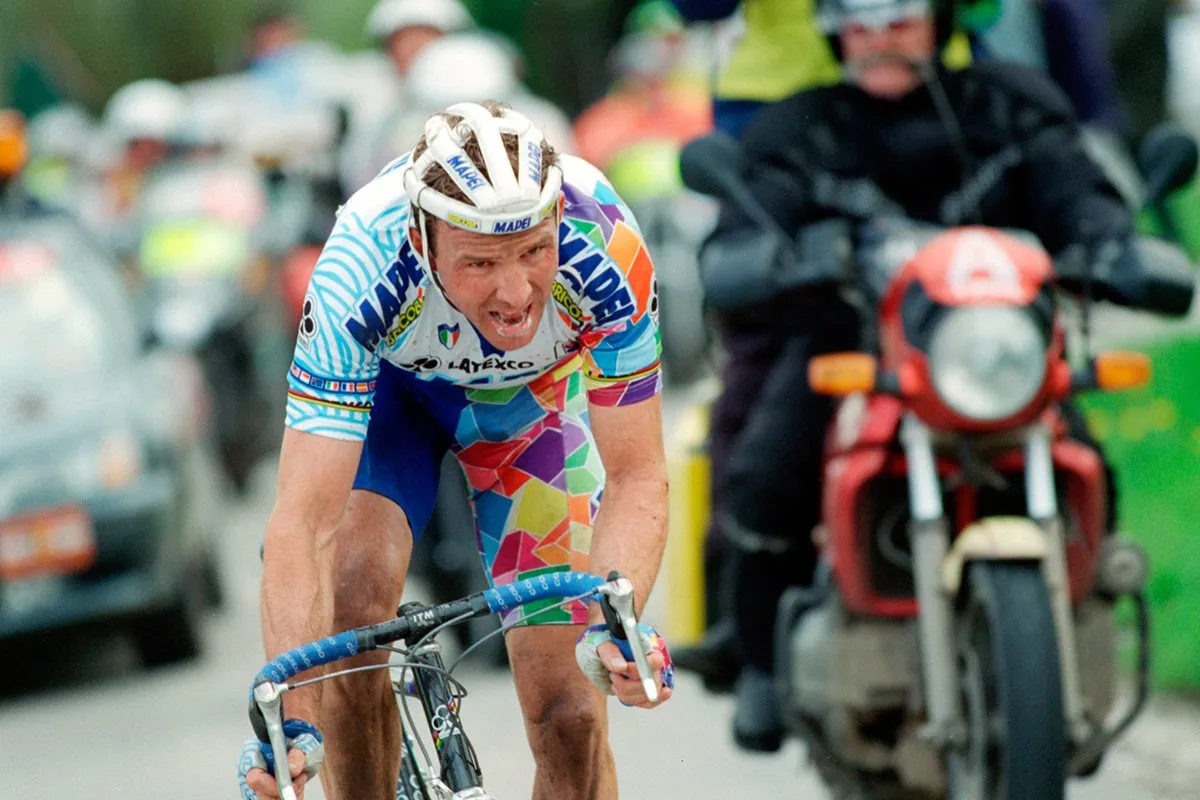
The 1980s were characterised by complete domination by Belgian and Dutch riders, including the legendary 1985 edition that saw only 24 out of 174 finish.
The 1990s era of Flanders is best known for Johan Museeuw’s exploits that included three victories and eight podium finishes. So complete was his control of the race he was nicknamed the ‘Lion of Flanders’.
Post-2000
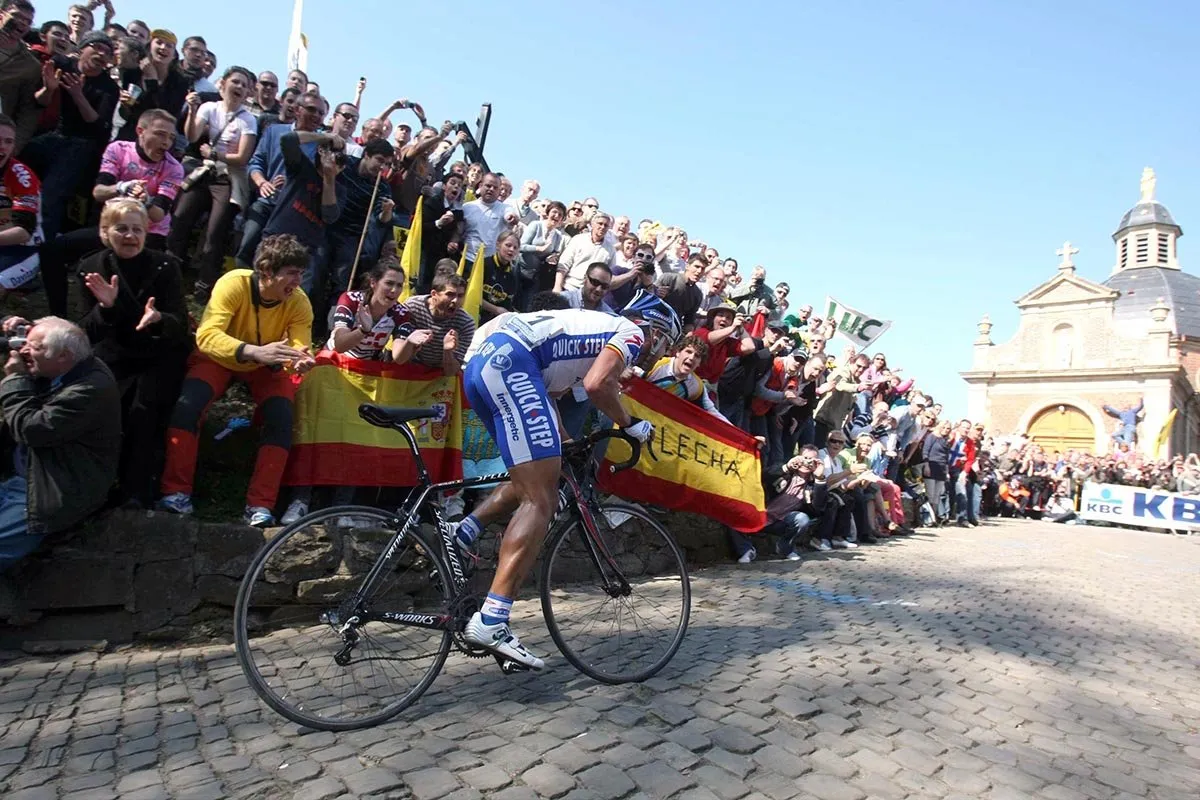
In 2005 the Tour of Flanders was included in the inaugural UCI Pro Tour, establishing it as one of the five Monuments of cycling. In the 2000s a new star of Belgian cycling emerged, Tom Boonen, who won two consecutive victories in 2005 and 2006, with another following in 2012.
The big upset came in 2011, not from the riders but from the organising committee. The race was taken over by ‘Flanders Classics’, who moved the finish to Oudenaarde, much closer to the Koppenberg but also removing the Muur from the parcours to a great outcry from the fans. The Tour of Flanders celebrated its 100th edition on 3rd April 2016.